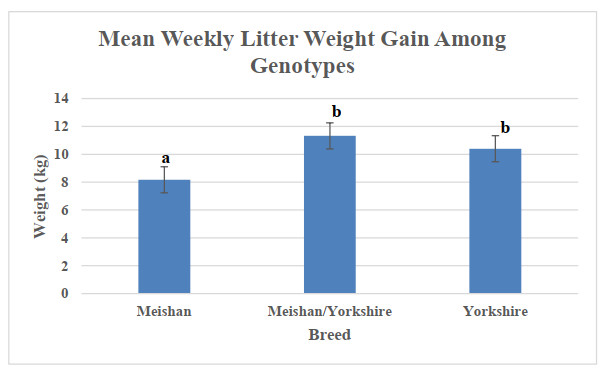
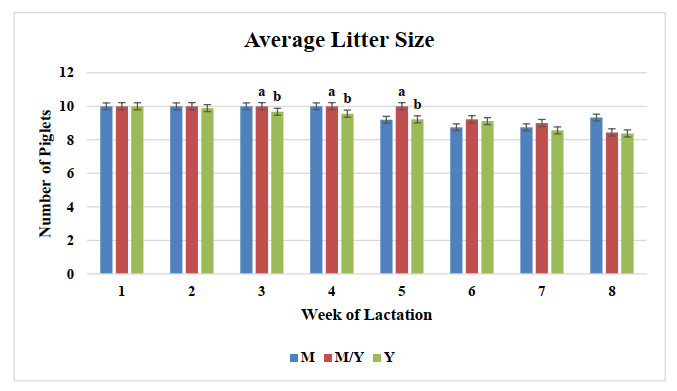
Six Meishan (M), nine Yorkshire (Y), and ten Meishan/Yorkshire (M/Y) crossbred first- and second-parity sows were used to investigate the influence of genotype on lactation length, piglet growth, and milk composition to develop a strategy for using nurse sows. Litter size was standardized to 10 piglets between 5 and 7 days of lactation. A new set of 1-week-old piglets was cross-fostered onto each female at the end of each 3-week period. Subsequent litter size depended on the number of piglets each female was able to support in the previous litter. Mean days of lactation for M, M/Y, and Y were 50.2, 72.8, and 64.5, respectively. Average litter size declined in all three genotypes by week 6 of lactation. Mean litter weight gain/week of lactation for Y (11.3 kg) and M/Y (12.2 kg) was greater than for M (7.65 kg). No difference in milk fat percentage was observed among genotypes. Milk protein percentage decreased from week l to week 2, then increased linearly for the rest of the lactation. These results suggested that Y and M/Y sows would make better nurse sows than purebred M sows.
Citation: Denise L. Roberts, Gregory T. Bleck, Michael Ellis, Elizabeth A. Bangert, Walter L. Hurley, Matthew B. Wheeler. Comparison of an extended lactation period and lactation performance among Meishan (M), Yorkshire (Y), and Meishan/Yorkshire (M/Y) crossbred females for use in production as possible nurse sows[J]. AIMS Animal Science, 2026, 2(2): 105-121. doi: 10.3934/aas.2026008
Six Meishan (M), nine Yorkshire (Y), and ten Meishan/Yorkshire (M/Y) crossbred first- and second-parity sows were used to investigate the influence of genotype on lactation length, piglet growth, and milk composition to develop a strategy for using nurse sows. Litter size was standardized to 10 piglets between 5 and 7 days of lactation. A new set of 1-week-old piglets was cross-fostered onto each female at the end of each 3-week period. Subsequent litter size depended on the number of piglets each female was able to support in the previous litter. Mean days of lactation for M, M/Y, and Y were 50.2, 72.8, and 64.5, respectively. Average litter size declined in all three genotypes by week 6 of lactation. Mean litter weight gain/week of lactation for Y (11.3 kg) and M/Y (12.2 kg) was greater than for M (7.65 kg). No difference in milk fat percentage was observed among genotypes. Milk protein percentage decreased from week l to week 2, then increased linearly for the rest of the lactation. These results suggested that Y and M/Y sows would make better nurse sows than purebred M sows.

| [1] |
Luković Z, Škorput D (2015) Factors influencing litter size in pigs. Cabi Reviews: 1–9. https://doi.org/10.1079/PAVSNNR201510006 doi: 10.1079/PAVSNNR201510006
|
| [2] |
Kemp B, Da Silva CLA, Soede NM (2018) Recent advances in pig reproduction: Focus on impact of genetic selection for female fertility. Reprod Domest Anim 53 Suppl 2: 28–36. https://doi.org/10.1111/rda.13264 doi: 10.1111/rda.13264
|
| [3] |
van den Bosch M, van de Linde IB, Kemp B, et al. (2022) Disentangling litter size and farrowing duration effects on piglet stillbirth, acid-base blood parameters and pre-weaning mortality. Front Vet Sci 9: 836202. https://doi.org/10.3389/fvets.2022.836202 doi: 10.3389/fvets.2022.836202
|
| [4] |
Farmer C, Edwards SA (2022) Review: Improving the performance of neonatal piglets. Animal 16: 100350. https://doi.org/10.1016/j.animal.2021.100350 doi: 10.1016/j.animal.2021.100350
|
| [5] |
Oliviero C (2023) Offspring of hyper prolific sows: Immunity, birthweight, and heterogeneous litters. Mol Reprod Dev 90: 580–584. https://doi.org/10.1002/mrd.23572 doi: 10.1002/mrd.23572
|
| [6] |
Farmer C (2022) Achieving optimal sow performance, still an ongoing challenge in 2022. Animal Frontiers 12: 53–55. https://doi.org/10.1093/af/vfac064 doi: 10.1093/af/vfac064
|
| [7] |
Smith DM (1952) Yield and composition of milk of New Zealand Berkshire Sows. NZ J Sci Tech A34: 65–75. |
| [8] |
Hansen AV, Strathe AB, Kebreab E, et al. (2012) Predicting milk yield and composition in lactating sows: A Bayesian approach. J Anim Sci 90: 2285–2298. https://doi.org/10.2527/jas.2011-4788 doi: 10.2527/jas.2011-4788
|
| [9] |
King RH (2000) Factors that influence milk production in well-fed sows. J Anim Sci 78: 19–25. https://doi.org/10.2527/2000.78suppl_319x doi: 10.2527/2000.78suppl_319x
|
| [10] |
Lucas IAM, Lodge GA (1961) The Nutrition of the Young Pig. A Review. Commonwealth Agricultural Bureaux, Farnham Royal, Slough, Bucks, UK. |
| [11] |
Hojgaard CK, Bruun TS, Theil PK (2020) Impact of milk and nutrient intake of piglets and sow milk composition on piglet growth and body composition at weaning. J Anim Sci 98. https://doi.org/10.1093/jas/skaa060 doi: 10.1093/jas/skaa060
|
| [12] |
Lewis AJ, Speer VC, Haught DG (1978) Relationship between Yield and Composition of Sows' Milk and Weight Gains of Nursing Pigs. J Anim Sci 47: 634–638. https://doi.org/10.2527/jas1978.473634x doi: 10.2527/jas1978.473634x
|
| [13] |
Rutherford KMD, Baxter EM, DaEath RB, et al. (2013) The welfare implications of large litter size in the domestic pig Ⅰ: biological factors. Animal Welfare 22: 199–218. https://doi.org/10.7120/09627286.22.2.199 doi: 10.7120/09627286.22.2.199
|
| [14] |
Strathe AV, Bruun TS, Hansen CF (2017) Sows with high milk production had both a high feed intake and high body mobilization. Animal 11: 1913–1921. https://doi.org/10.1017/S1751731117000155 doi: 10.1017/S1751731117000155
|
| [15] |
Bruun TS, Pedersen TF, Thorup F, et al. (2023) Selecting the optimal strategies when using nurse sows for supernumerous piglets. Mol Reprod Dev 90: 546–560. https://doi.org/10.1002/mrd.23688 doi: 10.1002/mrd.23688
|
| [16] |
Grahofer A, Plush K (2023) Lactation in swine: Review article. Anim Front 13: 105–111. https://doi.org/10.1093/af/vfad020 doi: 10.1093/af/vfad020
|
| [17] |
Wensley MR, Tokach MD, Woodworth JC, et al. (2023) Strategies to minimize fallback pigs in the nursery. J Swine Health Product 31: 237–241. https://doi.org/10.54846/jshap/1319 doi: 10.54846/jshap/1319
|
| [18] |
Lee J, Shin H, Kim J, et al. (2024) Large litters have a detrimental impact on litter performance and postpartum maternal behaviour in primiparous sows. Porcine Health Management 10: 9. https://doi.org/10.1186/s40813-024-00360-2 doi: 10.1186/s40813-024-00360-2
|
| [19] |
McLaren DG (1990) Potential of Chinese pig breeds to improve pork production efficiency in the USA, 347–369. |
| [20] |
van der Steen HAM, de Groot PN (1992) Direct and maternal breed effects on growth and milk intake of piglets: Meishan versus Dutch breeds. Livestock Product Sci 30: 361–373. https://doi.org/10.1016/0301-6226(92)90044-5 doi: 10.1016/0301-6226(92)90044-5
|
| [21] |
Lee GJ, Haley CS (1995) Comparative farrowing to weaning performance in Meishan and Large White pigs and their crosses. Anim Sci 60: 269–280. https://doi.org/10.1017/S1357729800008432 doi: 10.1017/S1357729800008432
|
| [22] |
Young LD (1995) Reproduction of F1 Meishan, Fengjing, Minzhu, and Duroc gilts and sows. J Anim Sci 73: 711–721. https://doi.org/10.2527/1995.733711x doi: 10.2527/1995.733711x
|
| [23] |
Bruun TS, Amdi C, Vinther J, et al. (2016) Reproductive performance of "nurse sows" in Danish piggeries. Theriogenology 86: 981–987. https://doi.org/10.1016/j.theriogenology.2016.03.023 doi: 10.1016/j.theriogenology.2016.03.023
|
| [24] |
Schmitt O, Baxter EM, Boyle LA, et al. (2019) Nurse sow strategies in the domestic pig: Ⅰ. Consequences for selected measures of sow welfare. Animal 13: 580–589. https://doi.org/10.1017/S175173111800160X doi: 10.1017/S175173111800160X
|
| [25] |
English PR, MacPherson O, Edwards SA, et al. (1990) Evaluation of the chinese meishan as a nurse sow for establishing ill-nourished 3 week old white breed pigs. Proceedings of the British Society of Animal Production (1972) 1990: 57–57. https://doi.org/10.1017/S0308229600018389 doi: 10.1017/S0308229600018389
|
| [26] |
Dourmad JY (1991) Effect of feeding level in the gilt during pregnancy on voluntary feed intake during lactation and changes in body composition during gestation and lactation. Livestock Product Sci 27: 309–319. https://doi.org/10.1016/0301-6226(91)90126-B doi: 10.1016/0301-6226(91)90126-B
|
| [27] |
Elsley FWH, MacPherson RM, McDonald I (1968) The influence of intake of dietary energy in pregnancy and lactation upon sow productivity. J Agri Sci 71: 215–222. https://doi.org/10.1017/S0021859600014672 doi: 10.1017/S0021859600014672
|
| [28] |
O'Grady JF, Lynch PB, Kearney PA (1985) Voluntary feed intake by lactating sows. Livestock Product Sci 12: 355–365. https://doi.org/10.1016/0301-6226(85)90134-4 doi: 10.1016/0301-6226(85)90134-4
|
| [29] |
Sauber T, Stahly T, Ewan R, et al. (1994) Maximum lactational capacity of sows with a high and low genetic capacity for lean tissue growth. J Anim Sci 72: 364. |
| [30] |
White BR, McLaren DG, Dziuk PJ, et al. (1993) Age at puberty, ovulation rate, uterine length, prenatal survival and litter size in Chinese Meishan and Yorkshire females. Theriogenology 40: 85–97. https://doi.org/10.1016/0093-691X(93)90343-4 doi: 10.1016/0093-691X(93)90343-4
|
| [31] |
Coffey MT, Diggs BG, Handlin DL, et al. (1994) Effects of dietary energy during gestation and lactation on reproductive performance of sows: A cooperative study. J Anim Sci 72: 4–9. https://doi.org/10.2527/1994.7214 doi: 10.2527/1994.7214
|
| [32] |
Schoenherr WD, Stahly TS, Cromwell GL (1989) The effects of dietary fat or fiber addition on yield and composition of milk from sows housed in a warm or hot environment. J Anim Sci 67: 482–495.https://doi.org/10.2527/jas1989.672482x doi: 10.2527/jas1989.672482x
|
| [33] |
King'ori AM (2012) Sow lactation: Colostrum and milk yield: A review. J Anim Sci Adv 2: 525–533. |
| [34] |
Allen AD, Lasley JF (1960) Milk Production of Sows. J Anim Sci 19: 150–155. https://doi.org/10.2527/jas1960.191150x doi: 10.2527/jas1960.191150x
|
| [35] |
Garst AS, Ball SF, Williams BL, et al. (1999) Influence of pig substitution on milk yield, litter weights, and milk composition of machine milked sows. J Anim Sci 77: 1624–1630. https://doi.org/10.2527/1999.7771624x doi: 10.2527/1999.7771624x
|
| [36] |
Hamann J, Dodd FH (1992) Milking Routines. In: Bramley AJ, Dodd FH, Mein GA, et al., Machine milking and lactation, Berkshire, UK: Insight Books, 81–96. |
| [37] |
Mota-Rojas D, Marcet-Rius Mr, DomÃ-nguez-Oliva A, et al. (2023) The role of oxytocin in domestic animal's maternal care: Parturition, bonding, and lactation. Animals 13: 1207. https://doi.org/10.3390/ani13071207 doi: 10.3390/ani13071207
|
| [38] |
Klobasa F, Werhahn E, Butler JE (1987) Composition of sow milk during lactation. J Anim Sci 64: 1458–1466. https://doi.org/10.2527/jas1987.6451458x doi: 10.2527/jas1987.6451458x
|
| [39] |
Lodge GA (1959) The composition of sow's milk during lactation with particular reference to the relationship between protein and lactose. J Dairy Res 26: 134–139. https://doi.org/10.1017/S0022029900009808 doi: 10.1017/S0022029900009808
|
| [40] |
Zou S, McLaren DG, Hurley WL (1992) Pig colostrum and milk composition:comparisons between Chinese Meishan and US breeds. Livestock Product Sci 30: 115–127. https://doi.org/10.1016/S0301-6226(05)80024-7 doi: 10.1016/S0301-6226(05)80024-7
|
Figures(13)
Denise L. Roberts, Gregory T. Bleck, Michael Ellis, Elizabeth A. Bangert, Walter L. Hurley, Matthew B. Wheeler. Comparison of an extended lactation period and lactation performance among Meishan (M), Yorkshire (Y), and Meishan/Yorkshire (M/Y) crossbred females for use in production as possible nurse sows[J]. AIMS Animal Science, 2026, 2(2): 105-121. doi: 10.3934/aas.2026008

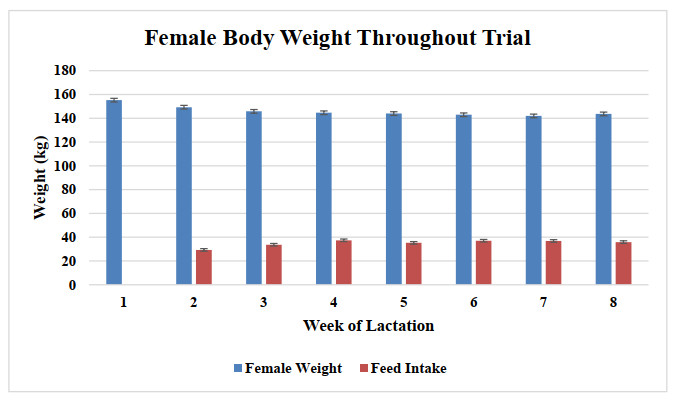
Overall female body weight and feed intake over the extended lactation trial
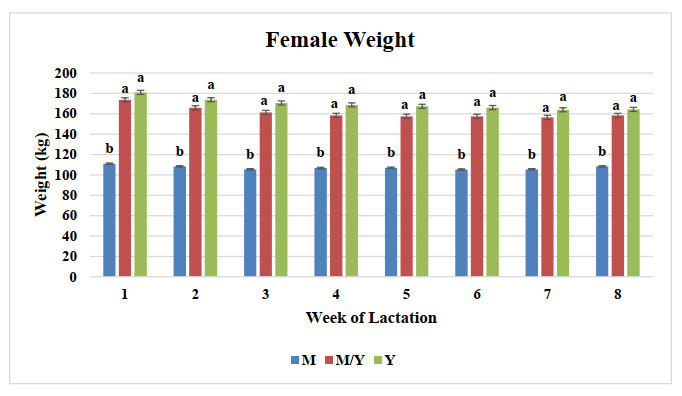
Female body weight between each genotype over extended lactation trial. Statistical analysis from the initial 8 weeks of study only. Means with different superscripts differ among genotypes (a,bP < 0.05) within the week of lactation
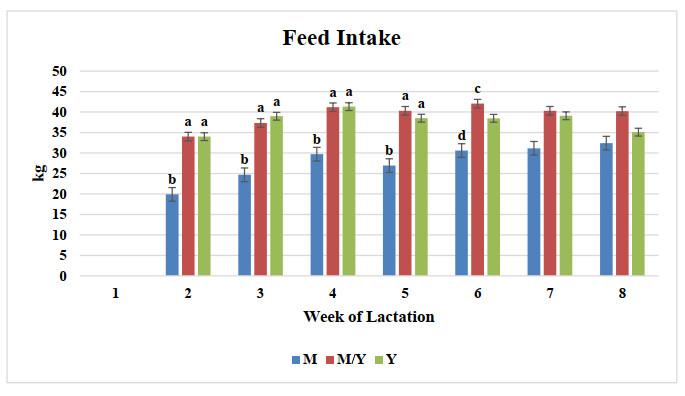
Female feed intake between each genotype over the extended lactation trial. Statistical analysis from the initial 8 weeks of study only. Means with different superscripts differ among genotypes (a,bP < 0.05; c,dP < 0.01) within the week of lactation
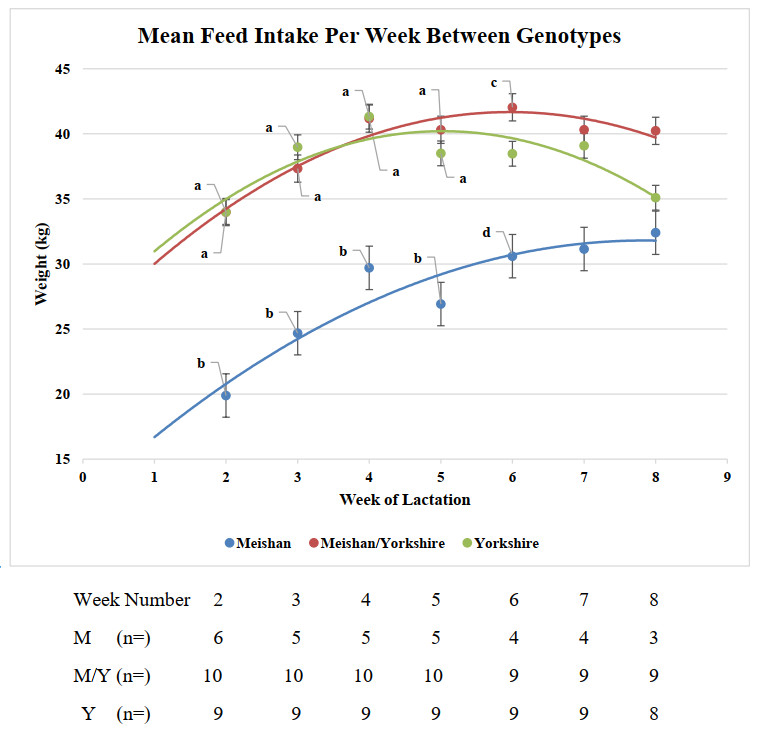
Average feed intake (kg) + SEM between sows plotted against week of lactation for Meishan, Meishan/Yorkshire, and Yorkshire sows. Statistical analysis from the initial 8 weeks of study only. Means with different superscripts at each timepoint differ among genotypes (a,bP < 0.05; c,dP < 0.01). M, M/Y, and Y = number of sows per week
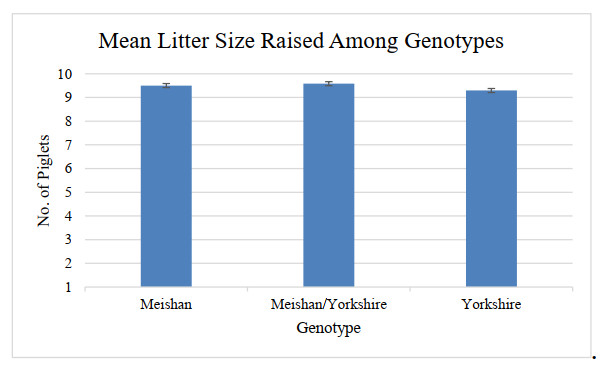
Mean litter size raised among the genotypes for the first 8 weeks of the lactation period
Average litter weight gain (kg) + SEM for Meishan Meishan/Yorkshire and Yorkshire sows for the first 8 weeks of the study. Means with different superscripts differ (a,bp < 0.001)
Litter size for each genotype over the extended lactation trial. Means with different superscripts differ among genotypes (a,bP < 0.05)
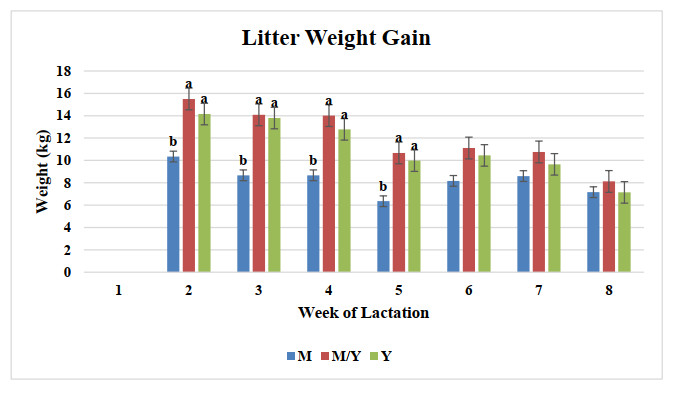
Litter weight gain for each genotype over the extended lactation trial. Means with different superscripts differ among genotypes (a,bP < 0.05)
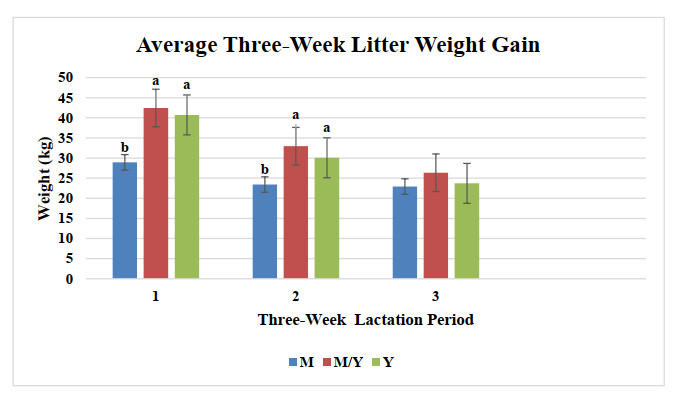
Average 3-week litter weight gains over the extended lactation trial. Period 1 (1–3 weeks), period 2 (4–6 weeks), and period 3 (7–9 weeks). Means with different superscripts differ among genotypes (a,bP < 0.05)
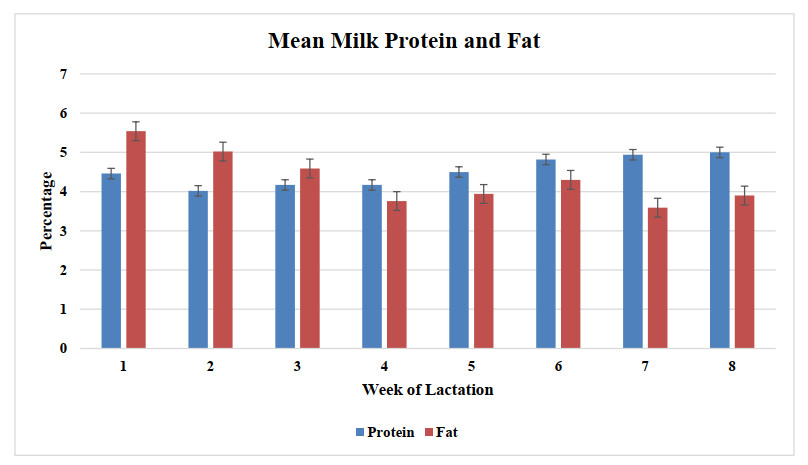
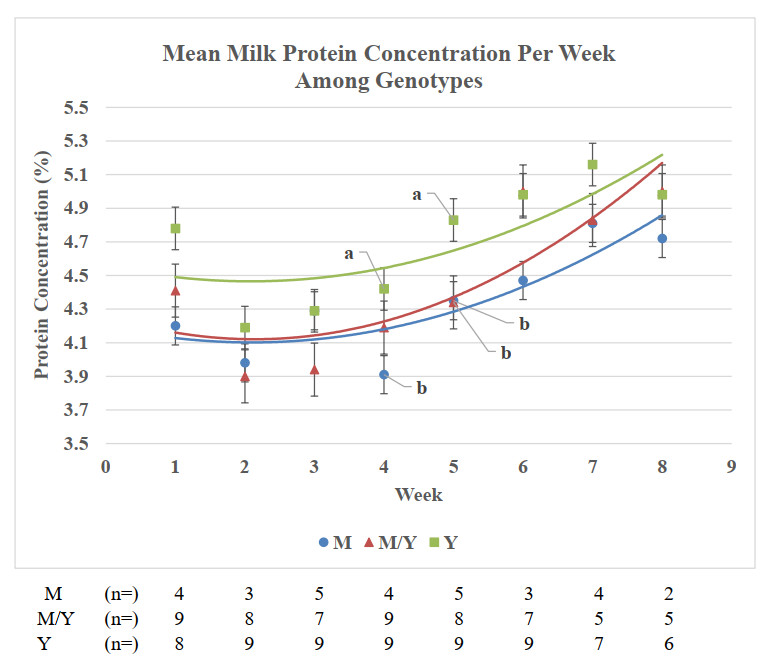
Mean milk protein and fat for all sows over the extended lactation trial. The regression curve (y = 0.029x2 - 0.131x + 4.370, r2 = 0.820) for protein percentage among the three genotypes showed a decrease over the first 2–3 weeks of lactation, followed by an increasing trend, with significant differences (P < 0.05) between Y and M at 4 weeks, and between Y vs. M/Y and M at 5 weeks (Figure 11)
Average milk protein concentration (%) + SEM plotted against week of lactation for Meishan, Meishan/Yorkshire, and Yorkshire sows. Statistical analysis from the initial 8 weeks of study only. Means with different superscripts at each timepoint differ among genotypes (a,bP < 0.05). M, M/Y, and Y = number of sows per week
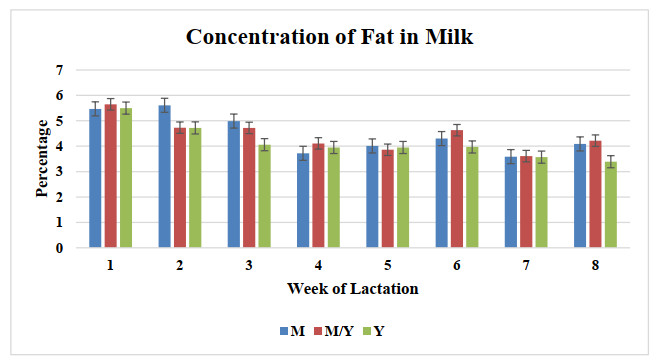
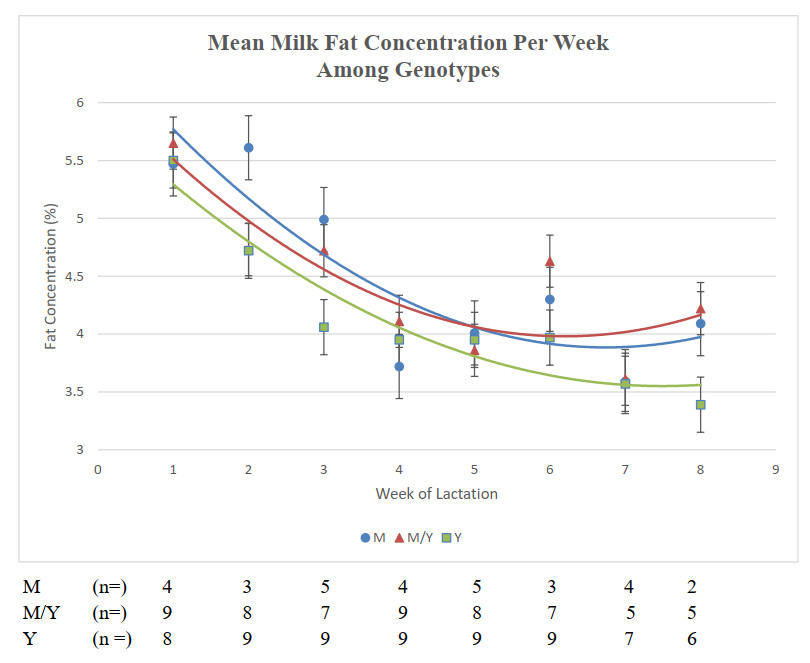
Milk fat concentration for each breed over the extended lactation trial
Average milk fat concentration (%) + SEM plotted against week of lactation for Meishan, Meishan/Yorkshire, and Yorkshire sows. Statistical analysis from the initial 8 weeks of study only. No significant differences were found among genotypes. M, M/Y, and Y = number of sows per week



 DownLoad: