One of the major challenges facing the poultry industry today is the prevalence of diseases like coccidiosis, which have resulted in substantial economic losses.
We aimed to evaluate the effects of dietary supplementation with varying levels of Artemisia annua on growth performance, blood parameters, and anticoccidial activity in broiler chickens under farm conditions.
A total of 600 unisex Sasso day-old chicks were randomly allocated to five dietary treatment groups (T0- Tam+, T1, T1.75, T2.5), each comprising five replicates of 24 chicks. Beginning on day 21 of rearing, daily coprological analysis was conducted to monitor the presence of coccidial oocysts. By day 28, oocyst presence was confirmed. Following this, treatments T1, T1.75, and T2.5 were administered basal diets supplemented with 1.0%, 1.75%, and 2.5% Artemisia annua leaf powder (AaLP), respectively. Treatment T0- served as the negative control (unmedicated), while Tam+ was designated the positive control, receiving amprolium as a standard anticoccidial agent.
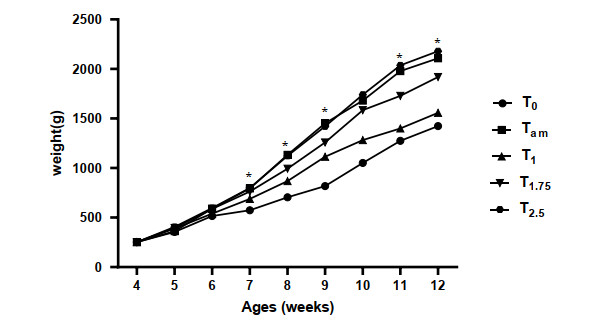
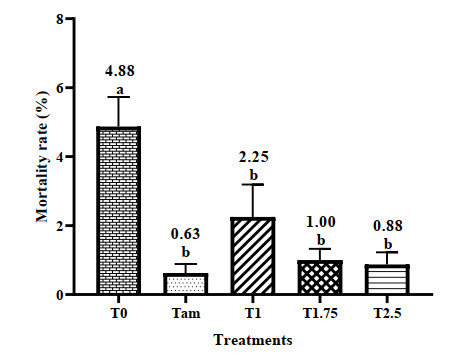
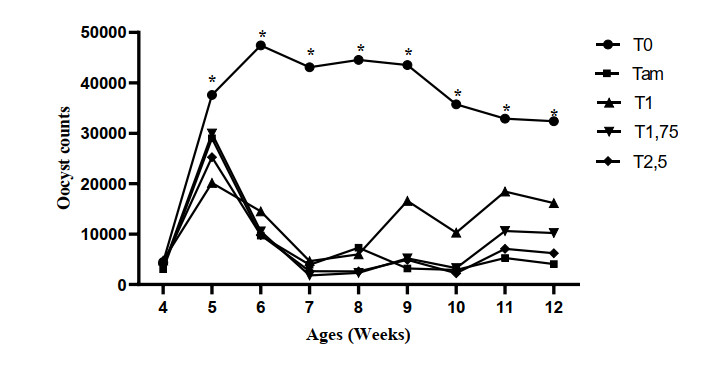
Overall, no significant differences were observed in average feed intake across the treatment groups throughout the trial. However, dietary supplementation with AaLP significantly increased body weight (BW) and body weight gain (BWG) (P < 0.001) in the treated groups. The feed conversion ratio (FCR) also showed a significant improvement (P < 0.05) at the 12th week and overall trial period. AaLP supplementation significantly reduced oocyst counts and mortality rate (P < 0.05) among the treated birds. Hematocrit values were significantly elevated (P < 0.05) at 8th and 12th weeks in the AaLP-treated groups, while no significant differences (P > 0.05) were noted in serum levels of Aspartate Aminotransferase (ASAT) and Alanine Aminotransferase (ALAT).
AaLP positively influenced gut health, as evidenced by reduced oocyst shedding and lower mortality rates. Overall, A. annua supplementation enhanced zootechnical performance without inducing adverse effects on blood parameters.
Citation: Voemesse Kokou, Kin'tche Robert, Paulinus Essen, Attivi Komi, Kulo Essosimna. Artemisia annua as a dietary additive: Effects on productivity and selected blood parameters in broiler chickens[J]. AIMS Animal Science, 2026, 2(2): 67-83. doi: 10.3934/aas.2026006
One of the major challenges facing the poultry industry today is the prevalence of diseases like coccidiosis, which have resulted in substantial economic losses.
We aimed to evaluate the effects of dietary supplementation with varying levels of Artemisia annua on growth performance, blood parameters, and anticoccidial activity in broiler chickens under farm conditions.
A total of 600 unisex Sasso day-old chicks were randomly allocated to five dietary treatment groups (T0- Tam+, T1, T1.75, T2.5), each comprising five replicates of 24 chicks. Beginning on day 21 of rearing, daily coprological analysis was conducted to monitor the presence of coccidial oocysts. By day 28, oocyst presence was confirmed. Following this, treatments T1, T1.75, and T2.5 were administered basal diets supplemented with 1.0%, 1.75%, and 2.5% Artemisia annua leaf powder (AaLP), respectively. Treatment T0- served as the negative control (unmedicated), while Tam+ was designated the positive control, receiving amprolium as a standard anticoccidial agent.
Overall, no significant differences were observed in average feed intake across the treatment groups throughout the trial. However, dietary supplementation with AaLP significantly increased body weight (BW) and body weight gain (BWG) (P < 0.001) in the treated groups. The feed conversion ratio (FCR) also showed a significant improvement (P < 0.05) at the 12th week and overall trial period. AaLP supplementation significantly reduced oocyst counts and mortality rate (P < 0.05) among the treated birds. Hematocrit values were significantly elevated (P < 0.05) at 8th and 12th weeks in the AaLP-treated groups, while no significant differences (P > 0.05) were noted in serum levels of Aspartate Aminotransferase (ASAT) and Alanine Aminotransferase (ALAT).
AaLP positively influenced gut health, as evidenced by reduced oocyst shedding and lower mortality rates. Overall, A. annua supplementation enhanced zootechnical performance without inducing adverse effects on blood parameters.

| [1] |
Singh R, Panaite TD, Criste RD, et al. (2019) Influence of Artemisia annua on broiler performance and intestinal microflora. Braz J Poult Sci 21: 01-010.https://doi.org/10.1590/1806-9061-2019-1092 doi: 10.1590/1806-9061-2019-1092

|
| [2] | Essen PO, Njoku GN, Ewa UE, et al. (2024) Growth response, carcass characteristics and economic returns of broiler chickens fed diets containing graded levels of ginger (Zingiber officinale) rhizome meal as a feed additive. Niger J Anim Sci 26: 93-204. |
| [3] |
Gržinić G, Piotrowicz-Cieślak A, Klimkowicz-Pawlas A, et al. (2023) Intensive poultry farming: A review of the impact on the environment and human health. Sci Total Environ 858: 160014.https://doi.org/10.1016/j.scitotenv.2022.160014 doi: 10.1016/j.scitotenv.2022.160014
|
| [4] |
Teng PY, Yadav S, Castro FLS, et al. (2020) Graded Eimeria challenge linearly regulated growth performance, gastrointestinal permeability, ileal digestibility, intestinal morphology, and tight junctions of broiler chickens. Poult Sci 99: 4203-4216.https://doi.org/10.1016/j.psj.2020.05.040 doi: 10.1016/j.psj.2020.05.040
|
| [5] |
Noruzi H, Aziz-Aliabadi F, Imari ZK (2024) Effects of different levels of pistachio (Pistachia vera) green hull aqueous extract on performance, intestinal morphology and antioxidant capacity in Eimeria-challenged broilers. Poult Sci 103: 103667.https://doi.org/10.1155/2016/2657981 doi: 10.1155/2016/2657981
|
| [6] |
Alagbe EO, Schulze H, Adeola O (2024) Dietary spirulina effects in Eimeria-challenged broiler chickens: Growth performance, nutrient digestibility, intestinal morphology, serum biomarkers, and gene expression. J Anim Sci 102: skae186.https://doi.org/10.1093/jas/skae186 doi: 10.1093/jas/skae186
|
| [7] | Federation of Veterinarians of Europe (FVE) (2022) FVE position paper on coccidia control in poultry. FVE Publications. Available from: https://fve.org/publications/fve-position-paper-on-coccidia-control-in-poultry/ |
| [8] |
Gao Y, Sun P, Hu D, et al. (2024) Advancements in understanding chicken coccidiosis: From Eimeria biology to innovative control strategies. One Health Adv 2.https://doi.org/10.1186/s44280-024-00039-x doi: 10.1186/s44280-024-00039-x
|
| [9] |
Muthamilselvan T, Kuo TF, Wu YC, et al. (2016) Herbal remedies for coccidiosis control: A review of plants, compounds, and anticoccidial actions. Evid Based Complement Alternat Med 2016: 2657981.https://doi.org/10.1155/2016/2657981 doi: 10.1155/2016/2657981
|
| [10] |
Voemesse K, Teteh A, Nideou D, et al. (2019) Effects of Moringa oleifera leaf meal in the diet on layer performance, haematological and serum biochemical values. Eur Poult Sci 83 : 1-12.https://doi.org/10.1399/eps.2019.263 doi: 10.1399/eps.2019.263
|
| [11] |
Tchodo FG, Dakpogan HB, Sanvee S, et al. (2024) The anticoccidial in vitro effects and antioxidant properties of several plants traditionally used for coccidiosis in Togo. Vet Sci 11: 345.https://doi.org/10.3390/vetsci11080345 doi: 10.3390/vetsci11080345
|
| [12] |
Qaid MM, Al-Mufarrej SI, Azzam MM, et al. (2021) Anticoccidial effectivity of a traditional medicinal plant, Cinnamomum verum, in broiler chickens infected with Eimeria tenella. Poult Sci 100: 100902.https://doi.org/10.1016/j.psj.2020.11.071 doi: 10.1016/j.psj.2020.11.071
|
| [13] |
Fatemi A, Asasi K, Razavi SM (2017) Anticoccidial effects of Artemisia annua ethanolic extract: Prevention, simultaneous challenge-medication, and treatment. Parasitol Res 116: 2581-2589.https://doi.org/10.1007/s00436-017-5567-y doi: 10.1007/s00436-017-5567-y
|
| [14] |
Coroian M, Pop LM, Popa V, et al. (2022) Efficacy of Artemisia annua against coccidiosis in broiler chickens: A field trial. Microorganisms 10: 2277.https://doi.org/10.3390/microorganisms10112277 doi: 10.3390/microorganisms10112277
|
| [15] | University of Lomé (UL) (2024) Meteorological station data. Lomé, Togo. |
| [16] | Essen PO, Njoku GN, Onya GU, et al. (2025a) Effects of scent leaf (Ocimum gratissimum) extract on growth performance and serum biochemical indices of broiler chickens. Anim Res Int 22: 5961-5974. |
| [17] | Alagbe JO, Oluwafemi RA (2019) Performance and haematological parameters of broiler chicks given different levels of dried lemon grass (Cymbopogon citratus) and garlic (Allium sativum) extract. J Microbiol Microbial Inf 2: 39-45. |
| [18] | Mamdouh M, Pinard MH, Calenge F, et al. (2024) Epidemiogenetic modelling for enhanced coccidiosis management in poultry. Presented at MODAH Conference, Toulouse (Occitanie), France, April 10-12, 2024. Available from: https://hal.science/hal-04730204v1/file/MODAH%202024%20Ithurbide.pdf |
| [19] |
Kaab HT, Hameed SS, Sahib AM (2022) The effect of Artemisia on immune response and productive performance against Newcastle disease in broiler chickens. J World Poult Res 12: 22-30.https://dx.doi.org/10.36380/jwpr.2022.3 doi: 10.36380/jwpr.2022.3
|
| [20] | Manish M, Shukla UK, Rameshwar P, et al. (2022) Effect of neem leaf powder on body weight of broilers. Pharma Innov J 11: 1628-1630. Available from: https://www.thepharmajournal.com/archives/2022/vol11issue5S/PartV/S-11-5-154-385.pdf |
| [21] |
Mesa-Pineda C, Navarro-Ruíz JL, López-Osorio S, et al. (2021) Chicken coccidiosis: From the parasite lifecycle to control of the disease. Front Vet Sci 8: 787653.https://doi.org/10.3389/fvets.2021.787653 doi: 10.3389/fvets.2021.787653
|
| [22] |
Ezeibe FI, Kenneth-Chukwu MO, Akpan CAN (2024) Turmeric paste enhances feed conversion ratios in broilers. Int J Vet Sci Anim Husb 9: 337-340.https://doi.org/10.22271/veterinary.2024.v9.i4f.211 doi: 10.22271/veterinary.2024.v9.i4f.211
|
| [23] |
Sharma KM, Liu G, Choppa VSR, et al. (2024) Effects of Artemisia annua supplementation on the performance and gut health of laying hens challenged with mixed Eimeria species. Front Physiol 15: 1381548.https://doi.org/10.3389/fphys.2024.1381548 doi: 10.3389/fphys.2024.1381548
|
| [24] |
Uchechukwu OE, Chang X, Oleforuh-Okoleh VU, et al. (2024) Phytobiotics in poultry: Revolutionizing broiler chicken nutrition with plant-derived gut health enhancers. J Anim Sci Biotechnol 15: 169.https://doi.org/10.1186/s40104-024-01101-9 doi: 10.1186/s40104-024-01101-9
|
| [25] |
Zafar H, Marij R, Tuba R. (2025) The dietary inclusion of plant extracts improves growth performance, gut microbiota and blood parameters of broilers: A meta-analysis. Ital J Anim Sci 24: 1028-1045.https://doi.org/10.1080/1828051X.2025.2491754 doi: 10.1080/1828051X.2025.2491754
|
| [26] |
Coroian M, Pop LM, Popa V, et al. (2022) Efficacy of Artemisia annua against coccidiosis in broiler chickens: A field trial. Microorganisms 10: 2277.https://doi.org/10.3390/microorganisms10112277 doi: 10.3390/microorganisms10112277
|
| [27] |
Qaid MM, Lamjed M, Maged AA, et al. (2022) Evaluation of the anticoccidial effect of traditional medicinal plants, Cinnamomum verum bark and Rumex nervosus leaves in experimentally infected broiler chickens with Eimeria tenella. Ital J Anim Sci 21: 408-421.https://doi.org/10.1080/1828051X.2022.2033139 doi: 10.1080/1828051X.2022.2033139
|
| [28] |
Han M, Hu W, Chen T, et al. (2022) Anticoccidial activity of natural plant extracts mixture against Eimeria tenella: An in vitro and in vivo study. Front Vet Sci 9: 1066543.https://doi.org/10.3389/fvets.2022.1066543 doi: 10.3389/fvets.2022.1066543
|
| [29] |
Kozłowski K, Vervenne-Zetteler P, Konieczka P, et al. (2022) Yucca schidigera improves performance and lowers oocyst counts in Eimeria-challenged broilers. Animals 12: 1668.https://doi.org/10.3390/ani12131668 doi: 10.3390/ani12131668
|
| [30] |
Nesse LL, Bakke AM, Eggen T, et al. (2019) The risk of development of antimicrobial resistance with the use of coccidiostats in poultry diets. Eur J Nutr Food Saf 11: 40-43.https://doi.org/10.9734/EJNFS/2019/v11i130127 doi: 10.9734/EJNFS/2019/v11i130127
|
| [31] | Masood S, Abbas RZ, Iqbal Z, et al. (2013) Role of natural antioxidants for the control of coccidiosis in poultry. Pak Vet J 33: 401-407. Available from: http://www.pvj.com.pk/pdf-files/33_4/401-407.pdf |
| [32] |
Ferreira JFS, Luthria DL, Sasaki T, et al. (2010) Flavonoids from Artemisia annua L. as antioxidants and their potential synergism with artemisinin against malaria and cancer. Molecules 15: 3135-3170.https://doi.org/10.3390/molecules15053135 doi: 10.3390/molecules15053135
|
| [33] |
Fatemi A, Razavi SM, Asasi K, et al. (2015) Effects of Artemisia annua extracts on sporulation of Eimeria oocysts. Parasitol Res 114: 1207-1211.https://doi.org/10.1007/s00436-014-4276-2 doi: 10.1007/s00436-014-4276-2
|
| [34] |
del Cacho E, Gallego M, Francesch M, et al. (2010) Effect of artemisinin on oocyst wall formation and sporulation during Eimeria tenella infection. Parasitol Int 59: 506-511.https://doi.org/10.1016/j.parint.2010.04.001 doi: 10.1016/j.parint.2010.04.001
|
| [35] |
Jiao J, Yang Y, Liu M, et al. (2018) Artemisinin and Artemisia annua leaves alleviate Eimeria tenella infection by facilitating apoptosis of host cells and suppressing inflammatory response. Vet Parasitol 254: 172-177.https://doi.org/10.1016/j.vetpar.2018.03.018 doi: 10.1016/j.vetpar.2018.03.018
|
| [36] |
Essen PO, Njoku GN, Onya GU, et al. (2025b) Effect of oil palm leaf meal (Elaeis guineensis) on growth performance, haematology and carcass characteristics of West African Dwarf sheep. J Vet Med Sci 11: 1-8.https://doi.org/10.1002/vms3.70581 doi: 10.1002/vms3.70581
|
| [37] | Irizaary-Rovira AR. (2004) Avian and reptilian clinical pathology (avian hematology and biochemical analysis). In: Cowell RL, editor. Veterinary Clinical Pathology Secrets. St. Louis (MO): Elsevier Inc.; p. 282-313.https://www.elsevier.com/books/veterinary-clinical-pathology-secrets/cowell/978-1-4160-3122-4 |
| [38] | McDougald LR, Fitz-Coy SH. (2008) Protozoal infection. In: Saif YM, editor. Diseases of Poultry. 12th ed. Ames (IA): Blackwell Publishing; p. 1068-1080. Available from: https://books.google.com/books/about/Diseases_of_Poultry.html?id = ZVZ4whXoJa4C |
| [39] | Kaplan LA, Pesce AJ, Kazmierczak SC (2003) Clinical Chemistry: Theory, Analysis, Correlation. 4th ed. St. Louis (MO): Mosby. |
Figures(3) / Tables(6)
Voemesse Kokou, Kin'tche Robert, Paulinus Essen, Attivi Komi, Kulo Essosimna. Artemisia annua as a dietary additive: Effects on productivity and selected blood parameters in broiler chickens[J]. AIMS Animal Science, 2026, 2(2): 67-83. doi: 10.3934/aas.2026006





 DownLoad: