Anticholinergic misuse is an underrecognized form of substance use disorder that can be difficult to treat. Noninvasive neuromodulation targeting prefrontal control networks has shown promise across substance use disorders but has not been described for biperiden dependence.
To report feasibility, tolerability, and preliminary clinical outcomes of a brief, intensive combined neuromodulation protocol; sequential anodal transcranial direct current stimulation (tDCS) followed by high frequency repetitive transcranial magnetic stimulation (rTMS) to the left dorsolateral prefrontal cortex (lDLPFC) in a single patient with refractory intramuscular biperiden dependence.
A 38-year-old man with schizoaffective disorder and borderline personality disorder self-administered up to 15 mg/day of intramuscular biperiden. He underwent an intensive course of neuromodulation consisting of two daily sessions (separated by a 20 minute break) for five consecutive days; each session comprised anodal tDCS to the lDLPFC (1.5 mA; 20 min 6 s) immediately followed by high frequency rTMS to the lDLPFC (15 Hz; 2400 pulses/session; 100% motor threshold). Addictive behavior was assessed with the Addictive Behavior Questionnaire (ABQ, 7DAS subscale) at baseline (T0), end of treatment (T1), and one month follow up (T2); daily vial consumption was recorded.
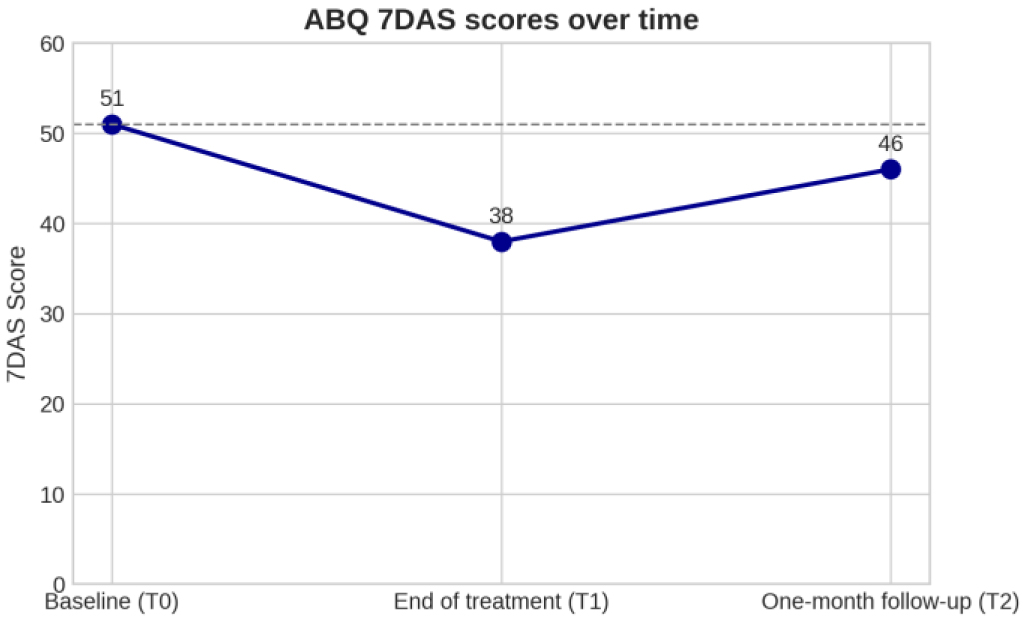
The 7DAS score decreased from 51 at T0 to 38 at T1, with a partial rebound to 46 at T2. Reported vial consumption fell from ≈3/day at baseline to 0/day by the end of treatment and remained between 0 and 1/day at one month. The intervention was well tolerated; only transient scalp discomfort and mild, short lived headaches were reported.
In this single case, a brief intensive sequential tDCS→rTMS protocol was feasible, well tolerated, and temporally associated with rapid reduction in biperiden use and improvement in addictive behavior scores. Findings are preliminary and hypothesis generating; controlled studies with objective toxicology, standardized stimulation parameters, and longer follow up are needed to evaluate efficacy, mechanisms, and durability.
Citation: Antonio Romeo, Antonio Bruno, Maria Rosaria Anna Muscatello, Fabrizio Turiaco. Intensive sequential tDCS–rTMS over left DLPFC for biperiden dependence: A case report[J]. AIMS Neuroscience, 2026, 13(3): 476-482. doi: 10.3934/Neuroscience.2026021
Anticholinergic misuse is an underrecognized form of substance use disorder that can be difficult to treat. Noninvasive neuromodulation targeting prefrontal control networks has shown promise across substance use disorders but has not been described for biperiden dependence.
To report feasibility, tolerability, and preliminary clinical outcomes of a brief, intensive combined neuromodulation protocol; sequential anodal transcranial direct current stimulation (tDCS) followed by high frequency repetitive transcranial magnetic stimulation (rTMS) to the left dorsolateral prefrontal cortex (lDLPFC) in a single patient with refractory intramuscular biperiden dependence.
A 38-year-old man with schizoaffective disorder and borderline personality disorder self-administered up to 15 mg/day of intramuscular biperiden. He underwent an intensive course of neuromodulation consisting of two daily sessions (separated by a 20 minute break) for five consecutive days; each session comprised anodal tDCS to the lDLPFC (1.5 mA; 20 min 6 s) immediately followed by high frequency rTMS to the lDLPFC (15 Hz; 2400 pulses/session; 100% motor threshold). Addictive behavior was assessed with the Addictive Behavior Questionnaire (ABQ, 7DAS subscale) at baseline (T0), end of treatment (T1), and one month follow up (T2); daily vial consumption was recorded.
The 7DAS score decreased from 51 at T0 to 38 at T1, with a partial rebound to 46 at T2. Reported vial consumption fell from ≈3/day at baseline to 0/day by the end of treatment and remained between 0 and 1/day at one month. The intervention was well tolerated; only transient scalp discomfort and mild, short lived headaches were reported.
In this single case, a brief intensive sequential tDCS→rTMS protocol was feasible, well tolerated, and temporally associated with rapid reduction in biperiden use and improvement in addictive behavior scores. Findings are preliminary and hypothesis generating; controlled studies with objective toxicology, standardized stimulation parameters, and longer follow up are needed to evaluate efficacy, mechanisms, and durability.

| [1] |
Hasin DS, O'Brien CP, Auriacombe M, et al. (2013) DSM-5 criteria for substance use disorders: recommendations and rationale. Am J Psychiatry 170: 834-851. https://doi.org/10.1176/appi.ajp.2013.12060782 
|
| [2] |
Swimmer KR, Sandelich S (2024) Substance use disorder. Emerg Med Clin North Am 42: 53-67. https://doi.org/10.1016/j.emc.2023.06.023
|
| [3] |
Liu J, Li J (2018) Drug addiction: a curable mental disorder?. Acta Pharmacol Sin 39: 1823-1829. https://doi.org/10.1038/s41401-018-0180-x
|
| [4] |
Feltenstein MW, See RE, Fuchs RA (2021) Neural substrates and circuits of drug addiction. Cold Spring Harb Perspect Med 11: a039628. https://doi.org/10.1101/cshperspect.a039628
|
| [5] |
Davis S, Zhu J (2022) Substance abuse and neurotransmission. Adv Pharmacol 93: 403-441. https://doi.org/10.1016/bs.apha.2021.10.007
|
| [6] |
Pierce RC, Kumaresan V (2006) The mesolimbic dopamine system: The final common pathway for the reinforcing effect of drugs of abuse?. Neurosci Biobehav Rev 30: 215-238. https://doi.org/10.1016/j.neubiorev.2005.04.016
|
| [7] |
Lester DB, Rogers TD, Blaha CD (2010) Acetylcholine–dopamine interactions in the pathophysiology and treatment of CNS disorders. CNS Neurosci Ther 16: 137-162. https://doi.org/10.1111/j.1755-5949.2010.00142.x
|
| [8] |
McHugh RK, Hearon BA, Otto MW (2010) Cognitive behavioral therapy for substance use disorders. Psychiatr Clin North Am 33: 511-525. https://doi.org/10.1016/j.psc.2010.04.012
|
| [9] |
Mehta DD, Praecht A, Ward HB, et al. (2024) A systematic review and meta-analysis of neuromodulation therapies for substance use disorders. Neuropsychopharmacol 49: 649-680. https://doi.org/10.1038/s41386-023-01776-0
|
| [10] |
Kobayashi M, Pascual-Leone A (2003) Transcranial magnetic stimulation in neurology. Lancet Neurol 2: 145-156. https://doi.org/10.1016/S1474-4422(03)00321-1
|
| [11] |
Fregni F, Pascual-Leone A (2007) Technology Insight: noninvasive brain stimulation in neurology—perspectives on the therapeutic potential of rTMS and tDCS. Nat Rev Neurol 3: 383-393. https://doi.org/10.1038/ncpneuro0530
|
| [12] |
Lefaucheur JP, Aleman A, Baeken C, et al. (2020) Evidence-based guidelines on the therapeutic use of repetitive transcranial magnetic stimulation (rTMS): An update (2014–2018). Clin Neurophysiol 131: 474-528. https://doi.org/10.1016/j.clinph.2019.11.002
|
| [13] |
Espi Martinez F, Espi Forcen F, Shapov A, et al. (2012) Biperiden dependence: case report and literature review. Case Rep Psychiatry 2012: 1-3. https://doi.org/10.1155/2012/949256
|
| [14] |
Affaticati A, Gerra ML, Amerio A, et al. (2015) The controversial case of biperiden: from prescription drug to drug of abuse. J Clin Psychopharmacol 35: 749-750. https://doi.org/10.1097/JCP.0000000000000421
|
| [15] |
Romero Lauro LJ, Rosanova M, Mattavelli G, et al. (2014) TDCS increases cortical excitability: Direct evidence from TMS–EEG. Cortex 58: 99-111. https://doi.org/10.1016/j.cortex.2014.05.003
|
| [16] |
Varoli E, Pisoni A, Mattavelli GC, et al. (2018) Tracking the effect of cathodal transcranial direct current stimulation on cortical excitability and connectivity by means of TMS-EEG. Front Neurosci 12: 319. https://doi.org/10.3389/fnins.2018.00319
|
| [17] |
Beam W, Borckardt JJ, Reeves ST, et al. (2009) An efficient and accurate new method for locating the F3 position for prefrontal TMS applications. Brain Stimul 2: 50-54. https://doi.org/10.1016/j.brs.2008.09.006
|
| [18] |
Caretti V, Gori A, Craparo G, et al. (2018) A new measure for assessing substance-related and addictive disorders: The Addictive Behavior Questionnaire (ABQ). J Clin Med 7: 194. https://doi.org/10.3390/jcm7080194
|
Figures(1)

Antonio Romeo, Antonio Bruno, Maria Rosaria Anna Muscatello, Fabrizio Turiaco. Intensive sequential tDCS–rTMS over left DLPFC for biperiden dependence: A case report[J]. AIMS Neuroscience, 2026, 13(3): 476-482. doi: 10.3934/Neuroscience.2026021




 DownLoad: