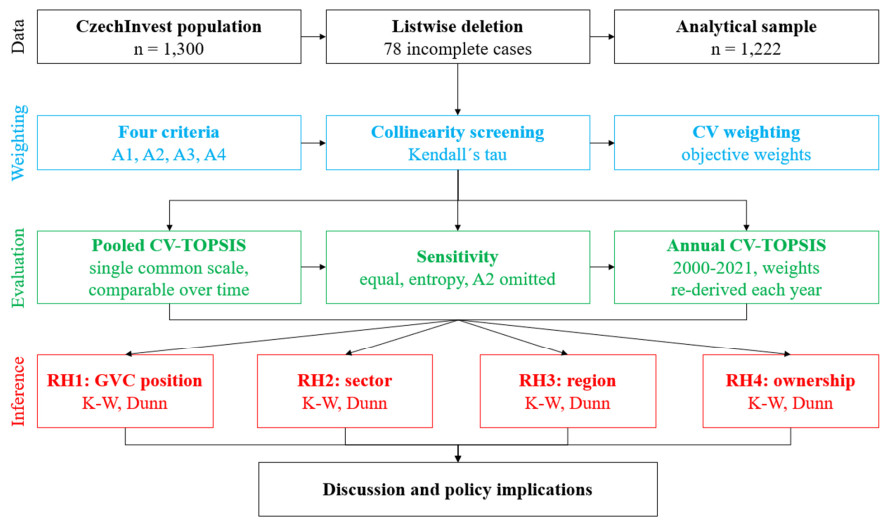
Evaluating the efficiency of incentivized investment projects requires a multidimensional framework that jointly considers investor outcomes, public support, and regional productivity. Our aim of this study was to evaluate the effectiveness of individual investment projects that have received investment incentives in the Czech Republic since 2000 using the CV-TOPSIS technique. In the context of the four criteria monitored (investment size, maximum level of public support, value added per employee, and effectiveness of the granted investment incentives), the research set consisted of all investment incentives with available data: 1,222 investment incentives. These investments were evaluated from the perspective of the level of involvement of companies (investments) in global value chains (GVC), sector, region and ownership. We developed an efficiency index combining investor's activity, public finance, and regional productivity dimensions. Our results confirmed that the effectiveness of investment incentives granted to business projects is conditioned by a complex combination of factors. The highest-ranked projects are concentrated in biotechnology and medical technology, electronics and electrical engineering, and transport equipment manufacturing. Investments in the Ústí nad Labem Region also achieved strong overall scores. In addition, projects implemented by firms occupying leading positions in production networks tended to perform better across evaluated dimensions. The findings suggest that the effectiveness of investment incentives depends on a complex interaction between industrial structure, regional conditions, and GVC integration. The study contributes to quantitative economic policy evaluation by providing a large-scale multicriteria assessment of incentivized investment projects supported projects in a post-transition economy.
Citation: Sylvie Kotíková, Roman Vavrek. Incentivised investment projects in the Czech Republic in the perspective of the integrated CV-TOPSIS framework since 2000: Has anything changed?[J]. National Accounting Review, 2026, 8(3): 460-487. doi: 10.3934/NAR.2026019
Evaluating the efficiency of incentivized investment projects requires a multidimensional framework that jointly considers investor outcomes, public support, and regional productivity. Our aim of this study was to evaluate the effectiveness of individual investment projects that have received investment incentives in the Czech Republic since 2000 using the CV-TOPSIS technique. In the context of the four criteria monitored (investment size, maximum level of public support, value added per employee, and effectiveness of the granted investment incentives), the research set consisted of all investment incentives with available data: 1,222 investment incentives. These investments were evaluated from the perspective of the level of involvement of companies (investments) in global value chains (GVC), sector, region and ownership. We developed an efficiency index combining investor's activity, public finance, and regional productivity dimensions. Our results confirmed that the effectiveness of investment incentives granted to business projects is conditioned by a complex combination of factors. The highest-ranked projects are concentrated in biotechnology and medical technology, electronics and electrical engineering, and transport equipment manufacturing. Investments in the Ústí nad Labem Region also achieved strong overall scores. In addition, projects implemented by firms occupying leading positions in production networks tended to perform better across evaluated dimensions. The findings suggest that the effectiveness of investment incentives depends on a complex interaction between industrial structure, regional conditions, and GVC integration. The study contributes to quantitative economic policy evaluation by providing a large-scale multicriteria assessment of incentivized investment projects supported projects in a post-transition economy.

| [1] | Alfaro L (2003) Foreign direct investment and growth: Does the sector matter. Harvard Business School. |
| [2] |
Alfaro L (2017) Gains from foreign direct investment: Macro and micro approaches. World Bank Eco Rev 30: 2–15. https://doi.org/10.1093/wber/lhw007 doi: 10.1093/wber/lhw007

|
| [3] |
Antràs P (2020) Conceptual aspects of global value chains. World Bank Econ Rev 34: 551–574. https://doi.org/10.1093/wber/lhaa006 doi: 10.1093/wber/lhaa006
|
| [4] |
Bait S, Marino Lauria S, Schiraldi MM (2021) Multi-criteria decision-making model for supporting manufacturing settlements location in Africa after COVID-19. Int J Eng Bus Manag 13: 18479790211023348. https://doi.org/10.1177/18479790211023348 doi: 10.1177/18479790211023348
|
| [5] |
Barasa L, Knoben J, Vermeulen P, et al. (2017) Institutions, resources and innovation in East Africa: A firm level approach. Res Policy 46: 280–291. https://doi.org/10.1016/j.respol.2016.11.008 doi: 10.1016/j.respol.2016.11.008
|
| [6] |
Benáček V, Lenihan H, Andreosso-O'Callaghan B, et al. (2014) Political risk, institutions and foreign direct investment: How do they relate in various European countries? World Econ 37: 625–653. https://doi.org/10.1111/twec.12112 doi: 10.1111/twec.12112
|
| [7] |
Çalık A, Çizmecioğlu S, Akpınar A (2019) An integrated AHP-TOPSIS framework for foreign direct investment in Turkey. J Multi-Crit Decis Anal 26: 296–307. https://doi.org/10.1002/mcda.1692 doi: 10.1002/mcda.1692
|
| [8] |
Cedidlova M (2013) The effectiveness of investment incentives in certain foreign companies operating in the Czech Republic. J Compet 5: 108–120. https://doi.org/10.7441/joc.2013.01.08 doi: 10.7441/joc.2013.01.08
|
| [9] |
Chan JYL, Leow SMH, Bea KT, et al. (2022) Mitigating the multicollinearity problem and its machine learning approach: A review. Mathematics 10: 1283. https://doi.org/10.3390/math10081283 doi: 10.3390/math10081283
|
| [10] |
Choi H (2018) Does FDI crowd out domestic firms? Micro-level evidence from the Republic of Korea. J Korea Trade (Bingley) 22: 405–416. https://doi.org/10.1108/JKT-02-2018-0011 doi: 10.1108/JKT-02-2018-0011
|
| [11] |
Colen L, Persyn D, Guariso A (2016) Bilateral investment treaties and FDI: Does the sector matter? World Dev 83: 193–206. https://doi.org/10.1016/j.worlddev.2016.01.020 doi: 10.1016/j.worlddev.2016.01.020
|
| [12] |
Correa da Cunha H, Singh V, Xie S (2022) The determinants of outward foreign direct investment from Latin America and the Caribbean: An integrated entropy-based TOPSIS multiple regression analysis framework. J Risk and Financ Manag 15: 130. https://doi.org/10.3390/jrfm15030130 doi: 10.3390/jrfm15030130
|
| [13] | CzechInvest (2025) Investment incentives and subsidies in the Czech Republic. Available from: https://czechinvest.gov.cz/en/For-Investors/Investment-Incentives?force. |
| [14] |
Damborský M (2023) Regional unemployment and investment incentives in Czechia. Geografický časopis-Geogr J 75: 107–124. https://doi.org/10.31577/geogrcas.2023.75.2.06 doi: 10.31577/geogrcas.2023.75.2.06
|
| [15] |
Danzman SB, Slaski A (2022) Explaining deference: Why and when do policymakers think FDI needs tax incentives? Rev Int Politic Econ 29: 1085–111. https://doi.org/10.1080/09692290.2021.1885475 doi: 10.1080/09692290.2021.1885475
|
| [16] |
Driffield N, Hughes D (2003) Foreign and domestic investment: Regional development or crowding out? Reg Stud 37: 277–288. https://doi.org/10.1080/0034340032000065433 doi: 10.1080/0034340032000065433
|
| [17] |
Driffield N, Harrington LR, Surdu I, et al. (2024) Maximising the (unequal) benefits of foreign direct investment: Addressing the two-speed problem. Contemp Soc Sci 19: 469–494. https://doi.org/10.1080/21582041.2024.2433670 doi: 10.1080/21582041.2024.2433670
|
| [18] |
Eichfelder S, Jacob M, Schneider K (2023) Do tax incentives affect investment quality? J Corp Financ 80: 102403. https://doi.org/10.1016/j.jcorpfin.2023.102403 doi: 10.1016/j.jcorpfin.2023.102403
|
| [19] |
Gereffi G, Pananond P, Tell F, et al. (2025) Navigating industrial policy and global value chains in an era of disruptions. J Int Bus Policy 8: 207–223. https://doi.org/10.1057/s42214-025-00223-9 doi: 10.1057/s42214-025-00223-9
|
| [20] |
Gokmenoglu K, Alaghemand S (2015) A multi-criteria decision-making model for evaluating priorities for foreign direct investment. Croat Oper Res Rev 6: 489–510. https://doi.org/10.17535/crorr.2015.0037 doi: 10.17535/crorr.2015.0037
|
| [21] |
Görg H, Greenaway D (2004) Much I do about nothing? Do domestic firms really benefit from foreign direct investment? World Bank Res Obs 19: 171–197. https://doi.org/10.1093/wbro/lkh019 doi: 10.1093/wbro/lkh019
|
| [22] |
Govori F, Fejzullahu A (2020) External financial flows and GDP growth. J Dev SOC 36: 56–76. https://doi.org/10.1177/0169796X19898964 doi: 10.1177/0169796X19898964
|
| [23] | Havránek T, Hampl M (2018) Foreign investment and domestic productivity in the Czech Republic: A quantitative survey. Munich Personal RePEc Archive. Available from: https://www.econstor.eu/handle/10419/175754. |
| [24] |
Hlaváček P, Janáček J (2019) The influence of foreign direct investment and public incentives on the socio-economic development of regions: An empirical study from the Czech Republic. E M Ekon Manag 22: 4–19. https://doi.org/10.15240/tul/001/2019-3-001 doi: 10.15240/tul/001/2019-3-001
|
| [25] | Jablonský J (2007) Operační Výzkum: Kvantitativní Modely Pro Ekonomické Rozhodování, Czech Republic: Professional Publishing, 3. vyd. |
| [26] |
Javorcik BS, Lo Turco A, Maggion D (2017) New and improved: Does FDI boost production complexity in host countries? Econ J 128: 2507–2537. https://doi.org/10.1111/ecoj.12530 doi: 10.1111/ecoj.12530
|
| [27] |
Katitas A, Pandya S (2024) Investment incentives attract foreign direct investment: Evidence from the Great Recession. Public Choice 200: 323–345. https://doi.org/10.1007/s11127-024-01158-0 doi: 10.1007/s11127-024-01158-0
|
| [28] |
Katrancı A, Kundakcı N, Pamucar D (2025) Financial performance evaluation of firms in BIST 100 index with ITARA and COBRA methods. Financ Inno 11: 34. https://doi.org/10.1186/s40854-024-00704-5 doi: 10.1186/s40854-024-00704-5
|
| [29] |
Kersuliene V, Zavadskas EK, Turskis Z (2010) Selection of rational dispute resolution method by applying new step-wise weight assessment ratio analysis (Swara). J Bus Econ Manag (Vilnius) 11: 243–258. https://doi.org/10.3846/jbem.2010.12 doi: 10.3846/jbem.2010.12
|
| [30] |
Khan Y, Ashraf S, Shah M (2026) Institutional barriers to food security: An intelligent fuzzy decision making model. Soft Comput 30: 2565–2588. https://doi.org/10.1007/s00500-025-10998-x doi: 10.1007/s00500-025-10998-x
|
| [31] |
Khan Y, Ashraf S, Farman M, et al. (2024) Exploring household food security through institutional factors: A statistical and mathematical analysis. Int J Fuzzy Log Inte 46: 9179–9195. https://doi.org/10.3233/JIFS-237938 doi: 10.3233/JIFS-237938
|
| [32] |
Klimek A (2024) Economic upgrading of Central and Eastern European economies through global value chain participation and foreign direct investment. Balt J Econ 24: 180–202. https://doi.org/10.1080/1406099x.2024.2376503 doi: 10.1080/1406099x.2024.2376503
|
| [33] |
Kotíková S (2019) Potential of the Czech business environment assumes the effects of foreign direct investment. E M Ekon Manag 22: 18–35. https://doi.org/10.15240/tul/001/2019-4-002 doi: 10.15240/tul/001/2019-4-002
|
| [34] |
Kotíková S (2023) Spillover effects: A challenging public interest to measure. Natl Account Rev 5: 373–404. https://doi.org/10.3934/NAR.2023022 doi: 10.3934/NAR.2023022
|
| [35] |
Kyriazos T, Poga M (2023) Dealing with multicollinearity in factor analysis: The problem, detections, and solutions. Open J Stat 13: 404–424. https://doi.org/10.4236/ojs.2023.133020 doi: 10.4236/ojs.2023.133020
|
| [36] |
Lin CT, Tsai MC (2010) Location choice for direct foreign investment in new hospitals in China by using ANP and TOPSIS. Qual Quant 44: 375–390. https://doi.org/10.1007/s11135-008-9199-2 doi: 10.1007/s11135-008-9199-2
|
| [37] |
Luo H, Li F (2018) Tomato yield, quality and water use efficiency under different drip fertigation strategies. Sci Hortic-amsterdam 235: 181–188. https://doi.org/10.1016/j.scienta.2018.02.072 doi: 10.1016/j.scienta.2018.02.072
|
| [38] |
Markauskas M, Baliute A (2021) Technological progress spillover effect in Lithuanian manufacturing industry. Equilibrium (Torun) 16: 783–806. https://doi.org/10.24136/eq.2021.029 doi: 10.24136/eq.2021.029
|
| [39] |
Marková J, Arltová M (2023) Impact of FDI income outflows for Czech economy. Polit ekon 71: 642–667. https://doi.org/10.18267/j.polek.1404 doi: 10.18267/j.polek.1404
|
| [40] |
Massey D (2007) In what sense a regional problem? Reg Stud 41: 49–59. https://doi.org/10.1080/00343400701232181 doi: 10.1080/00343400701232181
|
| [41] | Mullen JK (2010) FDI and domestic capital stock in US manufacturing industires: Crowding-out and displacement effects. Working Paper No. 0160. Available from: https://research.universityofgalway.ie/files/25849486/paper_0160.pdf. |
| [42] |
Narula R (2018) An extended dual economy model: Implications for emerging economies and their multinational firms. Int J Emerg Mark 13: 586–602. https://doi.org/10.1108/IJoEM-10-2017-0375 doi: 10.1108/IJoEM-10-2017-0375
|
| [43] |
Naughton H, Norback PJ, Tekin-Koru A (2016) Aggregation issues of foreign direct investment estimation in an interdependent world. World Econ 39: 2046–2073. https://doi.org/10.1111/twec.12388 doi: 10.1111/twec.12388
|
| [44] |
Newman C, Rand J, Talbot T, et al. (2015) Technology transfers, foreign investment and productivity spillovers. Eur Econ Rev 76: 168–187. https://doi.org/10.1016/j.euroecorev.2015.02.005 doi: 10.1016/j.euroecorev.2015.02.005
|
| [45] | Paul A, Popovici OC, Calin CA (2014) The attractiveness of Cee countries for FDI. A public policy approach using the Topsis method. Transylv Rev Adm Sci 42E: 156–180. |
| [46] |
Rathnayake S, Jayakody S, Wannisinghe P, et al. (2023) Macroeconomic factors affecting FDI in the African region. PLOS ONE 18: e0280843. https://doi.org/10.1371/journal.pone.0280843 doi: 10.1371/journal.pone.0280843
|
| [47] |
Şahi̇n RU, Gökhan NK, Keski̇n A, et al. (2025) Determinants of foreign direct investment in the textile sector: A researchwith IT2 Fuzzy TOPSIS methodology. Ind Textila 76: 286–292. https://doi.org/10.35530/IT.076.02.2024116 doi: 10.35530/IT.076.02.2024116
|
| [48] |
Sass M, Gál Z, Bálint J (2018) The impact of FDI on host countries: The analysis of selected service industries in the Visegrad countries. Post-Communist Econ 30: 652–674. https://doi.org/10.1080/14631377.2018.1445332 doi: 10.1080/14631377.2018.1445332
|
| [49] |
Senaviratna NAMR, Cooray TMJA (2019) Diagnosing multicollinearity of logistic regression model. Asian J Probab Stat, 1–9. https://doi.org/10.9734/ajpas/2019/v5i230132 doi: 10.9734/ajpas/2019/v5i230132
|
| [50] |
Singla A, Ahuja IS, Sethi AS (2018) Comparative analysis of technology push strategies influencing sustainable development in manufacturing industries using Topsis and Vikor technique. Int J Qual Res (Podgorica) 12: 129–146. https://doi.org/10.18421/IJQR12.01-08 doi: 10.18421/IJQR12.01-08
|
| [51] |
Slaski A, Danzman SB (2025) Competing to lose: FDI, investment incentives, and taxation capacity under fiscal federalism. Bus Politics, 1–18. https://doi.org/10.1017/bap.2025.10014 doi: 10.1017/bap.2025.10014
|
| [52] |
Stojčić N, Orlić E (2020) Spatial dependence, foreign investment and productivity spillovers in new EU member states. Reg Stud 54: 1057–1068. https://doi.org/10.1080/00343404.2019.1653451 doi: 10.1080/00343404.2019.1653451
|
| [53] |
Szymczak S, Parteka A, Wolszczak-Derlacz J (2023) Joint foreign ownership and global value chains effects on productivity: A comparison of firms from Poland and Germany. Int J Emerg Mark 20: 55–73. https://doi.org/10.1108/IJOEM-09-2022-1357 doi: 10.1108/IJOEM-09-2022-1357
|
| [54] |
Thakur-Weigold B, Miroudot S (2023) Supply chain myths in the resilience and deglobalization narrative: Consequences for policy. J Int Bus Policy 7: 99-111. https://doi.org/10.1057/s42214-023-00170-3 doi: 10.1057/s42214-023-00170-3
|
| [55] |
Tkalenko S, Derii Z, Butenko N, et al. (2022) Foreign direct investments and economic growth in the post-Covid-19 period: A causality analysis for Ukraine. Financ Credit Act-Probl Theory Pract 3: 357–366. https://doi.org/10.55643/fcaptp.3.44.2022.3665 doi: 10.55643/fcaptp.3.44.2022.3665
|
| [56] |
Tomelin J, Amal M, Hein N, et al. (2018) Foreign direct investment in the G-20: To what extent do institutions matter? RAUSP Manag J 53: 404–421. https://doi.org/10.1108/RAUSP-04-2018-003 doi: 10.1108/RAUSP-04-2018-003
|
| [57] |
Vaňková I, Vavrek R (2021) Evaluation of local accessibility of homes for seniors using multi‐criteria approach–evidence from the Czech Republic. Health Soc Care Comm 29. https://doi.org/10.1111/hsc.13231 doi: 10.1111/hsc.13231
|
| [58] |
Vavrek R, Chovancová J (2019) Assessment of economic and environmental energy performance of EU countries using CV-TOPSIS technique. Ecol Indic 106: 105519. https://doi.org/10.1016/j.ecolind.2019.105519 doi: 10.1016/j.ecolind.2019.105519
|
| [59] |
Vavrek R (2026) TOPSIS technique and its use in local self-government: A review of methodological literature. Croat Comp Public Ad 26: 243–277. https://doi.org/10.31297/hkju.26.2.5 doi: 10.31297/hkju.26.2.5
|
| [60] |
Wallerstein I (1974) The rise and future demise of the world capitalist system: Concepts for comparative analysis. Comp Stud Soc Hist 16: 387–415. https://doi.org/10.1017/S0010417500007520 doi: 10.1017/S0010417500007520
|
| [61] |
Wang Y (2010) FDI and productivity growth: The role of inter‐industry linkages. Can J Econ 43: 1243–1272. https://doi.org/10.1111/j.1540-5982.2010.01613.x doi: 10.1111/j.1540-5982.2010.01613.x
|
| [62] |
Wanke P, Tan Y, Antunes J, et al. (2024) Foreign direct investment performance drivers at the country level: A robust compromise multi-criteria decision-making approach. Technol Econ Dev Econ 30: 148–174. https://doi.org/10.3846/tede.2024.19532 doi: 10.3846/tede.2024.19532
|
| [63] |
Wellhausen RL (2013) Innovation in tow: R & D FDI and investment incentives. Bus and Politics 15: 467–91. https://doi.org/10.1515/bap-2013-0014 doi: 10.1515/bap-2013-0014
|
| [64] |
Wu C, Burge GS (2018) Competing for foreign direct investment: The case of local governments in China. Public Finance Rev 46: 1044–1068. https://doi.org/10.1177/1091142117698015 doi: 10.1177/1091142117698015
|
| [65] |
Yalçın N, Ünlü U (2018) A multi-criteria performance analysis of initial public offering (IPO) firms using CRITIC and VIKOR methods. Technol Econ Dev Econ 24: 534–560. https://doi.org/10.3846/20294913.2016.1213201 doi: 10.3846/20294913.2016.1213201
|
| [66] |
Yüksel S, Eti S, Dinçer H, et al. (2025) A novel fuzzy decision-making approach to pension fund investments in renewable energy. Financ Innov 11: 18. https://doi.org/10.1186/s40854-024-00703-6 doi: 10.1186/s40854-024-00703-6
|
 NAR-08-03-019-s001.pdf |
 |
Figures(5) / Tables(8)

Sylvie Kotíková, Roman Vavrek. Incentivised investment projects in the Czech Republic in the perspective of the integrated CV-TOPSIS framework since 2000: Has anything changed?[J]. National Accounting Review, 2026, 8(3): 460-487. doi: 10.3934/NAR.2026019





 DownLoad: