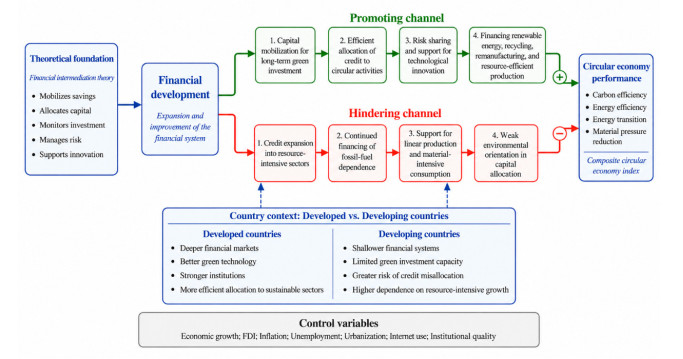
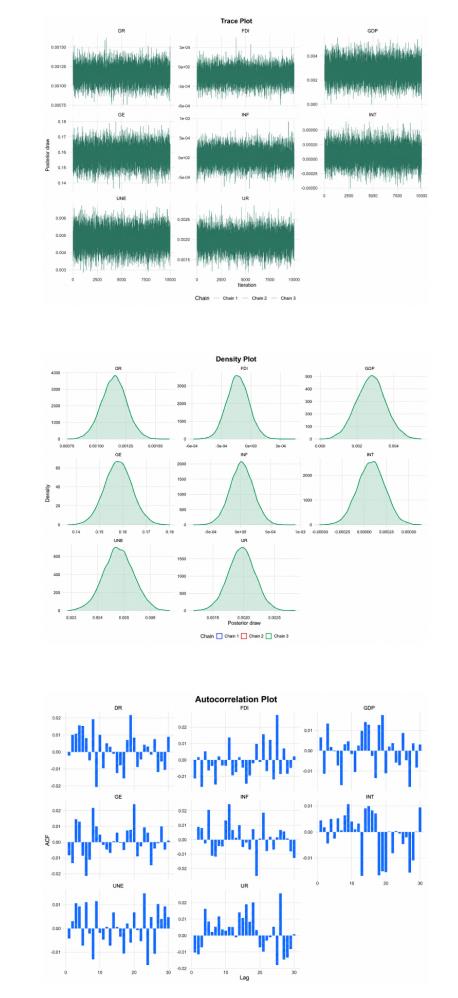
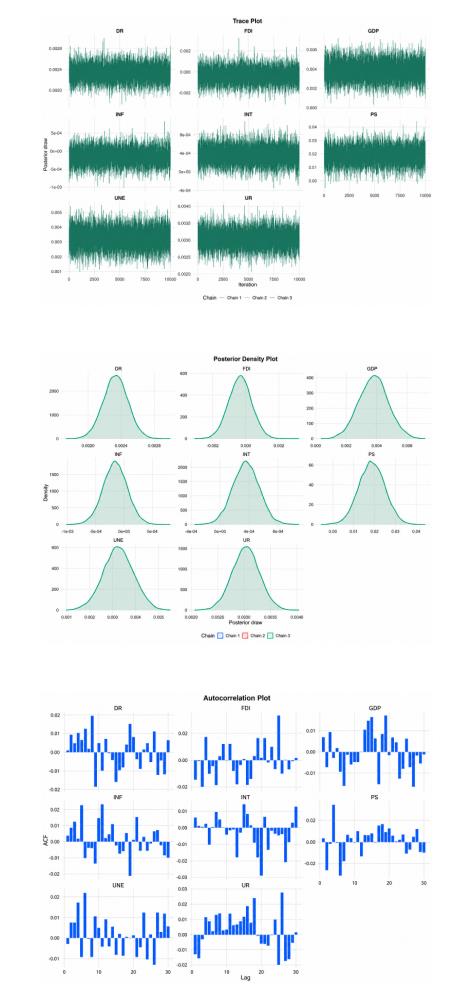
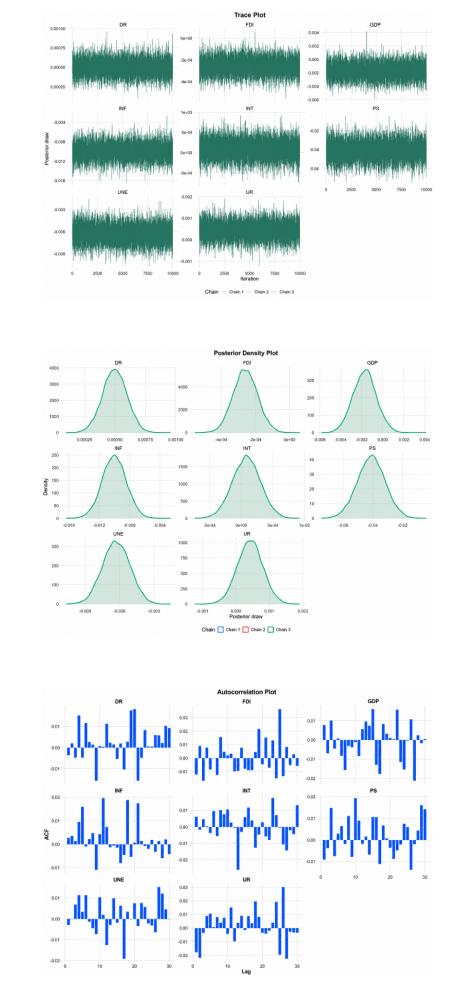
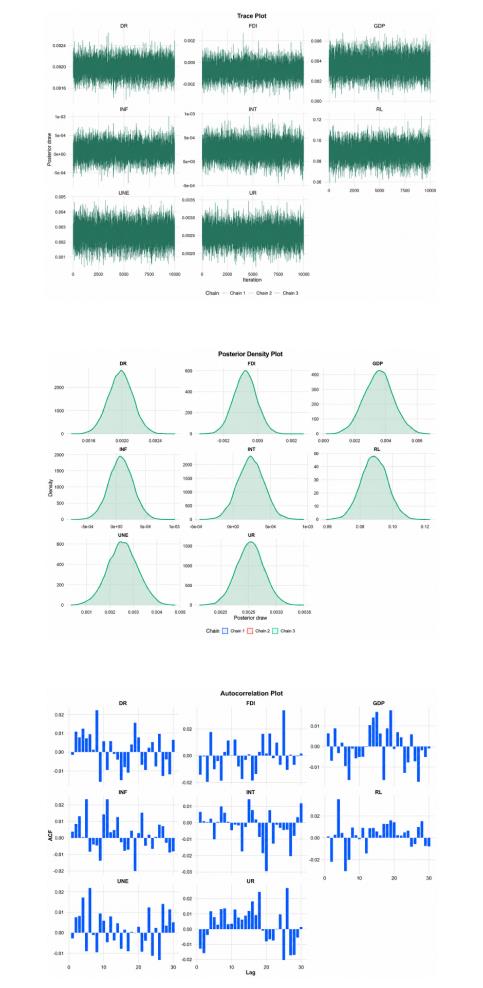
The circular economy has become increasingly important as countries seek to reduce resource dependence, improve energy efficiency, and decouple economic activity from environmental pressure. However, macro-level circular economy measurement remains fragmented, while the relationship between financial development and circular transition may differ substantially across levels of economic development. In this study, we constructed a macro-level circular economy index for 109 countries over the period 2002–2024, comprising 30 developed and 79 developing economies. Principal component analysis combined four dimensions: carbon efficiency, energy efficiency, energy transition, and material pressure. Bayesian regression was then used to examine the relationship between financial development and circular economy performance under six institutional specifications. The results revealed a substantial development gap: The mean circular economy index was 0.864 for developed countries and 0.413 for developing countries. In developed economies, the posterior coefficient of financial development ranged from 0.0017 to 0.0023, with P (β > 0) = 1.0000 across all six specifications. The corresponding approximate 95% credible intervals remained strictly positive, ranging from approximately [0.0013, 0.0021] to [0.0021, 0.0025], providing strong evidence of a stable positive relationship. In developing economies, the coefficients were substantially smaller and heterogeneous, ranging from −0.0005 to 0.0001. Most posterior intervals overlapped zero, while the political-stability specification produced a negative coefficient of −0.0005, with P (β < 0) = 1.0000 and an approximate 95% credible interval of [−0.0007, −0.0003]. These findings indicated that greater financial depth is consistently associated with stronger circular economy performance in developed economies but does not generate the same outcome in developing countries. The results highlight the importance of directing financial resources toward clean technology, renewable energy, resource efficiency, recycling, and other circular activities rather than relying on credit expansion alone.
Citation: Le Quoc Dinh, Tran Thi Kim Oanh. Financial development and the circular economy: Evidence across levels of economic development[J]. National Accounting Review, 2026, 8(3): 409-459. doi: 10.3934/NAR.2026018
The circular economy has become increasingly important as countries seek to reduce resource dependence, improve energy efficiency, and decouple economic activity from environmental pressure. However, macro-level circular economy measurement remains fragmented, while the relationship between financial development and circular transition may differ substantially across levels of economic development. In this study, we constructed a macro-level circular economy index for 109 countries over the period 2002–2024, comprising 30 developed and 79 developing economies. Principal component analysis combined four dimensions: carbon efficiency, energy efficiency, energy transition, and material pressure. Bayesian regression was then used to examine the relationship between financial development and circular economy performance under six institutional specifications. The results revealed a substantial development gap: The mean circular economy index was 0.864 for developed countries and 0.413 for developing countries. In developed economies, the posterior coefficient of financial development ranged from 0.0017 to 0.0023, with P (β > 0) = 1.0000 across all six specifications. The corresponding approximate 95% credible intervals remained strictly positive, ranging from approximately [0.0013, 0.0021] to [0.0021, 0.0025], providing strong evidence of a stable positive relationship. In developing economies, the coefficients were substantially smaller and heterogeneous, ranging from −0.0005 to 0.0001. Most posterior intervals overlapped zero, while the political-stability specification produced a negative coefficient of −0.0005, with P (β < 0) = 1.0000 and an approximate 95% credible interval of [−0.0007, −0.0003]. These findings indicated that greater financial depth is consistently associated with stronger circular economy performance in developed economies but does not generate the same outcome in developing countries. The results highlight the importance of directing financial resources toward clean technology, renewable energy, resource efficiency, recycling, and other circular activities rather than relying on credit expansion alone.

| [1] |
Abdi H, Williams LJ (2010) Principal component analysis. Wiley Interdiscip Rev Comput Stat 2: 433–459. https://doi.org/10.1002/wics.101 doi: 10.1002/wics.101

|
| [2] |
Al-Khatib AW (2023) The impact of industrial Internet of things on sustainable performance: The indirect effect of supply chain visibility. Bus Process Manag J 29: 1607–1629. https://doi.org/10.1108/BPMJ-03-2023-0198 doi: 10.1108/BPMJ-03-2023-0198
|
| [3] |
Allwood JM, Ashby MF, Gutowski TG, et al. (2011) Material efficiency: A white paper. Resour Conserv Recycl 55: 362–381. https://doi.org/10.1016/j.resconrec.2010.11.002 doi: 10.1016/j.resconrec.2010.11.002
|
| [4] |
Bajwa FA, Fu J, Bajwa IA, et al. (2025) Digital financial inclusion and its dual impact on economic and environmental outcomes in ASEAN countries. Data Sci Finance Econ 5: 53–75. https://doi.org/10.3934/DSFE.2025004 doi: 10.3934/DSFE.2025004
|
| [5] |
Beck T, Levine R, Loayza N (2000) Finance and the sources of growth. J Financ Econ 58: 261–300. https://doi.org/10.1016/S0304-405X(00)00072-6 doi: 10.1016/S0304-405X(00)00072-6
|
| [6] |
Cai Y, Rahman HU, Khan AB, et al. (2025) The role of environmental quality, financial development and institutional quality in sustainable economic growth: Evidence from China. Contemp Econ 19: 312–328. https://doi.org/10.5709/ce.1897-9254.568 doi: 10.5709/ce.1897-9254.568
|
| [7] |
Cai Z, Tang Y, Lin J (2024) Exploring the impact of circular economy practices on ecological footprint, inflation rate, and renewable energy consumption: Evidence from G20 economies. Environ Sci Pollut Res 31: 26536–26554. https://doi.org/10.1007/s11356-024-32688-1 doi: 10.1007/s11356-024-32688-1
|
| [8] |
Chen P, Chen Q (2025) Two birds with one stone: Can green finance drive the circular economy? Humanit Soc Sci Commun 12: 1–14. https://doi.org/10.1057/s41599-025-05626-w doi: 10.1057/s41599-025-05626-w
|
| [9] |
Chen S, Elheddad M, Sharma N, et al. (2026) Impact of financial development on the circular economy: Empirical evidence from the European Union. Bus Strategy Environ 35: 251–263. https://doi.org/10.1002/bse.70168 doi: 10.1002/bse.70168
|
| [10] |
Cheng J, Jiang Y (2024) How can carbon markets drive the development of renewable energy sector? Empirical evidence from China. Data Sci Finance Econ 4: 249–269. https://doi.org/10.3934/DSFE.2024010 doi: 10.3934/DSFE.2024010
|
| [11] |
Chib S, Greenberg E (1995) Hierarchical analysis of SUR models with extensions to correlated serial errors and time-varying parameter models. J Econom 68: 339–360. https://doi.org/10.1016/0304-4076(94)01653-H doi: 10.1016/0304-4076(94)01653-H
|
| [12] |
Chowdhury MAF, Uddin MS, Ahmed Z, et al. (2026) Circular economy, institutional quality, and sovereign credit risk nexus: Evidence from European countries. Bus Strategy Environ 35: 2469–2481. https://doi.org/10.1002/bse.70305 doi: 10.1002/bse.70305
|
| [13] | Circle Economy, The circularity gap report 2024. Amsterdam: Circle Economy Foundation, 2024. Available from: https://circulareconomy.europa.eu/platform/en/knowledge/circularity-gap-report-2024. |
| [14] |
Claudio-Quiroga G, Poza C (2024) Measuring the circular economy in Europe: Big differences among countries, great opportunities to converge. Sustain Dev 32: 4707–4725. https://doi.org/10.1002/sd.2925 doi: 10.1002/sd.2925
|
| [15] |
Conca L, Campobasso F, Toma P (2026) Exploring the impact of circular economy practices on corporate performance: A global analysis. Bus Strategy Environ 35: 2618–2632. https://doi.org/10.1002/bse.70315 doi: 10.1002/bse.70315
|
| [16] |
Das SK, Yedlarajiah P, Narendra R (2000) An approach for estimating the end-of-life product disassembly effort and cost. Int J Prod Res 38: 657–673. https://doi.org/10.1080/002075400189356 doi: 10.1080/002075400189356
|
| [17] |
Dat PT, Phan NTH, Le TTH (2025) Factors affecting the circular economy in Vietnam. Contemp Econ 19: 132–147. https://doi.org/10.5709/ce.1897-9254.558 doi: 10.5709/ce.1897-9254.558
|
| [18] |
Desalegn G, Tangl A (2022) Forecasting green financial innovation and its implications for financial performance in Ethiopian Financial Institutions: Evidence from ARIMA and ARDL model. Nat Account Rev 4: 95–111. https://doi.org/10.3934/NAR.2022006 doi: 10.3934/NAR.2022006
|
| [19] |
Di Maio F, Rem PC (2015) A robust indicator for promoting circular economy through recycling. J Environ Prot 6: 1095–1104. https://doi.org/10.4236/jep.2015.610096 doi: 10.4236/jep.2015.610096
|
| [20] |
Dinh LQ, Oanh TTK (2026) Measuring the circular economy at the macro level: Do developed and developing countries differ? Int J Sustain Dev Plan 21: 2391–2405. https://doi.org/10.18280/ijsdp.210601 doi: 10.18280/ijsdp.210601
|
| [21] |
Do Minh K, Nguyen HN (2022) Measuring the circular economy for companies: A case study of a packaging company in Vietnam. VNU J Econ Bus 2: 100–110. https://doi.org/10.25073/2588-1108/vnueab.4645 doi: 10.25073/2588-1108/vnueab.4645
|
| [22] |
Drofenik J, Seljak T, Pintarič ZN (2025) A multi-level approach to circular economy progress: Linking national targets with corporate implementation. J Clean Prod 493: 144902. https://doi.org/10.1016/j.jclepro.2025.144902 doi: 10.1016/j.jclepro.2025.144902
|
| [23] |
Durbin J (1954) Errors in variables. Rev Int Stat Inst 22: 23–32. https://doi.org/10.2307/1401917 doi: 10.2307/1401917
|
| [24] |
Elia V, Gnoni MG, Tornese F (2017) Measuring circular economy strategies through index methods: A critical analysis. J Clean Prod 142: 2741–2751. https://doi.org/10.1016/j.jclepro.2016.10.196 doi: 10.1016/j.jclepro.2016.10.196
|
| [25] | Ellen MacArthur Foundation, Towards a circular economy: Business rationale for an accelerated transition. Ellen MacArthur Foundation, 2015. Available from: https://content.ellenmacarthurfoundation.org/m/4384c08da576329c/original/Towards-a-circular-economy-Business-rationale-for-an-accelerated-transition.pdf. |
| [26] |
Emami N, Miatto A, Gheewala S, et al. (2025) Measuring progress toward a circular economy of the ASEAN Community. J Ind Ecol 29: 129–144. https://doi.org/10.1111/jiec.13597 doi: 10.1111/jiec.13597
|
| [27] | European Commission, Directive 2008/98/EC of the European Parliament and of the Council of 19 November 2008 on waste and repealing certain directives. Official Journal of the European Union, 2008. Available from: https://eur-lex.europa.eu/eli/dir/2008/98/oj/eng. |
| [28] | Evans J, Bocken N, Circular economy toolkit. Cambridge: Cambridge Institute for Manufacturing, 2013. Available from: http://circulareconomytoolkit.org. |
| [29] |
Fang F, Parida S, Sarkis J (2024) Private financing and the circular economy. Resour Conserv Recycl 205: 107581. https://doi.org/10.1016/j.resconrec.2024.107581 doi: 10.1016/j.resconrec.2024.107581
|
| [30] |
Ferrari G, Mondéjar Jiménez J, Zhao Y, et al. (2025) The debate on GDP: Where we are at. Or, how to run to its aid with contempt of danger and hope to get out unharmed. Natl Account Rev 7: 106–124. https://doi.org/10.3934/NAR.2025005 doi: 10.3934/NAR.2025005
|
| [31] |
Gao C, Gao C, Song K, et al. (2020) Pathways towards regional circular economy evaluated using material flow analysis and system dynamics. Resour Conserv Recycl 154: 104527. https://doi.org/10.1016/j.resconrec.2019.104527 doi: 10.1016/j.resconrec.2019.104527
|
| [32] |
Gelman A, Shalizi CR (2013) Philosophy and the practice of Bayesian statistics. Br J Math Stat Psychol 66: 8–38. https://doi.org/10.1111/j.2044-8317.2011.02037.x doi: 10.1111/j.2044-8317.2011.02037.x
|
| [33] |
Geng Y, Fu J, Sarkis J, et al. (2012) Towards a national circular economy indicator system in China: An evaluation and critical analysis. J Clean Prod 23: 216–224. https://doi.org/10.1016/j.jclepro.2011.07.005 doi: 10.1016/j.jclepro.2011.07.005
|
| [34] | Ghisellini P, Ulgiati S (2020) Managing the transition to the circular economy, Handbook of the Circular Economy, Cheltenham: Edward Elgar Publishing, 491–504. https://doi.org/10.4337/9781788972727.00048 |
| [35] | Greenberg J, Colquitt JA (2013) Handbook of Organizational Justice, 1 Eds., New York: Psychology Press, 680. https://doi.org/10.4324/9780203774847 |
| [36] |
Haas W, Krausmann F, Wiedenhofer D, et al. (2020) Spaceship earth's odyssey to a circular economy: A century long perspective. Resour Conserv Recycl 163: 105076. https://doi.org/10.1016/j.resconrec.2020.105076 doi: 10.1016/j.resconrec.2020.105076
|
| [37] |
Hausman JA (1978) Specification tests in econometrics. Econometrica 46: 1251–1271. https://doi.org/10.2307/1913827 doi: 10.2307/1913827
|
| [38] |
Hoang VH, Dong VC, Tran TMT (2026) Determinants of transforming to a circular economy: Evidence from a developing country. Sustain Futures 11: 101665. https://doi.org/10.1016/j.sftr.2026.101665 doi: 10.1016/j.sftr.2026.101665
|
| [39] |
Hung HT, Oanh TTK, Dinh LQ (2026) Financial development and circular economy across developed and developing economies. Discov Sustain. https://doi.org/10.1007/s43621-026-04174-w doi: 10.1007/s43621-026-04174-w
|
| [40] |
Huysman S, Debaveye S, Schaubroeck T, et al. (2015) The recyclability benefit rate of closed-loop and open-loop systems: A case study on plastic recycling in Flanders. Resour Conserv Recycl 101: 53–60. https://doi.org/10.1016/j.resconrec.2015.05.014 doi: 10.1016/j.resconrec.2015.05.014
|
| [41] |
Jiao W, Boons F (2017) Policy durability of circular economy in China: A process analysis of policy translation. Resour Conserv Recycl 117: 12–24. https://doi.org/10.1016/j.resconrec.2015.10.010 doi: 10.1016/j.resconrec.2015.10.010
|
| [42] |
Kaufmann D, Kraay A, Mastruzzi M (2010) Response to "What do the worldwide governance indicators measure?". Eur J Dev Res 22: 55–58. https://doi.org/10.1057/ejdr.2009.49 doi: 10.1057/ejdr.2009.49
|
| [43] |
King RG, Levine R (1993) Finance, entrepreneurship and growth. J Monet Econ 32: 513–542. https://doi.org/10.1016/0304-3932(93)90028-E doi: 10.1016/0304-3932(93)90028-E
|
| [44] |
Kirchherr J, Reike D, Hekkert M (2017) Conceptualizing the circular economy: An analysis of 114 definitions. Resour Conserv Recycl 127: 221–232. https://doi.org/10.1016/j.resconrec.2017.09.005 doi: 10.1016/j.resconrec.2017.09.005
|
| [45] |
Krasnoselskaya D, Timiryanova V (2023) Exploring the impact of ecological dimension on municipal investment: Empirical evidence from Russia. Natl Account Rev 5: 227–244. https://doi.org/10.3934/NAR.2023014 doi: 10.3934/NAR.2023014
|
| [46] | Kruschke JK, Vanpaemel W (2015) Bayesian estimation in hierarchical models, In: Busemeyer JR, Wang Z, Townsend JT, et al, The Oxford Handbook of Computational and Mathematical Psychology, Oxford: Oxford University Press, 279–299. https://doi.org/10.1093/oxfordhb/9780199957996.013.13 |
| [47] |
Lee HM, Lu WF, Song B (2014) A framework for assessing product end-of-life performance: Reviewing the state of the art and proposing an innovative approach using an end-of-life index. J Clean Prod 66: 355–371. https://doi.org/10.1016/j.jclepro.2013.11.001 doi: 10.1016/j.jclepro.2013.11.001
|
| [48] | Levine R (1997) Financial development and economic growth: Views and agenda. J Econ Lit 35: 688–726. Available from: https://www.jstor.org/stable/2729790. |
| [49] |
Li RH, Su CH (2012) Evaluation of the circular economy development level of Chinese chemical enterprises. Procedia Environ Sci 13: 1595–1601. https://doi.org/10.1016/j.proenv.2012.01.151 doi: 10.1016/j.proenv.2012.01.151
|
| [50] |
Li T, Huang Z, Drakeford BM (2019) Statistical measurement of total factor productivity under resource and environmental constraints. Natl Account Rev 1: 16–27. https://doi.org/10.3934/NAR.2019.1.16 doi: 10.3934/NAR.2019.1.16
|
| [51] |
Lieder M, Rashid A (2016) Towards circular economy implementation: A comprehensive review in context of manufacturing industry. J Clean Prod 115: 36–51. https://doi.org/10.1016/j.jclepro.2015.12.042 doi: 10.1016/j.jclepro.2015.12.042
|
| [52] |
Mayer A, Haas W, Wiedenhofer D, et al. (2019) Measuring progress towards a circular economy: A monitoring framework for economy-wide material loop closing in the EU28. J Ind Ecol 23: 62–76. https://doi.org/10.1111/jiec.12809 doi: 10.1111/jiec.12809
|
| [53] |
Moraga G, Huysveld S, Mathieux F, et al. (2019) Circular economy indicators: What do they measure? Resour Conserv Recycl 146: 452–461. https://doi.org/10.1016/j.resconrec.2019.03.045 doi: 10.1016/j.resconrec.2019.03.045
|
| [54] |
Mukherjee S, Panigrahi RR, Sharma R, et al. (2025) Advancing circular economy performance through blockchain adoption: A study using institutional and resource-based frameworks. Sustain Futures 9: 100521. https://doi.org/10.1016/j.sftr.2025.100521 doi: 10.1016/j.sftr.2025.100521
|
| [55] |
Munonye WC, Munonye DI (2025) Banking on circularity: Can financial institutions become the engines of a regenerative economy? Front Environ Econ 4: 1588384. https://doi.org/10.3389/frevc.2025.1588384 doi: 10.3389/frevc.2025.1588384
|
| [56] |
Munoz S, Hosseini MR, Crawford RH (2024) Towards a holistic assessment of circular economy strategies: The 9R circularity index. Sustain Prod Consum 47: 400–412. https://doi.org/10.1016/j.spc.2024.04.015 doi: 10.1016/j.spc.2024.04.015
|
| [57] |
Murray A, Skene K, Haynes K (2017) The circular economy: An interdisciplinary exploration of the concept and application in a global context. J Bus Ethics 140: 369–380. https://doi.org/10.1007/s10551-015-2693-2 doi: 10.1007/s10551-015-2693-2
|
| [58] |
Nazir S, Doni F (2024) Nexus of circular economy R0 to R9 principles in integrated reporting: Insights from a multiple case study comparison. Bus Strategy Environ 33: 4058–4085. https://doi.org/10.1002/bse.3684 doi: 10.1002/bse.3684
|
| [59] |
Nelen D, Manshoven S, Peeters JR, et al. (2014) A multidimensional indicator set to assess the benefits of WEEE material recycling. J Clean Prod 83: 305–316. https://doi.org/10.1016/j.jclepro.2014.06.094 doi: 10.1016/j.jclepro.2014.06.094
|
| [60] |
Oster E (2019) Unobservable selection and coefficient stability: Theory and evidence. J Bus Econ Stat 37: 187–204. https://doi.org/10.1080/07350015.2016.1227711 doi: 10.1080/07350015.2016.1227711
|
| [61] |
Park HS, Behera SK (2014) Methodological aspects of applying eco-efficiency indicators to industrial symbiosis networks. J Clean Prod 64: 478–485. https://doi.org/10.1016/j.jclepro.2013.08.032 doi: 10.1016/j.jclepro.2013.08.032
|
| [62] | Potting J, Hekkert MP, Worrell E, et al, Circular economy: Measuring innovation in the product chain. The Hague: PBL Netherlands Environmental Assessment Agency, 2017. Available from: https://www.pbl.nl/en/publications/circular-economy-measuring-innovation-in-product-chains. |
| [63] |
Qing Y, Qiongqiong G, Mingyue C (2011) Study and integrative evaluation on the development of circular economy of Shaanxi Province. Energy Procedia 5: 1568–1578. https://doi.org/10.1016/j.egypro.2011.03.268 doi: 10.1016/j.egypro.2011.03.268
|
| [64] |
Rani T, Amjad MA, Asghar N, et al. (2023) Exploring the moderating effect of globalization, financial development and environmental degradation nexus: A roadmap to sustainable development. Environ Dev Sustain 25: 14499–14517. https://doi.org/10.1007/s10668-022-02676-x doi: 10.1007/s10668-022-02676-x
|
| [65] |
Rani T, Rehman SAU, Prisca K (2025) Assessing South Asia's environmental-economic nexus: Green investments, green electricity and green technology innovation through combined quantile regression. Environ Prog Sustain Energy. https://doi.org/10.1002/ep.70113 doi: 10.1002/ep.70113
|
| [66] |
Saidani M, Yannou B, Leroy Y, et al. (2019) A taxonomy of circular economy indicators. J Clean Prod 207: 542–559. https://doi.org/10.1016/j.jclepro.2018.10.014 doi: 10.1016/j.jclepro.2018.10.014
|
| [67] |
Scheepens AE, Vogtländer JG, Brezet JC (2016) Two life cycle assessment based methods to analyse and design complex regional circular economy systems: Case: Making water tourism more sustainable. J Clean Prod 114: 257–268. https://doi.org/10.1016/j.jclepro.2015.05.075 doi: 10.1016/j.jclepro.2015.05.075
|
| [68] | Schumpeter JA (1911) The Theory of Economic Development, Cambridge, MA: Harvard University Press. |
| [69] |
Streimikis J, Ślusarczyk B, Siksnelyte-Butkiene I, et al. (2024) Development of circular economy in the Visegrad Group of countries. Contemp Econ 18: 365–375. https://doi.org/10.5709/ce.1897-9254.543 doi: 10.5709/ce.1897-9254.543
|
| [70] |
Toboso-Chavero S, de Jong M, Schraven D, et al. (2025) Urban circular economy initiatives: Development and application of a unified theoretical framework. Cities 167: 106371. https://doi.org/10.1016/j.cities.2025.106371 doi: 10.1016/j.cities.2025.106371
|
| [71] |
Tuyet NTB, Dinh LQ (2025) The role of economic freedom and institutional quality in driving sustainable development: Comparative evidence from developed and developing economies. Int J Sustain Dev Plan 20: 2963-2972. https://doi.org/10.18280/ijsdp.200720 doi: 10.18280/ijsdp.200720
|
| [72] | van Schaik A, Reuter MA (2016) Recycling indices visualizing the performance of the circular economy. World Metall ERZMETALL 69: 201–216. |
| [73] |
Wang Y, Liao M, Xu L, et al. (2021) The impact of foreign direct investment on China's carbon emissions through energy intensity and emissions trading system. Energy Econ 97: 105212. https://doi.org/10.1016/j.eneco.2021.105212 doi: 10.1016/j.eneco.2021.105212
|
| [74] |
Wiedenhofer D, Wieland H, Leipold S, et al. (2025) The circular economy and climate change: The state of national and global evidence on mitigation potential. Annu Rev Environ Resour 50. https://doi.org/10.1146/annurev-environ-111523-102441 doi: 10.1146/annurev-environ-111523-102441
|
| [75] | World Resources Institute (WRI), 9 key findings on global progress toward a circular economy. World Resources Institute, 2025. Available from: https://www.wri.org/insights/circular-economy-global-progress. |
| [76] | Wu DM (1973) Alternative tests of independence between stochastic regressors and disturbances. Econometrica 41: 733–750. |
| [77] |
Xie R, Zhao Y, Chen L (2020) Structural path analysis and its applications: Literature review. Natl Account Rev 2: 83–94. https://doi.org/10.3934/NAR.2020005 doi: 10.3934/NAR.2020005
|
| [78] |
Yong R (2007) The circular economy in China. J Mater Cycles Waste Manag 9: 121–129. https://doi.org/10.1007/s10163-007-0183-z doi: 10.1007/s10163-007-0183-z
|
| [79] |
Zhijun F, Nailing Y (2007) Putting a circular economy into practice in China. Sustain Sci 2: 95–101. https://doi.org/10.1007/s11625-006-0018-1 doi: 10.1007/s11625-006-0018-1
|
Figures(13) / Tables(20)

Le Quoc Dinh, Tran Thi Kim Oanh. Financial development and the circular economy: Evidence across levels of economic development[J]. National Accounting Review, 2026, 8(3): 409-459. doi: 10.3934/NAR.2026018





 DownLoad: