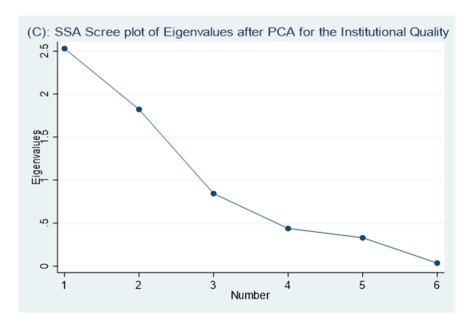
The persistently elevated levels of income inequality in Sub-Saharan Africa (SSA) remain a significant obstacle to achieving Sustainable Development Goal 10 (SDG 10), which seeks to reduce inequalities within and across countries. In this study, we investigated the impact of public expenditure on education and institutional quality on income inequality in SSA using the Dynamic Common Correlated Effects Instrumental Variable (DCCE-IV) estimator. Institutional quality was measured through a composite index constructed from six governance indicators using Principal Component Analysis (PCA). The empirical analysis was based on a panel of 40 SSA countries and their respective sub-regions, covering the period from 1980 to 2024. Outcomes demonstrated that institutions and education spending contribute to increased inequality, with variations across sub-regions. Institutions lead to higher inequality in West, East, and Southern-Africa. Additionally, education spending reduces inequality in Southern and West-Africa but worsens it in Central and Eastern Africa. The interaction between institutions and education spending exacerbates inequality in Southern, Eastern, and West Africa. The study underscores the need for a redistributive framework in SSA to manage education spending effectively and establish strong institutions for the welfare of all citizens, particularly low-income earners.
Citation: TEWA PAPY VOTO, Nicholas Ngepah. Income inequality in SSA and its sub-regions: The role of government education spending and institutional quality[J]. National Accounting Review, 2026, 8(3): 488-512. doi: 10.3934/NAR.2026020
The persistently elevated levels of income inequality in Sub-Saharan Africa (SSA) remain a significant obstacle to achieving Sustainable Development Goal 10 (SDG 10), which seeks to reduce inequalities within and across countries. In this study, we investigated the impact of public expenditure on education and institutional quality on income inequality in SSA using the Dynamic Common Correlated Effects Instrumental Variable (DCCE-IV) estimator. Institutional quality was measured through a composite index constructed from six governance indicators using Principal Component Analysis (PCA). The empirical analysis was based on a panel of 40 SSA countries and their respective sub-regions, covering the period from 1980 to 2024. Outcomes demonstrated that institutions and education spending contribute to increased inequality, with variations across sub-regions. Institutions lead to higher inequality in West, East, and Southern-Africa. Additionally, education spending reduces inequality in Southern and West-Africa but worsens it in Central and Eastern Africa. The interaction between institutions and education spending exacerbates inequality in Southern, Eastern, and West Africa. The study underscores the need for a redistributive framework in SSA to manage education spending effectively and establish strong institutions for the welfare of all citizens, particularly low-income earners.

| [1] | Acemoglu D, Robinson J (2012) Why nations fail: The origins of power, prosperity, and poverty. Crown. |
| [2] |
Acemoglu D, Johnson S, Robinson JA (2005) Institutions as a Fundamental Cause of Long-Run Growth. Handbook Eco Growth 1: 385–472. https://doi.org/10.1016/S1574-0684(05)01006-3 doi: 10.1016/S1574-0684(05)01006-3

|
| [3] |
Adeleye BN (2024) Income Inequality, Human Capital and Institutional Quality in Sub-Saharan Africa. Soc Indic Res 171: 133–157. https://doi.org/10.1007/s11205-023-03244-0 doi: 10.1007/s11205-023-03244-0
|
| [4] |
Alesina A, Baqir R, Easterly W (1999) Public goods and ethnic divisions. Q J Econ 114: 1243–1284. https://doi.org/10.1162/003355399556269 doi: 10.1162/003355399556269
|
| [5] |
Alesina A, Devleeschauwer A, Easterly W, et al. (2003) Fractionalization. J Econ Growth 8: 155–194. https://doi.org/10.1023/A:1024471506938 doi: 10.1023/A:1024471506938
|
| [6] | Anyanwu JC, Erhijakpor AEO (2016) International Remittances and Income Inequality in Africa. Afr Dev Rev 28: 52–73. https://doi.org:10.1111/1467-8268.12172 |
| [7] |
Asongu SA, Kodila-Tedika O (2018) Institutions and poverty: A critical comment based on evolving currents and debates. Soc Indic Res 139: 99–117. https://doi.org/10.1007/s11205-017-1709-y doi: 10.1007/s11205-017-1709-y
|
| [8] | Barro RJ (2013) Education and Economic Growth. In: P. Aghion & S. N. Durlauf (Eds.), Handbook of Economic Growth, 2A: 1–67. North-Holland. |
| [9] | Becker GS (1964) Human capital: a theoretical analysis with special reference to education. New York/ London: National Bureau for Economic Research. |
| [10] |
Becker GS, Chiswick BR (1966) Education and the distribution of earnings. Am Econ Rev 56: 358–369. https://doi.org:10.2307/1813617 doi: 10.2307/1813617
|
| [11] |
Ben Mimoun M, Raies A (2022) Is social spending pro-poor in developing countries? The role of governance and political freedom. Poverty Public Polic 14: 214–241. https://doi.org/10.1002/pop4.347 doi: 10.1002/pop4.347
|
| [12] |
Bicaba Z, Brixiová Z, Ncube M (2017) Can extreme poverty in Sub-Saharan Africa be eliminated by 2030? J Afr Dev 19: 93–110. https://doi.org/10.5325/jafrideve.19.2.0093 doi: 10.5325/jafrideve.19.2.0093
|
| [13] | Bourguignon F (2015) Revisiting the Debate on Inequality and Economic Development. Dans Revue d'économie politique 125: 633–663. https://doi.org:10.3917/redp.255.0633 |
| [14] | Bowles S, Durlauf SN, Hoff K (2006) Poverty Traps. Princeton University Press. JSTOR — Poverty Traps. |
| [15] |
Castelló-Climent A, Doménech R (2017) Human capital and income inequality: Some facts and some puzzles. J Human Capital 11. https://doi.org/10.1086/694078 doi: 10.1086/694078
|
| [16] |
Chancel L, Piketty T, Saez E, Zucman G, et al. (2022) World Inequality Report 2022. World Inequality Lab. https://doi.org/10.4159/9780674276598 doi: 10.4159/9780674276598
|
| [17] | Chiswick, B. R. (1974). Income Distribution: Analysis and Policies. Praeger. |
| [18] |
Chong A, Gradstein M (2007) Inequality and institutions. Rev Econ Stat 89(3). https://doi.org/10.1162/rest.89.3.454 doi: 10.1162/rest.89.3.454
|
| [19] | Clark, C. (1940). The Conditions of Economic Progress. Macmillan. |
| [20] |
Coady D, Dizioli A (2018) Income inequality and education revisited: persistence, endogeneity and heterogeneity. Appl Econ 50: 2747–2761. https://doi.org/10.1080/00036846.2017.1406659 doi: 10.1080/00036846.2017.1406659
|
| [21] | Collier P (2007) The bottom billion: Why the poorest countries are failing and what can be done about it. Oxford Univ. Press |
| [22] | Deaton A (2013) The great escape health, wealth, and the origins of inequality, 376. Princeton University Press. |
| [23] |
De Gregorio J, Lee JW (2002) Education and income inequality: New evidence from cross-country data. Rev Income Wealth 48: 395–416. https://doi.org/10.1111/1475-4991.00051 doi: 10.1111/1475-4991.00051
|
| [24] | Ditzen J (2019) Estimating long run efects in models with cross-sectional dependence using xtdcce2. CEERP Working Paper No. 7. Available from: https://ceerp.hw.ac.uk/RePEc/hwc/wpaper/007.pdf. |
| [25] | Engerman SL, Sokolof KL (1997) Factor endowments, institutions, and differential paths of growth among new world economies. In: S. H. Haber (Ed.), How Latin America fell behind: Essays on the economic histories of Brazil and Mexico, 1800–1914,260–304. Stanford Univ. Press. |
| [26] | Galli R, van der Hoeven R (2001) Is inflation bad for income inequality: The importance of the initial rate of inflation. Employment Paper. International Labour Organization, Geneva. |
| [27] |
Gbato A (2017) Impact of Taxation on Growth in Sub-Saharan Africa: New Evidence Based on a New Data Set. Int J Econ Financ 9. https://doi.org/10.5539/ijef.v9n11p173 doi: 10.5539/ijef.v9n11p173
|
| [28] | Hotelling H (1933) Analysis of a complex of statistical variables into principal components. J Educ Psychol 24: 417. |
| [29] |
Kapingura F, Tsegaye A (2024) Education spending, institutions and income inequality in Sub-Saharan Africa. Econ Anal Policy 81. https://doi.org/10.1016/j.eap.2024.02.009 doi: 10.1016/j.eap.2024.02.009
|
| [30] | Knight JB, Sabot RH (1983) Educational expansion and the Kuznets effect. Ame Econ Rev 73: 1132–1136. Available from: https://www.jstor.org/stable/1814679. |
| [31] | Kuznets S (1955) Economic growth and income inequality. Am Econ Rev 45, 1–28. |
| [32] |
Lagravinesea R, Paolo Liberatib P, Sacchic A (2020) Tax buoyancy in OECD countries: New empirical evidence. J Macroecon 63: 103189. https://doi.org/10.1016/j.jmacro.2020.103189 doi: 10.1016/j.jmacro.2020.103189
|
| [33] |
Li Z, Lunku H S, Danga M (2024) Dynamics of income inequality in Sub-Saharan Africa: the role of foreign direct investment and expenditure on education. Indian Econ Rev 59. https://doi.org/10.1007/s41775-024-00239-7 doi: 10.1007/s41775-024-00239-7
|
| [34] | Mauro P (1995) Corruption and Growth. Q J Econ 110: 681–712. |
| [35] |
Meltzer AH, Richard SF (1981) A Rational Theory of the Size of Government. J Polit Econ 89: 914–927. https://doi.org/10.1086/261013 doi: 10.1086/261013
|
| [36] | Meo MS, Nathaniel SP, Khan MM, et al. (2023) Does temperature contribute to environment degradation? Pakistani experience based on nonlinear bounds testing approach. Glob Bus Rev 24: 535–549. |
| [37] | Milanovic B (2016) Global inequality: A new approach for the age of globalization. Harvard University Press, 320. |
| [38] |
Mincer J (1970) The Distribution of Labor Incomes: A Survey with Special Reference to the Human Capital Approach. J Econ Lit 8: 1–26. https://doi.org/10.2307/2721175 doi: 10.2307/2721175
|
| [39] | North DC (1990) Institutions, Institutional Change, and Economic Performance. Cambridge University Press. |
| [40] |
Nsavyimana O, Li C (2025) Impact analysis of the mobile telephone and the internet on economic development in the East African Community. Data Sci Financ Econ 5: 156–176. https://doi.org/10.3934/DSFE.2025008 doi: 10.3934/DSFE.2025008
|
| [41] | OECD (2023) Effective Policy Implementation in Sub-Saharan Africa: Lessons Learned and Future Directions. |
| [42] | Bhorat H, Naidoo K, Odusola A, et al. (2017) Income inequality trends in sub-Saharan Africa: Divergence, determinants, and consequences. New York, NY: UNDP Regional Bureau for Africa. |
| [43] | Panton-Ntshona S (2021) Does education matter for income inequality? Evidence from Sub-Saharan Africa. Master's thesis, University of Cape Town. Available from: https://open.uct.ac.za/handle/11427/36142 |
| [44] | Pesaran MH (2004) General diagnostic tests for cross section dependence in panels. Technical Report. CESifo Group Munich. |
| [45] |
Pesaran MH (2015) Testing weak cross-sectional dependence in large panels. Econo Rev 34: 1089–1117. https://doi.org/10.1080/07474938.2014.956623 doi: 10.1080/07474938.2014.956623
|
| [46] | Piketty T (2015) Capital in the Twenty-First Century. Harvard University Press. Capital in the Twenty-First Century (dowbor.org). |
| [47] | Ravallion M (2009) A comparative perspective on poverty reduction. Policy Research Working Paper 5080. World Bank Document (psu.edu). |
| [48] |
Sadorsky P (2014) The effect of urbanization and industrialization on energy use in emerging economies: implications for sustainable development. Am J Econ Sociol 73: 392–409. https://doi.org/10.1111/ajes.12072 doi: 10.1111/ajes.12072
|
| [49] | Schultz TW (1963) The Economic Value of Education. Columbia University Press. Google Books |
| [50] |
Shimeles A, Nabassaga T (2018) Why is inequality high in Africa? J Afr Econ 27: 108–126. https://doi.org/10.1093/jae/ejx036. doi: 10.1093/jae/ejx036
|
| [51] |
Solt F (2019) The Standardized World Income Inequality Database. Soc Sci Quart 100: 1054–1071. https://doi.org/10.1111/ssqu.12622. doi: 10.1111/ssqu.12622
|
| [52] | Stiglitz JE (2012) The Price of Inequality: How Today's Divided Society Endangers Our Future. W. W. Norton & Company. The Price of Inequality: How Today's Divided Society Endangers Our Future (resistir.info). |
| [53] | Turnovsky SJ (2011) Capital accumulation and economic growth. MIT Press. |
| [54] |
Voto TP, Ngepah N (2024) Personal income tax, redistribution and income inequality in Sub-Saharan Africa. Int Re Econ 71: 205–223. https://doi.org/10.1007/s12232-023-00440-9 doi: 10.1007/s12232-023-00440-9
|
| [55] |
Voto TP, Ngepah N (2024a) Income inequality: The effects of public education expenditure and information and communications technology in sub-Saharan Africa. South Afr J Econ Manag Scie 27: 5647. https://doi.org/10.4102/sajems.v27i1.5647 doi: 10.4102/sajems.v27i1.5647
|
| [56] |
Xu C, Han M, Amegnonna T, et al. (2021) Trade openness, FDI, and income inequality: evidence from sub-Saharan Africa. Afr Dev Rev 33: 193–203. https://doi.org/10.1111/1467-8268.12511 doi: 10.1111/1467-8268.12511
|
Figures(3) / Tables(7)

TEWA PAPY VOTO, Nicholas Ngepah. Income inequality in SSA and its sub-regions: The role of government education spending and institutional quality[J]. National Accounting Review, 2026, 8(3): 488-512. doi: 10.3934/NAR.2026020





 DownLoad: