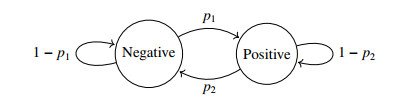
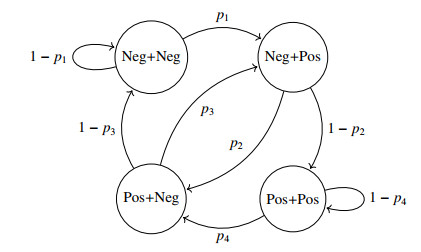
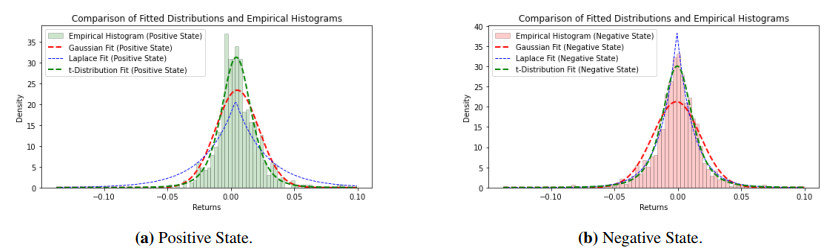
This paper proposes a sentiment-based framework to forecast financial asset returns that combines financial news sentiment analyses with a Markov finite mixture model. Daily sentiment states are constructed from financial news headlines using the FinBERT model and are linked to the distributional characteristics of asset returns. Treating sentiment as a Markov process, the study examines how transitions across sentiment regimes shape the return distribution and contribute to the return heterogeneity. To capture this heterogeneity, we develop a finite Markov mixture distribution, conduct goodness-of-fit assessments, and then integrate the resulting sentiment-driven specification into a FIGARCH-based forecasting framework. Empirical results across 37 assets from different markets indicate that incorporating a four-state, headline-derived Markov sentiment structure outperforms traditional FIGARCH benchmarks across all metrics for Close-to-Close return forecasts. Meanwhile, the traditional models and classification-based approaches remain competitive for Open-to-Close and Open-to-Open horizons in specific metrics. These findings highlight the nuanced, time-dependent nature of news sentiment measures and how they are incorporated into asset price forecasting models.
Citation: Mostafa Abdolahi Moghadam Salkoye, Roman N. Makarov. Sentiment-driven Markov mixture modeling of asset returns[J]. Data Science in Finance and Economics, 2026, 6(3): 452-474. doi: 10.3934/DSFE.2026016
This paper proposes a sentiment-based framework to forecast financial asset returns that combines financial news sentiment analyses with a Markov finite mixture model. Daily sentiment states are constructed from financial news headlines using the FinBERT model and are linked to the distributional characteristics of asset returns. Treating sentiment as a Markov process, the study examines how transitions across sentiment regimes shape the return distribution and contribute to the return heterogeneity. To capture this heterogeneity, we develop a finite Markov mixture distribution, conduct goodness-of-fit assessments, and then integrate the resulting sentiment-driven specification into a FIGARCH-based forecasting framework. Empirical results across 37 assets from different markets indicate that incorporating a four-state, headline-derived Markov sentiment structure outperforms traditional FIGARCH benchmarks across all metrics for Close-to-Close return forecasts. Meanwhile, the traditional models and classification-based approaches remain competitive for Open-to-Close and Open-to-Open horizons in specific metrics. These findings highlight the nuanced, time-dependent nature of news sentiment measures and how they are incorporated into asset price forecasting models.

| [1] |
Ang A, Timmermann A (2012) Regime changes and financial markets. Annu Rev Financ Econ 4: 313–337. https://doi.org/10.1146/annurev-financial-110311-101808 doi: 10.1146/annurev-financial-110311-101808

|
| [2] | Araci D (2019) FinBERT: Financial sentiment analysis with pre-trained language models. arXiv preprint arXiv: 1908.10063. https://doi.org/10.48550/arXiv.1908.10063 |
| [3] |
Baillie RT, Bollerslev T, Mikkelsen HO (1996) Fractionally integrated generalized autoregressive conditional heteroskedasticity. J Econometrics 74: 3–30. https://doi.org/10.1016/S0304-4076(96)01824-9 doi: 10.1016/S0304-4076(96)01824-9
|
| [4] |
Baissa DK, Rainey C (2020) When BLUE is not best: Non-normal errors and the linear model. Polit Sci Res Meth 8: 136–148. https://doi.org/10.1017/psrm.2018.34 doi: 10.1017/psrm.2018.34
|
| [5] | Case J, Clements A (2021) The impact of sentiment in the news media on daily and monthly stock market returns. Data Min, 1504: 180–195. Springer Singapore. https://doi.org/10.1007/978-981-16-8531-6_13 |
| [6] |
Choi SY, Yoon JH (2020) Modeling and risk analysis using parametric distributions with an application in equity-linked securities. Math Probl Eng 2020: 9763065. https://doi.org/10.1155/2020/9763065 doi: 10.1155/2020/9763065
|
| [7] |
Dridi A, Atzeni M, Reforgiato Recupero D (2019) FineNews: Fine-grained semantic sentiment analysis on financial microblogs and news. Int J Mach Learn Cybern 10: 2199–2207. https://doi.org/10.1007/s13042-018-0805-x doi: 10.1007/s13042-018-0805-x
|
| [8] |
Dua P, Tuteja D (2021) Regime shifts in the behaviour of international currency and equity markets: A Markov-switching analysis. J Quant Econ 19: 309–336. https://doi.org/10.1007/s40953-021-00273-9 doi: 10.1007/s40953-021-00273-9
|
| [9] |
Feng L, Fu T, Shi Y (2022) How does news sentiment affect the states of Japanese stock return volatility? Int Rev Financ Anal 84: 102267. https://doi.org/10.1016/j.irfa.2022.102267 doi: 10.1016/j.irfa.2022.102267
|
| [10] | Frühwirth-Schnatter S (2006) Finite Mixture and Markov Switching Models. Springer. https://doi.org/10.1007/978-0-387-35768-3 |
| [11] |
Guidolin M, Timmermann A (2006) An econometric model of nonlinear dynamics in the joint distribution of stock and bond returns. J Appl Econometrics 21: 1–22. https://doi.org/10.1002/jae.824 doi: 10.1002/jae.824
|
| [12] |
Haas M, Mittnik S, Paolella MS (2004) A new approach to Markov-switching GARCH models. J Financ Econometrics 2: 493–530. https://doi.org/10.1093/jjfinec/nbh020 doi: 10.1093/jjfinec/nbh020
|
| [13] |
Hamilton JD (1989) A new approach to the economic analysis of nonstationary time series and the business cycle. Econometrica 57: 357–384. https://doi.org/10.1093/jjfinec/nbh020 doi: 10.1093/jjfinec/nbh020
|
| [14] |
Huang AH, Wang H, Yang Y (2023) FinBERT : A large language model for extracting information from financial text. Contemp Account Res, 40: 806–841. https://doi.org/10.1111/1911-3846.12832 doi: 10.1111/1911-3846.12832
|
| [15] |
Kelly S, Ahmad K (2018) Estimating the impact of domain-specific news sentiment on financial assets. Knowl-Based Syst 150: 116–126. https://doi.org/10.1016/j.knosys.2018.03.004 doi: 10.1016/j.knosys.2018.03.004
|
| [16] | Kolmogorov AN (1933) Sulla determinazione empirica di una legge didistribuzione. Giorn Dell'inst Ital Degli Att, 4: 89–91 |
| [17] |
Kullback S, Leibler RA (1951) On information and sufficiency. Ann Methods Stat 22: 79–86. https://doi.org/10.1214/aoms/1177729694 doi: 10.1214/aoms/1177729694
|
| [18] | Remillard B (2016) Statistical Methods for Financial Engineering. Chapman and Hall/CRC. https://doi.org/10.1201/b14285 |
| [19] |
Shi Y, Feng L (2016) A discussion on the innovation distribution of the Markov regime-switching GARCH model. Econ Model, 53: 278–288. https://doi.org/10.1016/j.econmod.2015.11.018 doi: 10.1016/j.econmod.2015.11.018
|
| [20] |
Shi Y, Ho KY (2015) Modeling high-frequency volatility with three-state FIGARCH models. Econ Model 51: 473–483. https://doi.org/10.1016/j.econmod.2015.09.008 doi: 10.1016/j.econmod.2015.09.008
|
| [21] |
Shi Y, Ho KY (2021) News sentiment and states of stock return volatility: Evidence from long memory and discrete choice models. Financ Res Lett 38: 101446. https://doi.org/10.1016/j.frl.2020.101446 doi: 10.1016/j.frl.2020.101446
|
| [22] | Smirnov NV (1939) On the estimation of the discrepancy between empirical curves of distribution for two independent samples. Bull Math Univ Moscou 2: 3–14. |
| [23] |
Tetlock PC (2007) Giving content to investor sentiment: The role of media in the stock market. J Financ 62: 1139–1168. https://doi.org/10.1111/j.1540-6261.2007.01232.x doi: 10.1111/j.1540-6261.2007.01232.x
|
| [24] |
Wan X, Yang J, Marinov S, et al. (2021) Sentiment correlation in financial news networks and associated market movements. Sci Rep 11: 3062. https://doi.org/10.1038/s41598-021-82338-6 doi: 10.1038/s41598-021-82338-6
|
| [25] | Xiang Y, Zhang A, Guo J, et al. (2025) Adaptive multimodal prompt-tuning model for few-shot multimodal sentiment analysis. Int J Mach Learn Cybernet. https://doi.org/10.1007/s13042-025-02549-5 |
| [26] |
Xu W, Wang J, Ma F, et al. (2019) Forecast the realized range-based volatility: The role of investor sentiment and regime switching. Physica A 527: 121422. https://doi.org/10.1016/j.physa.2019.121422 doi: 10.1016/j.physa.2019.121422
|
| [27] |
Yao W, Wei Y, Yu C (2014) Robust mixture regression using the t-distribution. Comput Stat Data Anal 71: 116–127. https://doi.org/10.1016/j.csda.2013.07.019 doi: 10.1016/j.csda.2013.07.019
|
| [28] |
Young DS, Hunter DR (2010) Mixtures of regressions with predictor-dependent mixing proportions. Comput Stat Data Anal 54: 2253–2266. https://doi.org/10.1016/j.csda.2010.04.002 doi: 10.1016/j.csda.2010.04.002
|
Figures(3) / Tables(10)
Mostafa Abdolahi Moghadam Salkoye, Roman N. Makarov. Sentiment-driven Markov mixture modeling of asset returns[J]. Data Science in Finance and Economics, 2026, 6(3): 452-474. doi: 10.3934/DSFE.2026016





 DownLoad: