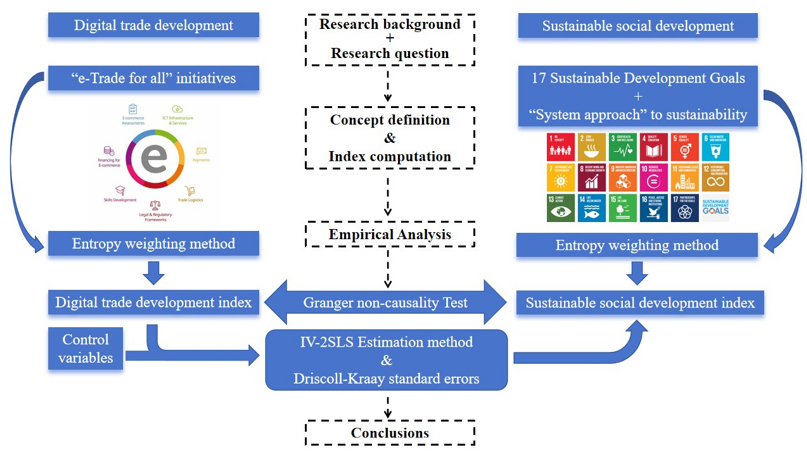
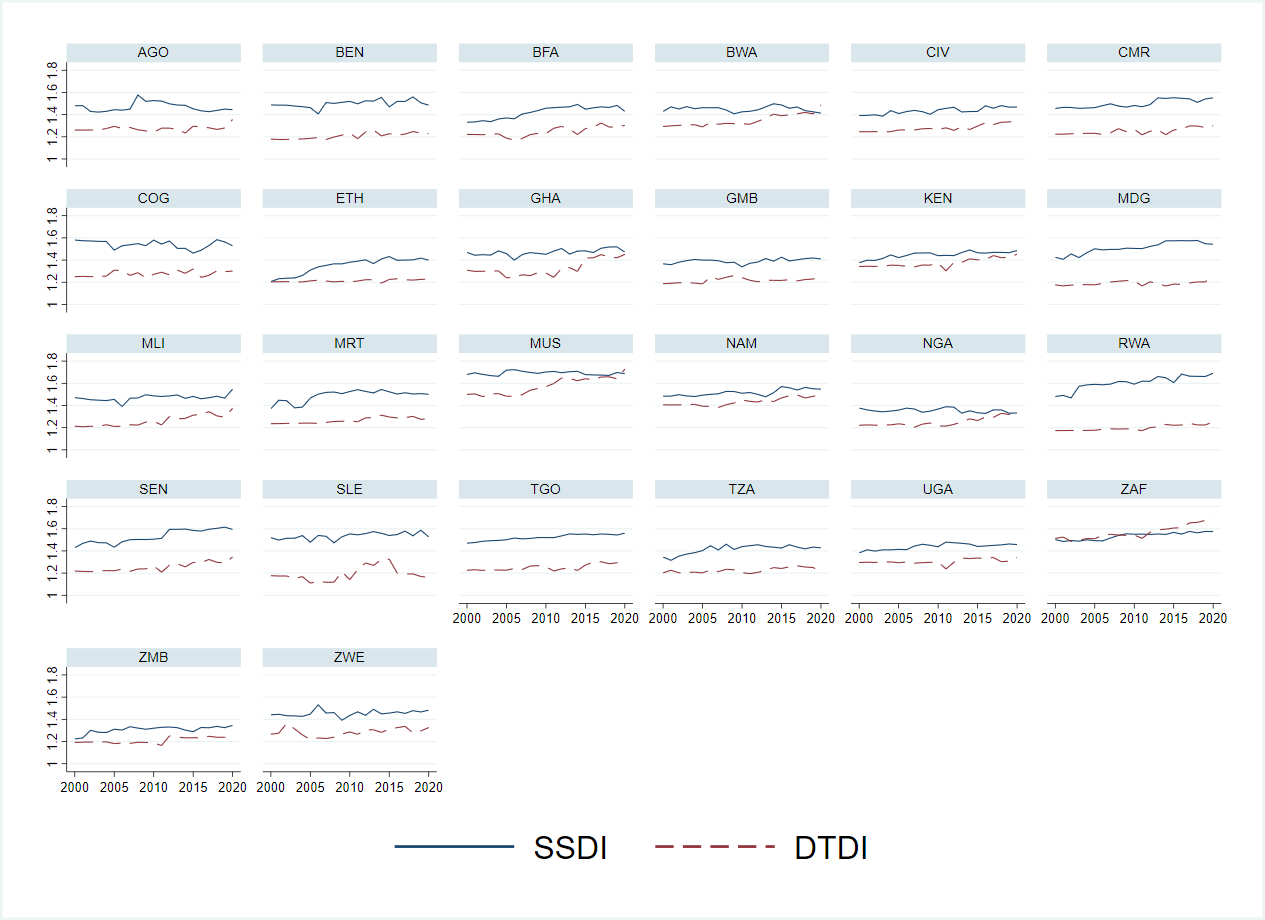
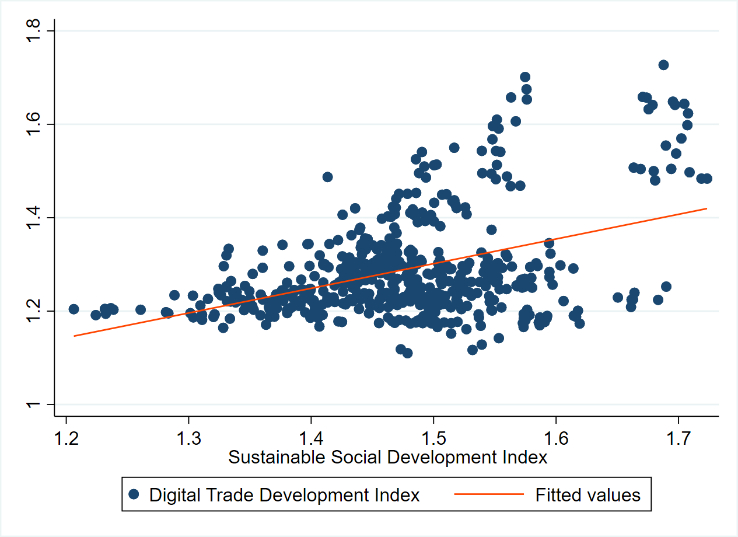
This research explored the relationship between digital trade development and sustainable social development in Sub-Saharan Africa (SSA). We first defined these two concepts and then constructed the Sustainable Social Development Index (SSDI) and the Digital Trade Development Index (DTDI) using the entropy weighting method and panel data of 26 Sub-Saharan African countries from 2000 to 2020. We also analyzed the relationship between these indices using the Granger non-causality test and the instrumental variables two-stage least squares estimation method. Our findings show a statistically significant bidirectional causal relationship between DTDI and SSDI. Moreover, our estimation result shows that a 1% increase in DTDI is linked to a 0.33% improvement in SSDI. This provides evidence of the potential for digital trade to promote sustainable social progress in SSA. The study concludes that improving the financial infrastructure and promoting gender equality are crucial strategies for advancing both digital trade and social sustainability. This research enhances our understanding of the link between economic and social development and offers valuable insights for policymakers in emerging economies.
Citation: Tojo Herilanto Rakotondrazaka, Lingli Xu. Nexus between digital trade development level and sustainable social development in Sub-Saharan Africa[J]. Urban Resilience and Sustainability, 2025, 3(1): 1-25. doi: 10.3934/urs.2025001
This research explored the relationship between digital trade development and sustainable social development in Sub-Saharan Africa (SSA). We first defined these two concepts and then constructed the Sustainable Social Development Index (SSDI) and the Digital Trade Development Index (DTDI) using the entropy weighting method and panel data of 26 Sub-Saharan African countries from 2000 to 2020. We also analyzed the relationship between these indices using the Granger non-causality test and the instrumental variables two-stage least squares estimation method. Our findings show a statistically significant bidirectional causal relationship between DTDI and SSDI. Moreover, our estimation result shows that a 1% increase in DTDI is linked to a 0.33% improvement in SSDI. This provides evidence of the potential for digital trade to promote sustainable social progress in SSA. The study concludes that improving the financial infrastructure and promoting gender equality are crucial strategies for advancing both digital trade and social sustainability. This research enhances our understanding of the link between economic and social development and offers valuable insights for policymakers in emerging economies.

| [1] | Cheng X (2021) Impacts of digital trade on international trade and its development suggestions, In: Frontier Computing (FC 2020), Springer: Singapore, 539–546. https://doi.org/10.1007/978-981-16-0115-6-60 |
| [2] | World Trade Organization (2023) Digital trade for development. Available from: https://www.wto.org/english/res_e/publications_e/dtd2023_e.htm. |
| [3] | African Union (2020) The digital transformation strategy for Africa (2020–2030). Available from: https://au.int/en/documents/20200518/digital-transformation-strategy-africa-2020-2030. |
| [4] | Lund S, Manyika J (2016) How digital trade is transforming globalisation, in Strengthening the Global Trade and Investment System for Sustainable Development, Geneva, International Centre for Trade and Sustainable Development (ICTSD) and World Economic Forum. Available from: https://www.tralac.org/news/article/8854-how-digital-trade-is-transforming-globalisation.html. |
| [5] | UNCTAD (2022) Digital trade: Opportunities and actions for developing countries. Available from: https://unctad.org/system/files/official-document/presspb2021d10_en.pdf. |
| [6] | UNWCED (1987) Report of the World Commission on Environment and Development: Our Common Future, Oxford: Oxford University Press. Available from: https://sustainabledevelopment.un.org/content/documents/5987our-common-future.pdf. |
| [7] | Sen A (2013) A Survey of Sustainable Development: Social and Economic Dimensions, Island Press. |
| [8] |
Davidson M (2010) Social sustainability and the city. Geogr Compass 4: 872–880. https://doi.org/10.1111/j.1749-8198.2010.00339.x doi: 10.1111/j.1749-8198.2010.00339.x

|
| [9] | United Nations (2015) Transforming our World: The 2030 Agenda for Sustainable Development, New York: United Nations. Available from: https://sustainabledevelopment.un.org/post2015/transformingourworld/publication. |
| [10] | Sachs JD, Lafortune G, Fuller G, et al. (2023) Implementing the SDG Stimulus: Sustainable Development Report 2023, Dublin: Dublin University Press. https://doi.org/10.25546/102924 |
| [11] |
Dempsey N, Bramley G, Power S, et al. (2011) The social dimension of sustainable development: Defining urban social sustainability. Sustain Dev 19: 289–300. https://doi.org/10.1002/sd.417 doi: 10.1002/sd.417
|
| [12] | de Fine Licht K, Folland A (2024) Redefining 'sustainability': A systematic approach for defining and assessing 'sustainability' and 'social sustainability'. Theoria. https://doi.org/10.1111/theo.12568 |
| [13] |
Isgren E, Longo SB (2024) Social sustainability: More confusion than clarity. J Environ Stud Sci 14: 820–825. https://doi.org/10.1007/s13412-024-00978-2 doi: 10.1007/s13412-024-00978-2
|
| [14] |
Luna-Nemecio J, Tobón S, Juárez-Hernández LG (2020) Sustainability-based on socioformation and complex thought or sustainable social development. Resour Environ Sustain 2: 100007. https://doi.org/10.1016/j.resenv.2020.100007 doi: 10.1016/j.resenv.2020.100007
|
| [15] | Jankiewicz M (2024) The influence of changes in the economy structure on social sustainability in developing countries—A spatial approach. Sustain Dev. https://doi.org/10.1002/sd.3205 |
| [16] |
Barbier EB, Burgess JC (2017) The Sustainable Development Goals and the systems approach to sustainability. Economics 11: 20170028. https://doi.org/10.5018/economics-ejournal.ja.2017-28 doi: 10.5018/economics-ejournal.ja.2017-28
|
| [17] | UNCTAD (2016) 'eTrade for All'—A new multistakeholder initiative to boost global gains from e-trade, Geneva, Switzerland. Available from: https://unctad.org/system/files/official-document/dtlstictmisc2016d6_en.pdf. |
| [18] |
Romer PM (1994) The origins of endogenous growth. J Econ Perspect 8: 3–22. https://doi.org/10.1257/jep.8.1.3 doi: 10.1257/jep.8.1.3
|
| [19] | Becker GS (1992) Human capital and the economy. Proc Am Philos Soc 136: 85–92. Available from: https://www.jstor.org/stable/986801. |
| [20] | Krugman P (1998) What's new about the new economic geography? Oxf Rev Econ Policy 14: 7–17. Available from: https://econpapers.repec.org/RePEc:oup:oxford:v:14:y:1998:i:2:p:7-17. |
| [21] | Baker PR, Le L (2023) Promoting sustainable development through digital trade and digital trade policies. ARTNeT Work Pap. https://hdl.handle.net/20.500.12870/6640 |
| [22] | Anukoonwattaka W, Romão P, Shahu N, et al. (2024) Harnessing digital trade to advance the Sustainable Development Goals : An empirical study. ARTNeT Work Pap. https://hdl.handle.net/20.500.12870/6806 |
| [23] |
Bankole FO, Osei-Bryson KM, Brown I (2015) The impacts of telecommunications infrastructure and institutional quality on trade efficiency in Africa. Inf Technol Dev 21: 29–43. https://doi.org/10.1080/02681102.2013.874324 doi: 10.1080/02681102.2013.874324
|
| [24] |
Asongu SA, Odhiambo NM (2020) Inequality and gender inclusion: Minimum ICT policy thresholds for promoting female employment in Sub-Saharan Africa. Telecommun Policy 44: 101900. https://doi.org/10.1016/j.telpol.2019.101900 doi: 10.1016/j.telpol.2019.101900
|
| [25] |
Abukari A-BT, Zakaria A, Azumah SB (2022) Gender-based participation in income generating activities in cocoa growing communities. The role of youth training programs. Heliyon 8: e08880. https://doi.org/10.1016/j.heliyon.2022.e08880 doi: 10.1016/j.heliyon.2022.e08880
|
| [26] | Dossou T, Kambaye E, Berhe M, et al. (2022) Does E-governance reduce income inequality in Sub-Saharan Africa? Evidence from a dynamic panel. Eur Xtramile Cent Afr Stud WP22066. http://dx.doi.org/10.2139/ssrn.4235551 |
| [27] | Ncube CB, De Beer J (2024) Trade Rules as Regulatory Tools for Inclusive Innovation: Connecting Digital Trade and Clean Technology to Achieve Sustainable Development Goals. Available from: https://openair.africa/trade-rules-as-regulatory-tools-for-inclusive-innovation-connecting-digital-trade-and-clean-technology-to-achieve-sustainable-development-goals/. |
| [28] | Akinola A, Evans O (2023) Information communication technology (ICT) and its effects on social and political inclusion in Africa, In: Economic Inclusion in Post-Independence Africa: An Inclusive Approach to Economic Development, Cham: Springer Nature Switzerland, 45–58. https://doi.org/10.1007/978-3-031-31431-5_3 |
| [29] | McKenzie S (2004) Social sustainability: Towards some definitions. Available from: https://www2.econ.iastate.edu/classes/tsc220/hallam/Readings/SocialMcKenzie.pdf. |
| [30] |
Vallance S, Perkins HC, Dixon JE (2011) What is social sustainability? A clarification of concepts. Geoforum 42: 342–348. https://doi.org/10.1016/j.geoforum.2011.01.002 doi: 10.1016/j.geoforum.2011.01.002
|
| [31] |
Whitton J, Parry MI, Howe JM (2014) Social sustainability: Participant-led dialogue as a basis for the development of a conceptual framework for energy infrastructure decisions. Int J Sustain Policy Pract 9: 1–13. https://doi.org/10.18848/2325-1166/CGP/v09i03/55425 doi: 10.18848/2325-1166/CGP/v09i03/55425
|
| [32] |
Murphy K (2012) The social pillar of sustainable development: A literature review and framework for policy analysis. Sustain Sci Pract Policy 8: 15–29. https://doi.org/10.1080/15487733.2012.11908081 doi: 10.1080/15487733.2012.11908081
|
| [33] |
Eizenberg E, Jabareen Y (2017) Social sustainability: A new conceptual framework. Sustainability 9: 68. https://doi.org/10.3390/su9010068 doi: 10.3390/su9010068
|
| [34] | Woodcraft S (2015) Understanding and measuring social sustainability. J Urban Regen Renew 8: 133–144. Available from: https://www.henrystewartpublications.com/jurr. |
| [35] |
Cai Q, Chen W, Wang M, et al. (2024) How does green finance influence carbon emission intensity? A non-linear fsQCA-ANN approach. Pol J Environ Stud 1–7. https://doi.org/10.15244/pjoes/190658 doi: 10.15244/pjoes/190658
|
| [36] |
Amodu N (2020) Corporate social responsibility and economic globalization: Mainstreaming Sustainable Development Goals into the AfCFTA discourse. Leg Issues Econ Integr 47: 71–104. https://doi.org/10.54648/leie2020004 doi: 10.54648/leie2020004
|
| [37] |
Missimer M, Robèrt KH, Broman G (2017) A strategic approach to social sustainability—Part 1: Exploring the social system. J Clean Prod 140: 32–41. https://doi.org/10.1016/j.jclepro.2016.03.170 doi: 10.1016/j.jclepro.2016.03.170
|
| [38] |
Barbier EB (1987) The concept of sustainable economic development. Environ Conserv 14: 101–110. https://doi.org/10.1017/S0376892900011449 doi: 10.1017/S0376892900011449
|
| [39] | Barbier EB, Burgess JC (2021) The SDGs and the systems approach to sustainability, In: Economics of the SDGs: Putting the Sustainable Development Goals into Practice, Cham: Palgrave Macmillan, 15–37. https://doi.org/10.1007/978-3-030-78698-4_2 |
| [40] | WTO (1998) Work Programme on Electronic Commerce, Geneva, Switzerland. Available from: https://www.wto.org/english/tratop_e/ecom_e/ecom_work_programme_e.htm. |
| [41] | Weber RH (2020) A new international trade framework for digital assets, In: A Post-WTO International Legal Order: Utopian, Dystopian and Other Scenarios, Cham: Springer, 277–291. https://doi.org/10.1007/978-3-030-45428-9_16 |
| [42] | López-González J, Jouanjean MA (2017) Digital trade: Developing a framework for analysis, Paris: OECD Publishing. https://doi.org/10.1787/524c8c83-en |
| [43] | IMF, OECD, UN, et al. (2023) Handbook on Measuring Digital Trade, 2 Eds., OECD Publishing. https://doi.org/10.1787/ac99e6d3-en |
| [44] |
Fu HL, Huang PY, Xu Y, et al. (2022) Digital trade and environmental sustainability: The role of financial development and ecological innovation for a greener revolution in China. Econ Res-Ekon Istraz 36: 2125889. https://doi.org/10.1080/1331677X.2022.2125889 doi: 10.1080/1331677X.2022.2125889
|
| [45] |
Zhang XD, Song XQ, Lu JG, et al. (2022) How financial development and digital trade affect ecological sustainability: The role of renewable energy using an advanced panel in G-7 Countries. Renew Energy 199: 1005–1015. https://doi.org/10.1016/j.renene.2022.09.028 doi: 10.1016/j.renene.2022.09.028
|
| [46] |
Xiong S, Luo R (2023) Investigating the relationship between digital trade, natural resources, energy transition, and green productivity: Moderating role of R and D investment. Resour Policy 86: 104069. https://doi.org/10.1016/j.resourpol.2023.104069 doi: 10.1016/j.resourpol.2023.104069
|
| [47] |
Shahbaz M, Wang J, Dong K, et al. (2022) The impact of digital economy on energy transition across the globe: The mediating role of government governance. Renew Sustain Energy Rev 166: 112620. https://doi.org/10.1016/j.rser.2022.112620 doi: 10.1016/j.rser.2022.112620
|
| [48] |
Khan S, Haneklaus N (2023) Sustainable economic development across globe: The dynamics between technology, digital trade and economic performance. Technol Soc 72: 102207. https://doi.org/10.1016/j.techsoc.2023.102207 doi: 10.1016/j.techsoc.2023.102207
|
| [49] | Weber RH (2010) Digital trade in wto-law taking stock and looking ahead. Asian J Wto Int Health Law Policy 5: 1–24. |
| [50] | US International Trade Commission (USITC) (2013) Digital trade in the US and global economies, Part 1. Available from: https://ecipe.org/wp-content/uploads/2014/12/USITC_speech.pdf. |
| [51] | Meltzer JP (2014) Supporting the internet as a platform for international trade: Opportunities for small and medium-sized enterprises and developing countries. https://dx.doi.org/10.2139/ssrn.2400578 |
| [52] | United States Trade Representative (USTR) (2017) Key barriers to digital trade. Available from: https://ustr.gov/about-us/policy-offices/press-office/fact-sheets/2017/march/key-barriers-digital-trade. |
| [53] | Ma SZ, Fang C, Liang YF (2018) Digital trade: Definition, practical significance and research prospects. J Int Trade 16–30. https://doi.org/10.13510/j.cnki.jit.2018.10.002 |
| [54] | Fayyaz S (2019) A review on measuring digital trade and e-commerce as new economic statistics products. Stat Stat Econ J 99: 57–68. Available from: https://csu.gov.cz/docs/107508/b93f56be-0840-bf45-b6cc-264a7ace7bc6/32019719q1_057.pdf?version = 1.0. |
| [55] | OECD, WTO, IMF (2020) Handbook on Measuring Digital Trade, 1 Eds., OECD Publishing. Available from: https://www.oecd.org/en/publications/handbook-on-measuring-digital-trade-second-edition_ac99e6d3-en.html. |
| [56] |
Huang KM, Madnick S, Choucri N, et al. (2021) A systematic framework to understand transnational governance for cybersecurity risks from digital trade. Glob Policy 12: 625–638. https://doi.org/10.1111/1758-5899.13014 doi: 10.1111/1758-5899.13014
|
| [57] |
Wang CH, Zheng CL, Hu CS, et al. (2023) Resources sustainability and energy transition in China: Asymmetric role of digital trade and policy uncertainty using QARDL. Resour Policy 85: 103845. https://doi.org/10.1016/j.resourpol.2023.103845 doi: 10.1016/j.resourpol.2023.103845
|
| [58] | Nardo M, Saisana M, Saltelli A, et al. (2008) Handbook on Constructing Composite Indicators: Methodology and User Guide, OECD Publishing. Available from: https://www.oecd-ilibrary.org/economics/handbook-on-constructing-composite-indicators-methodology-and-user-guide_9789264043466-en. |
| [59] |
Costanza R, Daly L, Fioramonti L, et al. (2016) Modelling and measuring sustainable wellbeing in connection with the UN Sustainable Development Goals. Ecol Econ 130: 350–355. https://doi.org/10.1016/j.ecolecon.2016.07.009 doi: 10.1016/j.ecolecon.2016.07.009
|
| [60] |
Barbier EB, Burgess JC (2019) Sustainable development goal indicators: Analyzing trade-offs and complementarities. World Dev 122: 295–305. https://doi.org/10.1016/j.worlddev.2019.05.026 doi: 10.1016/j.worlddev.2019.05.026
|
| [61] |
Dhahri S, Slimani S, Omri A (2021) Behavioral entrepreneurship for achieving the Sustainable Development Goals. Technol Forecast Soc Change 165: 120561. https://doi.org/10.1016/j.techfore.2020.120561 doi: 10.1016/j.techfore.2020.120561
|
| [62] | Rakotondrazaka TH, Xu L (2024) Does import of information and communications technology (ICT) goods foster sustainable economic development in Sub-Saharan Africa? The role of governance quality. Cureus J Bus Econ 1: es44404-024-00752–1. https://doi.org/10.7759/s44404-024-00752-1 |
| [63] |
Haldar A, Sethi N, Jena PK, et al. (2023) Towards achieving Sustainable Development Goal 7 in sub‐Saharan Africa: Role of governance and renewable energy. Sustain Dev 31: 2446–2463. https://doi.org/10.1002/sd.2521 doi: 10.1002/sd.2521
|
| [64] |
Zhu Q, Zhou XX (2023) Regional differences and dynamic evolution of digital trade: Data from China. Appl Econ 56: 3722–3740. https://doi.org/10.1080/00036846.2023.2208338 doi: 10.1080/00036846.2023.2208338
|
| [65] |
Xu J, Wang J, Yang X, et al. (2024) Digital economy and sustainable development: Insight from synergistic pollution control and carbon reduction. J Knowl Econ 2024: 1–28. https://doi.org/10.1007/s13132-024-01950-9 doi: 10.1007/s13132-024-01950-9
|
| [66] |
Yang G, Han M (2024) Research on the impact of digital economic development level on ecological environment. J Int Digit Econ 4: 50–70. https://doi.org/10.1108/jide-11-2023-0024 doi: 10.1108/jide-11-2023-0024
|
| [67] |
Ma SZ, Guo JW, Zhang HS (2019) Policy analysis and development evaluation of digital trade: An international comparison. China World Econ 27: 49–75. https://doi.org/10.1111/cwe.12280 doi: 10.1111/cwe.12280
|
| [68] |
Ji H, Xiong BQ, Zhou FX (2023) Impact of digital trade on regional carbon emissions. Environ Sci Pollut Res 30: 105474–105488. https://doi.org/10.1007/s11356-023-29858-y doi: 10.1007/s11356-023-29858-y
|
| [69] |
Wang YF, Liu J, Zhao ZH, et al. (2023) Research on carbon emission reduction effect of China's regional digital trade under the "double carbon" target--combination of the regulatory role of industrial agglomeration and carbon emissions trading mechanism. J Clean Prod 405: 137049. https://doi.org/10.1016/j.jclepro.2023.137049 doi: 10.1016/j.jclepro.2023.137049
|
| [70] |
Li X, Hu Y, Ding L, et al. (2024) Impact of the digital trade on lowering carbon emissions in 46 countries. Sci Rep 14: 25957. https://doi.org/10.1038/s41598-024-76586-5 doi: 10.1038/s41598-024-76586-5
|
| [71] |
Hu Y, Zhou HQ, Yan B, et al. (2022) An assessment of China's digital trade development and influencing factors. Front Psychol 13: 837885. https://doi.org/10.3389/fpsyg.2022.837885 doi: 10.3389/fpsyg.2022.837885
|
| [72] |
Avom D, Bangaké C, Kamguia B (2024) Does capital flight set Africa as the seat of darkness? Linking capital flight and energy poverty. Energy 308: 133033. https://doi.org/10.1016/j.energy.2024.133033 doi: 10.1016/j.energy.2024.133033
|
| [73] |
Dumitrescu EI, Hurlin C (2012) Testing for Granger non-causality in heterogeneous panels. Econ Model 29: 1450–1460. https://doi.org/10.1016/j.econmod.2012.02.014 doi: 10.1016/j.econmod.2012.02.014
|
| [74] | Weber S, Lopez L (2023) Granger causality in panel datasets: Relationship between economic growth and CO2 emissions, In: Applied Econometric Analysis Using Cross Section and Panel Data, Singapore: Springer, 539–570. https://doi.org/10.1007/978-981-99-4902-1_18 |
| [75] |
Pesaran MH (2007) A simple panel unit root test in the presence of cross-section dependence. J Appl Econ 22: 265–312. https://doi.org/10.1002/jae.951 doi: 10.1002/jae.951
|
| [76] |
Xiao J, Karavias Y, Juodis A, et al. (2023) Improved tests for Granger noncausality in panel data. Stata J 23: 230–242. https://doi.org/10.1177/1536867X231162034 doi: 10.1177/1536867X231162034
|
| [77] |
Juodis A, Karavias Y, Sarafidis V (2021) A homogeneous approach to testing for Granger non-causality in heterogeneous panels. Empir Econ 60: 93–112. https://doi.org/10.1007/s00181-020-01970-9 doi: 10.1007/s00181-020-01970-9
|
| [78] | Rakotondrazaka TH, Xu L (2024) How does trade in digitally delivered services affect employment in Africa? Glob Econ J 2450006. https://doi.org/10.1142/S2194565924500064 |
| [79] |
Rakotondrazaka TH, Velomasy YG (2024) Digital economy and poverty reduction in Africa: The role of governance quality. Eur J Bus Manag Res 9: 1–7. https://doi.org/10.24018/ejbmr.2024.9.4.2372 doi: 10.24018/ejbmr.2024.9.4.2372
|
| [80] |
Marchal L, Nedoncelle C (2019) Immigrants, occupations and firm export performance. Rev Int Econ 27: 1480–1509. https://doi.org/10.1111/roie.12432 doi: 10.1111/roie.12432
|
| [81] |
Egger P, Larch M, Staub KE, et al. (2011) The trade effects of endogenous preferential trade agreements. Am Econ J Econ Policy 3: 113–143. https://doi.org/10.1257/pol.3.3.113 doi: 10.1257/pol.3.3.113
|
| [82] |
Song C, Liu Q, Song J, et al. (2024) Impact path of digital economy on carbon emission efficiency: Mediating effect based on technological innovation. J Env Manage 358: 120940. https://doi.org/10.1016/j.jenvman.2024.120940 doi: 10.1016/j.jenvman.2024.120940
|
| [83] |
Kpognon K, Ondoa HA, Bah M (2020) Trade openness and youth employment in Sub-Saharan Africa: Should we regulate the labor market? J Econ Integr 35: 751–777. https://doi.org/10.11130/jei.2020.35.4.751 doi: 10.11130/jei.2020.35.4.751
|
| [84] |
Langnel Z, Amegavi GB, Agomor KS (2021) Environmental degradation and female economic inclusion in Sub-Saharan Africa: Effort towards Sustainable Development Goal 5. Dev South Afr 38: 717–730. https://doi.org/10.1080/0376835x.2020.1870933 doi: 10.1080/0376835x.2020.1870933
|
| [85] |
Agradi M, Adom PK, Vezzulli A (2022) Towards sustainability: Does energy efficiency reduce unemployment in African societies? Sustain Cities Soc 79: 103683. https://doi.org/10.1016/j.scs.2022.103683 doi: 10.1016/j.scs.2022.103683
|
| [86] |
Xu S, Asiedu M, Effah NAA (2022) Inclusive finance, gender inequality, and sustainable economic growth in Africa. J Knowl Econ 14: 4866–4902. https://doi.org/10.1007/s13132-022-01036-4 doi: 10.1007/s13132-022-01036-4
|
| [87] |
Rakotondrazaka TH (2024) A study on the technological spillover effect of China's OFDI in Africa. North Am Acad Res 7: 22–38. https://doi.org/10.5281/zenodo.10700696 doi: 10.5281/zenodo.10700696
|
| [88] |
Kleibergen F, Paap R (2006) Generalized reduced rank tests using the singular value decomposition. J Econom 133: 97–126. https://doi.org/10.1016/j.jeconom.2005.02.011 doi: 10.1016/j.jeconom.2005.02.011
|
| [89] |
Hansen LP, Heaton J, Yaron A (1996) Finite-sample properties of some alternative GMM estimators. J Bus Econ Stat 14: 262–280. https://doi.org/10.1080/07350015.1996.10524656 doi: 10.1080/07350015.1996.10524656
|
| [90] |
Kleibergen F (2007) Generalizing weak instrument robust Ⅳ statistics towards multiple parameters, unrestricted covariance matrices and identification statistics. J Econom 139: 181–216. https://doi.org/10.1016/j.jeconom.2006.06.010 doi: 10.1016/j.jeconom.2006.06.010
|
| [91] | Stock JH, Yogo M (2002) Testing for weak instruments in linear Ⅳ regression. Available from: https://www.nber.org/papers/t0284. |
| [92] |
Driscoll JC, Kraay AC (1998) Consistent covariance matrix estimation with spatially dependent panel data. Rev Econ Stat 80: 549–560. https://doi.org/10.1162/003465398557825 doi: 10.1162/003465398557825
|
 urs-03-01-001-s001.pdf urs-03-01-001-s001.pdf |
 |
Figures(6) / Tables(10)
Tojo Herilanto Rakotondrazaka, Lingli Xu. Nexus between digital trade development level and sustainable social development in Sub-Saharan Africa[J]. Urban Resilience and Sustainability, 2025, 3(1): 1-25. doi: 10.3934/urs.2025001





 DownLoad: