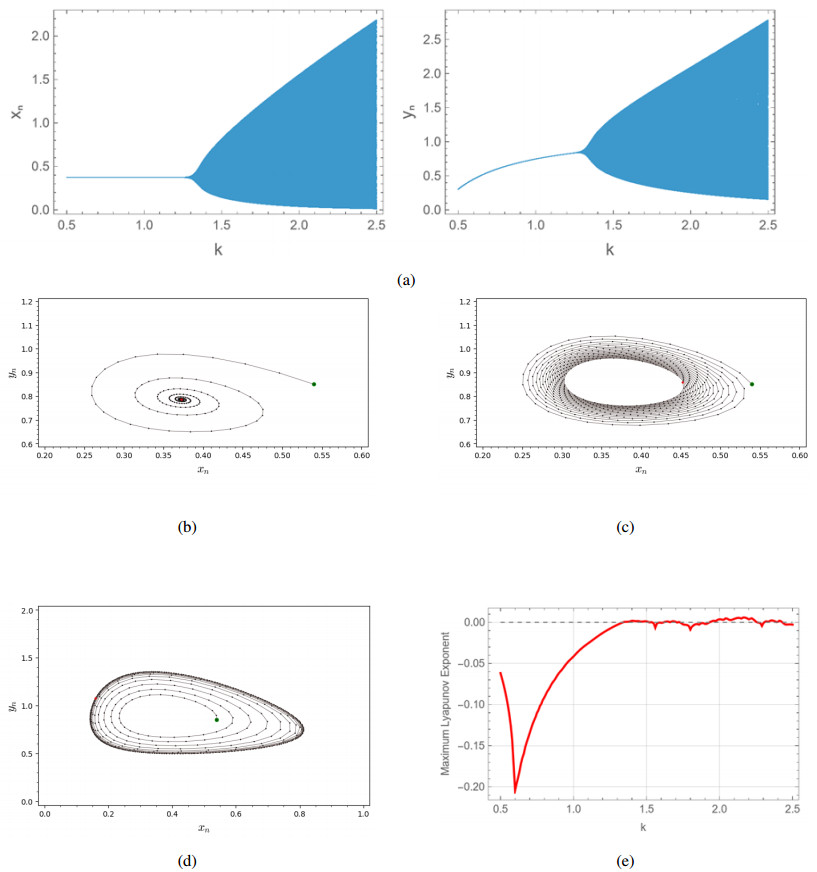
This study investigates the stability and bifurcation analysis of a discrete-time predator-prey system using a nonstandard finite difference scheme. We analytically demonstrate that the system undergoes a Neimark–Sacker bifurcation near its unique positive fixed point. To suppress the resulting chaotic dynamics, control strategies based on the OGY and state feedback control methods are implemented. Numerical simulations are conducted to support the theoretical analysis, confirming the effectiveness of the proposed control techniques.
Citation: Özlem Ak Gümüş. Dynamics of a discrete-time prey-predator system with nonstandard finite difference scheme[J]. AIMS Mathematics, 2025, 10(8): 17998-18023. doi: 10.3934/math.2025802
This study investigates the stability and bifurcation analysis of a discrete-time predator-prey system using a nonstandard finite difference scheme. We analytically demonstrate that the system undergoes a Neimark–Sacker bifurcation near its unique positive fixed point. To suppress the resulting chaotic dynamics, control strategies based on the OGY and state feedback control methods are implemented. Numerical simulations are conducted to support the theoretical analysis, confirming the effectiveness of the proposed control techniques.

| [1] |
A. A. Berryman, The origins and evolution of predator-prey theory, Ecology, 73 (1992), 1530–1535. https://doi.org/10.2307/1940005 doi: 10.2307/1940005

|
| [2] | R. M. May, Stability and complexity in model ecosystems, Princeton University Press, Princeton, NJ, USA, 1974. https://doi.org/10.1109/TSMC.1976.4309488 |
| [3] |
C. Köme, Y. Yazlık, Stability, bifurcation analysis and chaos control in a discrete predator-prey system incorporating prey immigration, J. Appl. Math. Comput., 70 (2024), 5213–5247. https://doi.org/10.1007/s12190-024-02230-0 doi: 10.1007/s12190-024-02230-0
|
| [4] |
Ö. A. Gümüş, A study on stability, bifurcation analysis and chaos control of a discrete-time prey-predator system involving Allee effect, J. Appl. Anal. Comput., 13 (2023), 3166–3194. https://doi.org/10.11948/20220532 doi: 10.11948/20220532
|
| [5] |
Rajni, S. Sahu, S. Sarda, B. Ghosh, Stock patterns in a class of delayed discrete-time population models, Discrete Contin. Dyn. Syst. Ser. S, 18 (2025), 1285–1303. https://doi.org/10.3934/dcdss.2024078 doi: 10.3934/dcdss.2024078
|
| [6] |
Z. Eskandari, P. A. Naik, M. Yavuz, Dynamical behaviors of a discrete-time prey-predator model with harvesting effect on the predator, J. Appl. Anal. Comput., 14 (2024), 283–297. https://doi.org/10.11948/20230212 doi: 10.11948/20230212
|
| [7] |
Ö. A. Gümüş, Bifurcation analysis and chaos control of discrete-time prey-predator model with Allee effect, Hacet. J. Math. Stat., 22 (2023), 1–17. https://doi.org/10.15672/hujms.1179682 doi: 10.15672/hujms.1179682
|
| [8] |
M. Qurban, A. Khaliq, M. Saqib, T. Abdeljawad, Stability, bifurcation, and control: Modeling interaction of the predator-prey system with Allee effect, Ain Shams Eng. J., 15 (2024), 102631. https://doi.org/10.1016/j.asej.2024.102631 doi: 10.1016/j.asej.2024.102631
|
| [9] |
Ö. A. Gümüş, M. Fečkan, Stability, Neimark–Sacker bifurcation and chaos control for a prey-predator system with harvesting effect on predator, Miskolc Math. Notes, 22 (2021), 663–679. https://doi.org/10.18514/MMN.2021.3450 doi: 10.18514/MMN.2021.3450
|
| [10] |
B. Ghosh, S. Sarda, S. Sahu, Torus doubling route to chaos and chaos eradication in delayed discrete-time predator-prey models, Math. Method. Appl. Sci., 45 (2022), 1–18. https://doi.org/10.1002/mma.8789 doi: 10.1002/mma.8789
|
| [11] |
J. Wang, C. Lei, Complex dynamics of a nonlinear discrete predator-prey system with Allee effect, Open Math., 22 (2024), 20240013. https://doi.org/10.1515/math-2024-0013 doi: 10.1515/math-2024-0013
|
| [12] |
P. Baydemir, H. Merdan, Bifurcation analysis, chaos control, and FAST approach for the complex dynamics of a discrete-time predator-prey system with a weak Allee effect, Chaos Soliton. Fract., 196 (2025), 116317. https://doi.org/10.1016/j.chaos.2025.116317 doi: 10.1016/j.chaos.2025.116317
|
| [13] |
Ö. A. Gümüş, A. A. Elsadany, A. M. Yousef, H. N. Agiza, Theoretical and numerical bifurcation analysis in a prey-predator model with prey harvesting effort, Int. J. Model. Simul. Sci. Comput., 15 (2024), 1–21. https://doi.org/10.1142/S1793962325500163 doi: 10.1142/S1793962325500163
|
| [14] | A. Lotka, Elements of physical biology, Williams and Wilkins Co., Baltimore, MD, USA, 1925. |
| [15] | V. Volterra, Variazioni e fluttuazioni del numero d'individui in specie animali conviventi, Mem. R. Accad. Naz. Lincei, 2 (1926), 31–113. |
| [16] | R. M. May, Theoretical ecology: Principles and applications, Blackwell Science, Oxford, 1976. |
| [17] |
S. M. Moghadas, M. E. Alexander, B. D. Corbett, A non-standard numerical scheme for a generalized Gause-type predator-prey model, Physica D, 188 (2004), 134–151. https://doi.org/10.1016/S0167-2789(03)00285-9 doi: 10.1016/S0167-2789(03)00285-9
|
| [18] |
W. Koa, K. Ryu, A qualitative study on general Gause-type predator-prey models with non-monotonic functional response, Nonlinear Anal.-Real, 10 (2009), 2558–2573. https://doi.org/10.1016/j.nonrwa.2008.05.012 doi: 10.1016/j.nonrwa.2008.05.012
|
| [19] |
A. Q. Khan, A. Maqbool, M. J. Uddin, S. M. S. Rana, Dynamical analysis of a two-dimensional discrete predator-prey model, J. Comput. Appl. Math., 440 (2024), 115578. https://doi.org/10.1016/j.cam.2023.115578 doi: 10.1016/j.cam.2023.115578
|
| [20] | H. I. Freedman, Deterministic mathematical models in population ecology, Marcel Dekker, New York, 1980. |
| [21] | S. M. S. Rana, Dynamic complexity in a discrete-time predator-prey system with Michaelis–Menten functional response: Gompertz growth of prey, Comput. Ecol. Softw., 10 (2020), 117–132. |
| [22] |
R. E. Kooij, A. Zegeling, Predator-prey models with non-analytical functional response, Chaos Soliton. Fract., 123 (2019), 163–172. https://doi.org/10.1016/j.chaos.2019.03.036 doi: 10.1016/j.chaos.2019.03.036
|
| [23] |
Z. Eskandari, Z. Avazzadeh, R. K. Ghaziani, B. Li, Dynamics and bifurcations of a discrete-time Lotka–Volterra model using nonstandard finite difference discretization method, Math. Method. Appl. Sci., 48 (2022), 7197–7212. https://doi.org/10.1002/mma.8859 doi: 10.1002/mma.8859
|
| [24] | L. J. Allen, Introduction to mathematical biology, Pearson/Prentice Hall, New Jersey, 2007. |
| [25] | J. D. Murray, Mathematical biology: I. An introduction, Springer, New York, 2002. |
| [26] |
D. T. Dimitrov, H. V. Kojouharov, Nonstandard finite-difference methods for predator-prey models with general functional response, Math. Comput. Simul., 78 (2008), 1–11. https://doi.org/10.1016/j.matcom.2007.05.001 doi: 10.1016/j.matcom.2007.05.001
|
| [27] |
Z. Iqbal, M. A. U. Rehman, M. Imran, N. Ahmed, U. Fatima, A. Akgul, et al., A finite difference scheme to solve a fractional order epidemic model of computer virus, AIMS Math., 8 (2023), 2337–2359. https://doi.org/10.3934/math.2023121 doi: 10.3934/math.2023121
|
| [28] | G. F. Gause, The struggle for existence, Williams and Wilkins, Baltimore, 1934,123–147. https://doi.org/10.5962/BHL.TITLE.4489 |
| [29] |
A. Martin, S. Ruan, Predator-prey models with delay and prey harvesting, J. Math. Biol., 43 (2001), 247–267. https://doi.org/10.1007/s002850100095 doi: 10.1007/s002850100095
|
| [30] |
A. B. Ashine, Global asymptotic stability analysis of predator-prey system, Math. Model. Appl., 2 (2017), 40. https://doi.org/10.11648/j.mma.20170204.11 doi: 10.11648/j.mma.20170204.11
|
| [31] |
M. Peng, R. Lin, Z. Zhang, L. Huang, The dynamics of a delayed predator-prey model with square root functional response and stage structure, Electron. Res. Arch., 32 (2024), 1–20. https://doi.org/10.3934/era.2024150 doi: 10.3934/era.2024150
|
| [32] |
M. A. Khan, Q. Din, Codimension-two bifurcation in a class of a discrete-time predator-prey interaction with cannibalism, Qual. Theor. Dyn. Syst., 24 (2025), 1–24. https://doi.org/10.1007/s12346-025-01235-9 doi: 10.1007/s12346-025-01235-9
|
| [33] |
W. Li, Q. Xu, X. Wang, C. Zhang, Dynamics analysis of spatiotemporal discrete predator-prey model based on coupled map lattices, AIMS Math., 10 (2025), 1248–1299. https://doi.org/10.3934/math.2025059 doi: 10.3934/math.2025059
|
| [34] | R. E. Mickens, Nonstandard finite difference model of differential equations, World Scientific, Singapore, 1994. |
| [35] | R. E. Mickens, Application of nonstandard finite difference schemes, World Scientific, Singapore, 2000. |
| [36] |
R. E. Mickens, Nonstandard finite difference schemes for differential equations, J. Differ. Equ. Appl., 8 (2002), 823–847. https://doi.org/10.1080/1023619021000000807 doi: 10.1080/1023619021000000807
|
| [37] | Ö. A. Gümüş, Dynamic equilibria and bifurcation in predator and prey populations: A discrete-time approach, In: 14th Al Farabi Int. Sci. Res. Innov. Congr., Beyşehir, Türkiye, 2025,864–873. |
| [38] | S. Elaydi, An introduction to sifference equations, Springer, New York, 1996. |
| [39] | M. R. S. Kulenović, G. Ladas, Dynamics of second order rational difference equations: With open problems and conjectures, Chapman and Hall/CRC, Boca Raton, 2001. |
| [40] | Y. A. Kuznetsov, Elements of applied bifurcation theory, Springer-Verlag, New York, 1998. |
| [41] | E. Ott, C. Grebogi, J. A. Yorke, Controlling chaos, Phys. Rev. Lett., 64 (1990), 1196–1199. https://doi.org/10.1103/PhysRevLett.64.1196 |
| [42] |
C. Grebogi, Y. C. Lai, Controlling chaotic dynamical systems, Syst. Control Lett., 31 (1997), 307–312. https://doi.org/10.1016/S0167-6911(97)00046-7 doi: 10.1016/S0167-6911(97)00046-7
|
| [43] |
F. J. Romeiras, C. Grebogi, E. Ott, W. Dayawansa, Controlling chaotic dynamical systems, Physica D, 58 (1992), 165–192. https://doi.org/10.1016/0167-2789(92)90107-X doi: 10.1016/0167-2789(92)90107-X
|
| [44] | S. Lynch, Dynamical systems with applications using mathematica, Birkhäuser, Boston, 2007. |
| [45] |
Q. Din, Bifurcation analysis and chaos control in discrete-time glycolysis models, J. Math. Chem., 56 (2018), 904–931. https://doi.org/10.1007/s10910-017-0839-4 doi: 10.1007/s10910-017-0839-4
|
| [46] | Q. Din, T. Donchev, D. Kolev, Stability, bifurcation analysis and chaos control in chlorine dioxide-iodine-malonic acid reaction, MATCH Commun. Math. Comput. Chem., 79 (2018), 577–606. |
| [47] | S. Kapcak, Discrete dynamical systems with Sagemath, Electron. J. Math. Technol., 12 (2018). |


Figures(3)

Özlem Ak Gümüş. Dynamics of a discrete-time prey-predator system with nonstandard finite difference scheme[J]. AIMS Mathematics, 2025, 10(8): 17998-18023. doi: 10.3934/math.2025802





 DownLoad: