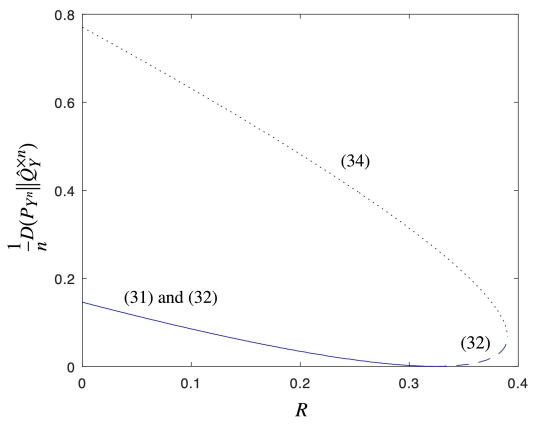
Given a discrete memoryless channel and a target distribution on its output alphabet, one wishes to construct a length-$ n $ rate-$ R $ codebook such that the output distribution—computed over a codeword that is chosen uniformly at random—should be close to the $ n $-fold tensor product of the target distribution. Here "close" means that the relative entropy between the output distribution and said $ n $-fold product should be small. We characterize the smallest achievable relative entropy divided by $ n $ as $ n $ tends to infinity. We then demonstrate two applications of this result. The first application is an alternative proof of the achievability of the rate-equivocation region of the wiretap channel. The second application is a new capacity result for communication subject to state masking in the scenario where the decoder has access to channel-state information.
Citation: Ligong Wang. Output statistics, equivocation, and state masking[J]. AIMS Mathematics, 2025, 10(6): 13151-13165. doi: 10.3934/math.2025590
Given a discrete memoryless channel and a target distribution on its output alphabet, one wishes to construct a length-$ n $ rate-$ R $ codebook such that the output distribution—computed over a codeword that is chosen uniformly at random—should be close to the $ n $-fold tensor product of the target distribution. Here "close" means that the relative entropy between the output distribution and said $ n $-fold product should be small. We characterize the smallest achievable relative entropy divided by $ n $ as $ n $ tends to infinity. We then demonstrate two applications of this result. The first application is an alternative proof of the achievability of the rate-equivocation region of the wiretap channel. The second application is a new capacity result for communication subject to state masking in the scenario where the decoder has access to channel-state information.

| [1] |
A. D. Wyner, The common information of two independent random variables, IEEE Trans. Inform. Theory, 21 (1975), 163–179. https://doi.org/10.1109/TIT.1975.1055346 doi: 10.1109/TIT.1975.1055346

|
| [2] |
T. S. Han, S. Verdú, Approximation theory of output statistics, IEEE Trans. Inform. Theory, 39 (1993), 752–772. https://doi.org/10.1109/18.256486 doi: 10.1109/18.256486
|
| [3] |
S. Shamai, S. Verdú, The empirical distribution of good codes, IEEE Trans. Inform. Theory, 43 (1997), 836–846. https://doi.org/10.1109/18.568695 doi: 10.1109/18.568695
|
| [4] |
M. Hayashi, General nonasymptotic and asymptotic formulas in channel resolvability and identification capacity and their application to the wiretap channel, IEEE Trans. Inform. Theory, 52 (2006), 1562–1575. https://doi.org/10.1109/TIT.2006.871040 doi: 10.1109/TIT.2006.871040
|
| [5] |
P. Cuff, Distributed channel synthesis, IEEE Trans. Inform. Theory, 59 (2013), 7071–7096. https://doi.org/10.1109/TIT.2013.2279330 doi: 10.1109/TIT.2013.2279330
|
| [6] | P. Cuff, A stronger soft-covering lemma and applications, in 2015 IEEE Conf. Comm. and Network Security, Florence, Italy, 2015. https://doi.org/10.1109/CNS.2015.7346808 |
| [7] | J. Hou, G. Kramer, Effective secrecy: Reliability, confusion and stealth, in Proc. IEEE Int. Symp. Inform. Theory, Honolulu, HI, USA, 2014. https://doi.org/10.1109/ISIT.2014.6874903 |
| [8] | M. Raginsky, I. Sason, Concentration of measure inequalities in information theory, communications, and coding: Third edition, Now Foundations and Trends, 2018. |
| [9] |
Y. Polyanskiy, S. Verdú, Empirical distribution of good channel codes with nonvanishing error probability, IEEE Trans. Inform. Theory, 60 (2014), 5–21. https://doi.org/10.1109/TIT.2013.2284506 doi: 10.1109/TIT.2013.2284506
|
| [10] |
A. D. Wyner, The wiretap channel, Bell Syst. Techn. J., 54 (1975), 1355–1387. https://doi.org/10.1002/j.1538-7305.1975.tb02040.x doi: 10.1002/j.1538-7305.1975.tb02040.x
|
| [11] |
N. Merhav, S. Shamai, Information rates subject to state masking, IEEE Trans. Inform. Theory, 53 (2007), 2254–2261. https://doi.org/10.1109/TIT.2007.896860 doi: 10.1109/TIT.2007.896860
|
| [12] |
L. Wang, G. W. Wornell, Communication over discrete channels subject to state obfuscation, IEEE Trans. Inform. Theory, 70 (2024), 8455–8466. https://doi.org/10.1109/TIT.2024.3432573 doi: 10.1109/TIT.2024.3432573
|
| [13] | T. M. Cover, J. A. Thomas, Elements of information theory, 2 Eds., John Wiley & Sons, New York, 2006. |
| [14] |
I. Csiszár, J. Körner, Broadcast channels with confidential messages, IEEE Trans. Inform. Theory, 24 (1978), 339–348. https://doi.org/10.1109/TIT.1978.1055892 doi: 10.1109/TIT.1978.1055892
|
| [15] | S. I. Gel'fand, M. S. Pinsker, Coding for channels with random parameters, Prob. Contr. Inform. Theory, 9 (1980), 19–31. |
Figures(1)

Ligong Wang. Output statistics, equivocation, and state masking[J]. AIMS Mathematics, 2025, 10(6): 13151-13165. doi: 10.3934/math.2025590





 DownLoad: