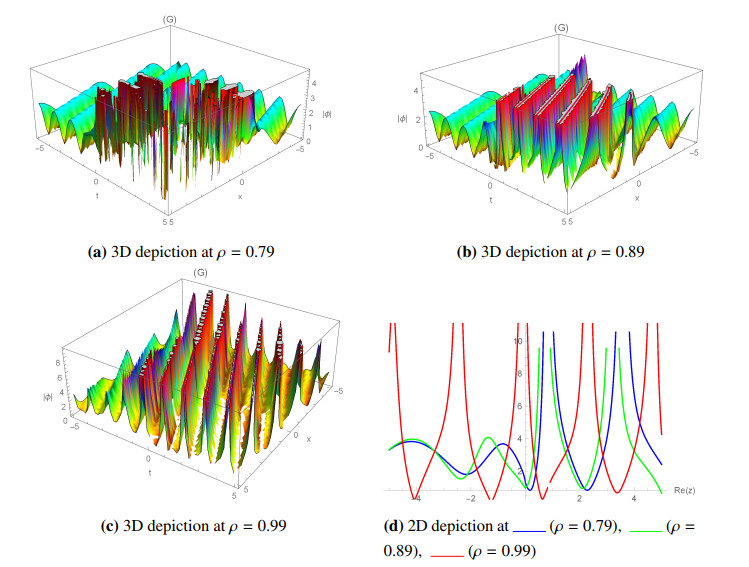
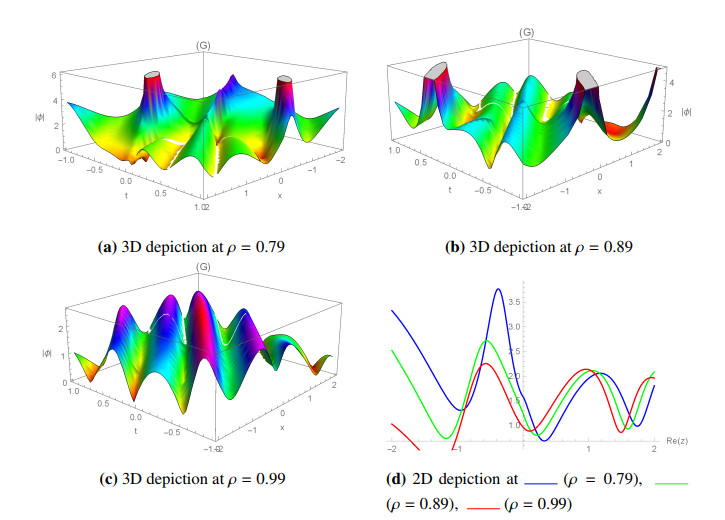
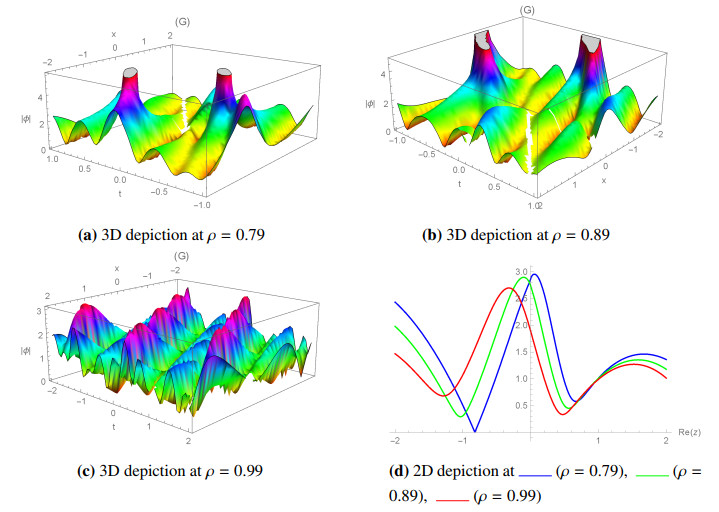
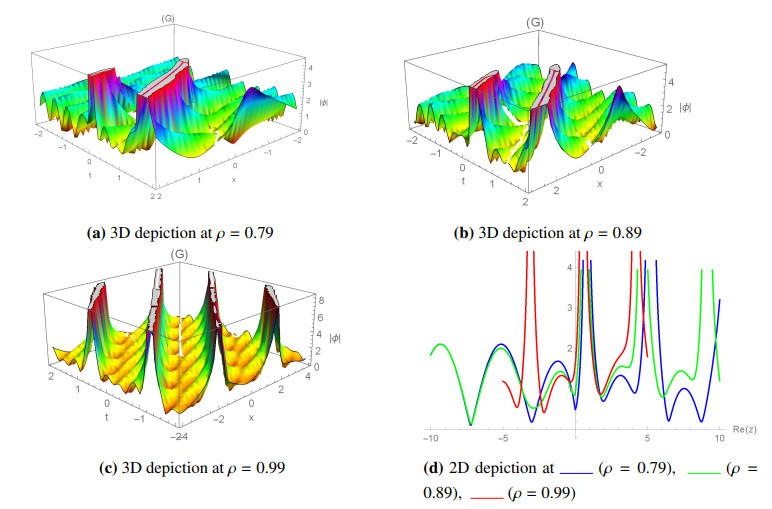
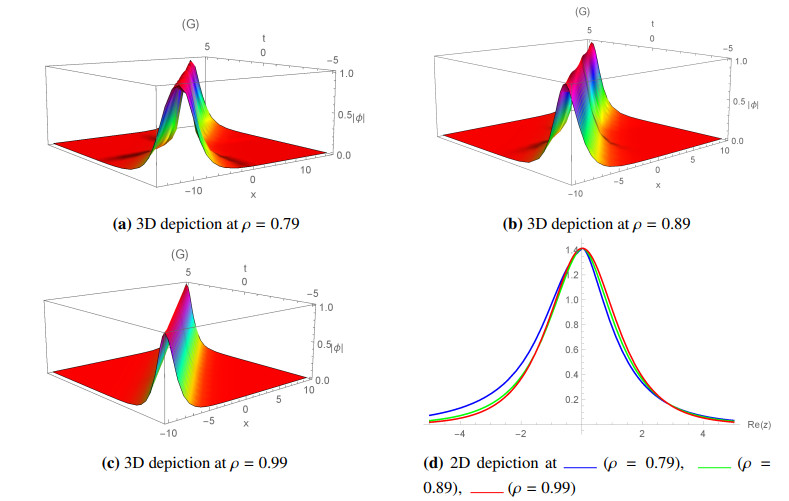
This work examined new analytical soliton solutions of the conformable fractional nonlinear (1+1)-dimensional Akbota problem utilizing the modified extended direct algebraic technique and a new Kudryashov method. This study investigated the application of the fractional Akbota equation in optical fiber telecommunications, where soliton solutions are crucial for maintaining signal integrity over long distances. Akbota is an integrable equation of the Heisenberg ferromagnetic variety, and it holds considerable importance for surface geometry and curve analysis in optics and magnetism. The derived soliton solutions might be characterized as dark, bright, periodic, or in other forms. The results collected are validated and shown in three-dimensional and two-dimensional graphs. The utilization of fractional derivatives has yielded results that are more contemporary than those presently found in the literature. The findings indicate that the fractional variant of the Akbota equation enhances modeling precision for nonlinear phenomena in optical fibers, rendering it an essential instrument for improving fiber optic networks. Consequently, the derived answers are beneficial for subsequent investigations of this model. The utilized methodologies yield a variety of solutions. In conclusion, the applied techniques are straightforward, effective, and dependable for solving other different models in mathematical physics. The novelty of this work lies in the application of the conformable fractional approach to the Akbota equation system, along with the implementation of new analytical methods that reveal a broader spectrum of soliton solutions, including bright, dark, periodic-singular, and breather structures, many of which have not been previously reported for this model.
Citation: Musarat Bibi, Salah Mahmoud Boulaaras, Patricia J.Y. Wong, Muhammad Shoaib Saleem. Exploring families of soliton solutions for the fractional Akbota equation in optical fiber telecommunication systems[J]. AIMS Mathematics, 2025, 10(5): 12254-12285. doi: 10.3934/math.2025555
This work examined new analytical soliton solutions of the conformable fractional nonlinear (1+1)-dimensional Akbota problem utilizing the modified extended direct algebraic technique and a new Kudryashov method. This study investigated the application of the fractional Akbota equation in optical fiber telecommunications, where soliton solutions are crucial for maintaining signal integrity over long distances. Akbota is an integrable equation of the Heisenberg ferromagnetic variety, and it holds considerable importance for surface geometry and curve analysis in optics and magnetism. The derived soliton solutions might be characterized as dark, bright, periodic, or in other forms. The results collected are validated and shown in three-dimensional and two-dimensional graphs. The utilization of fractional derivatives has yielded results that are more contemporary than those presently found in the literature. The findings indicate that the fractional variant of the Akbota equation enhances modeling precision for nonlinear phenomena in optical fibers, rendering it an essential instrument for improving fiber optic networks. Consequently, the derived answers are beneficial for subsequent investigations of this model. The utilized methodologies yield a variety of solutions. In conclusion, the applied techniques are straightforward, effective, and dependable for solving other different models in mathematical physics. The novelty of this work lies in the application of the conformable fractional approach to the Akbota equation system, along with the implementation of new analytical methods that reveal a broader spectrum of soliton solutions, including bright, dark, periodic-singular, and breather structures, many of which have not been previously reported for this model.

| [1] |
E. M. E. Zayed, Y. A. Amer, R. M. A. Shohib, The fractional complex transformation for nonlinear fractional partial differential equations in the mathematical physics, J. Assoc. Arab Univ. Basic Appl. Sci., 19 (2016), 59–69. https://doi.org/10.1016/j.jaubas.2014.06.008 doi: 10.1016/j.jaubas.2014.06.008

|
| [2] |
H. G. Sun, Y. Zhang, D. Baleanu, W. Chen, Y. Q. Chen, A new collection of real world applications of fractional calculus in science and engineering, Commun. Nonlinear Sci. Numer. Simul., 64 (2018), 213–231. https://doi.org/10.1016/j.cnsns.2018.04.019 doi: 10.1016/j.cnsns.2018.04.019
|
| [3] |
J. Singh, D. Kumar, A. Kılıçman, Numerical solutions of nonlinear fractional partial differential equations arising in spatial diffusion of biological populations, Abstr. Appl. Anal., 2014 (2014), 535793. https://doi.org/10.1155/2014/535793 doi: 10.1155/2014/535793
|
| [4] |
A. Ara, N. A. Khan, O. A. Razzaq, T. Hameed, M. A. Z. Raja, Wavelets optimization method for evaluation of fractional partial differential equations: an application to financial modelling, Adv. Differ. Equ., 2018 (2018), 1–13. https://doi.org/10.1186/s13662-017-1461-2 doi: 10.1186/s13662-017-1461-2
|
| [5] |
M. Şenol, Abundant solitary wave solutions to the new extended (3+1)-dimensional nonlinear evolution equation arising in fluid dynamics, Mod. Phys. Lett. B, 39 (2025), 2450475. https://doi.org/10.1142/S021798492450475X doi: 10.1142/S021798492450475X
|
| [6] |
L. Akinyemi, M. Şenol, U. Akpan, K. Oluwasegun, The optical soliton solutions of generalized coupled nonlinear Schrödinger-Korteweg-de Vries equations, Opt. Quantum Electron., 53 (2021), 1–14. https://doi.org/10.1007/s11082-021-03030-7 doi: 10.1007/s11082-021-03030-7
|
| [7] |
M. Bilal, W. C. Hu, J. L. Ren, Different wave structures to the Chen-Lee-Liu equation of monomode fibers and its modulation instability analysis, Eur. Phys. J. Plus, 136 (2021), 385. https://doi.org/10.1140/epjp/s13360-021-01383-2 doi: 10.1140/epjp/s13360-021-01383-2
|
| [8] |
M. Bilal, J. L. Ren, Dynamics of exact solitary wave solutions to the conformable time-space fractional model with reliable analytical approaches, Opt. Quantum Electron., 54 (2022), 40. https://doi.org/10.1007/s11082-021-03408-7 doi: 10.1007/s11082-021-03408-7
|
| [9] |
U. Younas, M. Bilal, J. L. Ren, Propagation of the pure-cubic optical solitons and stability analysis in the absence of chromatic dispersion, Opt. Quantum Electron., 53 (2021), 1–25. https://doi.org/10.1007/s11082-021-03151-z doi: 10.1007/s11082-021-03151-z
|
| [10] |
M. Bilal, J. L. Ren, M. Inc, R. T. Alqahtani, Dynamics of solitons and weakly ion-acoustic wave structures to the nonlinear dynamical model via analytical techniques, Opt. Quantum Electron., 55 (2023), 656. https://doi.org/10.1007/s11082-023-04880-z doi: 10.1007/s11082-023-04880-z
|
| [11] |
M. Bilal, H. Haris, A. Waheed, M. Faheem, The analysis of exact solitons solutions in monomode optical fibers to the generalized nonlinear Schrödinger system by the compatible techniques, Int. J. Math. Comput. Eng., 1 (2023), 149–170. https://doi.org/10.2478/ijmce-2023-0012 doi: 10.2478/ijmce-2023-0012
|
| [12] |
A. Zafar, M. Ashraf, A. Saboor, A. Bekir, M-Fractional soliton solutions of fifth-order generalized nonlinear fractional differential equation via $(G'/G^{2})$-expansion method, Physica Scr., 99 (2024), 025242. https://doi.org/10.1088/1402-4896/ad1e45 doi: 10.1088/1402-4896/ad1e45
|
| [13] |
S. Kaewta, S. Sirisubtawee, S. Koonprasert, S. Sungnul, Applications of the $(G'/G^{2})$-expansion method for solving certain nonlinear conformable evolution equations, Fractal Fract., 5 (2021), 88. https://doi.org/10.3390/fractalfract5030088 doi: 10.3390/fractalfract5030088
|
| [14] |
A. H. Ganie, M. M. AlBaidani, A. Khan, A comparative study of the fractional partial differential equations via novel transform, Symmetry, 15 (2023), 1101. https://doi.org/10.3390/sym15051101 doi: 10.3390/sym15051101
|
| [15] |
J. L. Zhang, J. Q. Xie, W. Shi, Y. T. Huo, Z. K. Ren, D. P. He, Resonance and bifurcation of fractional quintic Mathieu-Duffing system, Chaos, 33 (2023), 023131. https://doi.org/10.1063/5.0138864 doi: 10.1063/5.0138864
|
| [16] |
S. O. Abdulla, S. T. Abdulazeez, M. Modanli, Comparison of third-order fractional partial differential equation based on the fractional operators using the explicit finite difference method, Alex. Eng. J., 70 (2023), 37–44. https://doi.org/10.1016/j.aej.2023.02.032 doi: 10.1016/j.aej.2023.02.032
|
| [17] |
V. P. Dubey, D. Kumar, J. Singh, A. M. Alshehri, S. Dubey, Analysis of local fractional Klein-Gordon equations arising in relativistic fractal quantum mechanics, Wav. Ran. Com. Media., 1 (2022), 113009. https://doi.org/10.1080/17455030.2022.2112993 doi: 10.1080/17455030.2022.2112993
|
| [18] |
V. R. Hosseini, W. Zou, The peridynamic differential operator for solving time-fractional partial differential equations, Nonlinear Dyn., 109 (2022), 1823–1850. https://doi.org/10.1007/s11071-022-07424-4 doi: 10.1007/s11071-022-07424-4
|
| [19] |
S. Y. Lu, M. Z. Liu, L. R. Yin, Z. T. Yin, X. Liu, W. F. Zheng, The multi-modal fusion in visual question answering: a review of attention mechanisms, PeerJ Comput. Sci., 9 (2023), e1400. https://doi.org/10.7717/peerj-cs.1400 doi: 10.7717/peerj-cs.1400
|
| [20] |
S. Y. Lu, Y. M. Ding, M. Z. Liu, Z. T. Yin, L. R. Yin, W. F. Zheng, Multiscale feature extraction and fusion of image and text in VQA, Int. J. Comput. Intell. Syst., 16 (2023), 54. https://doi.org/10.1007/s44196-023-00233-6 doi: 10.1007/s44196-023-00233-6
|
| [21] |
G. Nugmanova, Z. Zhunussova, K. Yesmakhanova, G. Mamyrbekova, R. Myrzakulov, Integrable Heisenberg Ferromagnet equations with self-consistent potentials, Int. J. Phys. Math. Sci., 9 (2015), 472–475. https://doi.org/10.5281/zenodo.1107972 doi: 10.5281/zenodo.1107972
|
| [22] | T. Mathanaranjan, R. Myrzakulov, Conservation laws, soliton solutions and stability analysis for the Akbota equation, 2023. https://doi.org/10.13140/RG.2.2.32430.08006 |
| [23] |
W. A. Faridi, M. A. Bakar, M. B. Riaz, Z. Myrzakulova, R. Myrzakulov, A. M. Mostafa, Exploring the optical soliton solutions of Heisenberg ferromagnet-type of Akbota equation arising in surface geometry by explicit approach, Opt. Quantum Electron., 56 (2024), 1046. https://doi.org/10.1007/s11082-024-06904-8 doi: 10.1007/s11082-024-06904-8
|
| [24] |
Z. Li, S. Zhao, Bifurcation, chaotic behavior and solitary wave solutions for the Akbota equation, AIMS Math., 9 (2024), 22590–22601. https://doi.org/10.3934/math.20241100 doi: 10.3934/math.20241100
|
| [25] |
M. M. Tariq, M. B. Riaz, M. Aziz-ur-Rehman, Investigation of space-time dynamics of Akbota equation using Sardar sub-equation and Khater methods: unveiling bifurcation and chaotic structure, Int. J. Theor. Phys., 63 (2024), 210. https://doi.org/10.1007/s10773-024-05733-5 doi: 10.1007/s10773-024-05733-5
|
| [26] |
T. Mathanaranjan, R. Myrzakulov, Integrable Akbota equation: conservation laws, optical soliton solutions and stability analysis, Opt. Quantum Electron., 56 (2024), 564. https://doi.org/10.1007/s11082-023-06227-0 doi: 10.1007/s11082-023-06227-0
|
| [27] |
H. Y. Kong, R. Guo, Dynamic behaviors of novel nonlinear wave solutions for the Akbota equation, Optik, 282 (2023), 170863. https://doi.org/10.1016/j.ijleo.2023.170863 doi: 10.1016/j.ijleo.2023.170863
|
| [28] |
K. A. Gepreel, R. M. A. Shohib, M. E. M. Alngar, Analyzing multiplicative noise effects on stochastic resonant nonlinear Schrödinger equation via two integration algorithms, Opt. Quantum Electron., 57 (2025), 156. https://doi.org/10.1007/s11082-025-08067-6 doi: 10.1007/s11082-025-08067-6
|
| [29] |
N. T. Trouba, H. Y. Xu, M. E. M. Alngar, R. M. A. Shohib, H. A. Mahmoud, X. Z. Zhu, Soliton solutions and stability analysis of the stochastic nonlinear reaction-diffusion equation with multiplicative white noise in soliton dynamics and optical physics, AIMS Math., 10 (2025), 1859–1881. https://doi.org/10.3934/math.2025086 doi: 10.3934/math.2025086
|
| [30] |
N. T. Trouba, M. E. M. Alngar, R. M. A. Shohib, H. A. Mahmoud, Y. Yildirim, H. Y. Xu, et al., Novel solitary wave solutions of the (3+1)-dimensional nonlinear Schrödinger equation with generalized Kudryashov self-phase modulation, AIMS Math., 10 (2025), 4374–4411. https://doi.org/10.3934/math.2025202 doi: 10.3934/math.2025202
|
| [31] |
R. Khalil, M. Al Horani, A. Yousef, M. Sababheh, A new definition of fractional derivative, J. Comput. Appl. Math., 264 (2014), 65–70. https://doi.org/10.1016/j.cam.2014.01.002 doi: 10.1016/j.cam.2014.01.002
|
| [32] |
A. Zafar, A. R. Seadawy, The conformable space-time fractional mKdV equations and their exact solutions, J. King Saud Univ. Sci., 31 (2019), 1478–1484. https://doi.org/10.1016/j.jksus.2019.09.003 doi: 10.1016/j.jksus.2019.09.003
|
| [33] |
H. Yasmin, N. H. Aljahdaly, A. M. Saeed, R. Shah, Investigating symmetric soliton solutions for the fractional coupled Konno-Onno system using improved versions of a novel analytical technique, Mathematics, 11 (2023), 1–30. https://doi.org/10.3390/math11122686 doi: 10.3390/math11122686
|
| [34] |
H. Yasmin, N. H. Aljahdaly, A. M. Saeed, R. Shah, Probing families of optical soliton solutions in fractional perturbed Radhakrishnan-Kundu-Lakshmanan model with improved versions of extended direct algebraic method, Fractal Fract., 7 (2023), 1–29. https://doi.org/10.3390/fractalfract7070512 doi: 10.3390/fractalfract7070512
|
| [35] |
M. Bilal, J. Iqbal, R. Ali, F. A. Awwad, E. A. A. Ismail, Exploring families of solitary wave solutions for the fractional coupled Higgs system using modified extended direct algebraic method, Fractal Fract., 7 (2023), 1–33. https://doi.org/10.3390/fractalfract7090653 doi: 10.3390/fractalfract7090653
|
| [36] |
S. M. Mirhosseini-Alizamini, H. Rezazadeh, K. Srinivasa, A. Bekir, New closed form solutions of the new coupled Konno-Oono equation using the new extended direct algebraic method, Pramana, 94 (2020), 52. https://doi.org/10.1007/s12043-020-1921-1 doi: 10.1007/s12043-020-1921-1
|
| [37] |
H. Khan, S. Barak, P. Kumam, M. Arif, Analytical solutions of fractional Klein-Gordon and gas dynamics equations, via the $(G^{'}/G)$-expansion method, Symmetry, 11 (2019), 1–12. https://doi.org/10.3390/sym11040566 doi: 10.3390/sym11040566
|
| [38] |
A. Biswas, A. Sonmezoglu, M. Ekici, M. Mirzazadeh, Q. Zhou, S. P. Moshokoa, et al., Optical soliton perturbation with fractional temporal evolution by generalized Kudryashov's method, Optik, 164 (2018), 303–310. https://doi.org/10.1016/j.ijleo.2018.03.032 doi: 10.1016/j.ijleo.2018.03.032
|
| [39] |
R. Yadav, S. Malik, S. Kumar, R. Sharma, A. Biswas, Y. Yıldırım, et al., Highly dispersive W-shaped and other optical solitons with quadratic-cubic nonlinearity: symmetry analysis and new Kudryashov's method, Chaos Solitons Fract., 173 (2023), 113675. https://doi.org/10.1016/j.chaos.2023.113675 doi: 10.1016/j.chaos.2023.113675
|
| [40] |
D. Kumar, M. Kaplan, Application of the modified Kudryashov method to the generalized Schrödinger-Boussinesq equations, Opt. Quantum Electron., 50 (2018), 1–14. https://doi.org/10.1007/s11082-018-1595-9 doi: 10.1007/s11082-018-1595-9
|
| [41] |
N. A. Kudryashov, Method for finding highly dispersive optical solitons of nonlinear differential equations, Optik, 206 (2020), 163550. https://doi.org/10.1016/j.ijleo.2019.163550 doi: 10.1016/j.ijleo.2019.163550
|
Figures(9) / Tables(1)

Musarat Bibi, Salah Mahmoud Boulaaras, Patricia J.Y. Wong, Muhammad Shoaib Saleem. Exploring families of soliton solutions for the fractional Akbota equation in optical fiber telecommunication systems[J]. AIMS Mathematics, 2025, 10(5): 12254-12285. doi: 10.3934/math.2025555





 DownLoad: