In the collective risk model and also in a compound excess-of-loss reinsurance frameworks, it is usual to assume that the risk parameters associated with the random variables, the number of claims, and the claim size are independent for mathematical convenience. Here, we assumed Poisson and Pareto distributions for these two random variables. This paper focuses on the prior and posterior (Bayesian) net premiums of the total claims amount, assuming some degree of dependence between the two risk profiles associated with these two random variables. Here, the degree of dependence was modeled using the Sarmanov-Lee family of distributions, a special type of copula, which allows us to study the impact of this assumption on the following year's total cost of claims when prior margins are assumed to have gamma and shifted Erlang distributions. The numerical applications show that a low degree of correlation between these variables leads to collective and net Bayes premiums that can be sensitive when the hypothesis of independence is broken. The dependence hypothesis has a more significant effect in the model when no layer is considered. We illustrate the methodology proposed with some real numerical examples.
Citation: Emilio Gómez-Déniz. A quasi-conjugate bivariate prior distribution suitable for studying dependence in reinsurance and non reinsurance models with and without a layer[J]. AIMS Mathematics, 2025, 10(5): 12055-12078. doi: 10.3934/math.2025546
In the collective risk model and also in a compound excess-of-loss reinsurance frameworks, it is usual to assume that the risk parameters associated with the random variables, the number of claims, and the claim size are independent for mathematical convenience. Here, we assumed Poisson and Pareto distributions for these two random variables. This paper focuses on the prior and posterior (Bayesian) net premiums of the total claims amount, assuming some degree of dependence between the two risk profiles associated with these two random variables. Here, the degree of dependence was modeled using the Sarmanov-Lee family of distributions, a special type of copula, which allows us to study the impact of this assumption on the following year's total cost of claims when prior margins are assumed to have gamma and shifted Erlang distributions. The numerical applications show that a low degree of correlation between these variables leads to collective and net Bayes premiums that can be sensitive when the hypothesis of independence is broken. The dependence hypothesis has a more significant effect in the model when no layer is considered. We illustrate the methodology proposed with some real numerical examples.

| [1] | H. Albrecher, J. Beirlant, J. L. Teugels, Reinsurance: actuarial and statistical aspects, Wiley, 2017. |
| [2] |
A. J. Mata, Princing excess of loss reinsurance with reinstatements, ASTIN Bull., 30 (2000), 349–368. https://doi.org/10.2143/AST.30.2.504640 doi: 10.2143/AST.30.2.504640

|
| [3] |
M. Kaluszka, Truncated stop loss as optimal reinsurance agreement in one-period models, ASTIN Bull., 35 (2005), 337–349. https://doi.org/10.2143/AST.35.2.2003456 doi: 10.2143/AST.35.2.2003456
|
| [4] | J. Cai, Stop-loss premium, In: Encyclopedia of actuarial science, John Wiley & Sons, New York, 2006, 1–5. https://doi.org/10.1002/9780470012505.tas038 |
| [5] | M. D. L. Centeno, Retention and reinsurance programmes, In: Encyclopedia of actuarial science, John Wiley & Sons, New York, 2006, 1–9. https://doi.org/10.1002/9780470012505.tar028 |
| [6] |
A. Zanotto, G. P. Clemente, An optimal reinsurance simulation model for non-life insurance in the Solvency Ⅱ framework, Eur. Actuar. J., 12 (2022), 89–123. https://doi.org/10.1007/s13385-021-00281-2 doi: 10.1007/s13385-021-00281-2
|
| [7] |
J. Cao, D. Li, V. R. Young, B. Zou, Reinsurance games with two reinsurers: tree versus chain, Eur. J. Oper. Res., 310 (2023), 928–941. https://doi.org/10.1016/j.ejor.2023.04.005 doi: 10.1016/j.ejor.2023.04.005
|
| [8] |
M. Fackler, The global financial crisis-risk transfer, insurance layers, and (lack of?) reinsurance culture, British Actuarial J., 28 (2023), 1–22. https://doi.org/10.1017/S1357321723000120 doi: 10.1017/S1357321723000120
|
| [9] |
D. Yao, J. Zhu, Optimal reinsurance under a new design: two layers and multiple reinsurers, Quant. Finance, 24 (2024), 655–676. https://doi.org/10.1080/14697688.2024.2349019 doi: 10.1080/14697688.2024.2349019
|
| [10] |
O. Hesselager, A class of conjugate priors with applications to excess-of-loss reinsurance, ASTIN Bull., 23 (1993), 77–93. https://doi.org/10.2143/AST.23.1.2005102 doi: 10.2143/AST.23.1.2005102
|
| [11] |
M. Rytgaard, Estimation in the Pareto distribution, ASTIN Bull., 20 (1990), 201–216. https://doi.org/10.2143/AST.20.2.2005443 doi: 10.2143/AST.20.2.2005443
|
| [12] |
R. D. Reiss, M. Tomas, A new class of Bayesian estimators in Paretian excess-of-loss reinsurance, ASTIN Bull., 29 (1999), 339–349. https://doi.org/10.2143/AST.29.2.504620 doi: 10.2143/AST.29.2.504620
|
| [13] | M. Denuit, J. Dhaene, M. Goovaerts, R. Kaas, Actuarial theory for dependent risks measures, orders and models, John Wiley & Sons, Ltd., 2005. https://doi.org/10.1002/0470016450 |
| [14] | O. V. Sarmanov, Generalized normal correlation and two-dimensional Frechet classes, Soviet Math. Doklady, 25 (1966), 1207–1222. |
| [15] |
M. L. T. Lee, Properties and applications of the Sarmanov family of bivariate distributions, Commun. Stat.-Theory Methods, 25 (1996), 1207–1222. https://doi.org/10.1080/03610929608831759 doi: 10.1080/03610929608831759
|
| [16] |
A. Hernández-Bastida, M. P. Fernández, E. Gómez-Déniz, The net Bayes premium with dependence between the risk profiles, Insur.: Math. Econ., 45 (2009), 247–254. https://doi.org/10.1016/j.insmatheco.2009.07.002 doi: 10.1016/j.insmatheco.2009.07.002
|
| [17] | Z. Bahraoui, C. Bolancé, E. Pelican, R. Vernic, On the bivariate Sarmanov distribution and copula. An application on insurance data using truncated marginal distributions, SORT, 39 (2015), 209–230. |
| [18] |
C. Bolancé, R. Vernic, Multivariate count data generalized linear models: three approaches based on the Sarmanov distribution, Insur.: Math. Econ., 85 (2019), 89–103. https://doi.org/10.1016/j.insmatheco.2019.01.001 doi: 10.1016/j.insmatheco.2019.01.001
|
| [19] |
E. C. K. Cheung, W. Ni, R. Oh, J. K. Woo, Bayesian credibility under a bivariate prior on the frequency and the severity of claims, Insur.: Math. Econ., 100 (2021), 274–295. https://doi.org/10.1016/j.insmatheco.2021.06.003 doi: 10.1016/j.insmatheco.2021.06.003
|
| [20] |
H. H. Panjer, G. E. Willmot, Compound Poisson models in actuarial risk theory, J. Econ., 23 (1983), 63–76. https://doi.org/10.1016/0304-4076(83)90075-1 doi: 10.1016/0304-4076(83)90075-1
|
| [21] |
H. H. Panjer, Recursive evaluation of a family of compound distributions, ASTIN Bull., 12 (1981), 22–26. https://doi.org/10.1017/S0515036100006796 doi: 10.1017/S0515036100006796
|
| [22] | T. Rolski, H. Schmidli, V. Schmidt, J. Teugel, Stochastic processes for insurance and finance, John Wiley & Sons, Hoboken, NJ., 1999. https://doi.org/10.1002/9780470317044 |
| [23] |
C. M. Ramsay, The distribution of compound sums of Pareto distributed losses, Scand. Actuar. J., 2009 (2009), 27–37. https://doi.org/10.1080/03461230802627835 doi: 10.1080/03461230802627835
|
| [24] |
B. Roehner, P. Winiwarter, Aggregation of independent Paretian random variables, Adv. Appl. Probabil., 17 (1985), 465–469. https://doi.org/10.2307/1427153 doi: 10.2307/1427153
|
| [25] |
W. R. Heilmann, Decision theoretic foundations of credibility theory, Insur.: Math. Econ., 8 (1989), 77–95. https://doi.org/10.1016/0167-6687(89)90050-4 doi: 10.1016/0167-6687(89)90050-4
|
| [26] |
E. Gómez-Déniz, A generalization of the credibility theory obtained by using the weighted balanced loss function, Insur.: Math. Econ., 42 (2008), 850–854. https://doi.org/10.1016/j.insmatheco.2007.09.002 doi: 10.1016/j.insmatheco.2007.09.002
|
| [27] | D. C. M. Dickson, Insurance risk and ruin, Cambridge University Press, Cambridge, 2005. https://doi.org/10.1017/CBO9780511624155 |
| [28] | M. Makarov, Applications of exact extreme value theorem, J. Oper. Risk, 2 (2007), 115–120. |
| [29] | P. V. Shevchenko, M. V. Wüthrich, The structural modelling of operational risk via Bayesian inference: combining loss data with expert opinions, J. Oper. Risk, 1 (2006), 3–26. |
| [30] | D. Drouet Mari, S. Kotz, Correlation and dependence, Singapore: Imperial Press, 2001. https://doi.org/10.1142/p226 |
| [31] |
S. Kotz, R. van Dorp, A versatile bivariate distribution on a bounded domain: another look at the product moment correlation, J. Appl. Stat., 29 (2002), 1165–1179. https://doi.org/10.1080/0266476022000011247 doi: 10.1080/0266476022000011247
|
| [32] | J. M. Sarabia, E. Gómez-Déniz, Construction of multivariate distributions: a review of some recent results, Stat. Oper. Res. Trans., 32 (2008), 3–36. |
| [33] | L. Cohen, Probability distributions with given multivariate marginals, J. Math. Phys., 25 (1984), 2402–2403. |
| [34] | D. Morgenstern, Einfache beispiele zweidimensionaler verteilungen, Mitteilungsbl. Math. Stat., 8 (1956), 234–235. |
| [35] |
D. J. G. Farlie, The performance of some correlation coeficients for a general bivariate distribution, Biometrika, 47 (1960), 307–323. https://doi.org/10.2307/2333302 doi: 10.2307/2333302
|
| [36] | E. J. Gumbel, Bivariate exponential distributions, J. Am. Stat. Assoc., 55 (1960), 698–707. |
| [37] | B. C. Arnold, S. J. Press, Bayesian estimation and prediction for pareto data, J. Am. Stat. Assoc., 84 (1989), 1079–1084. |
| [38] | R. V. Hogg, S. A. Klugman, Loss distributions, John Wiley & Sons: Hoboken, NJ, USA., 1984. https://doi.org/10.1002/9780470316634 |
| [39] |
H. Jeong, E. A. Valdez, Predictive compound risk models with dependence, Insur.: Math. Econ., 94 (2020), 182–195. https://doi.org/10.1016/j.insmatheco.2020.07.011 doi: 10.1016/j.insmatheco.2020.07.011
|
| [40] |
E. Gómez-Déniz, Bivariate credibility bonus-malus premiums distinguishing between two types of claims, Insur.: Math. Econ., 70 (2016), 117–124. https://doi.org/10.1016/j.insmatheco.2016.06.009 doi: 10.1016/j.insmatheco.2016.06.009
|
| [41] | P. de Jong, G. Z. Heller, Generalized linear models for insurance data, Cambridge University Press, 2008. |
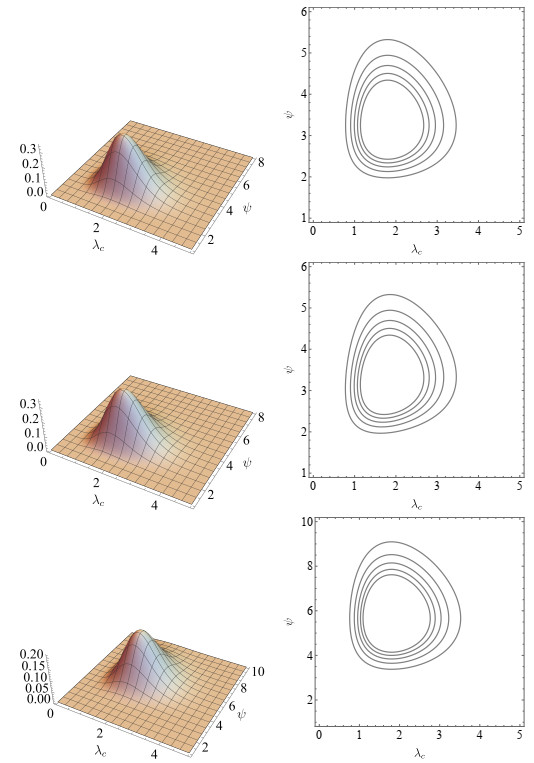

Figures(2) / Tables(7)

Emilio Gómez-Déniz. A quasi-conjugate bivariate prior distribution suitable for studying dependence in reinsurance and non reinsurance models with and without a layer[J]. AIMS Mathematics, 2025, 10(5): 12055-12078. doi: 10.3934/math.2025546





 DownLoad: