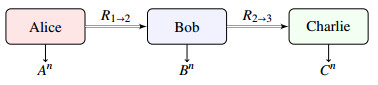
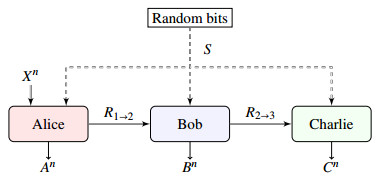
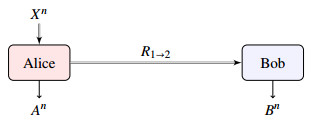
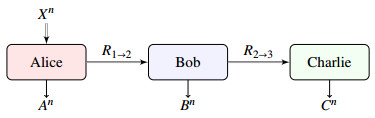
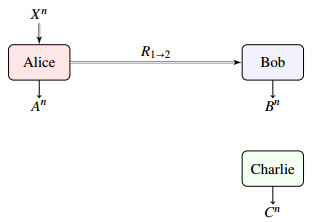
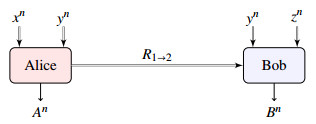
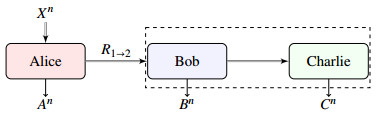
We introduce the notion of empirical coordination for quantum correlations. Quantum mechanics enables the calculation of probabilities for experimental outcomes, emphasizing statistical averages rather than detailed descriptions of individual events. Empirical coordination is thus a natural framework for quantum systems. Focusing on the cascade network, the optimal coordination rates are established, indicating the minimal resources required to simulate, on average, a quantum state. As we consider a network with classical communication links, superposition cannot be maintained, hence the quantum correlations are separable (i.e., a convex combination of product states). This precludes entanglement. Providing the users with shared randomness, before communication begins, does not affect the optimal rates for empirical coordination. We begin with a rate characterization for a basic two-node network, and then generalize to a cascade network. The special case of a network with an isolated node is considered as well. The results can be further generalized to other networks as our analysis includes a generic achievability scheme. The optimal rate formula involves optimization over a collection of state extensions. This is a unique feature of the quantum setting, as the classical parallel does not include optimization. As demonstrated through examples, the performance depends heavily on the choice of decomposition. We further discuss the consequences of our results for quantum cooperative games.
Citation: Husein Natur, Uzi Pereg. Empirical coordination of separable quantum correlations[J]. AIMS Mathematics, 2025, 10(4): 10028-10061. doi: 10.3934/math.2025458
We introduce the notion of empirical coordination for quantum correlations. Quantum mechanics enables the calculation of probabilities for experimental outcomes, emphasizing statistical averages rather than detailed descriptions of individual events. Empirical coordination is thus a natural framework for quantum systems. Focusing on the cascade network, the optimal coordination rates are established, indicating the minimal resources required to simulate, on average, a quantum state. As we consider a network with classical communication links, superposition cannot be maintained, hence the quantum correlations are separable (i.e., a convex combination of product states). This precludes entanglement. Providing the users with shared randomness, before communication begins, does not affect the optimal rates for empirical coordination. We begin with a rate characterization for a basic two-node network, and then generalize to a cascade network. The special case of a network with an isolated node is considered as well. The results can be further generalized to other networks as our analysis includes a generic achievability scheme. The optimal rate formula involves optimization over a collection of state extensions. This is a unique feature of the quantum setting, as the classical parallel does not include optimization. As demonstrated through examples, the performance depends heavily on the choice of decomposition. We further discuss the consequences of our results for quantum cooperative games.

| [1] | J. Soni, R. Goodman, A mind at play: how Claude Shannon invented the information age, Simon and Schuster, 2017. |
| [2] |
D. J. Costello, G. D. Forney, Channel coding: The road to channel capacity, P. IEEE, 95 (2007), 1150–1177. https://doi.org/10.1109/JPROC.2007.895188 doi: 10.1109/JPROC.2007.895188

|
| [3] |
K. Arora, J. Singh, Y. S. Randhawa, A survey on channel coding techniques for 5G wireless networks, Telecommun. Syst., 73 (2020), 637–663. https://doi.org/10.1007/s11235-019-00630-3 doi: 10.1007/s11235-019-00630-3
|
| [4] | A. E. Gamal, Y. H. Kim, Network information theory, Cambridge University Press, 2011. https://doi.org/10.1017/CBO9781139030687 |
| [5] |
L. He, M. Xue, B. Gu, Internet-of-things enabled supply chain planning and coordination with big data services: Certain theoretic implications, J. Manage. Sci. Eng., 5 (2020), 1–22. https://doi.org/10.1016/j.jmse.2020.03.002 doi: 10.1016/j.jmse.2020.03.002
|
| [6] | H. Boche, M. Schubert, S. Stanczak, A unifying approach to multiuser receiver design under QoS constraints, In: 2005 IEEE 61st Vehicular Technol. Conf., 2 (2005), 992–996. https://doi.org/10.1016/j.talanta.2005.04.029 |
| [7] |
P. Gupta, P. Kumar, The capacity of wireless networks, IEEE T. Inform. Theory, 46 (2000), 388–404. https://doi.org/10.1109/18.825799 doi: 10.1109/18.825799
|
| [8] |
U. Pereg, C. Deppe, H. Boche, The quantum multiple-access channel with cribbing encoders, IEEE T. Inform. Theory, 68 (2022), 3965–3988. https://doi.org/10.1109/TIT.2022.3149827 doi: 10.1109/TIT.2022.3149827
|
| [9] | M. Lederman, U. Pereg, Secure communication with unreliable entanglement assistance, In: 2024 IEEE Int. Symp. Inf. Theory (ISIT), 2024, 1017–1022. https://doi.org/10.1109/ISIT57864.2024.10619085 |
| [10] |
D. N. C. Tse, S. V. Hanly, Linear multiuser receivers: Effective interference, effective bandwidth and user capacity, IEEE T. Inform. Theory, 45 (1999), 641–657. https://doi.org/10.1109/18.749008 doi: 10.1109/18.749008
|
| [11] |
J. Rosenberger, C. Deppe, U. Pereg, Identification over quantum broadcast channels, Quantum Inf. Process., 22 (2023), 361. https://doi.org/10.1109/ISIT50566.2022.9834865 doi: 10.1109/ISIT50566.2022.9834865
|
| [12] |
U. Pereg, C. Deppe, H. Boche, The multiple-access channel with entangled transmitters, IEEE T. Inform. Theory, 71 (2025), 1096–1120. https://doi.org/10.1109/TIT.2024.3516507 doi: 10.1109/TIT.2024.3516507
|
| [13] |
K. S. K. Arumugam, M. R. Bloch, Covert communication over a $k$-user multiple-access channel, IEEE T. Inform. Theory, 65 (2019), 7020–7044. https://doi.org/10.1109/TIT.2019.2930484 doi: 10.1109/TIT.2019.2930484
|
| [14] |
L. Torres-Figueroa, R. Ferrara, C. Deppe, H. Boche, Message identification for task-oriented communications: Exploiting an exponential increase in the number of connected devices, IEEE Internet Things Mag., 6 (2023), 42–47. https://doi.org/10.1109/IOTM.001.2300166 doi: 10.1109/IOTM.001.2300166
|
| [15] |
M. Sudan, H. Tyagi, S. Watanabe, Communication for generating correlation: A unifying survey, IEEE T. Inform. Theory, 66 (2019), 5–37. https://doi.org/10.1109/TIT.2019.2946364 doi: 10.1109/TIT.2019.2946364
|
| [16] | P. W. Cuff, H. H. Permuter, T. M. Cover, Coordination capacity, IEEE T. Inform. Theory, 56 (2010), 4181–4206. https://doi.org/10.1109/TIT.2010.2054651 |
| [17] |
M. Le Treust, Joint empirical coordination of source and channel, IEEE T. Inform. Theory, 63 (2017), 5087–5114. https://doi.org/10.1109/TIT.2017.2714682 doi: 10.1109/TIT.2017.2714682
|
| [18] | M. R. Bloch, J. Kliewer, Strong coordination over a line network, In: 2013 IEEE Int. Symp. Inf. Theory (ISIT 2013), 2013, 2319–2323. https://doi.org/10.1109/ISIT.2013.6620640 |
| [19] | M. Mylonakis, P. A. Stavrou, M. Skoglund, Remote empirical coordination, In: 2020 Int. Symp. Inf. Theory Appl. (ISITA 2020), IEEE, 2020, 31–35. https://doi.org/10.1007/s15016-020-7534-6 |
| [20] |
M. Berta, F. G. Brandão, M. Christandl, S. Wehner, Entanglement cost of quantum channels, IEEE T. Inform. Theory, 59 (2013), 6779–6795. https://doi.org/10.1109/TIT.2013.2268533 doi: 10.1109/TIT.2013.2268533
|
| [21] |
C. H. Bennett, I. Devetak, A. W. Harrow, P. W. Shor, A. Winter, The quantum reverse Shannon theorem and resource tradeoffs for simulating quantum channels, IEEE T. Inform. Theory, 60 (2014), 2926–2959. https://doi.org/10.1109/TIT.2014.2309968 doi: 10.1109/TIT.2014.2309968
|
| [22] |
M. M. Wilde, Entanglement cost and quantum channel simulation, Phys. Rev. A, 98 (2018), 042338. https://doi.org/10.1103/PhysRevA.98.042338 doi: 10.1103/PhysRevA.98.042338
|
| [23] | I. George, M. H. Hsieh, E. Chitambar, One-shot bounds on state generation using correlated resources and local encoders, In: IEEE Int. Symp. Inf. Theory (ISIT 2023), 2023, 96–101. https://doi.org/10.1109/ISIT54713.2023.10206997 |
| [24] | H. A. Salehi, F. Shirani, S. S. Pradhan, Quantum advantage in non-interactive source simulation, arXiv preprint, 2024. https://doi.org/10.48550/arXiv.2402.00242 |
| [25] |
M. Berta, O. Fawzi, S. Wehner, Quantum to classical randomness extractors, IEEE T. Inform. Theory, 60 (2014), 1168–1192. https://doi.org/10.1109/TIT.2013.2291780 doi: 10.1109/TIT.2013.2291780
|
| [26] | M. Tahmasbi, M. R. Bloch, Steganography protocols for quantum channels, J. Math. Phys., 61 (2020). https://doi.org/10.1063/5.0004731 |
| [27] |
G. Vardoyan, E. van Milligen, S. Guha, S. Wehner, D. Towsley, On the bipartite entanglement capacity of quantum networks, IEEE Trans. Quantum Eng., 5 (2024), 1–14. https://doi.org/10.1109/TQE.2024.3443660 doi: 10.1109/TQE.2024.3443660
|
| [28] | I. George, E. Chitambar, Revisiting pure state transformations with zero communication, arXiv preprint, 2023. https://doi.org/10.48550/arXiv.2301.04735 |
| [29] |
I. George, E. Chitambar, Reexamination of quantum state transformations with zero communication, Phys. Rev. A, 109 (2024), 062418. https://doi.org/10.1103/PhysRevA.109.062418 doi: 10.1103/PhysRevA.109.062418
|
| [30] | I. Bjelaković, H. Boche, G. Janßen, Universal quantum state merging, J. Math. Phys., 54 (2013). https://doi.org/10.1063/1.4795243 |
| [31] |
M. Horodecki, J. Oppenheim, A. Winter, Quantum state merging and negative information, Commun. Math. Phys., 269 (2007), 107–136. https://doi.org/10.1007/s00220-006-0118-x doi: 10.1007/s00220-006-0118-x
|
| [32] |
P. Hayden, A. Winter, Communication cost of entanglement transformations, Phys. Rev. A, 67 (2003), 012326. https://doi.org/10.1103/PhysRevA.67.012326 doi: 10.1103/PhysRevA.67.012326
|
| [33] |
A. W. Harrow, H. K. Lo, A tight lower bound on the classical communication cost of entanglement dilution, IEEE T. Inform. Theory, 50 (2004), 319–327. https://doi.org/10.1109/TIT.2003.822597 doi: 10.1109/TIT.2003.822597
|
| [34] |
W. Kumagai, M. Hayashi, Entanglement concentration is irreversible, Phys. Rev. Lett., 111 (2013), 130407. https://doi.org/10.1103/PhysRevLett.111.130407 doi: 10.1103/PhysRevLett.111.130407
|
| [35] | Z. Goldfeld, H. H. Permuter, G. Kramer, The Ahlswede-Körner coordination problem with one-sided encoder cooperation, In: Proc. IEEE Int. Symp. Inf. Theory (ISIT 2014), IEEE, 2014, 1341–1345. https://doi.org/10.1109/ISIT.2014.6875051 |
| [36] | G. Kramer, S. A. Savari, Quantum data compression of ensembles of mixed states with commuting density operators, arXiv preprint, 2001. https://doi.org/10.48550/arXiv.quant-ph/0101119 |
| [37] |
E. Soljanin, Compressing quantum mixed-state sources by sending classical information, IEEE T. Inform. Theory, 48 (2002), 2263–2275. https://doi.org/10.1109/TIT.2002.800500 doi: 10.1109/TIT.2002.800500
|
| [38] |
Z. Goldfeld, H. H. Permuter, G. Kramer, Duality of a source coding problem and the semi-deterministic broadcast channel with rate-limited cooperation, IEEE T. Inform. Theory, 62 (2016), 2285–2307. https://doi.org/10.1109/TIT.2016.2533479 doi: 10.1109/TIT.2016.2533479
|
| [39] | M. A. Sohail, T. A. Atif, S. S. Pradhan, A new formulation of lossy quantum-classical and classical source coding based on a posterior channel, In: IEEE Int. Symp. Inf. Theory (ISIT 2023), 2023,743–748. https://doi.org/10.1109/ISIT54713.2023.10206859 |
| [40] | H. M. Garmaroudi, S. S. Pradhan, J. Chen, Rate-limited quantum-to-classical optimal transport: A lossy source coding perspective, In: IEEE Int. Symp. Inf. Theory (ISIT 2023), 2023, 1925–1930. https://doi.org/10.1109/ISIT54713.2023.10206947 |
| [41] | M. Le Treust, M. Bloch, Empirical coordination, state masking and state amplification: Core of the decoder's knowledge, In: 2016 IEEE Int. Symp. Inf. Theory (ISIT 2016), IEEE, 2016,895–899. https://doi.org/10.1109/ISIT.2016.7541428 |
| [42] | P. Cuff, L. Zhao, Coordination using implicit communication, In: 2011 IEEE Inf. Theory Workshop (ITW 2011), IEEE, 2011,467–471. https://doi.org/10.1109/ITW.2011.6089504 |
| [43] | G. Cervia, L. Luzzi, M. R. Bloch, M. Le Treust, Polar coding for empirical coordination of signals and actions over noisy channels, In: 2016 IEEE Inf. Theory Workshop (ITW 2016), IEEE, 2016, 81–85. https://doi.org/10.1109/ITW.2016.7606800 |
| [44] | R. Blasco-Serrano, R. Thobaben, M. Skoglund, Communication and interference coordination, In: 2014 Inf. Theory Appl. Workshop (ITA 2014), IEEE, 2014, 1–8. https://doi.org/10.1109/ITA.2014.6804218 |
| [45] | F. Haddadpour, M. H. Yassaee, A. Gohari, M. R. Aref, Coordination via a relay, In: 2012 IEEE Int. Symp. Inf. Theory Proc. (ISIT 2012), IEEE, 2012, 3048–3052. https://doi.org/10.1109/ISIT.2012.6284121 |
| [46] |
C. A. Fuchs, A. Peres, Quantum-state disturbance versus information gain: Uncertainty relations for quantum information, Phys. Rev. A, 53 (1996), 2038. https://doi.org/10.1103/PhysRevA.53.2038 doi: 10.1103/PhysRevA.53.2038
|
| [47] |
C. A. Fuchs, A. Peres, Quantum theory needs no 'interpretation', Phys. Today, 53 (2000), 70–71. https://doi.org/10.1063/1.1325194 doi: 10.1063/1.1325194
|
| [48] | J. Bricmont, Making sense of quantum mechanics, Springer, 37 (2016). https://doi.org/10.1007/978-3-319-25889-8 |
| [49] |
E. Soljanin, Compressing quantum mixed-state sources by sending classical information, IEEE T. Inform. Theory, 48 (2002), 2263–2275. https://doi.org/10.1109/TIT.2002.800500 doi: 10.1109/TIT.2002.800500
|
| [50] |
H. Barnum, C. M. Caves, C. A. Fuchs, R. Jozsa, B. Schumacher, On quantum coding for ensembles of mixed states, J. Phys. A: Math. General, 34 (2001), 35. https://doi.org/10.1023/A:1010336118743 doi: 10.1023/A:1010336118743
|
| [51] |
W. Dür, G. Vidal, J. Cirac, Visible compression of commuting mixed states, Phys. Rev. A, 64 (2001), 022308. https://doi.org/10.1103/PhysRevA.64.022308 doi: 10.1103/PhysRevA.64.022308
|
| [52] |
M. Horodecki, Limits for compression of quantum information carried by ensembles of mixed states, Phys. Rev. A, 57 (1998), 3364. https://doi.org/10.1103/PhysRevA.57.3364 doi: 10.1103/PhysRevA.57.3364
|
| [53] | M. Horodecki, Towards optimal compression for mixed signal states, Preprint, 1999. https://doi.org/10.1103/PhysRevA.61.052309 |
| [54] |
M. Koashi, N. Imoto, Compressibility of quantum mixed-state signals, Phys. Rev. Lett., 87 (2001), 017902. https://doi.org/10.1103/PhysRevLett.87.017902 doi: 10.1103/PhysRevLett.87.017902
|
| [55] |
M. Koashi, N. Imoto, Operations that do not disturb partially known quantum states, Phys. Rev. A, 66 (2002), 022318. https://doi.org/10.1103/PhysRevA.66.022318 doi: 10.1103/PhysRevA.66.022318
|
| [56] | M. Hayashi, Optimal visible compression rate for mixed states is determined by entanglement of purification, Phys. Rev. A-At., Mol. Opt. Phys., 73 (2006). https://doi.org/10.1103/PhysRevA.73.060301 |
| [57] | Z. B. Khanian, From quantum source compression to quantum thermodynamics, arXiv preprint, 2020. https://doi.org/10.48550/arXiv.2012.14143 |
| [58] | Z. B. Khanian, Strong converse bounds for compression of mixed states, arXiv preprint, 2022. https://doi.org/10.48550/arXiv.2206.09415 |
| [59] | H. Natur, U. Pereg, Entanglement coordination rates in multi-user networks, In: 2024 IEEE Information Theory Workshop (ITW), 2024. https://doi.org/10.1109/ITW61385.2024.10807005 |
| [60] | H. Nator, U. Pereg, Coordination capacity for classical-quantum correlations, In: 2024 IEEE Information Theory Workshop (ITW), 2024. https://doi.org/10.1109/ITW61385.2024.10807032 |
| [61] | H. Nator, U. Pereg, Quantum coordination rates in multi-user networks, IEEE T. Inform. Theory, 2024, In press. https://doi.org/10.1109/TIT.2025.3554042 |
| [62] | M. Hayashi, Quantum information theory: Mathematical foundation, Springer, 2016. https://doi.org/10.1007/978-3-662-49725-8 |
| [63] |
R. A. Chou, M. R. Bloch, J. Kliewer, Empirical and strong coordination via soft covering with polar codes, IEEE T. Inform. Theory, 64 (2018), 5087–5100. https://doi.org/10.1109/TIT.2018.2817519 doi: 10.1109/TIT.2018.2817519
|
| [64] | T. A. Atif, S. S. Pradhan, A. Winter, Quantum soft-covering lemma with applications to rate-distortion coding, resolvability and identification via quantum channels, arXiv preprint, 2023. https://doi.org/10.48550/arXiv.2306.12416 |
| [65] |
I. Devetak, A. Winter, Distillation of secret key and entanglement from quantum states, P. Roy. Soc. A-Math. Phys., 461 (2005), 207–235. https://doi.org/10.1098/rspa.2004.1372 doi: 10.1098/rspa.2004.1372
|
| [66] | M. Christandl, A. Ekert, M. Horodecki, P. Horodecki, J. Oppenheim, R. Renner, Unifying classical and quantum key distillation, Theory of Cryptography: 4th Theory of Cryptography Conference, TCC 2007, Amsterdam, The Netherlands, Springer, 2007,456–478. https://doi.org/10.1007/978-3-540-71095-0_8944 |
| [67] |
C. H. Bennett, I. Devetak, A. W. Harrow, P. W. Shor, A. Winter, The quantum reverse Shannon theorem and resource tradeoffs for simulating quantum channels, IEEE T. Inform. Theory, 60 (2014), 2926–2959. https://doi.org/10.1109/TIT.2014.2309968 doi: 10.1109/TIT.2014.2309968
|
| [68] |
A. K. Ekert, Quantum cryptography based on bell's theorem, Phys. Rev. Lett., 67 (1991), 661. https://doi.org/10.1103/PhysRevLett.67.661 doi: 10.1103/PhysRevLett.67.661
|
| [69] |
C. H. Bennett, G. Brassard, J. M. Robert, Privacy amplification by public discussion, SIAM J. Comput., 17 (1988), 210–229. https://doi.org/10.1137/0217014 doi: 10.1137/0217014
|
| [70] |
F. Dupuis, Privacy amplification and decoupling without smoothing, IEEE T. Inform. Theory, 69 (2023), 7784–7792. https://doi.org/10.1109/TIT.2023.3301812 doi: 10.1109/TIT.2023.3301812
|
| [71] |
Y. C. Shen, L. Gao, H. C. Cheng, Optimal second-order rates for quantum soft covering and privacy amplification, IEEE T. Inform. Theory, 70 (2024), 5077–5091. https://doi.org/10.1109/TIT.2024.3351963 doi: 10.1109/TIT.2024.3351963
|
| [72] |
M. Berta, O. Fawzi, S. Wehner, Quantum to classical randomness extractors, IEEE T. Inform. Theory, 60 (2013), 1168–1192. https://doi.org/10.1109/TIT.2013.2291780 doi: 10.1109/TIT.2013.2291780
|
| [73] | K. Cheng, X. Li, Randomness extraction in AC0 and with small locality, arXiv preprint, 2016. https://doi.org/10.48550/arXiv.1602.01530 |
| [74] | K. G. Anco, T. Nemoz, P. Brown, How much secure randomness is in a quantum state? arXiv preprint, 2024. https://doi.org/10.48550/arXiv.2410.16447 |
| [75] | M. Horodecki, J. Oppenheim, A. Winter, Partial quantum information, Nature, 436 (2005), 673–676. https://doi.org/10.1038/nature03909 |
| [76] |
A. Abeyesinghe, I. Devetak, P. Hayden, A. Winter, The mother of all protocols: Restructuring quantum information's family tree, P. Roy. Soc. A-Math. Phys., 465 (2018), 2537–2563. https://doi.org/10.1098/rspa.2009.0202 doi: 10.1098/rspa.2009.0202
|
| [77] |
M. Berta, M. Christandl, D. Touchette, Smooth entropy bounds on one-shot quantum state redistribution, IEEE T. Inform. Theory, 62 (2016), 1425–1439. https://doi.org/10.1109/TIT.2016.2516006 doi: 10.1109/TIT.2016.2516006
|
| [78] | I. Devetak, A triangle of dualities: reversibly decomposable quantum channels, source-channel duality, and time reversal, arXiv preprint, 2005. https://doi.org/10.48550/arXiv.quant-ph/0505138 |
| [79] | J. Oppenheim, State redistribution as merging: Introducing the coherent relay, arXiv preprint, 2008. https://doi.org/10.48550/arXiv.0805.1065 |
| [80] |
M. Berta, M. Christandl, R. Renner, The quantum reverse Shannon theorem based on one-shot information theory, Commun. Math. Phys., 306 (2011), 579–615. https://doi.org/10.1007/s00220-011-1309-7 doi: 10.1007/s00220-011-1309-7
|
| [81] |
C. H. Bennett, P. W. Shor, J. A. Smolin, A. V. Thapliyal, Entanglement-assisted capacity of a quantum channel and the reverse Shannon theorem, IEEE T. Inform. Theory, 48 (2002), 2637–2655. https://doi.org/10.1109/TIT.2002.802612 doi: 10.1109/TIT.2002.802612
|
| [82] | P. Cuff, Communication requirements for generating correlated random variables, In: 2008 IEEE Int. Symp. Inf. Theory, 2008, 1393–1397. https://doi.org/10.1109/ISIT.2008.4595216 |
| [83] |
C. Ahn, A. C. Doherty, P. Hayden, A. J. Winter, On the distributed compression of quantum information, IEEE T. Inform. Theory, 52 (2006), 4349–4357. https://doi.org/10.1109/TIT.2006.881734 doi: 10.1109/TIT.2006.881734
|
| [84] |
Z. B. Khanian, A. Winter, Distributed compression of correlated classical-quantum sources or: The price of ignorance, IEEE T. Inform. Theory, 66 (2020), 5620–5633. https://doi.org/10.1109/TIT.2020.2981322 doi: 10.1109/TIT.2020.2981322
|
| [85] |
S. Salek, D. Cadamuro, P. Kammerlander, K. Wiesner, Quantum rate-distortion coding of relevant information, IEEE T. Inform. Theory, 65 (2018), 2603–2613. https://doi.org/10.1109/TIT.2018.2878412 doi: 10.1109/TIT.2018.2878412
|
| [86] |
T. A. Atif, M. Heidari, S. S. Pradhan, Faithful simulation of distributed quantum measurements with applications in distributed rate-distortion theory, IEEE T. Inform. Theory, 68 (2022), 1085–1118. https://doi.org/10.1109/TIT.2021.3124976 doi: 10.1109/TIT.2021.3124976
|
| [87] |
Z. B. Khanian, K. Kuroiwa, D. Leung, Rate-distortion theory for mixed states, IEEE T. Inform. Theory, 71 (2024), 1077–1095. https://doi.org/10.1109/TIT.2024.3509825 doi: 10.1109/TIT.2024.3509825
|
| [88] |
P. Colomer, A. Winter, Decoupling by local random unitaries without simultaneous smoothing, and applications to multi-user quantum information tasks, Commun. Math. Phys., 405 (2024), 281. https://doi.org/10.1007/s00220-024-05191-4 doi: 10.1007/s00220-024-05191-4
|
| [89] | H. C. Cheng, L. Gao, M. Berta, Quantum broadcast channel simulation via multipartite convex splitting, arXiv preprint, 2023. https://doi.org/10.48550/arXiv.2304.12056 |
| [90] |
M. X. Cao, N. Ramakrishnan, M. Berta, M. Tomamichel, Channel simulation: Finite blocklengths and broadcast channels, IEEE T. Inform. Theory, 70 (2024), 6780–6808. https://doi.org/10.1109/TIT.2024.3445998 doi: 10.1109/TIT.2024.3445998
|
| [91] | A. Nema, S. Sreekumar, M. Berta, One-shot multiple access channel simulation, In: 2024 IEEE Int. Symp. Inf. Theory (ISIT), IEEE, 2024, 2981–2986. https://doi.org/10.1109/ISIT57864.2024.10619283 |
| [92] | I. George, H. C. Cheng, Coherent distributed source simulation as multipartite quantum state splitting, In: 2024 IEEE Int. Symp. Inf. Theory (ISIT), IEEE, 2024, 1221–1226. https://doi.org/10.1109/ISIT57864.2024.10619569 |
| [93] |
J. A. Smolin, F. Verstraete, A. Winter, Entanglement of assistance and multipartite state distillation, Phys. Rev. A-At., Mol. Opt. Phys., 72 (2005), 052317. https://doi.org/10.1103/PhysRevA.72.052317 doi: 10.1103/PhysRevA.72.052317
|
| [94] | S. Bravyi, D. Fattal, D. Gottesman, GHZ extraction yield for multipartite stabilizer states, J. Math. Phys., 47 (2006). https://doi.org/10.1063/1.2203431 |
| [95] |
R. Augusiak, P. Horodecki, Multipartite secret key distillation and bound entanglement, Phys. Rev. A-At., Mol. Opt. Phys., 80 (2009), 042307. https://doi.org/10.1103/PhysRevA.80.042307 doi: 10.1103/PhysRevA.80.042307
|
| [96] | A. Streltsov, C. Meignant, J. Eisert, Rates of multi-partite entanglement transformations and applications in quantum networks, arXiv preprint, 2017. https://doi.org/10.48550/arXiv.1709.09693 |
| [97] |
G. Murta, F. Grasselli, H. Kampermann, D. Bruß, Quantum conference key agreement: A review, Adv. Quantum Technol., 3 (2020), 2000025. https://doi.org/10.1002/qute.202070032 doi: 10.1002/qute.202070032
|
| [98] |
F. Salek, A. Winter, Multi-user distillation of common randomness and entanglement from quantum states, IEEE T. Inform. Theory, 68 (2022), 976–988. https://doi.org/10.1109/TIT.2021.3124965 doi: 10.1109/TIT.2021.3124965
|
| [99] | F. Salek, A. Winter, New protocols for conference key and multipartite entanglement distillation, arXiv preprint, 2023. https://doi.org/10.48550/arXiv.2308.01134 |
| [100] |
A. Streltsov, C. Meignant, J. Eisert, Rates of multipartite entanglement transformations, Phys. Rev. Lett., 125 (2020), 080502. https://doi.org/10.1103/PhysRevLett.125.080502 doi: 10.1103/PhysRevLett.125.080502
|
| [101] |
M. Q. Vu, T. V. Pham, N. T. Dang, A. T. Pham, Design and performance of relay-assisted satellite free-space optical quantum key distribution systems, IEEE Access, 8 (2020), 122498–122510. https://doi.org/10.1109/ACCESS.2020.3007461 doi: 10.1109/ACCESS.2020.3007461
|
| [102] | J. L. Jiang, M. X. Luo, S. Y. Ma, Quantum network capacity of entangled quantum internet, IEEE J. Sel. Area. Comm., 2024. https://doi.org/10.1109/JSAC.2024.3380091 |
| [103] | M. M. Wilde, Quantum information theory, 2 Eds., Cambridge Univ. Press, 2017. |
| [104] | H. G. Eggleston, Convexity, J. Lond. Math. Soc., 1 (1966), 183–186. https://doi.org/10.1112/jlms/s1-41.1.183b |
| [105] |
U. Pereg, Communication over quantum channels with parameter estimation, IEEE T. Inform. Theory, 68 (2022), 359–383. https://doi.org/10.1109/TIT.2021.3123221 doi: 10.1109/TIT.2021.3123221
|
| [106] |
C. E. Shannon, A mathematical theory of communication, Bell Syst. Tech. J., 27 (1948), 379–423. https://doi.org/10.1002/j.1538-7305.1948.tb01338.x doi: 10.1002/j.1538-7305.1948.tb01338.x
|
| [107] | I. Csiszár, J. Körner, Information theory: Coding theorems for discrete memoryless systems, Cambridge Univ. Press, 2011. https://doi.org/10.4074/S2113520711012138 |
| [108] | O. Gossner, P. Hernandez, A. Neyman, Online matching pennies, Technical Report, The Federmann Center for the Study of Rationality, Hebrew University of Jerusalem, Discussion Paper Series dp316, 2003. |
| [109] |
A. P. Flitney, D. Abbott, An introduction to quantum game theory, Fluct. Noise Lett., 2 (2002), R175–R187. https://doi.org/10.1142/S0219477502000981 doi: 10.1142/S0219477502000981
|
| [110] | C. Borcea, D. Iyer, P. Kang, A. Saxena, L. Iftode, Cooperative computing for distributed embedded systems, In: Proc. 22nd Int. Conf. Distrib. Comput. Syst., IEEE, 2002,227–236. https://doi.org/10.1109/ICDCS.2002.1022260 |
| [111] |
M. N. Ahangar, Q. Z. Ahmed, F. A. Khan, M. Hafeez, A survey of autonomous vehicles: Enabling communication technologies and challenges, Sensors, 21 (2021), 706. https://doi.org/10.3390/s21030706 doi: 10.3390/s21030706
|
| [112] |
J. A. Stankovic, T. Abdelzaher, C. Lu, L. Sha, J. C. Hou, Real-time communication and coordination in embedded sensor networks, P. IEEE, 91 (2003), 1002–1022. https://doi.org/10.1109/JPROC.2003.814620 doi: 10.1109/JPROC.2003.814620
|
| [113] | I. Burenkov, M. Jabir, S. Polyakov, Practical quantum-enhanced receivers for classical communication, AVS Quantum Sci., 3 (2021). https://doi.org/10.1116/5.0036959 |
| [114] | F. Granelli, R. Bassoli, J. Nötzel, F. H. Fitzek, H. Boche, N. L. da Fonseca, A novel architecture for future classical-quantum communication networks, Wirel. Commun. Mob. Com., 2022 (2022). https://doi.org/10.1155/2022/3770994 |
| [115] |
J. Nötzel, Entanglement-enabled communication, IEEE J. Sel. Area. Inf. Theory, 1 (2020), 401–415. https://doi.org/10.1109/JSAIT.2020.3017121 doi: 10.1109/JSAIT.2020.3017121
|
| [116] | J. Nötzel, S. DiAdamo, Entanglement-enabled communication for the Internet of things, In: 2020 Int. Conf. Comput., Inf. Telecommun. Syst. (CITS 2020), 2020, 1–6. https://doi.org/10.1109/CITS49457.2020.9232550 |
| [117] | B. Schumacher, Quantum coding, Phys. Rev. A, 51 (1995), 2738. https://doi.org/10.1103/PhysRevA.51.2738 |
| [118] |
R. Jozsa, B. Schumacher, A new proof of the quantum noiseless coding theorem, J. Mod. Optic., 41 (1994), 2343–2349. https://doi.org/10.1080/09500349414552191 doi: 10.1080/09500349414552191
|
| [119] |
H. Barnum, C. A. Fuchs, R. Jozsa, B. Schumacher, General fidelity limit for quantum channels, Phys. Rev. A, 54 (1996), 4707. https://doi.org/10.1103/PhysRevA.54.4707 doi: 10.1103/PhysRevA.54.4707
|
| [120] |
S. Pirandola, S. L. Braunstein, R. Laurenza, C. Ottaviani, T. P. Cope, G. Spedalieri, et al., Theory of channel simulation and bounds for private communication, Quantum Sci. Technol., 3 (2018), 035009. https://doi.org/10.1088/2058-9565/aac394 doi: 10.1088/2058-9565/aac394
|
| [121] |
J. T. Yard, I. Devetak, Optimal quantum source coding with quantum side information at the encoder and decoder, IEEE T. Inform. Theory, 55 (2009), 5339–5351. https://doi.org/10.1109/TIT.2009.2030494 doi: 10.1109/TIT.2009.2030494
|
Figures(7)

Husein Natur, Uzi Pereg. Empirical coordination of separable quantum correlations[J]. AIMS Mathematics, 2025, 10(4): 10028-10061. doi: 10.3934/math.2025458





 DownLoad: