This paper presents a novel numerical algorithm that integrates reproducing kernel functions with Legendre polynomials to effectively address multiple interface problems. We create a new set of bases within the reproducing kernel space, introduce a linear operator, and utilize its properties to derive an equivalent operator equation. The model equation is then transformed into a matrix equation, enhancing the solution process for complex interface issues. Comparative numerical examples demonstrate the superior accuracy of our method over conventional approaches. Furthermore, the solution's existence and uniqueness are validated, ensuring the algorithm's reliability and effectiveness.
Citation: Min Wu, Jiali Zhou, Chaoyue Guan, Jing Niu. A numerical method using Legendre polynomials for solving two-point interface problems[J]. AIMS Mathematics, 2025, 10(4): 7891-7905. doi: 10.3934/math.2025362
This paper presents a novel numerical algorithm that integrates reproducing kernel functions with Legendre polynomials to effectively address multiple interface problems. We create a new set of bases within the reproducing kernel space, introduce a linear operator, and utilize its properties to derive an equivalent operator equation. The model equation is then transformed into a matrix equation, enhancing the solution process for complex interface issues. Comparative numerical examples demonstrate the superior accuracy of our method over conventional approaches. Furthermore, the solution's existence and uniqueness are validated, ensuring the algorithm's reliability and effectiveness.

| [1] |
C. S. Peskin, Numerical analysis of blood flow in the heart, J. Comput. Phys., 25 (1977), 220–252. https://doi.org/10.1016/0021-9991(77)90100-0 doi: 10.1016/0021-9991(77)90100-0

|
| [2] |
M. F. McCracken, C. S. Peskin, A vortex method for blood flow through heart valves, J. Comput. Phys., 35 (1980), 183–205. https://doi.org/10.1016/0021-9991(80)90085-6 doi: 10.1016/0021-9991(80)90085-6
|
| [3] |
P. R. Kramer, C. S. Peskin, Incorporating thermal fluctuations into the immersed boundary method, Comput. Fluid Solid Mech., 47 (2003), 1755–1758. https://doi.org/10.1016/B978-008044046-0.50428-0 doi: 10.1016/B978-008044046-0.50428-0
|
| [4] |
R. J. LeVeque, Z. L. Li, The immersed interface method for elliptic equations with discontinuous coefficients and singular sources, SIAM J. Numer. Anal., 31 (1994), 1019–1044. https://doi.org/10.1137/0731054 doi: 10.1137/0731054
|
| [5] |
S. Z. Deng, K. Ito, Z. L. Li, Three-dimensional elliptic solvers for interface problems and applications, J. Comput. Phys., 184 (2003), 215–243. https://doi.org/10.1016/S0021-9991(02)00028-1 doi: 10.1016/S0021-9991(02)00028-1
|
| [6] |
A. A. Samarskii, I. V. Fryazinov, On the convergence of a locally one-dimensional scheme for solving the multidimensional equation of heat conduction on non-uniform meshes, Comput. Math. Math. Phys., 11 (1971), 125–144. https://doi.org/10.1016/0041-5553(71)90134-0 doi: 10.1016/0041-5553(71)90134-0
|
| [7] |
J. B. Bell, G. R. Shubin, An adaptive grid finite difference method for conservation laws, J. Comput. Phys., 52 (1983), 569–591. https://doi.org/10.1016/0021-9991(83)90008-6 doi: 10.1016/0021-9991(83)90008-6
|
| [8] |
M. Xu, R. Lin, L. Zhang, Analysis of the MAC scheme for the three dimensional Stokes problem, Appl. Numer. Math., 19 (2023), 131–147. https://doi.org/10.1016/j.apnum.2023.07.021 doi: 10.1016/j.apnum.2023.07.021
|
| [9] |
M. Xu, Ch. Shi, A Hessian recovery-based finite difference method for biharmonic problems, Appl. Math. Lett., 137 (2023), 108503. https://doi.org/10.1016/j.aml.2022.108503 doi: 10.1016/j.aml.2022.108503
|
| [10] |
T. Lin, Y. Lin, W. Sun, Error estimation of a class of quadratic immersed finite element methods for elliptic interface problems, Discrete Contin. Dyn. Syst. Ser. B, 7 (2007), 807. https://doi.org/10.3934/dcdsb.2007.7.807 doi: 10.3934/dcdsb.2007.7.807
|
| [11] | W. Wang, J. Guzman, C. W. Shu, The multiscale discontinuous Galerkin method for solving a class of second order elliptic problems with rough coefficients, Int. J. Numer. Anal. Model., 8 (2011), 28–47. |
| [12] |
M. Xu, R. Lin, Q. Zou, A C0 linear finite element method for a second-order elliptic equation in non-divergence form with Cordes coefficients, Numer. Meth. Part. D. E., 39 (2023), 2244–2269. https://doi.org/10.1002/num.22965 doi: 10.1002/num.22965
|
| [13] |
Y. Efendiev, R. Lazarov, M. Moon, K. Shi, A spectral multiscale hybridizable discontinuous Galerkin method for second order elliptic problems, Comput. Methods Appl. Mech. Eng., 292 (2015), 243–256. https://doi.org/10.1016/j.cma.2014.09.036 doi: 10.1016/j.cma.2014.09.036
|
| [14] | Y. Gao, J. Lv, L. Zhang, Mixed finite volume method for elliptic problems on non-matching multi-block triangular grids, Int. J. Numer. Anal. Model., 14 (2017), 456–476. |
| [15] | Q. Feng, B. Han, P. Minev, A high order compact finite difference scheme for elliptic interface problems with discontinuous and high-contrast coefficients, Appl. Math. Comput., 431 (2022), 127314. https://arXiv.org/abs/2105.04600 |
| [16] |
H. Ji, F. Wang, J. Chen, Z. Li, Analysis of nonconforming IFE methods and a new scheme for elliptic interface problems, ESAIM: Math. Model. Numer. Anal., 57 (2023), 2041–2076. https://doi.org/10.1051/m2an/2023047 doi: 10.1051/m2an/2023047
|
| [17] |
F. Xu, Y. Guo, Q. Huang, H. Ma, An efficient multigrid method for semilinear interface problems, Appl. Numer. Math., 179 (2022), 238–254. https://doi.org/10.1016/j.apnum.2022.05.003 doi: 10.1016/j.apnum.2022.05.003
|
| [18] |
F. Chen, M. Cui, C. Zhou, A type of efficient multigrid method for semilinear parabolic interface problems, Commun. Nonlinear Sci. Numer. Simul., 143 (2025), 108632. https://doi.org/10.1016/j.cnsns.2025.108632 doi: 10.1016/j.cnsns.2025.108632
|
| [19] |
H. Du, Z. Chen, A new reproducing kernel method with higher convergence order for solving a Volterra-Fredholm integral equation, Appl. Math. Lett., 102 (2020), 106117–106129. https://doi.org/10.1016/j.aml.2019.106117 doi: 10.1016/j.aml.2019.106117
|
| [20] |
F. Z. Geng, X. Xu, Reproducing kernel functions based univariate spline interpolation, Appl. Math. Lett., 122 (2021), 107525. https://doi.org/10.1016/j.aml.2021.107525 doi: 10.1016/j.aml.2021.107525
|
| [21] |
J. Romero, E. I. Plotkin, M. N. Swamy, Reproducing kernels and the use of root loci of specific functions in the recovery of signals from non-uniform samples, Signal Process., 49 (1996), 11–23. https://doi.org/10.1016/0165-1684(95)00142-5 doi: 10.1016/0165-1684(95)00142-5
|
| [22] |
J. Xian, S. P. Luo, W. Lin, Weighted sampling and signal reconstruction in spline subspaces, Signal Process., 86 (2006), 331–340. https://doi.org/10.1016/j.sigpro.2005.05.013 doi: 10.1016/j.sigpro.2005.05.013
|
| [23] |
I. Antoniou, K. Gustafson, Wavelets and stochastic processes, Math. Comput. Simulat., 49 (1999), 81–104. https://doi.org/10.1016/S0378-4754(99)00009-9 doi: 10.1016/S0378-4754(99)00009-9
|
| [24] |
S. Mendelson, Learnability in Hilbert spaces with reproducing kernels, J. Complexity, 18 (2002), 152–170. https://doi.org/10.1006/jcom.2001.0586 doi: 10.1006/jcom.2001.0586
|
| [25] |
M. Pontil, A note on different covering numbers in learning theory, J. Complexity, 19 (2003), 665–671. https://doi.org/10.1016/S0885-064X(03)00033-5 doi: 10.1016/S0885-064X(03)00033-5
|
| [26] |
J. Du, M. G. Cui, Solving the forced Duffing equation with integral boundary conditions in the reproducing kernel space, Int. J. Comput. Math., 87 (2010), 2088–2100. https://doi.org/10.1080/00207160802610843 doi: 10.1080/00207160802610843
|
| [27] |
Y. Yu, J. Niu, J. Zhang, S. Y. Ning, A reproducing kernel method for nonlinear C-q-fractional IVPs, Appl. Math. Lett., 105 (2022), 107751. https://doi.org/10.1016/j.aml.2021.107751 doi: 10.1016/j.aml.2021.107751
|
| [28] | M. Xu, L. Zhang, E. Tohidi, A fourth-order least-squares based reproducing kernel method for one-dimensional elliptic interface problems, Appl. Numer. Math., 162 (2021), 124–136. |
| [29] | Y. K. Yu, X. M. Yang, Y. Q. Cui, J. Niu, A broken reproducing kernel method for the multiple interface problems, Comput. Appl. Math., 41 (2022), 260. https://link.springer.com/article/10.1007/s40314-022-01963-7 |
| [30] |
R. Ewing, O. Iliev, R. Lazarov, A modified finite volume approximation of second-order elliptic equations with discontinuous coefficients, SIAM J. Sci. Comput., 23 (2001), 1335–1351. https://doi.org/10.1137/S1064827599353877 doi: 10.1137/S1064827599353877
|
| [31] |
Z. Zhao, Y. Lin, J. Niu, Convergence order of the reproducing kernel method for solving boundary value problems, Math. Model. Anal., 21 (2016), 466–477. https://doi.org/10.1080/13926292.2016.1205195 doi: 10.1080/13926292.2016.1205195
|
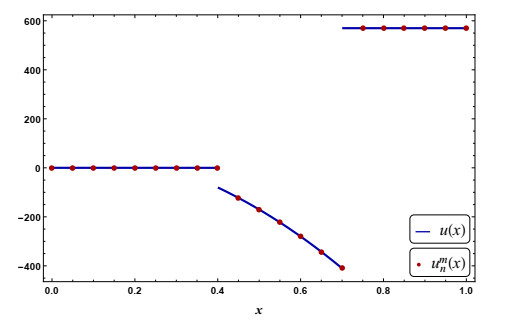
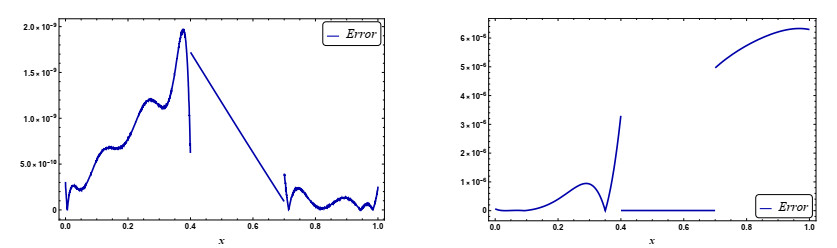
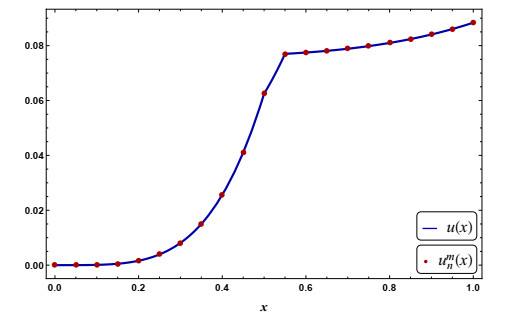
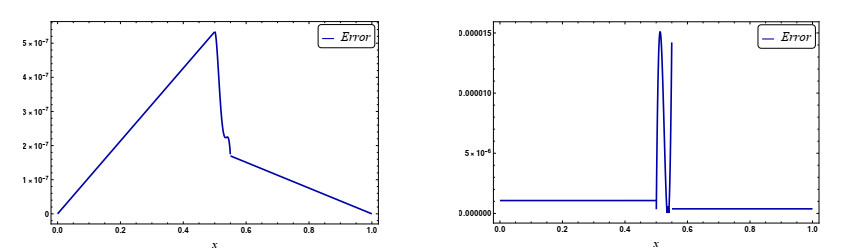
Figures(4) / Tables(5)

Min Wu, Jiali Zhou, Chaoyue Guan, Jing Niu. A numerical method using Legendre polynomials for solving two-point interface problems[J]. AIMS Mathematics, 2025, 10(4): 7891-7905. doi: 10.3934/math.2025362





 DownLoad: