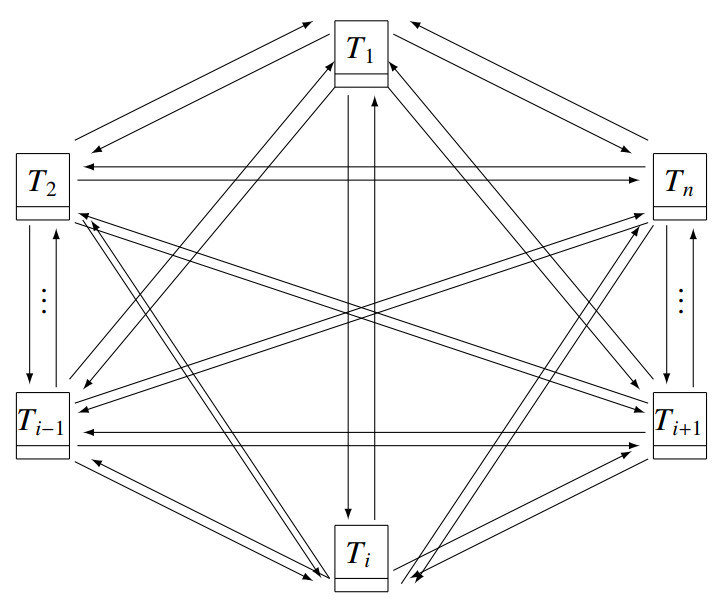
In recent years, the peer-to-peer (P2P) educational information sharing system was modeled by a system of fuzzy relation inequalities (FRIs) with addition-min or max-min composition. The max-min FRIs system was applicable to the P2P network considering the highest download traffic among the terminals. Moreover, every solution to such a max-min FRIs system corresponds exactly to one feasible flow control scheme. To embody the stability of a given feasible scheme, we introduce the concept of the widest symmetrical interval solution (WSIS), regarding the corresponding solution in the max-min FRIs system. Some effective procedures are proposed to find the WSIS regarding a provided solution. In addition, aiming to find the most stable feasible scheme, we further define the concept of a centralized solution. Some effective procedures are also proposed to find the centralized solution regarding the max-min FRIs system. Some numerical examples are provided, respectively, to demonstrate our proposed resolution procedures. Our obtained centralized solution will provide decision support for system administrators considering the stability of the feasible scheme.
Citation: Miaoxia Chen, Guocheng Zhu, Shayla Islam, Xiaopeng Yang. Centralized solution in max-min fuzzy relation inequalities[J]. AIMS Mathematics, 2025, 10(4): 7864-7890. doi: 10.3934/math.2025361
In recent years, the peer-to-peer (P2P) educational information sharing system was modeled by a system of fuzzy relation inequalities (FRIs) with addition-min or max-min composition. The max-min FRIs system was applicable to the P2P network considering the highest download traffic among the terminals. Moreover, every solution to such a max-min FRIs system corresponds exactly to one feasible flow control scheme. To embody the stability of a given feasible scheme, we introduce the concept of the widest symmetrical interval solution (WSIS), regarding the corresponding solution in the max-min FRIs system. Some effective procedures are proposed to find the WSIS regarding a provided solution. In addition, aiming to find the most stable feasible scheme, we further define the concept of a centralized solution. Some effective procedures are also proposed to find the centralized solution regarding the max-min FRIs system. Some numerical examples are provided, respectively, to demonstrate our proposed resolution procedures. Our obtained centralized solution will provide decision support for system administrators considering the stability of the feasible scheme.

| [1] | E. Sanchez, Resolution of composite fuzzy relation equations, Inf. Control, 30 (1976), 38–48. |
| [2] | W. Pedrycz, Granular Computing: Analysis and Design of Intelligent Systems, Boca Raton: CRC Press, 2018. |
| [3] | A. Di Nola, W. Pedrycz, S. Sessa, P. Z. Wang, Fuzzy relation equation under a class of triangular norms: A survey and new results, In: Readings in Fuzzy Sets for Intelligent Systems, Amsterdam: Elsevier, 1993,166–189. https://doi.org/10.1016/B978-1-4832-1450-4.50018-3 |
| [4] |
M. Miyakoshi, M. Shimbo, Solutions of composite fuzzy relational equations with triangular norms, Fuzzy Sets Syst., 16 (1985), 53–63. https://doi.org/10.1016/S0165-0114(85)80005-1 doi: 10.1016/S0165-0114(85)80005-1

|
| [5] | W. Pedrycz, Fuzzy relational equations with triangular norms and their resolutions, BUSEFAL, 11 (1982), 24–32. |
| [6] |
W. Pedrycz, On generalized fuzzy relational equations and their applications, J. Math. Anal. Appl., 107 (1985), 520–536. https://doi.org/10.1016/0022-247X(85)90329-4 doi: 10.1016/0022-247X(85)90329-4
|
| [7] | B. De Baets, Analytical Solution Methods for Fuzzy Relational Equations, : Fundamentals of Fuzzy Sets, Boston: Springer, 2000,291–340. https://doi.org/10.1007/978-1-4615-4429-6_7 |
| [8] | A. Di Nola, E. Sanchez, W. Pedrycz, S. Sessa, Fuzzy relation equations and their applications to knowledge engineering, Dordrecht: Springer, 1989. https://doi.org/10.1007/978-94-017-1650-5 |
| [9] | P. K. Li, S. C. Fang, On the resolution and optimization of a system of fuzzy relational equations with sup-t composition, Fuzzy Opt. Decis. Making, 7 (2008), 169–214. |
| [10] |
B.-S. Shieh, Solutions of fuzzy relation equations based on continuous t-norms, Inf. Sci., 177 (2007), 4208–4215. https://doi.org/10.1016/j.ins.2007.04.006 doi: 10.1016/j.ins.2007.04.006
|
| [11] |
S. Wang, H. Li, Column stacking approach to resolution of systems of fuzzy relational inequalities, J. Franklin Inst., 356 (2019), 3314–3332. https://doi.org/10.1016/j.jfranklin.2019.02.007 doi: 10.1016/j.jfranklin.2019.02.007
|
| [12] |
J. Drewniak, Fuzzy relation equations and inequalities, Fuzzy Sets Syst., 14 (1984), 237–247. https://doi.org/10.1016/0165-0114(84)90084-8 doi: 10.1016/0165-0114(84)90084-8
|
| [13] |
P. Z. Wang, D. Z. Zhang, E. Sanchez, E. S. Lee, Latticized linear programming and fuzzy relation inequalities, J. Math. Anal. Appl., 159 (1991), 72–87. https://doi.org/10.1016/0022-247X(91)90222-L doi: 10.1016/0022-247X(91)90222-L
|
| [14] |
F. F. Guo, L. P. Pang, D. Meng, Z. Q. Xia, An algorithm for solving optimization problems with fuzzy relational inequality constraints, Inf. Sci., 252 (2013), 20–31. https://doi.org/10.1016/j.ins.2011.09.030 doi: 10.1016/j.ins.2011.09.030
|
| [15] | J. X. Li, S. J. Yang, Fuzzy relation equalities about the data transmission mechanism in bittorrent-like peer-to-peer file sharing systems, Proceedings of the 2012 9th International Conference on Fuzzy Systems and Knowledge Discovery, 2012. Available from: https://doi.org/10.1109/FSKD.2012.6233956 |
| [16] |
X. P. Yang, H. T. Lin, X. G. Zhou, B. Y. Cao, Addition-min fuzzy relation inequalities with application in BitTorrent-like Peer-to-Peer file sharing system, Fuzzy Sets Syst., 343 (2018), 126–140. https://doi.org/10.1016/j.fss.2017.04.002 doi: 10.1016/j.fss.2017.04.002
|
| [17] | M. Li, X. Wang, Minimal solutions of fuzzy relation inequalities with addition-min composition and their applications, IEEE Trans. Fuzzy Syst., 31 (2023), 1665–1675. https://ieeexplore.ieee.org/document/9917301/ |
| [18] |
X. P. Yang, X. G. Zhou, B. Y. Cao, Min-max programming problem subject to addition-min fuzzy relation inequalities, IEEE Trans. Fuzzy Syst., 24 (2016), 111–119. https://doi.org/10.1109/TFUZZ.2015.2428716 doi: 10.1109/TFUZZ.2015.2428716
|
| [19] |
Y. K. Wu, S. M. Guu, Solving minimal-optimal solutions for the generalized min-max programming problem with addition-min composition, Fuzzy Sets Syst., 477 (2024), 108825. https://doi.org/10.1016/j.fss.2023.108825 doi: 10.1016/j.fss.2023.108825
|
| [20] |
X. Yang, Leximax minimum solution of addition-min fuzzy relation inequalities, Inf. Sci., 524 (2020), 184–198. https://doi.org/10.1016/j.ins.2020.03.047 doi: 10.1016/j.ins.2020.03.047
|
| [21] |
X. Yang, Random-term-absent addition-min fuzzy relation inequalities and their lexicographic minimum solutions, Fuzzy Sets Syst., 440 (2022), 42–61. https://doi.org/10.1016/j.fss.2021.08.007 doi: 10.1016/j.fss.2021.08.007
|
| [22] |
J. Qiu, X. Yang, Min-max programming problem with constraints of addition-min-product fuzzy relation inequalities, Fuzzy Opt. Decis. Making, 21 (2022), 291–317. https://doi.org/10.1007/s10700-021-09368-7 doi: 10.1007/s10700-021-09368-7
|
| [23] |
Y. K. Wu, S. M. Guu, F. H. Yang, K. M. Chang, On min-max optimization for systems with addition-min-product fuzzy relational inequalities, Int. J. Fuzzy Syst., 24 (2022), 2631–2642. https://doi.org/10.1007/s40815-022-01316-w doi: 10.1007/s40815-022-01316-w
|
| [24] | Y. Zhong, G. Xiao, X. Yang, Fuzzy relation lexicographic programming for modelling P2P file sharing system, Soft Comput., 23 (2019), 3605–3614. |
| [25] | G. Xiao, K. Hayat, X. Yang, Evaluation and its derived classification in a Server-to-Client architecture based on the fuzzy relation inequality, Fuzzy Opt. Decis. Making, 22 (2023), 213–245. |
| [26] |
X. Yang, Evaluation model and approximate solution to inconsistent max-min fuzzy relation inequalities in P2P file sharing system, Complexity, 2019 (2019), 6901818. https://doi.org/10.1155/2019/6901818 doi: 10.1155/2019/6901818
|
| [27] |
X. B Yang, X. P Yang, K. Hayat, A new characterisation of the minimal solution set to max-min fuzzy relation inequalities, Fuzzy Inf. Eng., 9 (2017), 423–435. https://doi.org/10.1016/j.fiae.2017.12.002 doi: 10.1016/j.fiae.2017.12.002
|
| [28] |
G. Xiao, T. Zhu, Y. Chen, X. Yang, Linear searching method for solving approximate solution to system of max-min fuzzy relation equations with application in the instructional information resources allocation, IEEE Access, 7 (2019), 65019–65028. https://doi.org/10.1109/ACCESS.2019.2912217 doi: 10.1109/ACCESS.2019.2912217
|
| [29] |
C. Wen, Y. Wu, Z. Li, Algebraic formulae for solving systems of max-min inverse fuzzy relational equations, Inf. Sci., 622 (2023), 1162–1183. https://doi.org/10.1016/j.ins.2022.11.123 doi: 10.1016/j.ins.2022.11.123
|
| [30] | X. P. Yang, Linear programming method for solving semi-latticized fuzzy relation geometric programming with max-min composition, Int. J. Uncertainty, Fuzziness Knowl.-Based Syst., 23 (2015), 781–804. |
| [31] |
X. G. Zhou, X. P. Yang, B. Y. Cao, Posynomial geometric programming problem subject to max-min fuzzy relation equations, Inf. Sci., 328 (2016), 15–25. https://doi.org/10.1016/j.ins.2015.07.058 doi: 10.1016/j.ins.2015.07.058
|
| [32] | X. Yang, X. Zhou, B. Cao, Y. Hong, Variable substitution method for solving single-variable term fuzzy relation geometric programming problem and its application, Int. J. Uncertainty, Fuzziness Knowl.-Based Syst., 27 (2019), 537–557. |
| [33] |
Y. B. Ma, X. B. Yang, B. Y. Cao, Fuzzy-Relation-Based lexicographic minimum solution to the P2P network system, IEEE Access, 8 (2020), 195447–195458. https://doi.org/10.1109/ACCESS.2020.3034279 doi: 10.1109/ACCESS.2020.3034279
|
| [34] |
Y. Chen, X. Liu, L. Zhang, Interval solution to fuzzy relation inequality with application in P2P educational information resource sharing systems, IEEE Access, 9 (2021), 96166–96175. https://doi.org/10.1109/ACCESS.2021.3092745 doi: 10.1109/ACCESS.2021.3092745
|
| [35] |
L. Zhang, Max-min fuzzy bi-level programming: resource sharing system with application, Appl. Math. Sci. Eng., 32 (2024), 2335319. https://doi.org/10.1080/27690911.2024.2335319 doi: 10.1080/27690911.2024.2335319
|
| [36] |
L. Zhang, Optimal symmetric interval solution of fuzzy relation inequality considering the stability in P2P educational information resources sharing system, Fuzzy Sets Syst., 478 (2024), 108835. https://doi.org/10.1016/j.fss.2023.108835 doi: 10.1016/j.fss.2023.108835
|
Figures(1)

Miaoxia Chen, Guocheng Zhu, Shayla Islam, Xiaopeng Yang. Centralized solution in max-min fuzzy relation inequalities[J]. AIMS Mathematics, 2025, 10(4): 7864-7890. doi: 10.3934/math.2025361





 DownLoad: