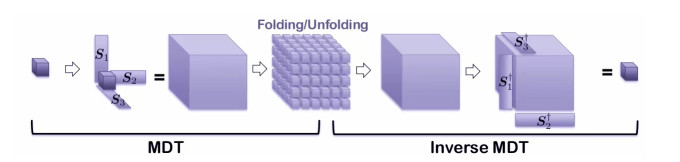
In this paper, we put up with a new algorithm for tensor completion problems that include missing slices or row/column fibers, where embedding a structured tensor by a multi-way delay-embedding transform (MDT) makes the tensor to be completed have a special structure. The main idea is to employ a tensor completion algorithm based on the tensor ring rank, constructing latent tensor ring factors with a structure that approximates the original tensor starting from the tensor structure. It is also proved that the sequence generated by the new algorithm converges to the optimal solution. Finally, the feasibility of the proposed algorithm is verified by experiments. Compared with other completed algorithms based on tensor ring rank, the completed accuracy is improved, up to 30%.
Citation: Ruiping Wen, Tingyan Liu, Yalei Pei. A new algorithm by embedding structured data for low-rank tensor ring completion[J]. AIMS Mathematics, 2025, 10(3): 6492-6511. doi: 10.3934/math.2025297
In this paper, we put up with a new algorithm for tensor completion problems that include missing slices or row/column fibers, where embedding a structured tensor by a multi-way delay-embedding transform (MDT) makes the tensor to be completed have a special structure. The main idea is to employ a tensor completion algorithm based on the tensor ring rank, constructing latent tensor ring factors with a structure that approximates the original tensor starting from the tensor structure. It is also proved that the sequence generated by the new algorithm converges to the optimal solution. Finally, the feasibility of the proposed algorithm is verified by experiments. Compared with other completed algorithms based on tensor ring rank, the completed accuracy is improved, up to 30%.

| [1] | A. E. Water, A. C. Sankaranarayanan, R. G. Baraniuk, SpaRCS: recovering low-rank and sparse matrices from compressive measurements, In: NIPS'11: Proceedings of the 25th international conference on neural information processing systems, 2011, 1089–1097. |
| [2] | M. Bertalmio, G. Sapiro, V. Caselles, C. Ballester, Image inpainting, In: SIGGRAPH '00: Proceedings of the 27th annual conference on computer graphics and interactive techniques, 2000,417–424. https://doi.org/10.1145/344779.344972 |
| [3] | N. Komodakis, Image completion using global optimization, In: 2006 IEEE computer society conference on computer vision and pattern recognition (CVPR'06), IEEE, New York, NY, USA, 17–22 June 2006,442–452. https://doi.org/10.1109/CVPR.2006.141 |
| [4] |
M. Mørup, Applications of tensor (multiway array) factorizations and decompositions in data mining, WIRS Data Min. Knowl., 1 (2011), 24–40. https://doi.org/10.1002/widm.1 doi: 10.1002/widm.1

|
| [5] |
P. Comon, X. Luciani, A. L. F. de Almeida, Tensor decompositions, alternating least squares and other tales, J. Chemom., 23 (2009), 393–405. https://doi.org/10.1002/cem.1236 doi: 10.1002/cem.1236
|
| [6] |
Q. Q. Shi, J. M. Yin, J. J. Cai, A. Cichocki, T. Yokota, L. Chen, et al., Block Hankel tensor ARIMA for mnltiple short time series forecasting, Proceedings of the AAAI Conference on Artificial Intelligence, 34 (2020), 5758–5766. https://doi.org/10.1609/aaai.v34i04.6032 doi: 10.1609/aaai.v34i04.6032
|
| [7] |
M. Signoretto, R. Van de Plas, B. De Moor, J. A. K. Suykens, Tensor versus matrix completion: a comparison with application to spectral data, IEEE Signal Process. Lett., 18 (2011), 403–406. https://doi.org/10.1109/LSP.2011.2151856 doi: 10.1109/LSP.2011.2151856
|
| [8] |
J. Liu, P. Musialski, P. Wonka, J. P. Ye, Tensor completion for estimating missing values in visual data, IEEE Trans. Pattern Anal. Mach. Intell., 35 (2013), 208–220. https://doi.org/10.1109/TPAMI.2012.39 doi: 10.1109/TPAMI.2012.39
|
| [9] |
F. L. Hitchcock, The expression of a tensor or a polyadic as a sum of products, Journal of Mathematics and Physics, 6 (1927), 164–189. https://doi.org/10.1002/sapm192761164 doi: 10.1002/sapm192761164
|
| [10] |
L. R. Tucker, R. F. Koopman, R. L. Linn, Evaluation of factor analytic research procedures by means of simulated correlation matrices, Psychometrika, 34 (1969), 421–459. https://doi.org/10.1007/BF02290601 doi: 10.1007/BF02290601
|
| [11] |
I. V. Oseledets, Tensor-train decomposition, SIAM J. Sci. Comput., 33 (2011), 2295–2317. https://doi.org/10.1137/090752286 doi: 10.1137/090752286
|
| [12] | Q. B. Zhao, G. X. Zhou, S. L. Xie, L. Q. Zhang, A. Cichocki, Tensor ring decomposition, arXiv: 1606.05535. |
| [13] |
Y. Y. Xu, W. T. Yin, A block coordinate descent method for regularized multiconvex optimization with applications to nonnegative tensor factorization and completion, SIAM Journal Imaging Sci., 6 (2013), 1758–1789. https://doi.org/10.1137/120887795 doi: 10.1137/120887795
|
| [14] |
Y. Y. Liu, F. H. Shang, L. C. Jiao, J. Cheng, H. Cheng, Trace norm regularized candecomp/parafac decomposition with missing data, IEEE Trans. Cybernetics, 45 (2015), 2437–2448. https://doi.org/10.1109/TCYB.2014.2374695 doi: 10.1109/TCYB.2014.2374695
|
| [15] |
J. A. Bengua, H. N. Phien, H. D. Tuan, M. N. Do, Efficient tensor completion for color image and video recovery: low-rank tensor train, IEEE Trans. Image Process., 26 (2017), 2466–2479. https://doi.org/10.1109/TIP.2017.2672439 doi: 10.1109/TIP.2017.2672439
|
| [16] |
Z. M. Zhang, S. Aeron, Exact tensor completion using t-svd, IEEE Trans. Signal Process., 65 (2017), 1511–1526. https://doi.org/10.1109/TSP.2016.2639466 doi: 10.1109/TSP.2016.2639466
|
| [17] |
Q. B. Zhao, L. Q. Zhang, A. Cichocki, Bayesian CP factorization of incomplete tensors with automatic rank determination, IEEE Trans. Pattern Anal. Mach. Intell., 37 (2015), 1751–1763. https://doi.org/10.1109/tpami.2015.2392756 doi: 10.1109/tpami.2015.2392756
|
| [18] |
X. Y. Chen, Z. C. He, L. J. Sun, A Bayesian tensor decomposition approach for spatiotemporal traffic data imputation, Transport. Res. C: Emer., 98 (2019), 73–84. https://doi.org/10.1016/j.trc.2018.11.003 doi: 10.1016/j.trc.2018.11.003
|
| [19] |
Z. Long, C. Zhu, J. N. Liu, Y. P. Liu, Bayesian low rank tensor ring for image recovery, IEEE Trans. Image Process., 30 (2021), 3568–3580. https://doi.org/10.1109/TIP.2021.3062195 doi: 10.1109/TIP.2021.3062195
|
| [20] | L. H. Yuan, J. T. Cao, X. Y. Zhao, Q. Wu, Q. B. Zhao, Higher-dimension tensor completion via low-rank tensor ring decomposition, In: 2018 Asia-Pacific signal and information processing association annual summit and conference (APSIPA ASC), IEEE, Honolulu, HI, USA, 12–15 November 2018, 1071–1076. https://doi.org/10.23919/APSIPA.2018.8659708 |
| [21] | Q. B. Zhao, M. Sugiyama, L. H. Yuan, A. Cichocki, Learning efficient tensor representations with ring-structured networks, In: ICASSP 2019 - 2019 IEEE international conference on acoustics, speech and signal processing (ICASSP), Brighton, UK, 12–17 May 2019, 8608–8612. https://doi.org/10.1109/ICASSP.2019.8682231 |
| [22] |
J. Z. Xue, Y. Q. Zhao, S. G. Huang, W. Z. Liao, J. C.-W. Chan, S. G. Kong, Multilayer sparsity-based tensor decomposition for low-rank tensor completion, IEEE Trans. Neur. Net. Learn. Syst., 33 (2022), 6916–6930. https://doi.org/10.1109/tnnls.2021.3083931 doi: 10.1109/tnnls.2021.3083931
|
| [23] |
J. Z. Xue, Y. Q. Zhao, Y. Y. Bu, J. C.-W. Chan, S. G. Kong, When Laplacian scale mixture meets three-layer transform: a parametric tensor sparsity for tensor completion, IEEE Trans. Cybernetics, 52 (2022), 13887–13901. https://doi.org/10.1109/TCYB.2021.3140148 doi: 10.1109/TCYB.2021.3140148
|
| [24] |
J. Z. Xue, Y.-Q. Zhao, T. L. Wu, J. C.-W. Chan, Tensor convolution-like low-rank dictionary for high-dimensional image representatio, IEEE Trans. Circ. Syst. Vid., 34 (2024), 13257–13270. https://doi.org/10.1109/TCSVT.2024.3442295 doi: 10.1109/TCSVT.2024.3442295
|
| [25] | T. Ding, M. Sznaier, O. I. Camps, A rank minimization approach to video inpainting, In: 2007 IEEE 11th international conference on computer vision, IEEE, Riode Janeiro, Brazil, October 2007, 1–8. https://doi.org/10.1109/ICCV.2007.4408932 |
| [26] |
E. N. Lorenz, Deterministic nonperiodic flow, J. Atmos. Sci., 20 (1963), 130–141. https://doi.org/10.1175/1520-0469(1963)020<0130:DNF>2.0.CO; 2 doi: 10.1175/1520-0469(1963)020<0130:DNF>2.0.CO; 2
|
| [27] |
I. Markovsky, Structured low-rank approximation and its applications, Automatica, 44 (2008), 891–909. https://doi.org/10.1016/j.automatica.2007.09.011 doi: 10.1016/j.automatica.2007.09.011
|
| [28] | P. Van Overschee, B. De Moor, Subspace algorithms for the stochastic identification problem, In: [1991] Proceedings of the 30th IEEE conference on decision and control, IEEE, Brighton, UK, 11–13 December 1991, 1321–1326. https://doi.org/10.1109/CDC.1991.261604 |
| [29] |
Y. Li, K. J. R. Liu, J. Razavilar, A parameter estimation scheme for damped sinusoidal signals based on low-rank Hankel approximation, IEEE Trans. Signal Process., 45 (1997), 481–486. https://doi.org/10.1109/78.554314 doi: 10.1109/78.554314
|
| [30] | W. Q. Wang, V. Aggarwal, S. Aeron, Efficient low rank tensor ring completion, In: 2017 IEEE international conference on computer vision (ICCV), IEEE, Venice, Italy, 22–29 October 2017, 5698–5706. https://doi.org/10.1109/ICCV.2017.607 |
| [31] | T. Yokota, B. Erem, S. Guler, S. K. Warfield, H. Hontani, Missing slice recovery for tensors using a low-rank model in embedded space, In: 2018 IEEE/CVF conference on computer vision and pattern recognition, IEEE, Salt Lake City, UT, USA, 18–23 June 2018, 8251–8259. https://doi.org/10.1109/CVPR.2018.00861 |
| [32] |
Y. Li, K. J. R. Liu, J. RazavilarK, A parameter estimation scheme for damped sinusoidal signals based on low-rank Hankel approximation, IEEE Trans. Signal Process., 45 (1997), 481–486. https://doi.org/10.1109/78.554314 doi: 10.1109/78.554314
|
| [33] |
T. G. Kolda, B. W. Bader, Tensor decompositions and applications, SIAM Rev., 51 (2009), 455–500. https://doi.org/10.1137/07070111X doi: 10.1137/07070111X
|
| [34] | G. H. Golub, C. F. Van Loan, Matrix computations, 4 Eds., Johns Hopkins University Press, 2014. |
| [35] |
J. F. Cai, E. J. Candès, Z. W. Shen, A singular value thresholding algorithm for matrix completion, SIAM J. Ooptimiz., 20 (2010), 1956–1982. https://doi.org/10.1137/080738970 doi: 10.1137/080738970
|
| [36] |
C. J. Hillar, L.-H. Lim, Most tensor problems are NP-hard, J. ACM, 60 (2013), 45. https://doi.org/10.1145/2512329 doi: 10.1145/2512329
|
| [37] |
M. Signoretto, Q. T. Dinh, L. De Lathauwer, J. A. K. Suykens, Learning with tensors: a framework based on convex optimization and spectral regularization, Mach. Learn., 94 (2014), 303–351. https://doi.org/10.1007/s10994-013-5366-3 doi: 10.1007/s10994-013-5366-3
|
| [38] |
L. H. Yuan, C. Li, D. Mandic, J. T. Cao, Q. B. Zhao, Tensor ring decomposition with rank minimization on latent space: an efficient approach for tensor completion, Proceedings of the AAAI Conference on Artificial Intelligence, 33 (2019), 9151–9158. https://doi.org/10.1609/aaai.v33i01.33019151 doi: 10.1609/aaai.v33i01.33019151
|
| [39] | Z. C. Lin, M. M. Chen, Y. Ma, The augmented Lagrange multiplier method for exact recovery of corrupted low-rank matrices, arXiv: 1009.5055. |
| [40] |
Z. Wang, A. C. Bovik, H. R. Sheikh, E. P. Simoncelli, Image quality assessment: from error visibility to structural similarity, IEEE Trans. Image Process., 13 (2004), 600–612. https://doi.org/10.1109/TIP.2003.819861 doi: 10.1109/TIP.2003.819861
|
Figures(6) / Tables(3)

Ruiping Wen, Tingyan Liu, Yalei Pei. A new algorithm by embedding structured data for low-rank tensor ring completion[J]. AIMS Mathematics, 2025, 10(3): 6492-6511. doi: 10.3934/math.2025297





 DownLoad: