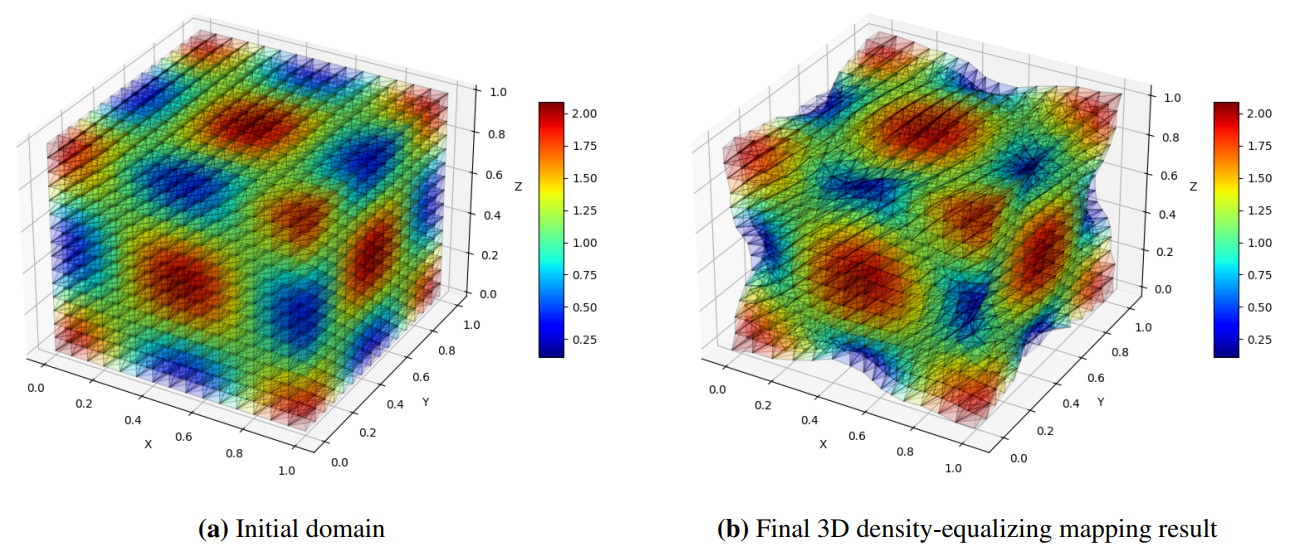
A density-equalizing map (DEM) serves as a powerful technique for creating shape deformations with the area changes reflecting an underlying density function. In recent decades, DEMs have found widespread applications in fields such as data visualization, geometry processing, and medical imaging. Traditional approaches to the DEM primarily rely on iterative numerical solvers for diffusion equations or optimization-based methods that minimize handcrafted energy functionals. However, these conventional techniques often face several challenges: they may suffer from limited accuracy, produce overlapping artifacts in extreme cases, and require substantial algorithmic redesign when extended from 2D to 3D, due to the derivative-dependent nature of their energy formulations. In this work, we proposed a novel learning-based density-equalizing mapping framework (LDEM) using deep neural networks. Specifically, we introduced a loss function that enforces density uniformity and geometric regularity, and utilized a hierarchical approach to predict the transformations at both the coarse and dense levels. Our method demonstrated superior density-equalizing and bijectivity properties compared to prior methods for a wide range of simple and complex density distributions, and can be easily applied to surface remeshing with different effects. Also, it generalizes seamlessly from 2D to 3D domains without structural changes to the model architecture or loss formulation. Altogether, our work opens up new possibilities for scalable and robust computation of density-equalizing maps for practical applications.
Citation: Yanwen Huang, Lok Ming Lui, Gary P. T. Choi. Learning-based density-equalizing map[J]. AIMS Mathematics, 2025, 10(11): 25756-25790. doi: 10.3934/math.20251140
A density-equalizing map (DEM) serves as a powerful technique for creating shape deformations with the area changes reflecting an underlying density function. In recent decades, DEMs have found widespread applications in fields such as data visualization, geometry processing, and medical imaging. Traditional approaches to the DEM primarily rely on iterative numerical solvers for diffusion equations or optimization-based methods that minimize handcrafted energy functionals. However, these conventional techniques often face several challenges: they may suffer from limited accuracy, produce overlapping artifacts in extreme cases, and require substantial algorithmic redesign when extended from 2D to 3D, due to the derivative-dependent nature of their energy formulations. In this work, we proposed a novel learning-based density-equalizing mapping framework (LDEM) using deep neural networks. Specifically, we introduced a loss function that enforces density uniformity and geometric regularity, and utilized a hierarchical approach to predict the transformations at both the coarse and dense levels. Our method demonstrated superior density-equalizing and bijectivity properties compared to prior methods for a wide range of simple and complex density distributions, and can be easily applied to surface remeshing with different effects. Also, it generalizes seamlessly from 2D to 3D domains without structural changes to the model architecture or loss formulation. Altogether, our work opens up new possibilities for scalable and robust computation of density-equalizing maps for practical applications.

| [1] |
M. T. Gastner, M. E. J. Newman, Diffusion-based method for producing density-equalizing maps, Proc. Natl. Acad. Sci., 101 (2004), 7499–7504. https://doi.org/10.1073/pnas.0400280101 doi: 10.1073/pnas.0400280101

|
| [2] |
H. Sun, Z. Li, Effectiveness of cartogram for the representation of spatial data, Cartogr. J., 47 (2010), 12–21. https://doi.org/10.1179/000870409X12525737905169 doi: 10.1179/000870409X12525737905169
|
| [3] | S. Nusrat, S. Kobourov, The state of the art in cartograms, Comput. Graph. Forum, 35 (2016), 619–642. |
| [4] | M. Hogräfer, M. Heitzler, H. J. Schulz, The state of the art in map-like visualization, Comput. Graph. Forum, 39 (2020), 647–674. |
| [5] |
K. S. Gleditsch, M. D. Ward, Diffusion and the international context of democratization, Int. Organ., 60 (2006), 911–933. https://doi.org/10.1017/S0020818306060309 doi: 10.1017/S0020818306060309
|
| [6] |
R. Arundel, C. Hochstenbach, Divided access and the spatial polarization of housing wealth, Urban Geogr., 41 (2020), 497–523. https://doi.org/10.1080/02723638.2019.1681722 doi: 10.1080/02723638.2019.1681722
|
| [7] |
V. Colizza, A. Barrat, M. Barthélemy, A. Vespignani, The role of the airline transportation network in the prediction and predictability of global epidemics, Proc. Natl. Acad. Sci., 103 (2006), 2015–2020. https://doi.org/10.1073/pnas.0510525103 doi: 10.1073/pnas.0510525103
|
| [8] |
J. R. M. H. Lenoir, R. R. Bertrand, L. Comte, L. Bourgeaud, T. Hattab, J. Murienne, et al., Species better track climate warming in the oceans than on land, Nat. Ecol. Evol., 4 (2020), 1044–1059. https://doi.org/10.1038/s41559-020-1198-2 doi: 10.1038/s41559-020-1198-2
|
| [9] |
M. Pratt, O. L. Sarmiento, F. Montes, D. Ogilvie, B. H. Marcus, L. G. Perez, et al., The implications of megatrends in information and communication technology and transportation for changes in global physical activity, Lancet, 380 (2012), 282–293. https://doi.org/10.1016/S0140-6736(12)60736-3 doi: 10.1016/S0140-6736(12)60736-3
|
| [10] | A. Mislove, S. Lehmann, Y. Y. Ahn, J. P. Onnela, J. N. Rosenquist, Understanding the demographics of Twitter users, Proceedings of the International AAAI Conference on Web and Social Media, 2011, 554–557. |
| [11] | J. Murphy, J. Zhu, Neo-colonialism in the academy? Anglo-American domination in management journals, Organization, 19 (2012), 915–927. |
| [12] |
R. K. Pan, K. Kaski, S. Fortunato, World citation and collaboration networks: uncovering the role of geography in science, Sci. Rep., 2 (2012), 902. https://doi.org/10.1038/srep00902 doi: 10.1038/srep00902
|
| [13] |
G. P. T. Choi, B. Chiu, C. H. Rycroft, Area-preserving mapping of 3D carotid ultrasound images using density-equalizing reference map, IEEE Trans. Biomed. Eng., 67 (2020), 1507–1517. https://doi.org/10.1109/TBME.2019.2963783 doi: 10.1109/TBME.2019.2963783
|
| [14] |
G. P. T. Choi, C. H. Rycroft, Density-equalizing maps for simply connected open surfaces, SIAM J. Imaging Sci., 11 (2018), 1134–1178. https://doi.org/10.1137/17M1124796 doi: 10.1137/17M1124796
|
| [15] |
Z. Lyu, G. P. T. Choi, L. M. Lui, Bijective density-equalizing quasiconformal map for multiply connected open surfaces, SIAM J. Imaging Sci., 17 (2024), 706–755. https://doi.org/10.1137/23M1594376 doi: 10.1137/23M1594376
|
| [16] |
G. P. T. Choi, C. H. Rycroft, Volumetric density-equalizing reference maps with applications, J. Sci. Comput., 86 (2021), 41. https://doi.org/10.1007/s10915-021-01411-4 doi: 10.1007/s10915-021-01411-4
|
| [17] |
W. R. Tobler, A continuous transformation useful for districting, Ann. N. Y. Acad. Sci., 219 (1973), 215–220. https://doi.org/10.1111/j.1749-6632.1973.tb41401.x doi: 10.1111/j.1749-6632.1973.tb41401.x
|
| [18] |
J. A. Dougenik, N. R. Chrisman, D. R. Niemeyer, An algorithm to construct continuous area cartograms, Prof. Geogr., 37 (1985), 75–81. https://doi.org/10.1111/j.0033-0124.1985.00075.x doi: 10.1111/j.0033-0124.1985.00075.x
|
| [19] | D. Dorling, Area cartograms: their use and creation, Concepts and Techniques in Modern Geography series no. 59, Environmental Publications, University of East Anglia, 1996. |
| [20] |
M. T. Gastner, V. Seguy, P. More, Fast flow-based algorithm for creating density-equalizing map projections, Proc. Natl. Acad. Sci., 115 (2018), E2156–E2164. https://doi.org/10.1073/pnas.1712674115 doi: 10.1073/pnas.1712674115
|
| [21] |
A. Arranz-López, J. A. Soria-Lara, A. Ariza-Álvarez, An end-user evaluation to analyze the effectiveness of cartograms for mapping relative non-motorized accessibility, Environ. Plan B: Urban Anal. City Sci., 48 (2021), 2880–2897. https://doi.org/10.1177/2399808321991541 doi: 10.1177/2399808321991541
|
| [22] |
Z. Li, S. Aryana, Diffusion-based cartogram on spheres, Cartogr. Geogr. Inf. Sci., 45 (2018), 464–475. https://doi.org/10.1080/15230406.2017.1408033 doi: 10.1080/15230406.2017.1408033
|
| [23] |
Z. Lyu, L. M. Lui, G. P. T. Choi, Spherical density-equalizing map for genus-0 closed surfaces, SIAM J. Imaging Sci., 17 (2024), 2110–2141. https://doi.org/10.1137/24M1633911 doi: 10.1137/24M1633911
|
| [24] | Z. Lyu, L. M. Lui, G. P. T. Choi, Ellipsoidal density-equalizing map for genus-0 closed surfaces, arXiv Preprint, 2024. https://doi.org/10.48550/arXiv.2410.12331 |
| [25] |
S. Yao, G. P. T. Choi, Toroidal density-equalizing map for genus-one surfaces, J. Comput. Appl. Math., 472 (2026), 116844. https://doi.org/10.1016/j.cam.2025.116844 doi: 10.1016/j.cam.2025.116844
|
| [26] |
M. Shaqfa, G. P. T. Choi, G. Anciaux, K. Beyer, Disk harmonics for analysing curved and flat self-affine rough surfaces and the topological reconstruction of open surfaces, J. Comput. Phys., 522 (2025), 113578. https://doi.org/10.1016/j.jcp.2024.113578 doi: 10.1016/j.jcp.2024.113578
|
| [27] |
G. P. T. Choi, M. Shaqfa, Hemispheroidal parameterization and harmonic decomposition of simply connected open surfaces, J. Comput. Appl. Math., 461 (2025), 116455. https://doi.org/10.1016/j.cam.2024.116455 doi: 10.1016/j.cam.2024.116455
|
| [28] | Z. Li, S. A. Aryana, Visualization of subsurface data using three-dimensional cartograms, Advances in Remote Sensing and Geo Informatics Applications: Proceedings of the 1st Springer Conference of the Arabian Journal of Geosciences (CAJG-1), Tunisia 2018, Springer, 2019, 17–19. https://doi.org/10.1007/978-3-030-01440-7_4 |
| [29] | I. Goodfellow, Y. Bengio, A. Courville, Deep learning, MIT Press, 2016. Available from: http://www.deeplearningbook.org. |
| [30] | A. Weiser, S. E. Zarantonello, A note on piecewise linear and multilinear table interpolation in many dimensions, Math. Comput., 50 (1988), 189–196. |




Figures(26) / Tables(3)

Yanwen Huang, Lok Ming Lui, Gary P. T. Choi. Learning-based density-equalizing map[J]. AIMS Mathematics, 2025, 10(11): 25756-25790. doi: 10.3934/math.20251140





 DownLoad: