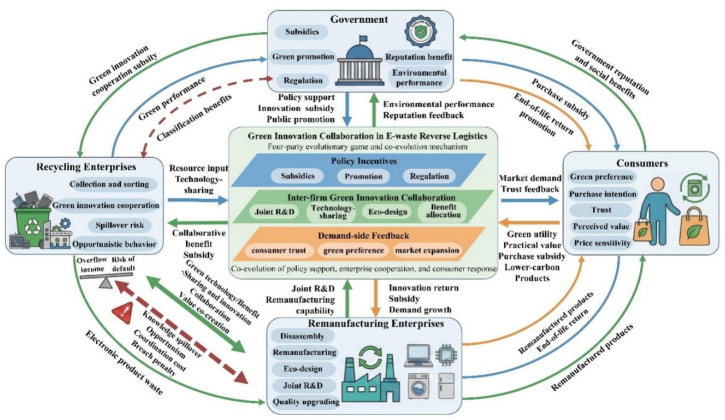
In the context of tightening energy constraints and increasing resource security risks, inadequate collaborative governance in reverse logistics networks has become a critical bottleneck constraining the efficiency of urban mining. However, the literature on reverse logistics governance remains largely confined to traditional supply-chain cooperation paradigms, offering limited insight into the synergistic governance mechanisms among the four parties under green innovation cooperation. This study constructs a four-party evolutionary game model involving the government, recycling enterprises, remanufacturing enterprises, and consumers from the perspective of green innovation cooperation. Green innovation spillover effects, subsidy intensity, and product pricing are integrated into a unified evolutionary framework, where system dynamics are examined through replicator dynamics, Jacobian stability analysis, and numerical simulations. The results reveal four distinct stable equilibrium states within the system. Notably, green innovation spillovers exhibit a significant threshold effect, whereby excessive spillovers undermine incentive compatibility constraints and induce opportunistic behavior. Furthermore, government subsidies exhibit stage-dependent incentive effects, with system stability requiring both internal transfer prices and terminal market prices within effective boundaries. The system converges toward an optimal collaborative equilibrium only when government incentives, enterprise cooperation, and consumer support are synergistically enhanced. These findings provide theoretical insights and practical implications for designing optimal reverse logistics policy frameworks and constructing sustainable urban mining development models.
Citation: Shuming Liu, Xiang Liu, Xianghua Liu, Ziquan Li, Jiahui Huang, Qiuzhi He. Exploring the e-waste reverse logistics governance dynamics: A four-party evolutionary game model for green innovation cooperation[J]. Journal of Industrial and Management Optimization, 2026, 22(8): 3864-3896. doi: 10.3934/jimo.2026138
In the context of tightening energy constraints and increasing resource security risks, inadequate collaborative governance in reverse logistics networks has become a critical bottleneck constraining the efficiency of urban mining. However, the literature on reverse logistics governance remains largely confined to traditional supply-chain cooperation paradigms, offering limited insight into the synergistic governance mechanisms among the four parties under green innovation cooperation. This study constructs a four-party evolutionary game model involving the government, recycling enterprises, remanufacturing enterprises, and consumers from the perspective of green innovation cooperation. Green innovation spillover effects, subsidy intensity, and product pricing are integrated into a unified evolutionary framework, where system dynamics are examined through replicator dynamics, Jacobian stability analysis, and numerical simulations. The results reveal four distinct stable equilibrium states within the system. Notably, green innovation spillovers exhibit a significant threshold effect, whereby excessive spillovers undermine incentive compatibility constraints and induce opportunistic behavior. Furthermore, government subsidies exhibit stage-dependent incentive effects, with system stability requiring both internal transfer prices and terminal market prices within effective boundaries. The system converges toward an optimal collaborative equilibrium only when government incentives, enterprise cooperation, and consumer support are synergistically enhanced. These findings provide theoretical insights and practical implications for designing optimal reverse logistics policy frameworks and constructing sustainable urban mining development models.

| [1] |
A. Kumar, A. Vishwanathan, Race for critical minerals: China's ambitions and challenges, Comp. Strategy, 44 (2025), 56–72. https://doi.org/10.1080/01495933.2024.2445490 doi: 10.1080/01495933.2024.2445490

|
| [2] |
B. Han, Y. Sim, Q. Y. Yan, N. Mathews, G. C. P. Gabriel, From electronic wastes to efficient and specific filtration membranes: A photovoltaic upcycling case enabling silver urban mining, J. Clean. Prod., 505 (2025), 145528. https://doi.org/10.1016/j.jclepro.2025.145528 doi: 10.1016/j.jclepro.2025.145528
|
| [3] |
E. A. Oke, H. Potgieter, Discarded e-waste/printed circuit boards: a review of their recent methods of disassembly, sorting and environmental implications, J. Mater. Cycles Waste Manag., 26 (2024), 1277–1293. https://doi.org/10.1007/s10163-024-01917-7 doi: 10.1007/s10163-024-01917-7
|
| [4] | C. P. Baldé, R. Kuehr, T. Yamamoto, International telecommunication union (ITU) and United Nations institute for training and research (UNITAR), Global E-waste Monitor, 2024. |
| [5] |
B. Y. Li, Q. X. Wang, B. X. Chen, T. Sun, Z. Wang, Y. B. Chen, Tripartite evolutionary game analysis of governance mechanism in Chinese WEEE recycling industry, Comput. Ind. Eng., 167 (2022), 108045. https://doi.org/10.1016/j.cie.2022.108045 doi: 10.1016/j.cie.2022.108045
|
| [6] | S. Mahore, R. Y. Mahore, S. J. Dhoble, Economics of electronic waste (e-waste): a critical review of negative externalities and the circular economy, 2023. Available from: https://www.sciencedirect.com/book/edited-volume/9780323909099/360-degree-waste-management-volume-2. |
| [7] | China Renewable Resources Recycling Association, Report on the development of China's renewable resource recycling industry, 2025. Available from: https://www.crra.org.cn. |
| [8] |
G. M. Duman, E. Kongar, ESG modeling and prediction uncertainty of electronic waste, Sustainability, 15 (2023), 11281. https://doi.org/10.3390/su151411281 doi: 10.3390/su151411281
|
| [9] |
Z. Ni, H. Chan, Z. Tan, Systematic literature review of reverse logistics for e-waste: overview, analysis, and future research agenda, Int. J. Logist. Res. Appl., 26 (2021), 843–871. https://doi.org/10.1080/13675567.2021.1993159 doi: 10.1080/13675567.2021.1993159
|
| [10] |
A. Krol, P. Nowakowski, B. Mrowczynska, How to improve WEEE management? Novel approach in mobile collection with application of artificial intelligence, Waste. Manage., 50 (2016), 222–233. https://doi.org/10.1016/j.wasman.2016.02.033 doi: 10.1016/j.wasman.2016.02.033
|
| [11] |
É. Maître-Ekern, Re-thinking producer responsibility for a sustainable circular economy from extended producer responsibility to pre-market producer responsibility, J. Clean. Prod., 286 (2021), 125454. https://doi.org/10.1016/j.jclepro.2020.125454 doi: 10.1016/j.jclepro.2020.125454
|
| [12] |
Y. Liu, Z. J. Xia, Q. Q. Shi, Q. Xu, Pricing and coordination of waste electrical and electronic equipment under third-party recycling in a closed-loop supply chain, Environ. Dev. Sustain., 23 (2021), 12077–12094. https://doi.org/10.1007/s10668-020-01158-2 doi: 10.1007/s10668-020-01158-2
|
| [13] |
L. Wang, K. Cai, Q. Song, X. Zeng, W. Yuan, J. Li, How effective are WEEE policies in China? A strategy evaluation through a PMC-index model with content analysis, Environ. Impact. Asses., 110 (2025), 107672. https://doi.org/10.1016/J.eiar.2024.107672 doi: 10.1016/J.eiar.2024.107672
|
| [14] |
P. Ji, X. Ma, G. Li, Developing green purchasing relationships for the manufacturing industry: An evolutionary game theory perspective, Int. J. Prod. Econ., 166 (2015), 155–162. https://doi.org/10.1016/j.ijpe.2014.10.009 doi: 10.1016/j.ijpe.2014.10.009
|
| [15] |
L. Cheng, M. Zhang, K. Wang, M. Yuan, Z. Liu, J. Wang, P. Huang, Evolutionary smart contracts for virtual power plant trading: integrating prospect theory and multi-stage negotiation in cross-regional energy markets, Int. J. Elec. Power., 173 (2025), 111453. https://doi.org/10.1016/j.ijepes.2025.111453 doi: 10.1016/j.ijepes.2025.111453
|
| [16] |
T. Shevchenko, K. Laitala, Y. Danko, Understanding consumer E-Waste recycling behavior: Introducing a new economic incentive to increase the collection rates, Sustainability, 11 (2019), 2656. https://doi.org/10.3390/su11092656 doi: 10.3390/su11092656
|
| [17] |
Y. Chen, J. F. Wang, Y. L. Yu, A study on consumers' willingness to pay for remanufactured products: a study based on hierarchical regression method, Front. Psychol., 10 (2019), 2044. https://doi.org/10.3389/fpsyg.2019.02044 doi: 10.3389/fpsyg.2019.02044
|
| [18] |
G. F. Liu, Y. Xu, T. T. Tian, T. Wang, Y. Liu, The impacts of China's fund policy on waste electrical and electronic equipment utilization, J. Clean. Prod., 251 (2020), 119582. https://doi.org/10.1016/j.jclepro.2019.119582 doi: 10.1016/j.jclepro.2019.119582
|
| [19] |
K. Wang, L. F. Cheng, M. Yin, K. Z. Zhang, R. K. Wang, M. Y. Zhang, et al., Evolutionary game theory in energy storage systems: A systematic review of collaborative decision-making, operational strategies, and coordination mechanisms for renewable energy integration, Sustainability, 17 (2025), 7400. https://doi.org/10.3390/su17167400 doi: 10.3390/su17167400
|
| [20] |
S. E. A. Chen, On the effectiveness of emission penalties in decentralized supply chains, Eur. J. Oper. Res., 274 (2019), 1155–1167. https://doi.org/10.1016/j.ejor.2018.11.001 doi: 10.1016/j.ejor.2018.11.001
|
| [21] |
J. F. Xiao, S. Y. Chen, J. W. Han, Z. X. Tan, S. Y. Mu, J. Y. Wang, The carbon emission reduction effect of renewable resource utilization: From the perspective of green innovation, Atmos. Pollut. Res., 15 (2024), 102121. https://doi.org/10.1016/j.apr.2024.102121 doi: 10.1016/j.apr.2024.102121
|
| [22] |
Y. H. Zhao, Z. Y. Zhao, Z. L. Qian, L. Zheng, S. Fan, S. Zuo, Is cooperative green innovation better for carbon reduction? Evidence from China, J. Clean. Prod., 394 (2023), 136400. https://doi.org/10.1016/j.jclepro.2023.136400 doi: 10.1016/j.jclepro.2023.136400
|
| [23] |
L. Ma, A. Ali, M. Shahzad, A. Khan, Factors of green innovation: the role of dynamic capabilities and knowledge sharing through green creativity, Kybernetes, 54 (2025), 54–70. https://doi.org/10.1108/K-06-2022-0911 doi: 10.1108/K-06-2022-0911
|
| [24] |
Z. X. Hu, J. G. Ma, Y. G. Zhong, J. X. Zhang, Y. F. Song, Multi-agent behavior strategies of WEEE recycling considering public participation under environmental regulation: A perspective of dual governance, J. Clean. Prod., 484 (2024), 144327. https://doi.org/10.1016/j.jclepro.2024.144327 doi: 10.1016/j.jclepro.2024.144327
|
| [25] |
W. X. Song, E. Elahi, G. S. Hou, P. M. Wang, Collaborative governance for urban waste management: A case study using evolutionary game theory, Sustain. Cities Soc., 126 (2025), 106380. https://doi.org/10.1016/j.scs.2025.106380 doi: 10.1016/j.scs.2025.106380
|
| [26] |
D. Li, F. Xu, The optimal risk choice of cooperative and non-cooperative green R & D in network industries, Technol. Anal. Strateg., 2025, 1–21. https://doi.org/10.1080/09537325.2025.2512549 doi: 10.1080/09537325.2025.2512549
|
| [27] |
L. F. Cheng, M. L. Li, C. Tan, P. Huang, M. Zhang, R. Sun, Computational game-theoretic models for adaptive urban energy systems: A comprehensive review of algorithms, strategies, and engineering applications, Arch. Comput. Method. E., 33 (2026), 2037–2114. https://doi.org/10.1007/s11831-025-10364-y doi: 10.1007/s11831-025-10364-y
|
| [28] |
M. C. J. Caniëls, W. Lambrechts, J. J. Platje, A. Motylska-Kuźma, B. Fortuński, Impressing my friends: The role of social value in green purchasing attitude for youthful consumers, J. Clean. Prod., 303 (2021), 126993. https://doi.org/10.1016/J.jclepro.2021.126993 doi: 10.1016/J.jclepro.2021.126993
|
| [29] |
Z. S. Yan, H. Q. Hu, Z. Q. Wang, Z. K. Liang, W. W. Kong, The effect of government subsidies on cooperative green innovation of supply chains from the perspective of cost sharing, J. Bus. Ind. Mark., 40 (2025), 415–431. https://doi.org/10.1108/jbim-01-2024-0051 doi: 10.1108/jbim-01-2024-0051
|
| [30] |
G. S. Zhang, X. Wang, Y. L. Wang, J. Q. Xu, A tripartite evolutionary game for the regional green logistics: the roles of government subsidy and platform's cost-sharing, Kybernetes, 53 (2024), 216–237. https://doi.org/10.1108/K-06-2022-0896 doi: 10.1108/K-06-2022-0896
|
| [31] |
X. Liu, K. Lin, L. Wang, Stochastic evolutionary game analysis of e-waste recycling in environmental regulation from the perspective of dual governance system, J. Clean. Prod., 319 (2021), 128685. https://doi.org/10.1016/j.jclepro.2021.128685 doi: 10.1016/j.jclepro.2021.128685
|
| [32] |
G. Esenduran, E. Kemahlioglu-Ziya, J. M. Swaminathan, Impact of take-back regulation on the remanufacturing industry, Prod. Oper. Manag., 26 (2017), 924–944. https://doi.org/10.1111/poms.12673 doi: 10.1111/poms.12673
|
| [33] |
X. M. Zhang, Q. W. Li, Z. Liu, C. T. Chang, Optimal pricing and remanufacturing mode in a closed-loop supply chain of WEEE under government fund policy, Comput. Ind. Eng., 151 (2021), 106951. https://doi.org/10.1016/j.cie.2020.106951 doi: 10.1016/j.cie.2020.106951
|
| [34] |
Z. Wang, J. Huo, Do government intervention measures promote e-waste recycling in China? J. Environ. Manage., 342 (2023), 118138. https://doi.org/10.1016/j.jenvman.2023.118138 doi: 10.1016/j.jenvman.2023.118138
|
| [35] |
Z. Liu, J. Tang, B. Li, Z. Wang, Trade-off between remanufacturing and recycling of WEEE and the environmental implication under the Chinese Fund Policy, J. Clean. Prod., 167 (2017), 97–109. https://doi.org/10.1016/j.jclepro.2017.08.137 doi: 10.1016/j.jclepro.2017.08.137
|
| [36] |
A. Vafadarnikjoo, N. Mishra, K. Govindan, K. Chalvatzis, Assessment of consumers' motivations to purchase a remanufactured product by applying Fuzzy Delphi method and single valued neutrosophic sets, J. Clean. Prod., 196 (2018), 230–244. https://doi.org/10.1016/j.jclepro.2018.06.037 doi: 10.1016/j.jclepro.2018.06.037
|
| [37] |
C. F. Chen, D. P. Zhang, L. Zhu, F. H. Zhang, Promoting green choices: How price premium displays influence consumer preference for green products, Resour. Conserv. Recy., 207 (2024), 107682. https://doi.org/10.1016/j.resconrec.2024.107682 doi: 10.1016/j.resconrec.2024.107682
|
| [38] |
G. Pretner, N. Darnall, F. Testa, F. Iraldo, Are consumers willing to pay for circular products? The role of recycled and second-hand attributes, messaging, and third-party certification, Resour. Conserv. Recy., 175 (2021), 105888. https://doi.org/10.1016/j.resconrec.2021.105888 doi: 10.1016/j.resconrec.2021.105888
|
| [39] |
S. L. Zhao, Q. H. Zhu, L. Cui, A decision-making model for remanufacturers: Considering both consumers' environmental preference and the government subsidy policy, Resour. Conserv. Recy., 128 (2018), 176–186. https://doi.org/10.1016/j.resconrec.2016.07.005 doi: 10.1016/j.resconrec.2016.07.005
|
| [40] |
Z. L. Yang, Y. Y. Shi, Y. C. Li, Analysis of intellectual property cooperation behavior and its simulation under two types of scenarios using evolutionary game theory, Comput. Ind. Eng., 125 (2018), 739–750. https://doi.org/10.1016/j.cie.2018.02.040 doi: 10.1016/j.cie.2018.02.040
|
| [41] |
X. Jiang, L. Wang, B. Cao, X. Fan, Benefit distribution and stability analysis of enterprises' technological innovation cooperation alliance, Comput. Ind. Eng., 161 (2021), 107637. https://doi.org/10.1016/j.cie.2021.107637 doi: 10.1016/j.cie.2021.107637
|
| [42] |
X. M. Zhao, X. L. Bai, How to motivate the producers' green innovation in WEEE recycling in China? An analysis based on evolutionary game theory, Waste. Manage., 122 (2021), 26–35. https://doi.org/10.1016/J.wasman.2020.12.027 doi: 10.1016/J.wasman.2020.12.027
|
| [43] |
F. Zhang, Z. Zhang, Y. Xue, J. Zhang, Y. Che, Dynamic green innovation decision of the supply chain with innovating and free-riding manufacturers: Cooperation and spillover, Complexity, 17 (2020), 8937847. https://doi.org/10.1155/2020/8937847 doi: 10.1155/2020/8937847
|
| [44] |
T. Schøtt, W. K. Jensen, Firms' innovation benefiting from networking and institutional support: A global analysis of national and firm effects, Res. Policy, 45 (2016), 1233–1246. https://doi.org/10.1016/j.respol.2016.03.006 doi: 10.1016/j.respol.2016.03.006
|
| [45] |
A. G. D. Sousa, M. J. Braga, L. F. F. Meyer, Impact of cooperation on the R & D activities of Brazilian firms, Procedia Econ. Finance, 24 (2015), 172–181. https://doi.org/10.1016/S2212-5671(15)00641-3 doi: 10.1016/S2212-5671(15)00641-3
|
| [46] |
S. S. Liu, G. L. Papageorgiou, Fair profit distribution in multi-echelon supply chains via transfer prices, Omega, 80 (2018), 77–94. https://doi.org/10.1016/j.omega.2017.08.010 doi: 10.1016/j.omega.2017.08.010
|
| [47] |
S. T. Wei, Z. Zhang, Y. G. Ke, X. T. Chen, The more cooperation, the better? Optimizing enterprise cooperative strategy in collaborative innovation networks, Physica A, 534 (2019), 120810. https://doi.org/10.1016/j.physa.2019.04.046 doi: 10.1016/j.physa.2019.04.046
|
| [48] |
Y. Wang, Y. Xiao, N. Yang, Improving reliability of a shared supplier with competition and spillovers, Eur. J. Oper. Res., 236 (2014), 499–510. https://doi.org/10.1016/j.ejor.2014.01.015 doi: 10.1016/j.ejor.2014.01.015
|
| [49] |
I. Shahsavani, A. Goli, A systematic literature review of circular supply chain network design: application of optimization models, Environ. Dev. Sustain., 27 (2025), 23483–23514. https://doi.org/10.1007/s10668-023-03362-2 doi: 10.1007/s10668-023-03362-2
|
| [50] |
A. Hosseini, A. Goli, Energy-Aware Dual-Channel agricultural supply chain network design under uncertainty, Comput. Ind. Eng., 207 (2025), 111294. https://doi.org/10.1016/j.cie.2025.111294 doi: 10.1016/j.cie.2025.111294
|
| [51] |
S. Khalilpourazari, H. H. Doulabi, A flexible robust model for blood supply chain network design problem, Ann. Oper. Res., 328 (2023), 701–726. https://doi.org/10.1007/s10479-022-04673-9 doi: 10.1007/s10479-022-04673-9
|
| [52] |
S. Rahmani, A. Goli, Robust sustainable canola oil-based biodiesel supply chain network design under supply and demand uncertainty, Environ. Sci. Pollut. R., 30 (2023), 86268–86299. https://doi.org/10.1007/s11356-023-28044-4 doi: 10.1007/s11356-023-28044-4
|
| [53] |
E. Kropat, A. Özmen, G. W. Weber, S. Meyer-Nieberg, O. Defterli, Fuzzy prediction strategies for gene-environment networks–Fuzzy regression analysis for two-modal regulatory systems, Rairo-Oper. Res., 50 (2016), 413–435. https://doi.org/10.1051/ro/2015044 doi: 10.1051/ro/2015044
|
| [54] |
E. Savku, A stochastic control approach for constrained C games with jumps and regimes, Mathematics, 11 (2023), 3043. https://doi.org/10.3390/math11143043 doi: 10.3390/math11143043
|
| [55] |
F. Yılmaz, E. Aydın, B. Z. Temoçin, D. Altntan, Strong order Runge-Kutta method for stochastic optimal control problems of the Merton jump diffusion model, Optim. Contr. Appl. Met., 47 (2026), 671–683. https://doi.org/10.1002/oca.70093 doi: 10.1002/oca.70093
|
| [56] |
İ. Özcan, G. W. Weber, Advances in cooperative game theory under uncertainty: A comprehensive survey, Electron. Res. Arch., 34 (2026), 1342–1362. https://doi.org/10.3934/era.2026061 doi: 10.3934/era.2026061
|
| [57] |
A. Hamidoğlu, L. Sysoeva, R. Milne, H. Wang, A game theory approach for the construction of a green and sustainable power grid, Renew. Sust. Energ. Rev., 233 (2026), 116856. https://doi.org/10.1016/j.rser.2026.116856 doi: 10.1016/j.rser.2026.116856
|
| [58] |
A. Ala, A. Goli, Incorporating machine learning and optimization techniques for assigning patients to operating rooms by considering fairness policies, Eng. Appl. Artif. Intel., 136 (2024), 108980. https://doi.org/10.1016/j.engappai.2024.108980 doi: 10.1016/j.engappai.2024.108980
|
| [59] |
E. Özceylan, P. K. Ataş, HEM NAEMP: a novel hybrid ensemble model for North Anatolian Fault zone earthquake magnitude prediction, Nat. Hazards, 121 (2025), 8387–8410. https://doi.org/10.1007/s11069-025-07134-1 doi: 10.1007/s11069-025-07134-1
|
| [60] |
A. Goli, Efficient optimization of robust project scheduling for industry 4.0: A hybrid approach based on machine learning and meta-heuristic algorithms, Int. J. Prod. Econ., 278 (2024), 109427. https://doi.org/10.1016/j.ijpe.2024.109427 doi: 10.1016/j.ijpe.2024.109427
|
| [61] |
A. Goli, Optimization of renewable energy project portfolio selection using hybrid AIS-AFS algorithm in an international case study, Sci. Rep., 14 (2024), 17388. https://doi.org/10.1038/s41598-024-68449-w doi: 10.1038/s41598-024-68449-w
|
| [62] |
A. Salehi, A. Babaei, V. Simić, E. B. Tirkolaee, A dynamic decision support system to tackle the spread of COVID-19: predictive and clustering approaches, Inform. Health. Soc. Ca., 51 (2026), 274–297. https://doi.org/10.1080/17538157.2025.2606853 doi: 10.1080/17538157.2025.2606853
|
| [63] |
T. Feng, S. Tai, C. Sun, Q. Man, Study on cooperative mechanism of prefabricated producers based on evolutionary game theory, Math. Probl. Eng., 2017 (2017), 1676045. https://doi.org/10.1155/2017/1676045 doi: 10.1155/2017/1676045
|
| [64] |
Y. Zhao, M. Wang, J. Lin, B. Sun, X. Li, Tripartite evolutionary game model for recycling strategies of decommissioned wind and solar energy equipment, Waste. Manage., 206 (2025), 115077. https://doi.org/10.1016/j.wasman.2025.115077 doi: 10.1016/j.wasman.2025.115077
|
| [65] |
L. Ma, L. Zhang, Evolutionary game analysis of construction waste recycling management in China, Resour. Conserv. Recy., 161 (2020), 104863. https://doi.org/10.1016/j.resconrec.2020.104863 doi: 10.1016/j.resconrec.2020.104863
|
| [66] |
K. Kang, Y. J. Zhao, J. Zhang, C. Qiang, Evolutionary game theoretic analysis on low-carbon strategy for supply chain enterprises, J. Clean. Prod., 230 (2019), 981–994. https://doi.org/10.1016/j.jclepro.2019.05.118 doi: 10.1016/j.jclepro.2019.05.118
|
| [67] |
R. M. Ma, L. F. Yao, H. Wang, Evolutionary game analysis of green innovation in E-commerce closed-loop supply chain WEEE recycling, Adv. Prod. Eng. Manag., 19 (2024), 93–107. https://doi.org/10.14743/apem2024.1.495 doi: 10.14743/apem2024.1.495
|
| [68] |
Z. Wang, Q. X. Wang, B. X. Chen, Y. Wang, Evolutionary game analysis on behavioral strategies of multiple stakeholders in E-waste recycling industry, Resour. Conserv. Recy., 155 (2020), 104618. https://doi.org/10.1016/j.resconrec.2019.104618 doi: 10.1016/j.resconrec.2019.104618
|
| [69] |
L. B. Guo, Q. Q. Zhang, J. Wu, E. D. R. S. Gonzalez, An evolutionary game model of manufacturers and consumers' behavior strategies for green technology and government subsidy in supply chain platform, Comput. Ind. Eng., 189 (2024), 109918. https://doi.org/10.1016/J.cie.2024.109918 doi: 10.1016/J.cie.2024.109918
|
| [70] |
M. Gao, Y. F. Chen, Multi-agent collaborative model of e-waste recycling, J. Environ. Manage., 349 (2024), 119457. https://doi.org/10.1016/J.jenvman.2023.119457 doi: 10.1016/J.jenvman.2023.119457
|
| [71] |
X. P. Hong, K. Govindan, L. Xu, D. Peng, Quantity and collection decisions in a closed-loop supply chain with technology licensing, Eur. J. Oper. Res., 256 (2016), 820–829. https://doi.org/10.1016/j.ejor.2016.06.051 doi: 10.1016/j.ejor.2016.06.051
|
| [72] |
D. Tojeiro-Rivero, R. Moreno, Technological cooperation, R & D outsourcing, and innovation performance at the firm level: The role of the regional context, Res. Policy, 48 (2019), 1798–1808. https://doi.org/10.1016/j.respol.2019.04.006 doi: 10.1016/j.respol.2019.04.006
|
| [73] |
I. Goldhirsch, P. L. Sulem, S. A. Orszag, Stability and Lyapunov stability of dynamical systems: A differential approach and a numerical method, Physica D, 27 (1987), 311–337. https://doi.org/10.1016/0167-2789(87)90034-0 doi: 10.1016/0167-2789(87)90034-0
|
| [74] | E-Commerce Research Center of 100EC. CN, 2024 China Second-hand E-commerce Market Data Report, 2025. Available from: http://www.100ec.cn/zt/esdcy/index.html. |
| [75] |
R. Y. Ma, B. Q. Lin, Internet development, information availability, and Chinese enterprises' cooperative green technology innovation, J. Environ. Manage., 367 (2024), 121972. https://doi.org/10.1016/J.jenvman.2024.121972 doi: 10.1016/J.jenvman.2024.121972
|
| [76] |
J. A. F. Freire, E. Gonçalves, Cooperation in innovative efforts: A systematic literature review, J. Knowl. Econ., 13 (2022), 3364–3400. https://doi.org/10.1007/S13132-021-00837-3 doi: 10.1007/S13132-021-00837-3
|
| [77] |
V. Torretta, M. Ragazzi, I. A. Istrate, E. C. Rada, Management of waste electrical and electronic equipment in two EU countries: A comparison, Waste. Manage., 33 (2013), 117–122. https://doi.org/10.1016/j.wasman.2012.07.029 doi: 10.1016/j.wasman.2012.07.029
|
| [78] |
L. L. Guo, Y. Qu, M. L. Tseng, C. Y. Wu, X. Y. Wang, Two-echelon reverse supply chain in collecting waste electrical and electronic equipment: A game theory model, Comput. Ind. Eng., 126 (2018), 187–195. https://doi.org/10.1016/j.cie.2018.09.036 doi: 10.1016/j.cie.2018.09.036
|


Figures(8) / Tables(4)
Shuming Liu, Xiang Liu, Xianghua Liu, Ziquan Li, Jiahui Huang, Qiuzhi He. Exploring the e-waste reverse logistics governance dynamics: A four-party evolutionary game model for green innovation cooperation[J]. Journal of Industrial and Management Optimization, 2026, 22(8): 3864-3896. doi: 10.3934/jimo.2026138




 DownLoad: