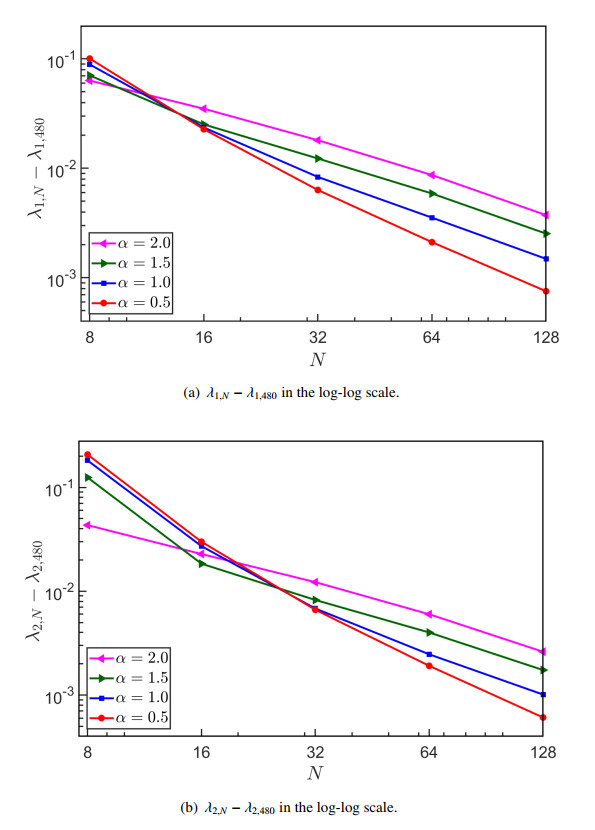
In this work, we propose an efficient and accurate numerical scheme for computing both the ground and first excited states of the nonlinear fractional Schrödinger eigenvalue problem. The method is based on a fractional gradient flow with discrete normalization, reformulated via the invariant energy quadratization (IEQ) approach to handle the nonlinear term in a linear way. Temporal discretization is performed using a second-order Crank-Nicolson scheme, while spatial discretization employs a Jacobi-Galerkin spectral method, yielding spectral convergence in space. We rigorously prove the discrete energy-decay property with respect to a modified energy functional. The resulting fully discrete scheme can compute different states simply by varying the initial condition, without altering the algorithmic framework. Numerical experiments confirm its high accuracy, efficiency, and robustness, and demonstrate its capability to capture intricate solution structures across a wide range of fractional orders and nonlinear interaction strengths.
Citation: Xiaozhuang Ma, Yiduo Zhang, Lizhen Chen, Xiaofeng Yang. Efficient Jacobi-Galerkin spectral and second-order time discretization scheme for ground and first excited states of nonlinear fractional Schrödinger equation[J]. Electronic Research Archive, 2025, 33(9): 5776-5793. doi: 10.3934/era.2025257
In this work, we propose an efficient and accurate numerical scheme for computing both the ground and first excited states of the nonlinear fractional Schrödinger eigenvalue problem. The method is based on a fractional gradient flow with discrete normalization, reformulated via the invariant energy quadratization (IEQ) approach to handle the nonlinear term in a linear way. Temporal discretization is performed using a second-order Crank-Nicolson scheme, while spatial discretization employs a Jacobi-Galerkin spectral method, yielding spectral convergence in space. We rigorously prove the discrete energy-decay property with respect to a modified energy functional. The resulting fully discrete scheme can compute different states simply by varying the initial condition, without altering the algorithmic framework. Numerical experiments confirm its high accuracy, efficiency, and robustness, and demonstrate its capability to capture intricate solution structures across a wide range of fractional orders and nonlinear interaction strengths.

| [1] |
H. D. Doebner, G. A. Goldin, P. Nattermann, Gauge transformations in quantum mechanics and the unification of nonlinear schrödinger equations, J. Math. Phys., 40 (1999), 49–63. https://doi.org/10.1063/1.532786 doi: 10.1063/1.532786

|
| [2] |
V. Banica, R. Lucà, N. Tzvetkov, L. Vega, Blow-up for the 1d cubic nls, Commun. Math. Phys., 405 (2024), 11. https://doi.org/10.1007/s00220-023-04906-3 doi: 10.1007/s00220-023-04906-3
|
| [3] | W. Bao, The nonlinear schrödinger equation and applications in bose-einstein condensation and plasma physics, in Dynamics in Models of Coarsening, Coagulation, Condensation and Quantization, (2007), 141–239. https://doi.org/10.1142/9789812770226_0003 |
| [4] |
G. Fibich, G. Papanicolaou, Self-focusing in the perturbed and unperturbed nonlinear schrödinger equation in critical dimension, SIAM J. Appl. Math., 60 (1999), 183–240. https://doi.org/10.1137/S0036139997322407 doi: 10.1137/S0036139997322407
|
| [5] |
N. Laskin, Fractional quantum mechanics, Phys. Rev. E, 62 (2000), 3135–3145. https://doi.org/10.1103/PhysRevE.62.3135 doi: 10.1103/PhysRevE.62.3135
|
| [6] |
N. Laskin, Fractional schrödinger equation, Phys. Rev. E, 66 (2002), 056108. https://doi.org/10.1103/PhysRevE.66.056108 doi: 10.1103/PhysRevE.66.056108
|
| [7] |
Q. Yang, I. Turner, F. Liu, M. Ilić, Novel numerical methods for solving the time-space fractional diffusion equation in two dimensions, Comput. Phys. Commun., 33 (2011), 1159–1180. https://doi.org/10.1137/100800634 doi: 10.1137/100800634
|
| [8] |
E. Di Nezza, G. Palatucci, E. Valdinoci, Hitchhiker's guide to the fractional sobolev spaces, Bull. Sci. Math., 136 (2012), 521–573. https://doi.org/10.1016/j.bulsci.2011.12.004 doi: 10.1016/j.bulsci.2011.12.004
|
| [9] |
A. Lischke, G. F. Pang, M. Gulian, F. Y. Song, C. Glusa, X. N. Zheng, et al., What is the fractional Laplacian? A comparative review with new results, J. Comput. Phys., 404 (2020), 109009. https://doi.org/10.1016/j.jcp.2019.109009 doi: 10.1016/j.jcp.2019.109009
|
| [10] |
B. Dyda, Fractional calculus for power functions and eigenvalues of the fractional Laplacian, Fract. Calc. Appl. Anal., 15 (2012), 536–555. https://doi.org/10.2478/s13540-012-0038-8 doi: 10.2478/s13540-012-0038-8
|
| [11] |
B. Dyda, A. Kuznetsov, M. Kwaśnicki, Eigenvalues of the fractional laplace operator in the unit ball, J. London Math. Soc., 95 (2017), 500–518. https://doi.org/10.1112/jlms.12024 doi: 10.1112/jlms.12024
|
| [12] |
E. M. Harrell, Commutators, eigenvalue gaps, and mean curvature in the theory of Schrödinger operators, Commun. Partial Differ. Equations, 32 (2007), 401–413. https://doi.org/10.1080/03605300500532889 doi: 10.1080/03605300500532889
|
| [13] |
M. Kwaśnicki, Eigenvalues of the fractional laplace operator in the interval, J. Funct. Anal., 262 (2012), 2379–2402. https://doi.org/10.1016/j.jfa.2011.12.004 doi: 10.1016/j.jfa.2011.12.004
|
| [14] |
P. Li, S. T. Yau, On the schrödinger equation and the eigenvalue problem, Commun. Math. Phys., 88 (1983), 309–318. https://doi.org/10.1007/BF01213210 doi: 10.1007/BF01213210
|
| [15] | I. M. Singer, B. Wong, S. S. T. Yau, S. T. Yau, An estimate of the gap of the first two eigenvalues in the schrödinger operator, Ann. Sc. Norm. Super. Pisa Cl. Sci., 12 (1985), 319–333. Available from: https://www.numdam.org/item/?id = ASNSP_1985_4_12_2_319_0. |
| [16] |
S. W. Duo, Y. Z. Zhang, Computing the ground and first excited states of the fractional schrödinger equation in an infinite potential well, Commun. Comput. Phys., 18 (2015), 321–350. https://doi.org/10.4208/cicp.300414.120215a doi: 10.4208/cicp.300414.120215a
|
| [17] |
J. P. Borthagaray, L. M. Del Pezzo, S. Martínez, Finite element approximation for the fractional eigenvalue problem, J. Sci. Comput., 77 (2018), 308–329. https://doi.org/10.1007/s10915-018-0710-1 doi: 10.1007/s10915-018-0710-1
|
| [18] | L. Z. Chen, Z. P. Mao, H. Y. Li, Jacobi-Galerkin spectral method for eigenvalue problems of riesz fractional differential equations, preprint, arXiv: 1803.03556. |
| [19] |
W. Z. Bao, X. R. Ruan, J. Shen, C. T. Sheng, Fundamental gaps of the fractional schrödinger operator, Commun. Math. Sci., 17 (2019), 447–471. https://doi.org/10.4310/CMS.2019.v17.n2.a7 doi: 10.4310/CMS.2019.v17.n2.a7
|
| [20] |
W. Z. Bao, L. Z. Chen, X. Y. Jiang, Y. Ma, A jacobi spectral method for computing eigenvalue gaps and their distribution statistics of the fractional schrödinger operator, J. Comput. Phys., 421 (2020), 109733. https://doi.org/10.1016/j.jcp.2020.109733 doi: 10.1016/j.jcp.2020.109733
|
| [21] |
S. L. Chang, C. S. Chien, B. W. Jeng, An efficient algorithm for the schrödinger-poisson eigenvalue problem, J. Comput. Appl. Math., 205 (2007), 509–532. https://doi.org/10.1016/j.cam.2006.05.013 doi: 10.1016/j.cam.2006.05.013
|
| [22] |
Y. Ma, L. Z. Chen, A Jacobi-Galerkin spectral method for computing the ground and first excited states of nonlinear fractional schrödinger equation, East Asian J. Appl. Math., 10 (2020), 274–294. https://doi.org/10.4208/eajam.140319.180719 doi: 10.4208/eajam.140319.180719
|
| [23] |
S. N. Ma, H. Y. Li, Z. M. Zhang, H. Chen, L. C. Chen, Efficient spectral methods for eigenvalue problems of the integral fractional laplacian on a ball of any dimension, J. Comput. Math., 42 (2024), 1032–1062. https://doi.org/10.4208/jcm.2304-m2022-0243 doi: 10.4208/jcm.2304-m2022-0243
|
| [24] |
X. Antoine, Q. L. Tang, Y. Zhang, On the ground states and dynamics of space fractional nonlinear schrödinger/gross-pitaevskii equations with rotation term and nonlocal nonlinear interactions, J. Comput. Phys., 325 (2016), 74–97. https://doi.org/10.1016/j.jcp.2016.08.009 doi: 10.1016/j.jcp.2016.08.009
|
| [25] |
Y. X. Gou, P. B. Ming, A deep learning method for computing eigenvalues of the fractional schrödinger operator, J. Syst. Sci. Complexity, 37 (2024), 391–412. https://doi.org/10.1007/s11424-024-3250-9 doi: 10.1007/s11424-024-3250-9
|
| [26] |
W. Z. Bao, Q. Du, Computing the ground state solution of bose-einstein condensates by a normalized gradient flow, SIAM J. Sci. Comput., 25 (2004), 1674–1697. https://doi.org/10.1137/S1064827503422956 doi: 10.1137/S1064827503422956
|
| [27] |
Z. Xu, X. Yang, H. Zhang, Z. Xie. Efficient and linear schemes for anisotropic cahn–hilliard modeln using the stabilized-invariant energy quadratization (s-ieq) approach, Comput. Phys. Commun., 238 (2019), 36–49. https://doi.org/10.1016/j.cpc.2018.12.019 doi: 10.1016/j.cpc.2018.12.019
|
| [28] |
X. Yang, Linear, first and second-order, unconditionally energy stable numerical schemes for the phase field model of homopolymer blends, J. Comput. Phys., 327 (2016), 294–316. https://doi.org/10.1016/j.jcp.2016.09.029 doi: 10.1016/j.jcp.2016.09.029
|
| [29] |
X. Yang, X. He, A fully-discrete decoupled finite element method for the conserved allen–cahn type phase-field model of three-phase fluid flow system, Comput. Methods Appl. Mech. Eng., 389 (2022), 114376. https://doi.org/10.1016/j.cma.2021.114376 doi: 10.1016/j.cma.2021.114376
|
| [30] | I. Podlubny, Fractional Differential Equations, Academic Press, San Diego, 1999. |
| [31] |
X. J. Li, C. J. Xu, A space-time spectral method for the time fractional diffusion equation, SIAM J. Numer. Anal., 47 (2009), 2108–2131. https://doi.org/10.1137/080718942 doi: 10.1137/080718942
|
| [32] | J. L. Lions, E. Magenes, Non-Homogeneous Boundary Value Problems and Applications, Springer-Verlag, Berlin, 1972. |
| [33] | P. Grisvard, Elliptic Problems in Nonsmooth Domains, SIAM, Philadelphia, 2011. https://doi.org/10.1137/1.9781611972030 |
| [34] | H. Triebel, Interpolation Theory, Function Spaces, Differential Operators, North-Holland Publishing Company, Amsterdam, 1978. |
| [35] |
Z. P. Mao, S. Chen, J. Shen, Efficient and accurate spectral method using generalized Jacobi functions for solving riesz fractional differential equations, Appl. Numer. Math., 106 (2016), 165–181. https://doi.org/10.1016/j.apnum.2016.04.002 doi: 10.1016/j.apnum.2016.04.002
|


Figures(3)
Xiaozhuang Ma, Yiduo Zhang, Lizhen Chen, Xiaofeng Yang. Efficient Jacobi-Galerkin spectral and second-order time discretization scheme for ground and first excited states of nonlinear fractional Schrödinger equation[J]. Electronic Research Archive, 2025, 33(9): 5776-5793. doi: 10.3934/era.2025257





 DownLoad: