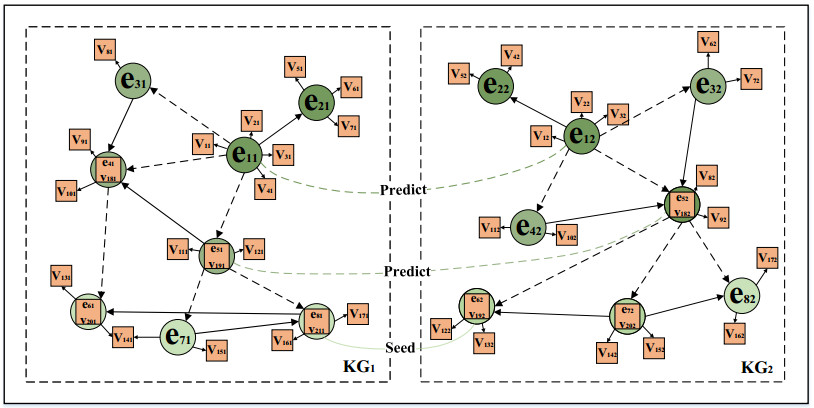
Entity alignment, as a fundamental technique in knowledge graph integration, aims to identify the equivalent entity pairs that refer to the same real-world entity across different knowledge graphs. In domain-specific knowledge graphs, based on the atomic divisibility characteristics of entity categories, these categories can be classified into atomically divisible and atomically indivisible types. However, traditional methods for entity alignment in atomically indivisible knowledge graphs often fall short when dealing with tasks that involve more than one atomically divisible entity category. To address such a challenge, we propose a novel multi-embedding entity alignment approach based on matching information interaction over atomically divisible entities (MiAD). MiAD effectively exploits the matching information interaction between low-level entities and high-level entities to enrich the semantic representation of high-level entities and to enhance the reliability of the alignment results. The high-level entities are atomically divisible, and the matching result among the low-level entities can provide a significant hint for the entity alignment of high-level entities by analyzing their inherent interrelationships. To tackle the insufficient utilization of these matching information interactions, we propose a multiple hierarchical embedding strategy, which consists of a structural semantic aggregator, an attribute semantic aggregator, a corroborative aggregator, and a joint aggregator. This method leverages both the intra-level interactions and cross-level interactions to generate the hierarchical embeddings of high-level and low-level entities, respectively, from multiple perspectives (i.e., relations, attributes, and corroborative textural descriptions). As a result, MiAD significantly improves the accuracy of alignment outcomes and strengthens the overall structural and semantic understanding of higher-level entities. Comprehensive experimental results demonstrate that MiAD achieves substantial performance improvements compared with seven baseline methods on the Chinese recipe dataset Ta-da.
Citation: Yaoli Xu, Tong Han, Pu Li, Changhai Wang, Xiaoyu Duan, Haojie Zhai. An multi-embedding entity alignment approach based on matching information interaction over atomically divisible entities[J]. Electronic Research Archive, 2025, 33(8): 4559-4602. doi: 10.3934/era.2025206
Entity alignment, as a fundamental technique in knowledge graph integration, aims to identify the equivalent entity pairs that refer to the same real-world entity across different knowledge graphs. In domain-specific knowledge graphs, based on the atomic divisibility characteristics of entity categories, these categories can be classified into atomically divisible and atomically indivisible types. However, traditional methods for entity alignment in atomically indivisible knowledge graphs often fall short when dealing with tasks that involve more than one atomically divisible entity category. To address such a challenge, we propose a novel multi-embedding entity alignment approach based on matching information interaction over atomically divisible entities (MiAD). MiAD effectively exploits the matching information interaction between low-level entities and high-level entities to enrich the semantic representation of high-level entities and to enhance the reliability of the alignment results. The high-level entities are atomically divisible, and the matching result among the low-level entities can provide a significant hint for the entity alignment of high-level entities by analyzing their inherent interrelationships. To tackle the insufficient utilization of these matching information interactions, we propose a multiple hierarchical embedding strategy, which consists of a structural semantic aggregator, an attribute semantic aggregator, a corroborative aggregator, and a joint aggregator. This method leverages both the intra-level interactions and cross-level interactions to generate the hierarchical embeddings of high-level and low-level entities, respectively, from multiple perspectives (i.e., relations, attributes, and corroborative textural descriptions). As a result, MiAD significantly improves the accuracy of alignment outcomes and strengthens the overall structural and semantic understanding of higher-level entities. Comprehensive experimental results demonstrate that MiAD achieves substantial performance improvements compared with seven baseline methods on the Chinese recipe dataset Ta-da.

| [1] |
T. C. Zhang, X. Tian, X. H. Sun, M. H. Yu, Y. H. Sun, G. Yu, Overview on knowledge graph embedding technology research (in Chinese), J. Software, 34 (2023), 277–311. https://doi.org/10.13328/j.cnki.jos.006429 doi: 10.13328/j.cnki.jos.006429

|
| [2] |
L. A. Huang, X. Luo, EASA: Entity alignment algorithm based on semantic aggregation and attribute attention, IEEE Access, 8 (2020), 18162–18170. https://doi.org/10.1109/access.2020.2968620 doi: 10.1109/access.2020.2968620
|
| [3] |
J. Chicaiza, P. Valdiviezo-Diaz, A comprehensive survey of knowledge graph-based recommender systems: Technologies, development, and contributions, Information, 12 (2021), 232. https://doi.org/10.3390/info12060232 doi: 10.3390/info12060232
|
| [4] |
L. Y. Yu, Z. Guo, G. Chen, X. X. Zhang, Y. W. Tang, H. Wei, Question answering system based on knowledge graph in air defense field, J. Phys. Conf. Ser., 1693 (2020), 012033. https://doi.org/10.1088/1742-6596/1693/1/012033 doi: 10.1088/1742-6596/1693/1/012033
|
| [5] |
M. Wang, H. F. Wang, B. H. Li, X. Zhao, X. Wang, Survey on key technologies of new generation knowledge graph (in Chinese), J. Comput. Res. Dev., 59 (2022), 1947–1965. https://doi.org/10.7544/issn1000-1239.20210829 doi: 10.7544/issn1000-1239.20210829
|
| [6] | S. Auer, C. Bizer, G. Kobilarov, J. Lehmann, R. Cyganiak, Z. Ives, Dbpedia: A nucleus for a web of open data, in The Semantic Web, Springer, (2007), 722–735. https://doi.org/10.1007/978-3-540-76298-0_52 |
| [7] |
F. M. Suchanek, G. Kasneci, G. Weikum, YAGO: A large ontology from Wikipedia and WordNet, J. Web Semant., 6 (2008), 203–217. https://doi.org/10.1016/j.websem.2008.06.001 doi: 10.1016/j.websem.2008.06.001
|
| [8] | K. Bollacker, C. Evans, P. Paritosh, T. Sturge, J. Taylor, Freebase: A collaboratively created graph database for structuring human knowledge, in Proceedings of the 2008 ACM SIGMOD International Conference on Management of Data, (2008), 1247–1250. https://doi.org/10.1145/1376616.1376746 |
| [9] |
D. Vrandečić, M. Krötzsch, Wikidata: A free collaborative knowledgebase, Commun. ACM, 57 (2014), 78–85. https://doi.org/10.1145/2629489 doi: 10.1145/2629489
|
| [10] |
R. Navigli, S. P. Ponzetto, BabelNet: The automatic construction, evaluation and application of a wide-coverage multilingual semantic network, Artif. Intell., 193 (2012), 217–250. https://doi.org/10.1016/j.artint.2012.07.001 doi: 10.1016/j.artint.2012.07.001
|
| [11] |
Y. J. Gao, C. C. Ge, Y. X. Guo, L. Chen, Survey on data integration technologies for relational data and knowledge graph (in Chinese), J. Software, 34 (2023), 2365–2391. https://doi.org/10.13328/j.cnki.jos.006808 doi: 10.13328/j.cnki.jos.006808
|
| [12] |
H. R. Huang, C. Li, X. T. Peng, L. F. He, S. Guo, H. Peng, et al., Cross-knowledge-graph entity alignment via relation prediction, Knowledge-Based Syst., 240 (2022), 107813. https://doi.org/10.1016/j.knosys.2021.107813 doi: 10.1016/j.knosys.2021.107813
|
| [13] |
Y. L. Xu, Z. H. Li, Q. Chen, Y. Y. Wang, F. F. Fan, An approach for reconciling inconsistent pairs based on factor graph (in Chinese), J. Comput. Res. Dev., 57 (2020), 175–187. https://doi.org/10.7544/issn1000-1239.2020.20180691 doi: 10.7544/issn1000-1239.2020.20180691
|
| [14] |
H. C. Wang, Y. N. Wang, J. F. Li, T. Luo, Degree aware based adversarial graph convolutional networks for entity alignment in heterogeneous knowledge graph, Neurocomputing, 487 (2022), 99–109. https://doi.org/10.1016/j.neucom.2022.02.002 doi: 10.1016/j.neucom.2022.02.002
|
| [15] | T. N. Kipf, M. Welling, Semi-supervised classification with graph convolutional networks, preprint, arXiv: 1609.02907. https://doi.org/10.48550/arXiv.1609.02907 |
| [16] | L. Yao, C. S. Mao, Y. Luo, KG-BERT: BERT for knowledge graph completion, preprint, arXiv: 1909.03193. https://doi.org/10.48550/arXiv.1909.03193 |
| [17] | L. B. Soares, N. Fitzgerald, J. Ling, T. Kwiatkowski, Matching the blanks: Distributional similarity for relation learning, in Proceedings of the 57th Annual Meeting of the Association for Computational Linguistics, (2019), 2895–2905. https://doi.org/10.18653/v1/P19-1279 |
| [18] | P. L. H. Cabot, R. Navigli, REBEL: Relation extraction by end-to-end language generation, in Findings of the Association for Computational Linguistics: EMNLP 2021, (2021), 2370–2381. https://doi.org/10.18653/v1/2021.findings-emnlp.204 |
| [19] | K. W. Church, Word2Vec, Nat. Lang. Eng., 23 (2017), 155–162. https://doi.org/10.1017/S1351324916000334 |
| [20] |
P. Bojanowski, E. Grave, A. Joulin, T. Mikolov, Enriching word vectors with subword information, Trans. Assoc. Comput. Ling., 5 (2017), 135–146. https://doi.org/10.1162/tacl_a_00051 doi: 10.1162/tacl_a_00051
|
| [21] | S. Arora, Y. Liang, T. Ma, A simple but tough-to-beat baseline for sentence embeddings, in 5th International Conference on Learning Representations, 2019. |
| [22] | M. H. Chen, Y. T. Tian, K. W. Chang, S. Skiena, C. Zaniolo, Co-training embeddings of knowledge graphs and entity descriptions for cross-lingual entity alignment, in Proceedings of the 27th International Joint Conference on Artificial Intelligence, (2018), 3998–4004. https://doi.org/10.24963/ijcai.2018/556 |
| [23] | J. Liu, B. Chai, Z. Shang, A cross-lingual medical knowledge graph entity alignment algorithm based on neural tensor network, Basic Clin. Physiol. Pharmacol. Toxicol., 128 (2021), 31–32. |
| [24] | Z. Y. Liu, Y. X. Cao, L. M. Pan, J. Z. Li, Z. Y. Liu, T. S. Chua, Exploring and evaluating attributes, values, and structures for entity alignment, preprint, arXiv: 2010.03249. https://doi.org/10.48550/arXiv.2010.03249 |
| [25] | A. Vaswani, N. Shazeer, N. Parmar, J. Uszkoreit, L. Jones, A. N. Gomez, et al., Attention is all you need, in Proceedings of the 31st International Conference on Neural Information Processing Systems, (2017), 6000–6010. |
| [26] | Z. C. Wang, Q. S. Lv, X. H. Lan, Y. Zhang, Cross-lingual knowledge graph alignment via graph convolutional networks, in Proceedings of the 2018 Conference on Empirical Methods in Natural Language Processing, (2018), 349–357. https://doi.org/10.18653/v1/d18-1032 |
| [27] | Y. Cao, Z. Y. Liu, C. J. Li, J. Z. Li, T. S. Chua, Multi-channel graph neural network for entity alignment, in Proceedings of the 57th Annual Meeting of the Association for Computational Linguistics, (2019), 1452–1461. https://doi.org/10.18653/v1/p19-1140 |
| [28] | Y. T. Wu, X. Liu, Y. S. Feng, Z. Wang, D. Y. Zhao, Jointly learning entity and relation representations for entity alignment, in Proceedings of the 2019 Conference on Empirical Methods in Natural Language Processing and the 9th International Joint Conference on Natural Language Processing, (2019), 240–249. https://doi.org/10.18653/v1/d19-1023 |
| [29] | J. H. Tang, K. F. Zhao, J. Li, A fused gromov-wasserstein framework for unsupervised knowledge graph entity alignment, in Findings of the Association for Computational Linguistics: ACL 2023, (2023), 3320–3334. https://doi.org/10.18653/v1/2023.findings-acl.205 |
| [30] | B. D. Trisedya, J. Qi, R. Zhang, Entity alignment between knowledge graphs using attribute embeddings, in Proceedings of the 33th AAAI Conference on Artificial Intelligence and the 31th Innovative Applications of Artificial Intelligence Conference and the 9th AAAI Symposium on Educational Advances in Artificial Intelligence, (2019), 297–304. https://doi.org/10.1609/aaai.v33i01.3301297 |
| [31] | W. Tang, F. L. Su, H. F. Sun, Q. Qi, J. Y. Wang, S. M. Tao, et al., Weakly supervised entity alignment with positional inspiration, in Proceedings of the Sixteenth ACM International Conference on Web Search and Data Mining, (2023), 814–822. https://doi.org/10.1145/3539597.3570394 |
| [32] | Z. Y. Zhong, M. H. Zhang, J. Fan, C. X. Dou, Semantics driven embedding learning for effective entity alignment, in 2022 IEEE 38th International Conference on Data Engineering, (2022), 2127–2140. https://doi.org/10.1109/icde53745.2022.00205 |
| [33] |
Y. L. Xu, J. J. Zhong, S. Z. Zhang, C. L. Li, P. Li, Y. B. Guo, et al., A domain-oriented entity alignment approach based on filtering multi-type graph neural networks, Appl. Sci., 13 (2023), 9237. https://doi.org/10.3390/app13169237 doi: 10.3390/app13169237
|
| [34] | A. Bordes, J. Weston, R. Collobert, Y. Bengio, Learning structured embeddings of knowledge bases, in Proceedings of the AAAI Conference on Artificial Intelligence, 25 (2011), 301–306. https://doi.org/10.1609/aaai.v25i1.7917 |
| [35] | A. Bordes, N. Usunier, A. Garcia-Durán, J. Weston, O. Yakhnenko, Translating embeddings for modeling multi-relational data, in Proceedings of the 27th International Conference on Neural Information Processing Systems, 2 (2013), 2787–2795. |
| [36] | T. Mikolov, I. Sutskever, K. Chen, G. Corrado, J. Dean, Distributed representations of words and phrases and their compositionality, in Proceedings of the 27th International Conference on Neural Information Processing Systems - Volume 2, (2013), 3111–3119. |
| [37] | Z. Wang, J. Zhang, J. Feng, Z. Chen, Knowledge graph embedding by translating on hyperplanes, in Proceedings of the AAAI Conference on Artificial Intelligence, 28 (2014), 1112–1119. https://doi.org/10.1609/aaai.v28i1.8870 |
| [38] | Y. Lin, Z. Y. Liu, M. Sun, Y. Liu, X. Zhu, Learning entity and relation embeddings for knowledge graph completion, in Proceedings of the AAAI Conference on Artificial Intelligence, 29 (2015), 2181–2187. https://doi.org/10.1609/aaai.v29i1.9491 |
| [39] | G. Ji, S. Z. He, L. H. Xu, K. Liu, J. Zhao, Knowledge graph embedding via dynamic mapping matrix, in Proceedings of the 53rd Annual Meeting of the Association for Computational Linguistics and the 7th International Joint Conference on Natural Language Processing, 1 (2015), 687–696. https://doi.org/10.3115/v1/p15-1067 |
| [40] | M. Fan, Q. Zhou, E. Chang, T. F. Zheng, Transition-based knowledge graph embedding with relational mapping properties, in Proceedings of the 28th Pacific Asia Conference on Language, Information and Computing, Department of Linguistics, Chulalongkorn University, (2014), 328–337. |
| [41] | D. Q. Nguyen, K. Sirts, L. Qu, M. Johnson, StransE: A novel embedding model of entities and relationships in knowledge bases, in Proceedings of the 2016 Conference of the North American Chapter of the Association for Computational Linguistics: Human Language Technologies, (2016), 460–466. https://doi.org/10.18653/v1/N16-1054 |
| [42] | S. S. Dasgupta, S. N. Ray, P. Talukdar, HyteTE: Hyperplane-based temporally aware knowledge graph embedding, in Proceedings of the 2018 Conference on Empirical Methods in Natural Language Processing, (2018), 2001–2011. https://doi.org/10.18653/v1/d18-1225 |
| [43] | A. García-Durán, S. Dumančić, M. Niepert, Learning sequence encoders for temporal knowledge graph completion, in Proceedings of the 2018 Conference on Empirical Methods in Natural Language Processing, (2018), 4816–4821. https://doi.org/10.18653/v1/d18-1516 |
| [44] | J. Leblay, M. W. Chekol, Deriving validity time in knowledge graph, in Companion Proceedings of the The Web Conference, (2018), 1771–1776. https://doi.org/10.1145/3184558.3191639 |
| [45] | R. Ye, X. Li, Y. J. Fang, H. Y. Zang, M. Z. Wang, A vectorized relational graph convolutional network for multi-relational network alignment, in Proceedings of the 28th International Joint Conference on Artificial Intelligence, (2019), 4135–4141. https://doi.org/10.24963/ijcai.2019/574 |
| [46] | J. Chen, Z. X. Li, P. P. Zhao, A. Liu, L. Zhao, Z. G. Chen, et al., Learning short-term differences and long-term dependencies for entity alignment, in The Semantic Web – ISWC 2020, Springer, 12506 (2020), 92–109. https://doi.org/10.1007/978-3-030-62419-4_6 |
| [47] | X. Mao, W. T. Wang, H. M. Xu, M. Lan, Y. B. Wu, MRAEA: An efficient and robust entity alignment approach for cross-lingual knowledge graph, in Proceedings of the 13th International Conference on Web Search and Data Mining, (2020), 420–428. https://doi.org/10.1145/3336191.3371804 |
| [48] | X. Mao, W. T. Wang, H. M. Xu, Y. B. Wu, M. Lan, Relational reflection entity alignment, in Proceedings of the 29th ACM International Conference on Information & Knowledge Management, (2020), 1095–1104. https://doi.org/10.1145/3340531.3412001 |
| [49] | K. S. Teong, L. K. Soon, T. T. Su, Schema-agnostic entity matching using pre-trained language models, in Proceedings of the 29th ACM International Conference on Information & Knowledge Management, (2020), 2241–2244. https://doi.org/10.1145/3340531.3412131 |
| [50] |
S. P. Guan, X. L. Jin, Y. Z. Wang, Y. T. Jia, H. W. Shen, Z. X. Li, et al., Self-learning and embedding based entity alignment, Knowl. Inf. Syst., 59 (2019), 361–386. https://doi.org/10.1007/s10115-018-1191-0 doi: 10.1007/s10115-018-1191-0
|
| [51] | R. Trivedi, B. Sisman, X. L. Dong, F. Christos, J. Ma, H. Y. Zha, LinkNBed: Multi-graph representation learning with entity linkage, in Proceedings of the 56th Annual Meeting of the Association for Computational Linguistics, (2018), 252–262. https://doi.org/10.18653/v1/p18-1024 |
| [52] | Q. Zhu, H. Wei, B. Sisman, D. Zheng, C. Faloutsos, X. L. Dong, et al., Collective multi-type entity alignment between knowledge graphs, in Proceedings of The Web Conference, (2020), 2241–2252. https://doi.org/10.1145/3366423.3380289 |
| [53] | Y. T. Wu, X. Liu, Y. S. Feng, Z. Wang, R. Yan, D. Y. Zhao, Relation-aware entity alignment for heterogeneous knowledge graphs, in Proceedings of the 28th International Joint Conference on Artificial Intelligence, (2019), 5278–5284. https://doi.org/10.24963/ijcai.2019/733 |
| [54] | H. W. Yang, Y. Y. Zou, P. Shi, W. Lu, J. Lin, X. Sun, Aligning cross-lingual entities with multi-aspect information, in Proceedings of the 2019 Conference on Empirical Methods in Natural Language Processing and the 9th International Joint Conference on Natural Language Processing, (2019), 4431–4441. https://doi.org/10.18653/v1/d19-1451 |
| [55] |
Z. F. Li, W. Huang, X. C. Gong, X. Y. Luo, K. Xiao, H. L. Deng, et al., Decoupled semantic graph neural network for knowledge graph embedding, Neurocomputing, 611 (2025), 128614. https://doi.org/10.1016/j.neucom.2024.128614 doi: 10.1016/j.neucom.2024.128614
|
| [56] |
Y. Zhang, X. Luo, J. Hu, M. Zhang, K. Xiao, Z. Li, Graph structure prefix injection transformer for multi-modal entity alignment, Inf. Process. Manage., 62 (2025), 104048. https://doi.org/10.1016/j.ipm.2024.104048 doi: 10.1016/j.ipm.2024.104048
|
| [57] |
Z. F. Li, L. F. Chen, Y. Jian, H. Wang, Y. Zhao, M. Zhang, et al., Aggregation or separation? Adaptive embedding message passing for knowledge graph completion, Inf. Sci., 691 (2025), 121639. https://doi.org/10.1016/j.ins.2024.121639 doi: 10.1016/j.ins.2024.121639
|


Figures(9) / Tables(7)
Yaoli Xu, Tong Han, Pu Li, Changhai Wang, Xiaoyu Duan, Haojie Zhai. An multi-embedding entity alignment approach based on matching information interaction over atomically divisible entities[J]. Electronic Research Archive, 2025, 33(8): 4559-4602. doi: 10.3934/era.2025206





 DownLoad: