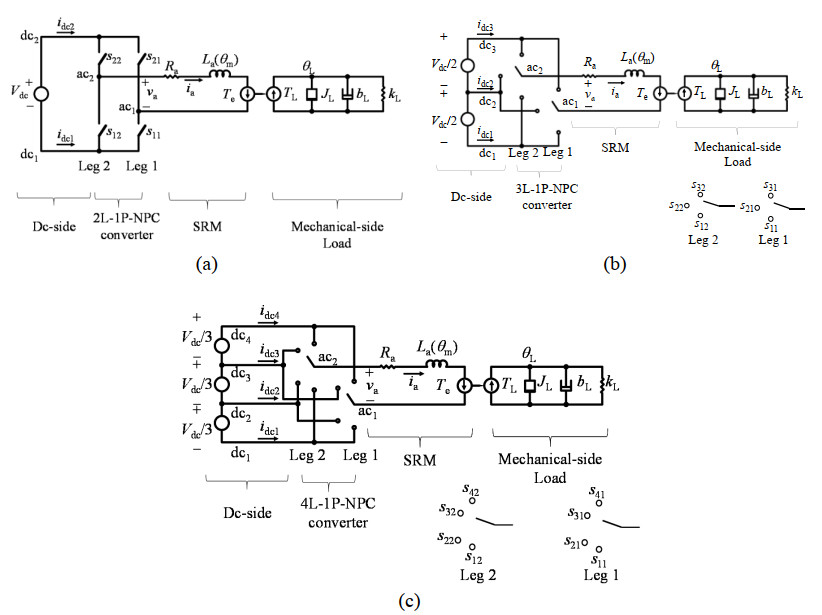
The harmonic performance, control robustness, and thermal characteristics of single-phase multilevel neutral-point-clamped (NPC) converters driving a single-phase reluctance motor (SPRM) are comprehensively analyzed in this study. Three converter topologies—a two-level single-phase NPC (2L-1P-NPC) converter, a three-level single-phase NPC (3L-1P-NPC) converter, and a four-level single-phase NPC (4L-1P-NPC) converter—are investigated under four modulation schemes: bipolar voltage pulsewidth modulation (BVPWM), unipolar voltage pulsewidth modulation (UVPWM), level-shifted pulsewidth modulation (LSPWM), and virtual-vector pulsewidth modulation (VVPWM), all operating at a fixed switching frequency of 10 kHz. High-fidelity simulations conducted in MATLAB-Simulink accurately replicate the coupled electromagnetic, mechanical, and thermal dynamics of the SPRM system, utilizing realistic motor and load parameters to ensure application-level relevance.
The results demonstrate that increasing the converter level substantially reduces total harmonic distortion (THD), with the 4L-1P-NPC topology under LSPWM achieving the lowest THD of 23.66%, thereby significantly improving voltage waveform quality and minimizing electromagnetic torque ripple. A proportional–integral (PI)-based feedback controller is implemented for velocity and position regulation, yielding precise trajectory tracking, a fast transient response, and negligible steady-state error. Additionally, thermal analysis quantifies power losses—conduction, switching, core, and copper—highlighting the trade-off between improved harmonic/dynamic performance and increased thermal stress. Notably, the junction temperature escalates from 121.8℃ in the 2L-1P-NPC converter to 188℃ in the 4L-1P-NPC converter, underscoring the necessity for advanced heat dissipation strategies in high-power applications.
By integrating harmonic distortion mitigation, closed-loop control design, and thermal evaluation, this work presents a unified framework for the optimal design and analysis of high-performance, thermally aware multilevel SPRM drives.
Citation: José M. Campos-Salazar, Roya Rafiezadeh, Juan L. Aguayo-Lazcano, Constanza Márquez. Reduction of harmonic distortion in electromagnetic torque of a single-phase reluctance motor using a multilevel neutral-point-clamped DC-AC converter[J]. AIMS Electronics and Electrical Engineering, 2025, 9(2): 215-242. doi: 10.3934/electreng.2025011
The harmonic performance, control robustness, and thermal characteristics of single-phase multilevel neutral-point-clamped (NPC) converters driving a single-phase reluctance motor (SPRM) are comprehensively analyzed in this study. Three converter topologies—a two-level single-phase NPC (2L-1P-NPC) converter, a three-level single-phase NPC (3L-1P-NPC) converter, and a four-level single-phase NPC (4L-1P-NPC) converter—are investigated under four modulation schemes: bipolar voltage pulsewidth modulation (BVPWM), unipolar voltage pulsewidth modulation (UVPWM), level-shifted pulsewidth modulation (LSPWM), and virtual-vector pulsewidth modulation (VVPWM), all operating at a fixed switching frequency of 10 kHz. High-fidelity simulations conducted in MATLAB-Simulink accurately replicate the coupled electromagnetic, mechanical, and thermal dynamics of the SPRM system, utilizing realistic motor and load parameters to ensure application-level relevance.
The results demonstrate that increasing the converter level substantially reduces total harmonic distortion (THD), with the 4L-1P-NPC topology under LSPWM achieving the lowest THD of 23.66%, thereby significantly improving voltage waveform quality and minimizing electromagnetic torque ripple. A proportional–integral (PI)-based feedback controller is implemented for velocity and position regulation, yielding precise trajectory tracking, a fast transient response, and negligible steady-state error. Additionally, thermal analysis quantifies power losses—conduction, switching, core, and copper—highlighting the trade-off between improved harmonic/dynamic performance and increased thermal stress. Notably, the junction temperature escalates from 121.8℃ in the 2L-1P-NPC converter to 188℃ in the 4L-1P-NPC converter, underscoring the necessity for advanced heat dissipation strategies in high-power applications.
By integrating harmonic distortion mitigation, closed-loop control design, and thermal evaluation, this work presents a unified framework for the optimal design and analysis of high-performance, thermally aware multilevel SPRM drives.

| [1] |
Singh GK (2005) A Research Survey of Induction Motor Operation with Non-Sinusoidal Supply Wave Forms. Electr Pow Syst Res 75: 200–213. https://doi.org/10.1016/j.epsr.2005.04.001 doi: 10.1016/j.epsr.2005.04.001

|
| [2] | Timár-P L (1989) Noise and Vibration of Electrical Machines; Elsevier. |
| [3] |
Wallace AK, Spee R, Martin LG (1990) Current Harmonics and Acoustic Noise in AC Adjustable-Speed Drives. IEEE T Ind Appl 26: 267–273. https://doi.org/10.1109/28.54252 doi: 10.1109/28.54252
|
| [4] |
Belmans RJM, D'Hondt L, Vandenput AJ, Geysen W (1987) Analysis of the Audible Noise of Three-Phase Squirrel-Cage Induction Motors Supplied by Inverters. IEEE T Ind Appl IA-23: 842–847. https://doi.org/10.1109/TIA.1987.4504993 doi: 10.1109/TIA.1987.4504993
|
| [5] |
Iida S, Okuma Y, Masukawa S, Miyairi S, Bose BK (1991) Study on Magnetic Noise Caused by Harmonics in Output Voltages of PWM Inverter. IEEE T Ind Electronic 38: 180–186. https://doi.org/10.1109/41.87585 doi: 10.1109/41.87585
|
| [6] |
Habetler TG, Divan DM (1991) Acoustic Noise Reduction in Sinusoidal PWM Drives Using a Randomly Modulated Carrier. IEEE T Power Electr 6: 356–363. https://doi.org/10.1109/63.85902 doi: 10.1109/63.85902
|
| [7] |
Blaabjerg F, Pedersen JK, Ritchie E, Nielsen P (1995) Determination of Mechanical Resonances in Induction Motors by Random Modulation and Acoustic Measurement. IEEE T Ind Appl 31: 823–829. https://doi.org/10.1109/28.395292 doi: 10.1109/28.395292
|
| [8] | Grant D, Houldsworth J (1984) PWM AC Motor Drive Employing Ultrasonic Carrier. Power Electronics and Variable Speed Drives Conference, London, 237‒240. |
| [9] |
Ueda S, Honda K, Ikimi T, Hombu M, Ueda A (1991) Magnetic Noise Reduction Technique for an AC Motor Driven by a PWM Inverter. IEEE T Power Electr 6: 470–475. https://doi.org/10.1109/63.85897 doi: 10.1109/63.85897
|
| [10] |
Hombu M, Ueda S, Ueda A, Matsuda Y (1985) A New Current Source GTO Inverter with Sinusoidal Output Voltage and Current. IEEE T Ind Appl IA-21: 1192–1198. https://doi.org/10.1109/TIA.1985.349523 doi: 10.1109/TIA.1985.349523
|
| [11] |
Wang C, Lai JCS, Pulle DWJ (2002) Prediction of Acoustic Noise from Variable-Speed Induction Motors: Deterministic versus Statistical Approaches. IEEE T Ind Appl 38: 1037–1044. https://doi.org/10.1109/TIA.2002.800567 doi: 10.1109/TIA.2002.800567
|
| [12] | Yang SJ (1981) Low-Noise Electrical Motors, Clarendon Press. |
| [13] |
Timar PL, Lai JCS (1994) Acoustic Noise of Electromagnetic Origin in an Ideal Frequency-Converter-Driven Induction Motor. IEE Proceedings - Electric Power Applications 141: 341–346. https://doi.org/10.1049/ip-epa:19941342 doi: 10.1049/ip-epa:19941342
|
| [14] |
Na SH, Jung YG, Lim YC, Yang SH (2002) Reduction of Audible Switching Noise in Induction Motor Drives Using Random Position Space Vector PWM. IEE Proceedings - Electric Power Applications 149: 195–200. https://doi.org/10.1049/ip-epa:20020244 doi: 10.1049/ip-epa:20020244
|
| [15] |
Xu L, Zhu ZQ, Howe D (2000) Acoustic Noise Radiated from Direct Torque Controlled Induction Motor Drives. Electric Power Applications, IEE Proceedings 147: 491–496. https://doi.org/10.1049/ip-epa:20000582 doi: 10.1049/ip-epa:20000582
|
| [16] |
Ishibashi F, Kamimoto K, Noda S, Itomi K (2003) Small Induction Motor Noise Calculation. IEEE T Energy Conver 18: 357–361. https://doi.org/10.1109/TEC.2002.808415 doi: 10.1109/TEC.2002.808415
|
| [17] | Fitzgerald AE, Kingsley C, Umans SD (2003) Electric Machinery, McGraw-Hill. |
| [18] | Murphy JMD, Turnbull FG (1988) Power Electronic Control of AC Motors, Franklin Book Company, Incorporated. |
| [19] |
McLean GW, Nix GF, Alwash SR (1969) Performance and Design of Induction Motors with Square-Wave Excitation. Proceedings of the Institution of Electrical Engineers 116: 1405–1411. https://doi.org/10.1049/piee.1969.0254 doi: 10.1049/piee.1969.0254
|
| [20] | Ding K, Cheng KWE, Wang SX, Wang DH, Shi Z (2008) Five-Level Cascaded Multilevel Motor Driver for Electrical Vehicle with Battery Charge Management. In Proceedings of the 2008 Australasian Universities Power Engineering Conference, 1–6. |
| [21] |
Pant GKS (2000) Vinay Analysis of a Multiphase Induction Machine Under Fault Condition in a Phase-Redundant A.C. Drive System. Electric Machines & Power Systems 28: 577–590. https://doi.org/10.1080/073135600268199 doi: 10.1080/073135600268199
|
| [22] | Busquets‐Monge S (2018) Neutral-Point-Clamped DC–AC Power Converters. In Wiley Encyclopedia of Electrical and Electronics Engineering, 1–20. https://doi.org/10.1002/047134608X.W8365 |
| [23] |
Rasilo P, Salem A, Abdallh A, De Belie F, Dupré L, Melkebeek JA (2015) Effect of Multilevel Inverter Supply on Core Losses in Magnetic Materials and Electrical Machines. IEEE T Energy Conver 30: 736–744. https://doi.org/10.1109/TEC.2014.2372095 doi: 10.1109/TEC.2014.2372095
|
| [24] |
Mahmoud H, Bacco G, Degano M, Bianchi N, Gerada C (2018) Synchronous Reluctance Motor Iron Losses: Considering Machine Nonlinearity at MTPA, FW, and MTPV Operating Conditions. IEEE T Energy Conver 33: 1402–1410. https://doi.org/10.1109/TEC.2018.2811543 doi: 10.1109/TEC.2018.2811543
|
| [25] |
Liu CT, Lai YS, Yen SC, Lin HN, Hsu YW, Luo TY, et al. (2022) Design of High-Efficiency Single-Phase Direct-on-Line Synchronous Reluctance Motors for Pump Applications. IEEE T Ind Appl 58: 5480–5487. https://doi.org/10.1109/TIA.2022.3164020 doi: 10.1109/TIA.2022.3164020
|
| [26] | Nasar SA (1990) Schaum's Outline of Electrical Power Systems, McGraw Hill Professional. |
| [27] | Houpis CH, Sheldon SN, D'Azzo JJ (2003) Linear Control System Analysis and Design: Fifth Edition, Revised and Expanded, CRC Press. |
| [28] |
Park RH (1929) Two-Reaction Theory of Synchronous Machines Generalized Method of Analysis-Part Ⅰ. Transactions of the American Institute of Electrical Engineers 48: 716–727. https://doi.org/10.1109/T-AIEE.1929.5055275 doi: 10.1109/T-AIEE.1929.5055275
|
| [29] | Mohan N (1995) Power Electronics: Converters, Applications, and Design, Wiley. |
| [30] | Bordonau J, Cosan M, Borojevic D, Mao H, Lee FC (1997) A State-Space Model for the Comprehensive Dynamic Analysis of Three-Level Voltage-Source Inverters. In Proceedings of the PESC97. Record 28th Annual IEEE Power Electronics Specialists Conference. Formerly Power Conditioning Specialists Conference 1970-71. Power Processing and Electronic Specialists Conference 1972, 2: 942–948. https://doi.org/10.1109/PESC.1997.616837 |
| [31] | Menéndez SSA (2004) Aportación al control del convertidor CC/CA de tres niveles. |
| [32] | Guerrero JM, Garcia de Vicuna L, Miret J, Matas J, Castilla M (2002) A Nonlinear Feed-Forward Control Technique for Single-Phase UPS Inverters. In Proceedings of the IEEE 2002 28th Annual Conference of the Industrial Electronics Society. IECON 02, 1: 257–261. https://doi.org/10.1109/IECON.2002.1187517 |
| [33] |
Holtz J (1992) Pulsewidth Modulation-a Survey. IEEE T Ind Electron 39: 410–420. https://doi.org/10.1109/41.161472 doi: 10.1109/41.161472
|
| [34] | Vedith S, Bhanu Tej JN, Sampath S, Usha Sree M, Nithin Rao P, Neelima K (2022) Review on Pulse Width Modulation and Optimization Techniques for Multilevel Inverters. In Proceedings of the International Conference on Artificial Intelligence and Sustainable Engineering; Sanyal, G., Travieso-González, C.M., Awasthi, S., Pinto, C.M.A., Purushothama, B.R., Eds.; Springer Nature: Singapore, 235–249. https://doi.org/10.1007/978-981-16-8542-2_19 |
| [35] |
Busquets-Monge S, Bordonau J, Boroyevich D, Somavilla S (2004) The Nearest Three Virtual Space Vector PWM - a Modulation for the Comprehensive Neutral-Point Balancing in the Three-Level NPC Inverter. IEEE Power Electronics Letters 2: 11–15. https://doi.org/10.1109/LPEL.2004.828445 doi: 10.1109/LPEL.2004.828445
|
| [36] |
Busquets-Monge S (2022) A Simple Virtual-Vector-Based PWM Formulation for Multilevel Three-Phase Neutral-Point-Clamped DC–AC Converters Including the Overmodulation Region. Electronics 11: 641. https://doi.org/10.3390/electronics11040641 doi: 10.3390/electronics11040641
|
| [37] |
Busquets-Monge S, Alepuz S, Rocabert J, Bordonau J (2009) Pulsewidth Modulations for the Comprehensive Capacitor Voltage Balance of $n$-Level Three-Leg Diode-Clamped Converters. IEEE T Power Electr 24: 1364–1375. https://doi.org/10.1109/TPEL.2009.2016661 doi: 10.1109/TPEL.2009.2016661
|
| [38] |
Busquets-Monge S, Maheshwari R, Nicolas-Apruzzese J, Lupon E, Munk-Nielsen S, Bordonau J (2015) Enhanced DC-Link Capacitor Voltage Balancing Control of DC–AC Multilevel Multileg Converters. IEEE T Ind Electron 62: 2663–2672. https://doi.org/10.1109/TIE.2014.2363820 doi: 10.1109/TIE.2014.2363820
|
| [39] | Busquets-Monge S, Ruderman A (2010) Carrier-Based PWM Strategies for the Comprehensive Capacitor Voltage Balance of Multilevel Multileg Diode-Clamped Converters. In Proceedings of the 2010 IEEE International Symposium on Industrial Electronics, 688–693. https://doi.org/10.1109/ISIE.2010.5637187 |
| [40] |
Ramu V, Satish Kumar P, Srinivas GN (2022) LSPWM, PSPWM and NLCPWM on Multilevel Inverters with Reduced Number of Switches. Materials Today: Proceedings 54: 710–727. https://doi.org/10.1016/j.matpr.2021.10.410 doi: 10.1016/j.matpr.2021.10.410
|
| [41] | Hammami M, Vujacic M, Grandi G (2018) Dc-Link Current and Voltage Ripple Harmonics in Three-Phase Three-Level Flying Capacitor Inverters with Sinusoidal Carrier-Based PWM. 2018 IEEE International Conference on Industrial Technology (ICIT), 664‒669. IEEE. https://doi.org/10.1109/ICIT.2018.8352257 |
| [42] | Angulo M, Lezana P, Kouro S, Rodriguez J, Wu B (2007) Level-Shifted PWM for Cascaded Multilevel Inverters with Even Power Distribution. In Proceedings of the 2007 IEEE Power Electronics Specialists Conference, 2373–2378. https://doi.org/10.1109/PESC.2007.4342382 |
| [43] |
Garcia-Reyes LA, Beltrán-Telles A, Bañuelos-Ruedas F, Reta-Hernández M, Ramírez-Arredondo JM, Silva-Casarín R (2022) Level-Shift PWM Control of a Single-Phase Full H-Bridge Inverter for Grid Interconnection, Applied to Ocean Current Power Generation. Energies 15: 1644. https://doi.org/10.3390/en15051644 doi: 10.3390/en15051644
|
| [44] |
Kishor Y, Patel RN (2022) Thermal Modelling and Reliability Analysis of Recently Introduced High Gain Converters for PV Application. Cleaner Energy Systems 3: 100016. https://doi.org/10.1016/j.cles.2022.100016 doi: 10.1016/j.cles.2022.100016
|
| [45] | Plesca A (2011) Thermal Analysis of Power Semiconductor Converters. In Power Quality Harmonics Analysis and Real Measurements Data. IntechOpen. https://doi.org/10.5772/16407 |
| [46] | Erickson RW (2013) Fundamentals of Power Electronics, Springer Science & Business Media. |
| [47] | Vasin A, Kocherov A, Okunev A (2021) Thermal Analysis of Power MOSFETS in Boost DC/DC Converter. In Proceedings of the 2021 International Russian Automation Conference (RusAutoCon), 474–479. https://doi.org/10.1109/RusAutoCon52004.2021.9537406 |
| [48] | Ogata K (2009) Modern Control Engineering, 5th edition, Pearson: Boston. |
| [49] |
Andrade DA, de Freitas MA, Neto LM, Paula HD, Domingos JL (2004) Effects of Magnetic Saturation on Induction Machines Driven by Static Converters. Sba Controle & Automação 15: 181–189. https://doi.org/10.1590/S0103-17592004000200007 doi: 10.1590/S0103-17592004000200007
|
| [50] | Kuo BC (1991) Automatic Control Systems, 6th edition, Prentice Hall: Englewood Cliffs, N.J. |
| [51] |
Hahn F, Andresen M, Buticchi G, Liserre M (2018) Thermal Analysis and Balancing for Modular Multilevel Converters in HVDC Applications. IEEE T Power Electron 33: 1985–1996. https://doi.org/10.1109/TPEL.2017.2691012 doi: 10.1109/TPEL.2017.2691012
|
| [52] | Liu Y, Sheng J, Dong Y, Zheng R, Li W, He X, et al. (2018) Thermal Analysis of Modular Multilevel Converters Under Subsynchronous Oscillation. In Proceedings of the 2018 IEEE Energy Conversion Congress and Exposition (ECCE), 5190–5195. https://doi.org/10.1109/ECCE.2018.8558414 |


Figures(9) / Tables(5)

José M. Campos-Salazar, Roya Rafiezadeh, Juan L. Aguayo-Lazcano, Constanza Márquez. Reduction of harmonic distortion in electromagnetic torque of a single-phase reluctance motor using a multilevel neutral-point-clamped DC-AC converter[J]. AIMS Electronics and Electrical Engineering, 2025, 9(2): 215-242. doi: 10.3934/electreng.2025011





 DownLoad: