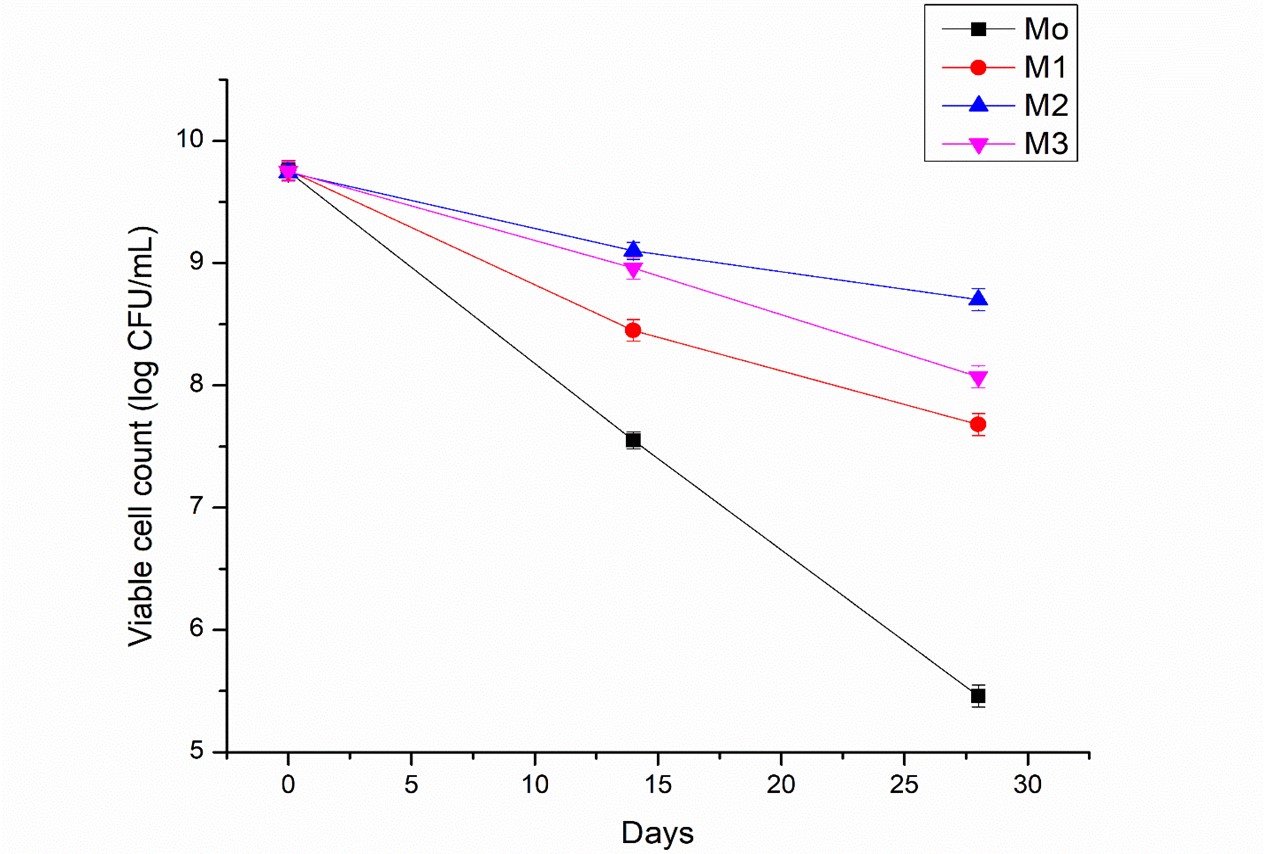
This study explores the potential of ciceritol-based encapsulation alongside betalain fortification to improve the survival of Bifidobacterium bifidum (SP-9) in ice cream formulations. The encapsulated beads, which contain B. bifidum, were evaluated under simulated gastric and intestinal conditions, thus demonstrating enhanced survival rates compared to free cells. Incorporating ciceritol in combination with sodium alginate (M2) significantly improved the survival in simulated intestinal conditions. Additionally, ice cream formulations enriched with encapsulated probiotics (M2 micro capsules) and various concentrations of betalain extract (49, 29, 9%) were subjected to physicochemical and sensory evaluations. The results were statistically significant (p < 0.05). The ice cream variant IC-9, which contains 3301.02 mg/100g db betalains, exhibited favorable quality attributes with an increased hardness (0.38 kg) and viscosity (502.13 mPa.s), while the firmness (766.91 g) and consistency (2749.2 g.sec) remained comparable to the control. No significant change in pH (6.70–6.76) was observed, although the acidity levels increased from 0.21% (control) to 0.31% (IC9). IC-9 received superior sensory scores for the overall acceptability (7.88) and whitening index (45.01%). Conclusively, the current research found that the combination of ciceritol and sodium alginate served as the best encapsulating material, and subsequently focused on the potential use of betalains as natural colorants in the development of functional ice cream in enhancing both health benefits and sensory appeal in frozen desserts.
Citation: Majid Hussain, Taha Rababah, Hifsa Izhar, Muhammad Azam, Ali Almajwal, Numan AL-Rayyan, Bandar N. Hamadneh, Vaida Bartkutė-Norkūnienė, Rania M. Jammal. Synergistic approach: Optimizing probiotic viability in ice cream through prebiotic based encapsulation and betalain fortification[J]. AIMS Agriculture and Food, 2025, 10(2): 293-313. doi: 10.3934/agrfood.2025015
This study explores the potential of ciceritol-based encapsulation alongside betalain fortification to improve the survival of Bifidobacterium bifidum (SP-9) in ice cream formulations. The encapsulated beads, which contain B. bifidum, were evaluated under simulated gastric and intestinal conditions, thus demonstrating enhanced survival rates compared to free cells. Incorporating ciceritol in combination with sodium alginate (M2) significantly improved the survival in simulated intestinal conditions. Additionally, ice cream formulations enriched with encapsulated probiotics (M2 micro capsules) and various concentrations of betalain extract (49, 29, 9%) were subjected to physicochemical and sensory evaluations. The results were statistically significant (p < 0.05). The ice cream variant IC-9, which contains 3301.02 mg/100g db betalains, exhibited favorable quality attributes with an increased hardness (0.38 kg) and viscosity (502.13 mPa.s), while the firmness (766.91 g) and consistency (2749.2 g.sec) remained comparable to the control. No significant change in pH (6.70–6.76) was observed, although the acidity levels increased from 0.21% (control) to 0.31% (IC9). IC-9 received superior sensory scores for the overall acceptability (7.88) and whitening index (45.01%). Conclusively, the current research found that the combination of ciceritol and sodium alginate served as the best encapsulating material, and subsequently focused on the potential use of betalains as natural colorants in the development of functional ice cream in enhancing both health benefits and sensory appeal in frozen desserts.

| [1] |
Sánchez B, Delgado S, Blanco‐Míguez A, et al. (2017) Probiotics, gut microbiota, and their influence on host health and disease. Mol Nutr Food Res 61: 1600240. https://doi.org/10.1002/mnfr.201600240 doi: 10.1002/mnfr.201600240

|
| [2] |
Fiol C, Prado D, Romero C, et al. (2017) Introduction of a new family of ice creams. Int J Gastronomy Food Sci 7: 5–10. https://doi.org/10.1016/j.ijgfs.2016.12.001 doi: 10.1016/j.ijgfs.2016.12.001
|
| [3] |
Khalil RA, El-Sawah TH, Alsulami T, et al. (2024) Development and characterization of functional low-fat frozen dairy dessert enhanced with dried lemongrass powder. Open Chem 22: 20240081. https://doi.org/10.1515/chem-2024-0081 doi: 10.1515/chem-2024-0081
|
| [4] |
Elkot WF, Alsulami T, Malek G, et al. (2025) Effect of using heart of date palm as a new source of protein, carbohydrates, and bioactive compounds on the characterization of low-fat camel milk ice cream. Int J Biol Macromol 289: 138869. https://doi.org/10.1016/j.ijbiomac.2024.138869 doi: 10.1016/j.ijbiomac.2024.138869
|
| [5] |
Bridle P, Timberlake C (1997) Anthocyanins as natural food colours—Selected aspects. Food Chem 58: 103–109. https://doi.org/10.1016/S0308-8146(96)00222-1 doi: 10.1016/S0308-8146(96)00222-1
|
| [6] | Aberoumand A (2011) A review article on edible pigments properties and sources as natural biocolorants in foodstuff and food industry. World J Dairy Food Sci 6: 71–78. |
| [7] |
Kanner J, Harel S, Granit R (2001) Betalains a new class of dietary cationized antioxidants. J Agric Food Chem 49: 5178–5185. https://doi.org/10.1021/jf010456f doi: 10.1021/jf010456f
|
| [8] |
Martinez RM, Longhi-Balbinot DT, Zarpelon AC, et al. (2015) Anti-inflammatory activity of betalain-rich dye of Beta vulgaris: effect on edema, leukocyte recruitment, superoxide anion and cytokine production. Arch Pharmacal Res 38: 494–504. https://doi.org/10.1007/s12272-014-0473-7 doi: 10.1007/s12272-014-0473-7
|
| [9] |
Homayouni A, Azizi A, Javadi M, et al. (2012) Factors influencing probiotic survival in ice cream: A review. Int J Dairy Sci 7: 1–10. https://doi.org/10.3923/ijds.2012.1.10 doi: 10.3923/ijds.2012.1.10
|
| [10] |
Soukoulis C, Fisk ID, Bohn T (2014) Ice cream as a vehicle for incorporating health‐promoting ingredients: Conceptualization and overview of quality and storage stability. Compr Rev Food Sci Food Saf 13: 627–655. https://doi.org/10.1111/1541-4337.12083 doi: 10.1111/1541-4337.12083
|
| [11] |
Azam M, Saeed M, Yasmin I, et al. (2021) Microencapsulation and invitro characterization of Bifidobacterium animalis for improved survival. J Food Meas Charact 15: 2591–2600. https://doi.org/10.1007/s11694-021-00839-4 doi: 10.1007/s11694-021-00839-4
|
| [12] |
Kearney L, Upton M, Mc Loughlin A (1990) Enhancing the viability of Lactobacillus plantarum inoculum by immobilizing the cells in calcium-alginate beads incorporating cryoprotectants. Appl Environ Microbiol 56: 3112–3116. https://doi.org/10.1128/aem.56.10.3112-3116.1990 doi: 10.1128/aem.56.10.3112-3116.1990
|
| [13] | Shah N, Ravula R (2000) Microencapsulation of probiotic bacteria and their survival in frozen fermented dairy desserts. Aust J Dairy Technol 55: 139. |
| [14] |
Mani-López E, Jiménez-Hernández E, Palou E, et al. (2017) Viability of Lactobacillus fermentum microencapsulated in flavoured alginate beads and added to a gelatine dessert. J Funct Foods 38: 447–453. https://doi.org/10.1016/j.jff.2017.09.026 doi: 10.1016/j.jff.2017.09.026
|
| [15] |
Azam M, Saeed M, Pasha I, et al. (2020) A prebiotic-based biopolymeric encapsulation system for improved survival of Lactobacillus rhamnosus. Food Biosci 37: 100679. https://doi.org/10.1016/j.fbio.2020.100679 doi: 10.1016/j.fbio.2020.100679
|
| [16] |
Akalın A, Erişir D (2008) Effects of inulin and oligofructose on the rheological characteristics and probiotic culture survival in low‐fat probiotic ice cream. J Food Sci 73: M184–M188. https://doi.org/10.1111/j.1750-3841.2008.00728.x doi: 10.1111/j.1750-3841.2008.00728.x
|
| [17] |
Abghari A, Sheikh-Zeinoddin M, Soleimanian-Zad S (2011) Nonfermented ice cream as a carrier for Lactobacillus acidophilus and Lactobacillus rhamnosus. Int J Food Sci Technol 46: 84–92. https://doi.org/10.1111/j.1365-2621.2010.02453.x doi: 10.1111/j.1365-2621.2010.02453.x
|
| [18] |
do Carmo EL, Teodoro RAR, Félix PHC, et al. (2018) Stability of spray-dried beetroot extract using oligosaccharides and whey proteins. Food Chem 249: 51–59. https://doi.org/10.1016/j.foodchem.2017.12.076 doi: 10.1016/j.foodchem.2017.12.076
|
| [19] |
Stintzing FC, Schieber A, Carle R (2003) Evaluation of colour properties and chemical quality parameters of cactus juices. Eur Food Res Technol 216: 303–311. https://doi.org/10.1007/s00217-002-0657-0 doi: 10.1007/s00217-002-0657-0
|
| [20] |
Hwang JY, Shyu YS, Hsu CK (2009) Grape wine lees improves the rheological and adds antioxidant properties to ice cream. LWT-Food Sci Technol 42: 312–318. https://doi.org/10.1016/j.lwt.2008.03.008 doi: 10.1016/j.lwt.2008.03.008
|
| [21] |
Brand-Williams W, Cuvelier M-E, Berset C (1995) Use of a free radical method to evaluate antioxidant activity. LWT-Food Sci Technol 28: 25–30. https://doi.org/10.1016/S0023-6438(95)80008-5 doi: 10.1016/S0023-6438(95)80008-5
|
| [22] | Ansari F, Pourjafar H (2017) Characteristics of beads from Lactobacillus acidophilus probiotic microencapsulation with calcium alginate and resistant starch. Iioab J 8: 47–52. |
| [23] |
Gandomi H, Abbaszadeh S, Misaghi A, et al. (2016) Effect of chitosan-alginate encapsulation with inulin on survival of Lactobacillus rhamnosus GG during apple juice storage and under simulated gastrointestinal conditions. LWT-Food SciTechnol 69: 365–371. https://doi.org/10.1016/j.lwt.2016.01.064 doi: 10.1016/j.lwt.2016.01.064
|
| [24] |
Sathyabama S, Vijayabharathi R (2014) Co-encapsulation of probiotics with prebiotics on alginate matrix and its effect on viability in simulated gastric environment. LWT-Food Sci Technol 57: 419–425. https://doi.org/10.1016/j.lwt.2013.12.024 doi: 10.1016/j.lwt.2013.12.024
|
| [25] | Arbuckle WS (2013) Ice cream: Springer Science & Business Media. |
| [26] | Bylund G (2015) Ice Ccream. Dairy Processing Handbook. 2nd ed: Tetra Pak Processing Systems AB, S-221 86 Lund, Sweden, 399–408. |
| [27] |
Sagdic O, Ozturk I, Cankurt H, et al. (2012) Interaction between some phenolic compounds and probiotic bacterium in functional ice cream production. Food Bioprocess Technol 5: 2964–2971. https://doi.org/10.1007/s11947-011-0611-x doi: 10.1007/s11947-011-0611-x
|
| [28] |
Singo T, Beswa D (2019) Effect of roselle extracts on the selected quality characteristics of ice cream. Int J Food Prop 22: 42–53. https://doi.org/10.1080/10942912.2019.1567535 doi: 10.1080/10942912.2019.1567535
|
| [29] |
Kappes S, Schmidt S, Lee SY (2007) Relationship between physical properties and sensory attributes of carbonated beverages. J Food Sci 72: S001–S011. https://doi.org/10.1111/j.1750-3841.2006.00205.x doi: 10.1111/j.1750-3841.2006.00205.x
|
| [30] |
Homayouni A, Norouzi S (2016) Evaluation of physicochemical traits, sensory properties and survival of Lactobacillus casei in fermented soy‐based ice cream. J Food Process Preserv 40: 681–687. https://doi.org/10.1111/jfpp.12648 doi: 10.1111/jfpp.12648
|
| [31] | El-Samahy S, Youssef K, Moussa-Ayoub T (2009) Producing ice cream with concentrated cactus pear pulp: A preliminary study. J Prof Assoc Cactus Dev 11: 1–12. |
| [32] |
Karaca OB, Guven M, Yasar K, et al. (2009) The functional, rheological and sensory characteristics of ice creams with various fat replacers. Int J Dairy Technol 62: 93–99. https://doi.org/10.1111/j.1471-0307.2008.00456.x doi: 10.1111/j.1471-0307.2008.00456.x
|
| [33] |
Muse M, Hartel RW (2004) Ice cream structural elements that affect melting rate and hardness. J Dairy Sci 87: 1–10. https://doi.org/10.3168/jds.S0022-0302(04)73135-5 doi: 10.3168/jds.S0022-0302(04)73135-5
|
| [34] | Owens B, Mallette J, Phebus J (2014) Effects of carbonated cola beverages, sports and energy drinks and orange juice on primary and permanent enamel dissolution. Austin J Dent 1: 1004. |
| [35] |
Abilgos-Ramos R, Labargan ES, Ballesteros J, et al. (2019) Nutritional quality and acceptability of brown rice ice cream sandwich. J Nutr Sci Vitaminol 65: S158–S162. https://doi.org/10.3177/jnsv.65.S158 doi: 10.3177/jnsv.65.S158
|
| [36] |
Akingbala J, Oguntimein G, Abass A (1991) Effect of processing methods on quality and acceptability of fufu from low cyanide cassava. J Sci Food Agric 57: 151–154. https://doi.org/10.1002/jsfa.2740570118 doi: 10.1002/jsfa.2740570118
|
| [37] | Montgomery DC (2017) Design and analysis of experiments: John wiley & sons. |
| [38] |
Čanadanović-Brunet JM, Savatović SS, Ćetković GS, et al. (2011) Antioxidant and antimicrobial activities of beet root pomace extracts. Czech J Food Sci 29: 575–585. https://doi.org/10.17221/210/2010-CJFS doi: 10.17221/210/2010-CJFS
|
| [39] | Kathiravan T, Nadanasabapathi S, Kumar R (2014) Standardization of process condition in batch thermal pasteurization and its effect on antioxidant, pigment and microbial inactivation of Ready to Drink (RTD) beetroot (Beta vulgaris L.) juice. Int Food Res J 21: 1305. |
| [40] |
Bazaria B, Kumar P (2016) Effect of whey protein concentrate as drying aid and drying parameters on physicochemical and functional properties of spray dried beetroot juice concentrate. Food Biosci 14: 21–27. https://doi.org/10.1016/j.fbio.2015.11.002 doi: 10.1016/j.fbio.2015.11.002
|
| [41] |
Bazaria B, Kumar P (2016) Compositional changes in functional attributes of vacuum concentrated beetroot juice. J Food Process Preserv 40: 1215–1222. https://doi.org/10.1111/jfpp.12705 doi: 10.1111/jfpp.12705
|
| [42] |
Atia A, Gomaa A, Fliss I, et al. (2016) A prebiotic matrix for encapsulation of probiotics: physicochemical and microbiological study. J Microencapsulation 33: 89–101. https://doi.org/10.3109/02652048.2015.1134688 doi: 10.3109/02652048.2015.1134688
|
| [43] |
Yasmin I, Saeed M, Pasha I, et al. (2019) Development of whey protein concentrate-pectin-alginate based delivery system to improve survival of B. longum BL-05 in simulated gastrointestinal conditions. Probiotics Antimicrob Proteins 11: 413–426. https://doi.org/10.1007/s12602-018-9407-x doi: 10.1007/s12602-018-9407-x
|
| [44] |
Azam M, Saeed M, Ahmad T, et al. (2022) Characterization of biopolymeric encapsulation system for improved survival of Lactobacillus brevis. J Food Meas Charact 16: 2292–2299. https://doi.org/10.1007/s11694-022-01334-0 doi: 10.1007/s11694-022-01334-0
|
| [45] |
Akın M, Akın M, Kırmacı Z (2007) Effects of inulin and sugar levels on the viability of yogurt and probiotic bacteria and the physical and sensory characteristics in probiotic ice-cream. Food Chem 104: 93–99. https://doi.org/10.1016/j.foodchem.2006.11.030 doi: 10.1016/j.foodchem.2006.11.030
|
| [46] |
Mohammadi R, Mortazavian AM, Khosrokhavar R, et al. (2011) Probiotic ice cream: viability of probiotic bacteria and sensory properties. Ann Microbiol 61: 411–424. https://doi.org/10.1007/s13213-010-0188-z doi: 10.1007/s13213-010-0188-z
|
| [47] |
Afzaal M, Saeed F, Saeed M, et al. (2020) Survival and stability of free and encapsulated probiotic bacteria under simulated gastrointestinal and thermal conditions. Int J Food Properties 23: 1899–1912. https://doi.org/10.1080/10942912.2020.1826513 doi: 10.1080/10942912.2020.1826513
|
| [48] |
Güneşer O (2016) Pigment and color stability of beetroot betalains in cow milk during thermal treatment. Food Chem 196: 220–227. https://doi.org/10.1016/j.foodchem.2015.09.033 doi: 10.1016/j.foodchem.2015.09.033
|
| [49] |
Alizadeh M, Azizi-Lalabadi M, Kheirouri S (2014) Impact of using stevia on physicochemical, sensory, rheology and glycemic index of soft ice cream. Food Nut Sci 5: 390. https://doi.org/10.4236/fns.2014.54047 doi: 10.4236/fns.2014.54047
|
| [50] |
BRITO-OLIVEIRA TC, PINHO SCd (2016) Characterization and evaluation of sensory acceptability of ice creams incorporated with beta-carotene encapsulated in solid lipid microparticles. Food Sci Technol 36: 664–671. https://doi.org/10.1590/1678-457x.13416 doi: 10.1590/1678-457x.13416
|
| [51] | Topdas EF, Çakmakci S, Çakiroglu K (2017) The antioxidant activity, vitamin c contents, physical, chemical and sensory properties of ice cream supplemented with cornelian cherry (Cornus mas L.) paste. Kafkas Üniversitesi Veteriner Fakültesi Dergisi 23: 691–697. |
| [52] | Pon S, Lee W, Chong G (2015) Textural and rheological properties of stevia ice cream. Int Food Res J 22: 1544. |
| [53] |
Aykan V, Sezgin E, Guzel‐Seydim ZB (2008) Use of fat replacers in the production of reduced‐calorie vanilla ice cream. Eur J Lipid Sci Technol 110: 516–520. https://doi.org/10.1002/ejlt.200700277 doi: 10.1002/ejlt.200700277
|
| [54] |
El‐Nagar G, Clowes G, Tudoricǎ C, et al. (2002) Rheological quality and stability of yog‐ice cream with added inulin. Int J Dairy Technol 55: 89–93. https://doi.org/10.1046/j.1471-0307.2002.00042.x doi: 10.1046/j.1471-0307.2002.00042.x
|
| [55] |
Alamprese C, Foschino R, Rossi M, et al. (2005) Effects of Lactobacillus rhamnosus GG addition in ice cream. Int J Dairy Technol 58: 200–206. https://doi.org/10.1111/j.1471-0307.2005.00214.x doi: 10.1111/j.1471-0307.2005.00214.x
|
| [56] |
Baryga A, Ziobro R, Gumul D, et al. (2023) Physicochemical properties and evaluation of antioxidant potential of sugar beet pulp—preliminary analysis for further use (future prospects). Agriculture 13: 1039. https://doi.org/10.3390/agriculture13051039 doi: 10.3390/agriculture13051039
|
| [57] | Enchev S, Bozhanska T (2022) Chemical composition of sugar beet, fodder beet and table beet depending on the harvest period. |
Figures(5) / Tables(7)

Majid Hussain, Taha Rababah, Hifsa Izhar, Muhammad Azam, Ali Almajwal, Numan AL-Rayyan, Bandar N. Hamadneh, Vaida Bartkutė-Norkūnienė, Rania M. Jammal. Synergistic approach: Optimizing probiotic viability in ice cream through prebiotic based encapsulation and betalain fortification[J]. AIMS Agriculture and Food, 2025, 10(2): 293-313. doi: 10.3934/agrfood.2025015




 DownLoad: