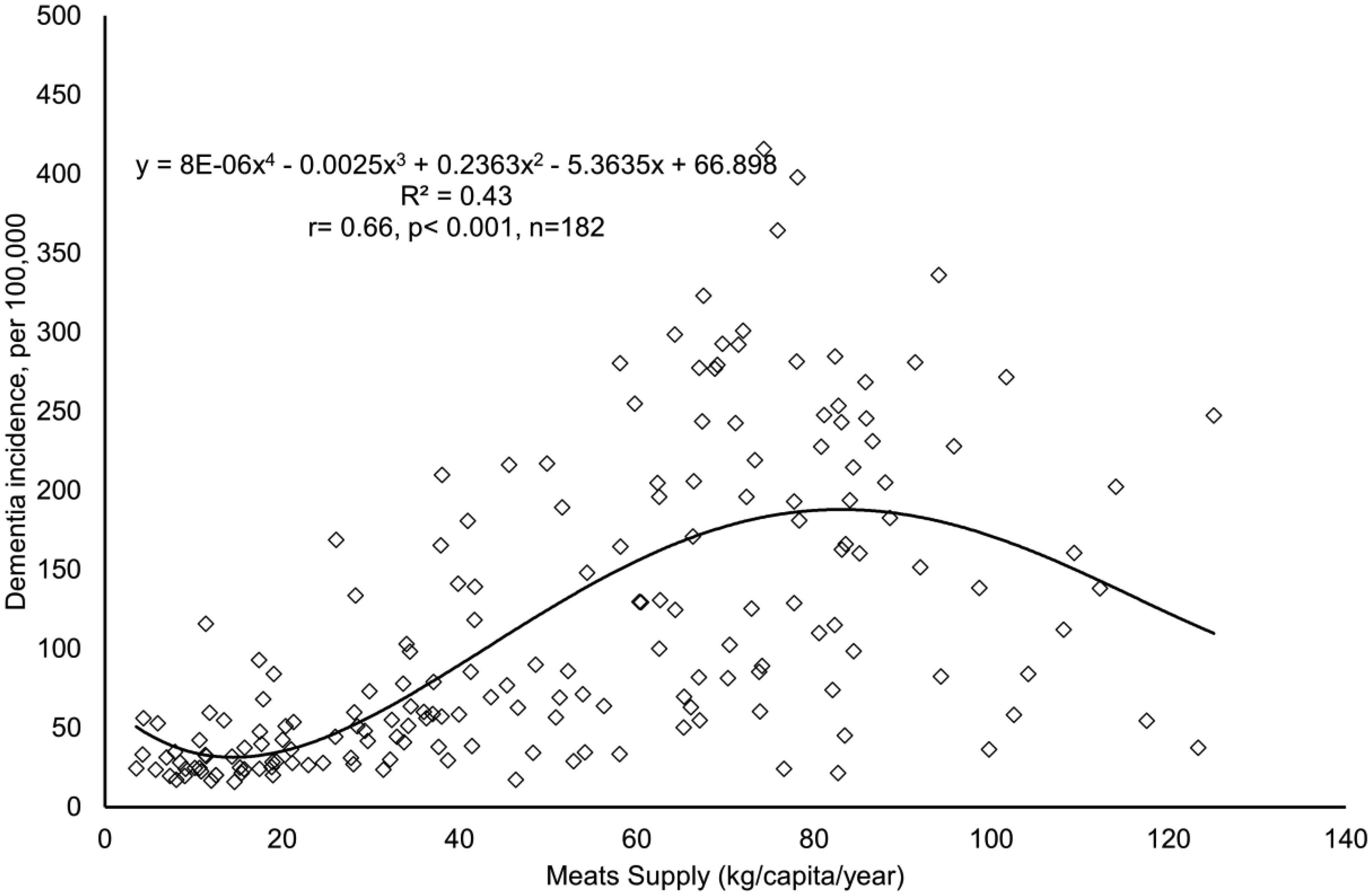
Dementia cases are projected to triple globally by 2050, largely driven by an aging population. While aging remains the primary risk factor, emerging evidence suggests that diet, including total meat supply, may influence dementia risk. This study investigates the relationship between total meat supply (red and white meat) and dementia incidence using data from 204 countries. Bivariate correlations revealed a significant positive association between total meat supply and dementia incidence globally (r = 0.59, p < 0.001), with a stronger effect observed in low- and middle-income countries (z = 3.92, p < 0.001). Partial correlation analyses and multiple regression models, controlling for aging, economic status, genetic predisposition, and urbanization, confirmed that meat supply remained a significant predictor of dementia (Beta = 0.20, p < 0.001). Aging showed the strongest influence (Beta = 0.79, p < 0.001), underscoring its dominant role. Regional analyses suggested socio-economic disparities, dietary habits, and limited access to diverse nutrition as factors amplifying the association in developing regions. These findings identify total meat supply as a modifiable dietary factor contributing to dementia risk, particularly in resource-constrained settings. Implementing tailored dietary interventions may help reduce dementia incidence globally, especially in vulnerable populations.
Citation: Wenpeng You. Global patterns linking total meat supply to dementia incidence: A population-based ecological study[J]. AIMS Neuroscience, 2025, 12(2): 203-221. doi: 10.3934/Neuroscience.2025012
Dementia cases are projected to triple globally by 2050, largely driven by an aging population. While aging remains the primary risk factor, emerging evidence suggests that diet, including total meat supply, may influence dementia risk. This study investigates the relationship between total meat supply (red and white meat) and dementia incidence using data from 204 countries. Bivariate correlations revealed a significant positive association between total meat supply and dementia incidence globally (r = 0.59, p < 0.001), with a stronger effect observed in low- and middle-income countries (z = 3.92, p < 0.001). Partial correlation analyses and multiple regression models, controlling for aging, economic status, genetic predisposition, and urbanization, confirmed that meat supply remained a significant predictor of dementia (Beta = 0.20, p < 0.001). Aging showed the strongest influence (Beta = 0.79, p < 0.001), underscoring its dominant role. Regional analyses suggested socio-economic disparities, dietary habits, and limited access to diverse nutrition as factors amplifying the association in developing regions. These findings identify total meat supply as a modifiable dietary factor contributing to dementia risk, particularly in resource-constrained settings. Implementing tailored dietary interventions may help reduce dementia incidence globally, especially in vulnerable populations.

| [1] | WHODementia (2025). [cited 2025 June 04 ]. Available from: https://www.who.int/en/news-room/fact-sheets/detail/dementia |
| [2] | von Gunten A, Nogueira E, Parmentier H, et al. (2019) Neurocognitive Disorders in Old Age: Alzheimer's Disease, Frontotemporal Dementia, Dementia with Lewy Bodies, and Prion and Infectious Diseases. Primary Care Mental Health in Older People . Cham: Springer. https://doi.org/10.1007/978-3-030-10814-4_21 |
| [3] |
Wahl D, Solon-Biet SM, Cogger VC, et al. (2019) Aging, lifestyle and dementia. Neurobiol Dis 130: 104481. https://doi.org/10.1016/j.nbd.2019.104481 
|
| [4] |
Pistollato F, Iglesias RC, Ruiz R, et al. (2018) Nutritional patterns associated with the maintenance of neurocognitive functions and the risk of dementia and Alzheimer's disease: A focus on human studies. Pharmacol Res 131: 32-43. https://doi.org/10.1016/j.phrs.2018.03.012
|
| [5] |
Valls-Pedret C, Sala-Vila A, Serra-Mir M, et al. (2015) Mediterranean diet and age-related cognitive decline: a randomized clinical trial. JAMA Intern Med 175: 1094-1103. https://doi.org/10.1001/jamainternmed.2015.1668
|
| [6] |
Aridi YS, Walker JL, Wright OR (2017) The association between the Mediterranean dietary pattern and cognitive health: a systematic review. Nutrients 9: 674. https://doi.org/10.3390/nu9070674
|
| [7] |
Martínez-Lapiscina EH, Clavero P, Toledo E, et al. (2013) Mediterranean diet improves cognition: the PREDIMED-NAVARRA randomised trial. J Neurol Neurosurg Psychiatry 84: 1318-1325. https://doi.org/10.1136/jnnp-2012-304792
|
| [8] | Bruinsma J (2003) World Agriculture: Towards 2015/2030: An FAO Study (1st ed.). Routledge. https://doi.org/10.4324/9781315083858 |
| [9] |
Albanese E, Dangour AD, Uauy R, et al. (2009) Dietary fish and meat intake and dementia in Latin America, China, and India: a 10/66 Dementia Research Group population-based study. Am J Clin Nutr 90: 392-400. https://doi.org/10.3945/ajcn.2009.27580
|
| [10] |
Grant WB (2014) Trends in diet and Alzheimer's disease during the nutrition transition in Japan and developing countries. J Alzheimers Dis 38: 611-620. https://doi.org/10.3233/JAD-130719
|
| [11] |
Titova OE, Ax E, Brooks SJ, et al. (2013) Mediterranean diet habits in older individuals: associations with cognitive functioning and brain volumes. Exp Gerontol 48: 1443-1448. https://doi.org/10.1016/j.exger.2013.10.002
|
| [12] |
Li Y, Li Y, Gu X, et al. (2025) Long-term intake of red meat in relation to dementia risk and cognitive function in US adults. Neurology 104: e210286. https://doi.org/10.1212/WNL.0000000000210286
|
| [13] |
Christodoulou CC, Pitsillides M, Hadjisavvas A, et al. (2025) Dietary Intake, Mediterranean and Nordic Diet Adherence in Alzheimer's Disease and Dementia: A Systematic Review. Nutrients 17: 336. https://doi.org/10.3390/nu17020336
|
| [14] |
Zhang H, Hardie L, Bawajeeh AO, et al. (2020) Meat consumption, cognitive function and disorders: a systematic review with narrative synthesis and meta-analysis. Nutrients 12: 1528. https://doi.org/10.3390/nu12051528
|
| [15] |
Ylilauri MP, Hantunen S, Lönnroos E, et al. (2022) Associations of dairy, meat, and fish intakes with risk of incident dementia and with cognitive performance: the Kuopio Ischaemic Heart Disease Risk Factor Study (KIHD). Eur J Nutr 61: 2531-2542. https://doi.org/10.1007/s00394-022-02834-x
|
| [16] |
Kouvari M, Tyrovolas S, Panagiotakos DB (2016) Red meat consumption and healthy ageing: A review. Maturitas 84: 17-24. https://doi.org/10.1016/j.maturitas.2015.11.006
|
| [17] |
Kim K, Hyeon J, Lee SA, et al. (2017) Role of total, red, processed, and white meat consumption in stroke incidence and mortality: a systematic review and meta-analysis of prospective cohort studies. J Am Heart Assoc 6: e005983. https://doi.org/10.1161/JAHA.117.005983
|
| [18] |
Wang Z, Bergeron N, Levison BS, et al. (2019) Impact of chronic dietary red meat, white meat, or non-meat protein on trimethylamine N-oxide metabolism and renal excretion in healthy men and women. Eur Heart J 40: 583-594. https://doi.org/10.1093/eurheartj/ehy799
|
| [19] |
Quan W, Xu Y, Luo J, et al. (2022) Association of dietary meat consumption habits with neurodegenerative cognitive impairment: an updated systematic review and dose–response meta-analysis of 24 prospective cohort studies. Food Funct 13: 12590-12601. https://doi.org/10.1039/D2FO03168J
|
| [20] |
Perrone L, Grant WB (2015) Observational and ecological studies of dietary advanced glycation end products in national diets and Alzheimer's disease incidence and prevalence. J Alzheimers Dis 45: 965-979. https://doi.org/10.3233/JAD-140720
|
| [21] |
Stadnik J (2024) Nutritional Value of Meat and Meat Products and Their Role in Human Health. Nutrients 16: 1446. https://doi.org/10.3390/nu16101446
|
| [22] |
Juárez M, Lam S, Bohrer BM, et al. (2021) Enhancing the nutritional value of red meat through genetic and feeding strategies. Foods 10: 872. https://doi.org/10.3390/foods10040872
|
| [23] | IHMEGlobal Burden of Disease Collaborative Network, Global Burden of Disease Study 2019 (GBD 2019) Results (2020). [cited 2025 June 04]. Available from: https://ghdx.healthdata.org/gbd-2019 |
| [24] | The World BankHow does the World Bank classify countries? (2022). [cited 2025 June 04]. Available from: https://datahelpdesk.worldbank.org/knowledgebase/articles/378834-how-does-the-world-bank-classify-countries |
| [25] | FAOFAOSTAT-Food Balance Sheet. Food and Agriculture Organization of the United Nations, FAOSTAT (2017). [cited 2025 June 04]. Available from: https://www.fao.org/news/archive/news-by-date/2017/en/ |
| [26] | The World BankIndicators | Data (2018). [cited 2025 June 04]. Available from: https://data.worldbank.org/indicator |
| [27] |
Gaziano TA, Bitton A, Anand S, et al. (2010) Growing epidemic of coronary heart disease in low-and middle-income countries. Curr Probl Cardiol 35: 72-115. https://doi.org/10.1016/j.cpcardiol.2009.10.002
|
| [28] |
You W, Henneberg M (2022) Large household reduces dementia mortality: A cross-sectional data analysis of 183 populations. PLoS One 17: e0263309. https://doi.org/10.1371/journal.pone.0263309
|
| [29] |
You W, Henneberg R, Henneberg M (2022) Healthcare services relaxing natural selection may contribute to increase of dementia incidence. Sci Rep 12: 1-10. https://doi.org/10.1038/s41598-022-12678-4
|
| [30] |
Henneberg M, Piontek J (1975) Biological state index of human groups. Anthropol Rev 41: 191-201. https://doi.org/10.18778/1898-6773.41.2.03
|
| [31] |
You W, Henneberg M (2018) Relaxed natural selection contributes to global obesity increase more in males than in females due to more environmental modifications in female body mass. PLoS One 13: e0199594. https://doi.org/10.1371/journal.pone.0199594
|
| [32] | The World BankLife expectancy at birth, total (years) (2022). [cited 2025 June 04]. Available from: https://data.worldbank.org/indicator/SP.DYN.LE00.IN?cid=GPD_10 |
| [33] |
You W, Henneberg M (2016) Meat consumption providing a surplus energy in modern diet contributes to obesity prevalence: an ecological analysis. BMC Nutr 2: 1-11. https://doi.org/10.1186/s40795-016-0063-9
|
| [34] | You W, Henneberg M (2016) Meat in modern diet, just as bad as sugar, correlates with worldwide obesity: an ecological analysis. J Nutr Food Sci 6: 4. https://doi.org/10.4172/2155-9600.1000517 |
| [35] | Smith S, Ralston J, Taubert K (2012) Urbanization and cardiovascular disease- Raising heart-healthy children in today's cities. Geneva: The World Heart Federation. [cited 2025 June 04]. Available from: https://world-heart-federation.org/resource/urbanization-and-cvd/. |
| [36] |
Allender S, Foster C, Hutchinson L, et al. (2008) Quantification of urbanization in relation to chronic diseases in developing countries: a systematic review. J Urban Health 85: 938-951. https://doi.org/10.1007/s11524-008-9325-4
|
| [37] |
You W, Donnelly F (2022) Physician care access plays a significant role in extending global and regional life expectancy. Eur J Intern Med 103: 62-68. https://doi.org/10.1016/j.ejim.2022.06.006
|
| [38] |
You W, Henneberg R, Coventry BJ, et al. (2022) Cutaneous malignant melanoma incidence is strongly associated with European depigmented skin type regardless of ambient ultraviolet radiation levels: evidence from Worldwide population-based data. AIMS Public Health 9: 378. https://doi.org/10.3934/publichealth.2022026
|
| [39] |
You W, Rühli F, Eppenberger P, et al. (2020) Gluten consumption may contribute to worldwide obesity prevalence. Anthropol Rev 83: 327-348. https://doi.org/10.2478/anre-2020-0023
|
| [40] | WHOThe top 10 causes of death (2024). [cited 2025 June 04]. Available from: https://www.who.int/news-room/fact-sheets/detail/the-top-10-causes-of-death#:~:text=The%20World%20Bank%20classifies%20the,middle%20and%20high |
| [41] | United Nations Statistics DivisionComposition of macro geographical (continental) regions, geographical sub-regions, and selected economic and other groupings (2013). [cited 2025 June 04]. Available from: http://unstats.un.org/unsd/methods/m49/m49regin.htm#ftnc |
| [42] | WHOWHO regional offices (2018). [cited 2025 June 04]. Available from: https://www.who.int/about/who-we-are/regional-offices |
| [43] | ACDMember Countries of Asia Cooperation Dialogue (2024). [cited 2025 June 04]. Available from: http://www.acd-dialogue.org/ |
| [44] | APECMember Economies-Asia-Pacific Economic Cooperation (2024). [cited 2025 June 04]. Available from: https://www.apec.org/About-Us/About-APEC/Member-Economies/ |
| [45] | The World BankArab World | Data (2015). [cited 2025 June 04]. Available from: https://data.worldbank.org/region/arab-world?view=chart |
| [46] | The United Nations Educational Scientific and Cultural OrganizationUNESCO Regions-Latin America and the Caribbean (2014). [cited 2025 June 04]. Available from: https://www.unesco.org/en/links/lac |
| [47] | OECDList of OECD Member countries (2024). [cited 2025 June 04]. Available from: https://www.oecd.org/en/about/members-partners.html |
| [48] | Southern African Development CommunityMember States (2022). [cited 2025 June 04]. Available from: https://www.sadc.int/member-states#:~:text=The%20Southern%20African%20Development%20Community%20%28SADC%29%20is%20a,Africa%2C%20United%20Republic%20of%20Tanzania%2C%20Zambia%20and%20Zimbabwe |
| [49] |
Grant WB, Blake SM (2023) Diet's role in modifying risk of Alzheimer's disease: history and present understanding. J Alzheimers Dis 96: 1353-1382. https://doi.org/10.3233/JAD-230418
|
| [50] |
Grant WB (2016) Using multicountry ecological and observational studies to determine dietary risk factors for Alzheimer's disease. J Am Coll Nutr 35: 476-489. https://doi.org/10.1080/07315724.2016.1161566
|
| [51] |
Shiraseb F, Hosseininasab D, Mirzababaei A, et al. (2022) Red, white, and processed meat consumption related to inflammatory and metabolic biomarkers among overweight and obese women. Front Nutr 9: 1015566. https://doi.org/10.3389/fnut.2022.1015566
|
| [52] |
Ospina EJ, Sierra CA, Ochoa O, et al. (2012) Substitution of saturated fat in processed meat products: A review. Crit Rev Food Sci Nutr 52: 113-122. https://doi.org/10.1080/10408398.2010.493978
|
| [53] |
Buawangpong N, Pinyopornpanish K, Phrommintikul A, et al. (2022) Increased plasma trimethylamine-N-oxide levels are associated with mild cognitive impairment in high cardiovascular risk elderly population. Food Funct 13: 10013-10022. https://doi.org/10.1039/D2FO02021A
|
| [54] |
Xie L, Pan L, Liu B, et al. (2024) Research progress on the association between trimethylamine/trimethylamine-N-oxide and neurological disorders. Postgrad Med J 100: 283-288. https://doi.org/10.1093/postmj/qgad133
|
| [55] |
Zhang H, Greenwood DC, Risch HA, et al. (2021) Meat consumption and risk of incident dementia: cohort study of 493,888 UK Biobank participants. Am J Clin Nutr 114: 175-184. https://doi.org/10.1093/ajcn/nqab028
|
| [56] |
Ngabirano L, Samieri C, Feart C, et al. (2019) Intake of meat, fish, fruits, and vegetables and long-term risk of dementia and Alzheimer's disease. J Alzheimers Dis 68: 711-722. https://doi.org/10.3233/JAD-180919
|
| [57] |
Barberger-Gateau P, Letenneur L, Deschamps V, et al. (2002) Fish, meat, and risk of dementia: cohort study. BMJ 325: 932-933. https://doi.org/10.1136/bmj.325.7370.932
|
| [58] |
Fischer K, Melo van Lent D, Wolfsgruber S, et al. (2018) Prospective associations between single foods, Alzheimer's dementia and memory decline in the elderly. Nutrients 10: 852. https://doi.org/10.3390/nu10070852
|
| [59] |
De la Monte SM, Neusner A, Chu J, et al. (2009) Epidemiological trends strongly suggest exposures as etiologic agents in the pathogenesis of sporadic Alzheimer's disease, diabetes mellitus, and non-alcoholic steatohepatitis. J Alzheimers Dis 17: 519-529. https://doi.org/10.3233/JAD-2009-1070
|
| [60] |
Barnard ND, Bunner AE, Agarwal U (2014) Saturated and trans fats and dementia: a systematic review. Neurobiol Aging 35: S65-S73. https://doi.org/10.1016/j.neurobiolaging.2014.02.030
|
| [61] |
Abe SK, Inoue M, Yasuda N, et al. (2025) PUFA, fish intake and risk of disabling dementia in Japan: the Japan Public Health Centre Disabling Dementia Study. Public Health Nutr 28: e65. https://doi.org/10.1017/S1368980025000308
|
| [62] |
Guo CP, Wei Z, Huang F, et al. (2017) High salt induced hypertension leads to cognitive defect. Oncotarget 8: 95780. https://doi.org/10.18632/oncotarget.21326
|
| [63] | You W, Henneberg M (2016) Meat consumption and prostate cancer incidence-global and regional associations. BJU Int 118: 6-20. |
| [64] |
Goldstein LB, Toth PP, Dearborn-Tomazos JL, et al. (2023) Aggressive LDL-C lowering and the brain: impact on risk for dementia and hemorrhagic stroke: a scientific statement from the American Heart Association. Arterioscler Thromb Vasc Biol 43: e404-e442. https://doi.org/10.1161/ATV.0000000000000164
|
| [65] |
Roberts RO, Roberts LA, Geda YE, et al. (2012) Relative intake of macronutrients impacts risk of mild cognitive impairment or dementia. J Alzheimers Dis 32: 329-339. https://doi.org/10.3233/JAD-2012-120862
|
| [66] |
Liu JL, Fan YG, Yang ZS, et al. (2018) Iron and Alzheimer's disease: from pathogenesis to therapeutic implications. Front Neurosci 12: 632. https://doi.org/10.3389/fnins.2018.00632
|
| [67] |
Piñero DJ, Connor JR (2000) Iron in the brain: an important contributor in normal and diseased states. Neuroscientist 6: 435-453. https://doi.org/10.1177/107385840000600607
|
| [68] | Li M, Yang X, Sun L, et al. (2024) Meat products consumption and risk for Alzheimer dementia and type 2 diabetes: a systematic review and meta-analysis of cohort studies. Food Sci Hum Well . https://doi.org/10.26599/FSHW.2024.9250307 |
| [69] |
Biessels GJ, Staekenborg S, Brunner E, et al. (2006) Risk of dementia in diabetes mellitus: a systematic review. Lancet Neurol 5: 64-74. https://doi.org/10.1016/S1474-4422(05)70284-2
|
| [70] |
Whitmer RA, Gunderson EP, Barrett-Connor E, et al. (2005) Obesity in middle age and future risk of dementia: a 27 year longitudinal population based study. BMJ 330: 1360. https://doi.org/10.1136/bmj.38446.466238.E0
|
| [71] |
Craft S (2009) The role of metabolic disorders in Alzheimer disease and vascular dementia: two roads converged. Arch Neurol 66: 300-305. https://doi.org/10.1001/archneurol.2009.27
|
| [72] |
Lin Y, Wiegand K (2023) Low R2 in ecology: Bitter, or B-side?. Ecol Indic 153: 110406. https://doi.org/10.1016/j.ecolind.2023.110406
|
| [73] | Babyak MA (2004) What you see may not be what you get: a brief, nontechnical introduction to overfitting in regression-type models. Psychosom Med 66: 411-421. https://doi.org/10.1097/00006842-200405000-00021 |
| [74] |
Wallander L (2009) 25 years of factorial surveys in sociology: A review. Soc Sci Res 38: 505-520. https://doi.org/10.1016/j.ssresearch.2009.03.004
|
Figures(1) / Tables(4)

Wenpeng You. Global patterns linking total meat supply to dementia incidence: A population-based ecological study[J]. AIMS Neuroscience, 2025, 12(2): 203-221. doi: 10.3934/Neuroscience.2025012





 DownLoad: