Neuromodulation techniques have emerged as valuable strategies for patients with depression and anxiety who do not respond to traditional therapies. Repetitive transcranial magnetic stimulation (rTMS) and transcranial direct current stimulation (tDCS) treatments are heterogeneous; however, they all share an average duration of at least 10 days, thus requiring significant patient commitment to maintain adequate compliance. Here we describe a 68-year-old woman who suffered from depression and generalized anxiety disorder and underwent a short-intensive combined protocol, thus highlighting its effectiveness and good tolerability.
Citation: Fiammetta Iannuzzo, Federica Donia, Lorenzo Bette, Fabrizio Turiaco, Antonio Bruno. Neuromodulation techniques in combination for a short-intensive treatment of depression and anxiety: a case report[J]. AIMS Neuroscience, 2025, 12(2): 140-146. doi: 10.3934/Neuroscience.2025009
Neuromodulation techniques have emerged as valuable strategies for patients with depression and anxiety who do not respond to traditional therapies. Repetitive transcranial magnetic stimulation (rTMS) and transcranial direct current stimulation (tDCS) treatments are heterogeneous; however, they all share an average duration of at least 10 days, thus requiring significant patient commitment to maintain adequate compliance. Here we describe a 68-year-old woman who suffered from depression and generalized anxiety disorder and underwent a short-intensive combined protocol, thus highlighting its effectiveness and good tolerability.

| [1] |
Zhu C, Zhang T, Li Q, et al. (2023) Depression and Anxiety During the COVID-19 Pandemic: Epidemiology, Mechanism, and Treatment. Neurosci Bull 39: 675-684. https://doi.org/10.1007/s12264-022-00970-2 
|
| [2] |
Marx W, Penninx BWJH, Solmi M, et al. (2023) Major depressive disorder. Nat Rev Dis Primers 9: 44. https://doi.org/10.1038/s41572-023-00454-1
|
| [3] |
Schmidt HD, Shelton RC, Duman RS (2011) Functional Biomarkers of Depression: Diagnosis, Treatment, and Pathophysiology. Neuropsychopharmacology 36: 2375-2394. https://doi.org/10.1038/npp.2011.151
|
| [4] |
Craske MG, Rauch SL, Ursano R, et al. (2009) What is an anxiety disorder?. Depress Anxiety 26: 1066-1085. https://doi.org/10.1002/da.20633
|
| [5] |
Craske MG, Stein MB, Eley TC, et al. (2017) Anxiety disorders. Nat Rev Dis Primers 3: 17024. https://doi.org/10.1038/nrdp.2017.24
|
| [6] |
Kobayashi M, Pascual-Leone A (2003) Transcranial magnetic stimulation in neurology. Lancet Neurol 2: 145-156. https://doi.org/10.1016/S1474-4422(03)00321-1
|
| [7] |
Fregni F, Pascual-Leone A (2007) Technology Insight: noninvasive brain stimulation in neurology—perspectives on the therapeutic potential of rTMS and tDCS. Nat Clin Pract Neurol 3: 383-393. https://doi.org/10.1038/ncpneuro0530
|
| [8] |
Lefaucheur JP, Aleman A, Baeken C, et al. (2020) Evidence-based guidelines on the therapeutic use of repetitive transcranial magnetic stimulation (rTMS): An update (2014–2018). Clin Neurophysiol 131: 474-528. https://doi.org/10.1016/j.clinph.2019.11.002
|
| [9] |
Dubin MJ, Liston C, Avissar MA, et al. (2017) Network-Guided Transcranial Magnetic Stimulation for Depression. Curr Behav Neurosci Rep 4: 70-77. https://doi.org/10.1007/s40473-017-0108-7
|
| [10] |
Nitsche MA, Paulus W (2000) Excitability changes induced in the human motor cortex by weak transcranial direct current stimulation. J Physiol 527: 633-639. https://doi.org/10.1111/j.1469-7793.2000.t01-1-00633.x
|
| [11] | Jog MV, Wang DJJ, Narr KL (2019) A review of transcranial direct current stimulation (tDCS) for the individualized treatment of depressive symptoms. Pers Med Psychiatry 17–18: 17-22. https://doi.org/10.1016/j.pmip.2019.03.001 |
| [12] |
Shiozawa P, Fregni F, Benseñor IM, et al. (2014) Transcranial direct current stimulation for major depression: an updated systematic review and meta-analysis. Int J Neuropsychopharmacol 17: 1443-1452. https://doi.org/10.1017/S1461145714000418
|
| [13] |
Li C, Tao M, Chen D, et al. (2024) Transcranial Direct Current Stimulation for Anxiety During Laparoscopic Colorectal Cancer Surgery. JAMA Netw Open 7: e246589. https://doi.org/10.1001/jamanetworkopen.2024.6589
|
| [14] |
Romero Lauro LJ, Rosanova M, Mattavelli G, et al. (2014) TDCS increases cortical excitability: Direct evidence from TMS–EEG. Cortex 58: 99-111. https://doi.org/10.1016/j.cortex.2014.05.003
|
| [15] |
Varoli E, Pisoni A, Mattavelli GC, et al. (2018) Tracking the Effect of Cathodal Transcranial Direct Current Stimulation on Cortical Excitability and Connectivity by Means of TMS-EEG. Front Neurosci 12: 319. https://doi.org/10.3389/fnins.2018.00319
|
| [16] |
Hamilton M (1960) A rating scale for depression. J Neurol Neurosurg Psychiatry 23: 56-62. https://doi.org/10.1136/jnnp.23.1.56
|
| [17] |
Hamilton M (1959) The assessment of anxiety states by rating. Br J Med Psychol 32: 50-55. https://doi.org/10.1111/j.2044-8341.1959.tb00467.x
|
| [18] |
Chen L, Hudaib A, Hoy KE, et al. (2019) Is rTMS effective for anxiety symptoms in major depressive disorder? An efficacy analysis comparing left-sided high-frequency, right-sided low-frequency, and sequential bilateral rTMS protocols. Depress Anxiety 36: 723-731. https://doi.org/10.1002/da.22894
|
| [19] |
Chen L, Thomas EHX, Kaewpijit P, et al. (2021) Corrigendum to, ‘Accelerated theta burst stimulation for the treatment of depression: A randomised controlled trial’ [Brain Stimulat. 14(5) (2021) 1095–1105]. Brain Stimul 14: 1218. https://doi.org/10.1016/j.brs.2021.07.018
|
| [20] |
Zhao H, Jiang C, Zhao M, et al. (2024) Comparisons of Accelerated Continuous and Intermittent Theta Burst Stimulation for Treatment-Resistant Depression and Suicidal Ideation. Biol Psychiatry 96: 26-33. https://doi.org/10.1016/j.biopsych.2023.12.013
|
| [21] |
Wang HY, You HL, Song CL, et al. (2024) Shared and distinct prefrontal cortex alterations of implicit emotion regulation in depression and anxiety: An fNIRS investigation. J Affect Disord 354: 126-135. https://doi.org/10.1016/j.jad.2024.03.032
|
| [22] |
White LK, Makhoul W, Teferi M, et al. (2023) The role of dlPFC laterality in the expression and regulation of anxiety. Neuropharmacology 224: 109355. https://doi.org/10.1016/j.neuropharm.2022.109355
|
| [23] |
Vergallito A, Gallucci A, Pisoni A, et al. (2021) Effectiveness of noninvasive brain stimulation in the treatment of anxiety disorders: a meta-analysis of sham or behaviour-controlled studies. J Psychiatry Neurosci 46: E592-E614. https://doi.org/10.1503/jpn.210050
|
| [24] |
Zheng EZ, Wong NML, Yang ASY, et al. (2024) Evaluating the effects of tDCS on depressive and anxiety symptoms from a transdiagnostic perspective: a systematic review and meta-analysis of randomized controlled trials. Transl Psychiatry 14: 295. https://doi.org/10.1038/s41398-024-03003-w
|
| [25] |
Park DC, Bischof GN (2013) The aging mind: neuroplasticity in response to cognitive training. Dialogues Clin Neurosci 15: 109-119. https://doi.org/10.31887/DCNS.2013.15.1/dpark
|
| [26] |
Minzenberg MJ, Leuchter AF (2019) The effect of psychotropic drugs on cortical excitability and plasticity measured with transcranial magnetic stimulation: Implications for psychiatric treatment. J Affect Disord 253: 126-140. https://doi.org/10.1016/j.jad.2019.04.067
|
| [27] |
Khedr EM, Elserogy Y, Fawzy M, et al. (2020) Effect of psychotropic drugs on cortical excitability of patients with major depressive disorders: A transcranial magnetic stimulation study. Psychiatry Res 291: 113287. https://doi.org/10.1016/j.psychres.2020.113287
|
| [28] |
He J, Tang Y, Lin J, et al. (2022) Non-invasive brain stimulation combined with psychosocial intervention for depression: a systematic review and meta-analysis. BMC Psychiatry 22: 273. https://doi.org/10.1186/s12888-022-03843-0
|
| [29] |
Tao Y, Liang Q, Zhang F, et al. (2024) Efficacy of non-invasive brain stimulation combined with antidepressant medications for depression: a systematic review and meta-analysis of randomized controlled trials. Syst Rev 13: 92. https://doi.org/10.1186/s13643-024-02480-w
|
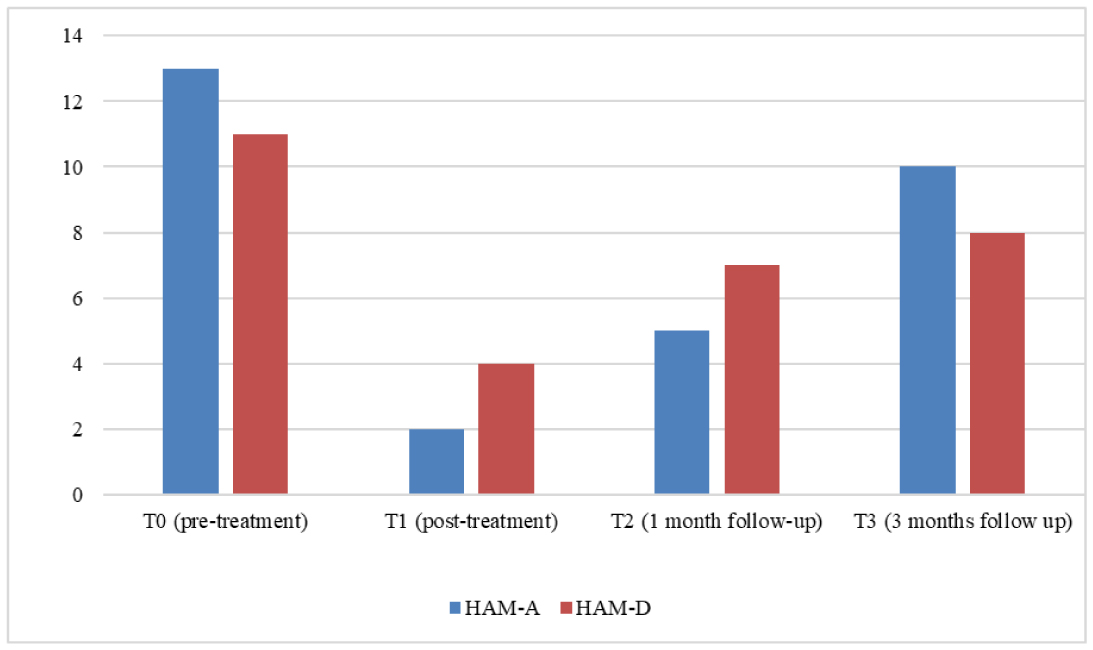
Figures(1)

Fiammetta Iannuzzo, Federica Donia, Lorenzo Bette, Fabrizio Turiaco, Antonio Bruno. Neuromodulation techniques in combination for a short-intensive treatment of depression and anxiety: a case report[J]. AIMS Neuroscience, 2025, 12(2): 140-146. doi: 10.3934/Neuroscience.2025009




 DownLoad: