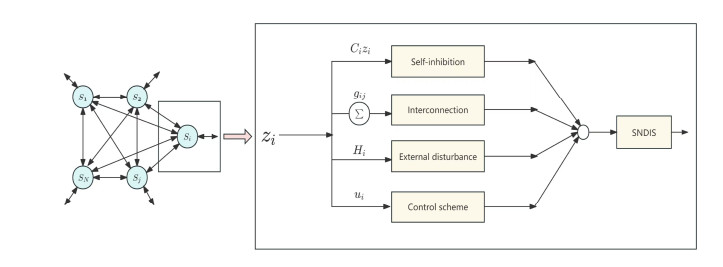
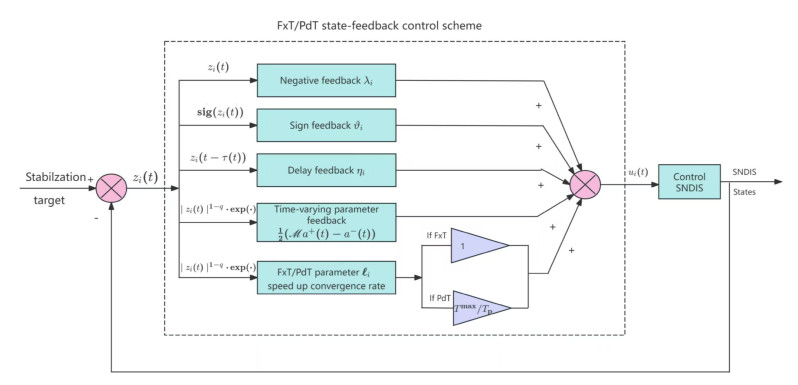
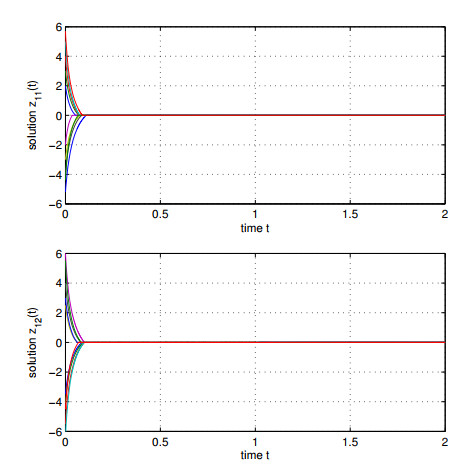
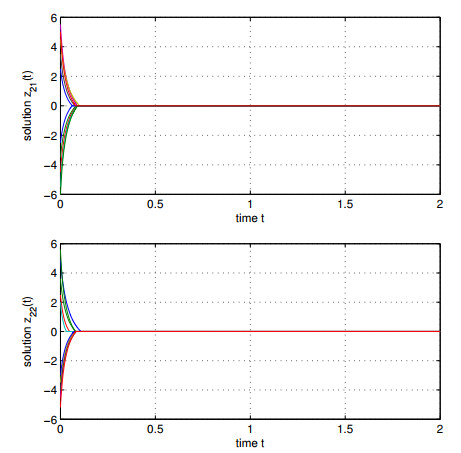
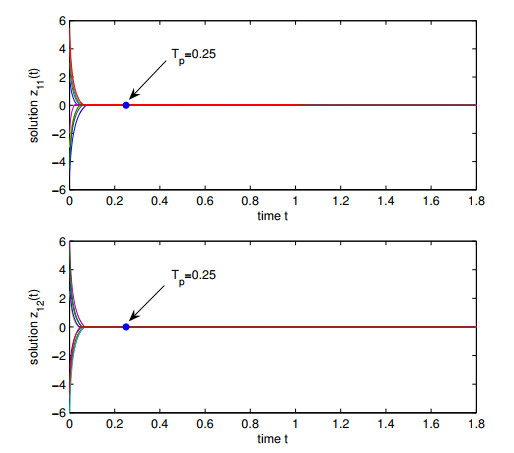
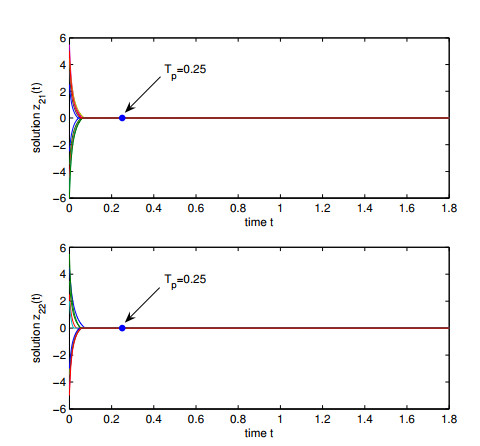
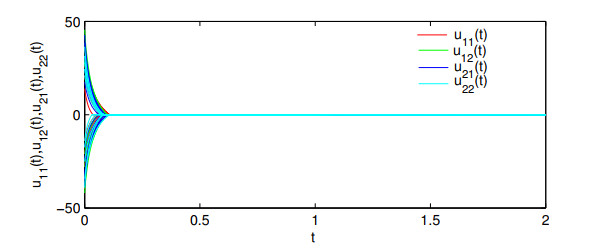
This article aims to study the fixed/predefined-time control problem of a social network-based delayed interconnected system with a discontinuous interconnection. First, unlike the fractional power function, hyperbolic tangent function and logistic function, a particular exponential function with an indefinite coefficient is utilized to establish fixed/predefined-time stability criteria for discontinuous delayed differential equations based on delayed differential inclusion. The settling time of fixed-time stability is estimated, and the estimation formula is independent of the system's initial states. The Lyapunov energy function method in this article extends the existing fixed/predefined time stability to the case of indefinite derivatives. Second, taking time-varying coefficients, discontinuity, and the time-delay effect, a social network-based interconnected model is established. With the help of the established fixed/predefined-time theorems and the design of the state feedback control schemes, the fixed/predefined-time stabilization is implemented on the social network-based delayed interconnected system with discontinuity. Finally, a numerical example is given to verify the effectiveness of the fixed/predefined-time control. Numerical simulation shows that, under the state feedback control scheme, the social network-based delayed interconnected system with two subsystems is stabilized in a fixed time at zero within 0.69 seconds. Under the predefined time control scheme, the stabilization at zero for the predefined time can be ensured within any set predefined time $ T_{\rm p} = 0.25 $. It is of practical significance to study the social network-based delayed interconnected system and its fixed/predefined-time control for the rapid formation of stable relationships and the implementation of accurate social governance.
Citation: Zuowei Cai, Zengyun Wang, Lihong Huang. Fixed/predefined-time control of social network-based delayed interconnected system with discontinuity[J]. Electronic Research Archive, 2025, 33(10): 6176-6205. doi: 10.3934/era.2025273
This article aims to study the fixed/predefined-time control problem of a social network-based delayed interconnected system with a discontinuous interconnection. First, unlike the fractional power function, hyperbolic tangent function and logistic function, a particular exponential function with an indefinite coefficient is utilized to establish fixed/predefined-time stability criteria for discontinuous delayed differential equations based on delayed differential inclusion. The settling time of fixed-time stability is estimated, and the estimation formula is independent of the system's initial states. The Lyapunov energy function method in this article extends the existing fixed/predefined time stability to the case of indefinite derivatives. Second, taking time-varying coefficients, discontinuity, and the time-delay effect, a social network-based interconnected model is established. With the help of the established fixed/predefined-time theorems and the design of the state feedback control schemes, the fixed/predefined-time stabilization is implemented on the social network-based delayed interconnected system with discontinuity. Finally, a numerical example is given to verify the effectiveness of the fixed/predefined-time control. Numerical simulation shows that, under the state feedback control scheme, the social network-based delayed interconnected system with two subsystems is stabilized in a fixed time at zero within 0.69 seconds. Under the predefined time control scheme, the stabilization at zero for the predefined time can be ensured within any set predefined time $ T_{\rm p} = 0.25 $. It is of practical significance to study the social network-based delayed interconnected system and its fixed/predefined-time control for the rapid formation of stable relationships and the implementation of accurate social governance.

| [1] |
K. A. Khan, B. S. N. Murthy, V. Madhusudanan, M. N. Srinivas, A. Zeb, Hopf-bifurcation of a two delayed social networking game addiction model with graded infection rate, Chaos Solitons Fractals, 182 (2024), 114798. https://doi.org/10.1016/j.chaos.2024.114798 doi: 10.1016/j.chaos.2024.114798

|
| [2] |
Z. Hu, Decentralized stabilization of large scale interconnected systems with delays, IEEE Trans. Autom. Control, 39 (1994), 180–182. https://doi.org/10.1109/9.273363 doi: 10.1109/9.273363
|
| [3] |
M. S. Mahmoud, Decentralized stabilization of interconnected systems with time-varying delays, IEEE Trans. Autom. Control, 54 (2009), 2663–2668. https://doi.org/10.1109/TAC.2009.2031572 doi: 10.1109/TAC.2009.2031572
|
| [4] |
G. Liu, Y. Zhang, C. Hua, Adaptive output feedback control for nonlinear interconnected time-delay systems subject to global performance constraint, IEEE Trans. Syst., Man, Cybern. Syst., 54 (2024), 7670–7682. https://doi.org/10.1109/TSMC.2024.3456794 doi: 10.1109/TSMC.2024.3456794
|
| [5] |
Z. Yu, Y. Sun, X. Dai, X. Su, Decentralized time-delay control using partial variables with measurable states for a class of interconnected systems with time delays, IEEE Trans. Cybern., 52 (2022), 10882–10894. https://doi.org/10.1109/TCYB.2021.3063163 doi: 10.1109/TCYB.2021.3063163
|
| [6] |
K. Liu, X. Sun, M. Krstic, Distributed predictor-based stabilization of continuous interconnected systems with input delays, Automatica, 91 (2018), 69–78. https://doi.org/10.1016/j.automatica.2018.01.030 doi: 10.1016/j.automatica.2018.01.030
|
| [7] |
X. Yan, S. K. Spurgeon, C. Edwards, Decentralised stabilisation for nonlinear time delay interconnected systems using static output feedback, Automatica, 49 (2013), 633–641. https://doi.org/10.1016/j.automatica.2012.11.040 doi: 10.1016/j.automatica.2012.11.040
|
| [8] |
Y. Liu, F. Fang, J. H. Park, Decentralized dissipative filtering for delayed nonlinear interconnected systems based on T-S fuzzy model, IEEE Trans. Fuzzy Syst., 27 (2019), 790–801. https://doi.org/10.1109/TFUZZ.2018.2870079 doi: 10.1109/TFUZZ.2018.2870079
|
| [9] |
F. Hsiao, C. Chen, Y. Liang, S. Xu, W. Chiang, T-S fuzzy controllers for nonlinear interconnected systems with multiple time delays, IEEE Trans. Circuits Syst. I Regular Pap., 52 (2005), 1883–1893. https://doi.org/10.1109/TCSI.2005.852492 doi: 10.1109/TCSI.2005.852492
|
| [10] |
Z. Wang, N. Rong, H. Zhang, Finite-time decentralized control of IT2 T-S fuzzy interconnected systems with discontinuous interconnections, IEEE Trans. Cybern., 49 (2019), 3547–3556. https://doi.org/10.1109/TCYB.2018.2848626 doi: 10.1109/TCYB.2018.2848626
|
| [11] |
N. Rong, Z. Wang, Event-based fixed-time control for interconnected systems with discontinuous interactions, IEEE Trans. Syst. Man Cybern. Syst., 52 (2022), 4925–4936. https://doi.org/10.1109/TSMC.2021.3103838 doi: 10.1109/TSMC.2021.3103838
|
| [12] |
N. Rong, Z. Wang, H. Zhang, Finite-time stabilization for discontinuous interconnected delayed systems via interval type-2 T-S fuzzy model approach, IEEE Trans. Fuzzy Syst., 27 (2019), 249–261. https://doi.org/10.1109/TFUZZ.2018.2856181 doi: 10.1109/TFUZZ.2018.2856181
|
| [13] | J. K. Hale, Theory of Functional Differential Equations, $2^{nd}$ edition, Springer, 1977. https://doi.org/10.1007/978-1-4612-9892-2 |
| [14] | J. P. Aubin, A. Cellina, Differential Inclusions, $1^{st}$ edition, Springer, 1984. https://doi.org/10.1007/978-3-642-69512-4 |
| [15] |
K. Wang, A. N. Michel, Stability analysis of differential inclusions in Banach space with applications to nonlinear systems with time delays, IEEE Trans. Circuits Syst. I Fundam. Theory Appl., 43 (1996), 617–626. https://doi.org/10.1109/81.526677 doi: 10.1109/81.526677
|
| [16] |
K. Liu, X. Sun, J. Liu, A. R. Teel, Stability theorems for delay differential inclusions, IEEE Trans. Autom. Control, 61 (2016), 3215–3220. https://doi.org/10.1109/TAC.2015.2507782 doi: 10.1109/TAC.2015.2507782
|
| [17] |
Z. Cai, J. Huang, L. Huang, Generalized Lyapunov-Razumikhin method for retarded differential inclusions: Applications to discontinuous neural networks, Discrete Contin. Dyn. Syst.-Ser. B, 22 (2017), 3591–3614. https://doi.org/10.3934/dcdsb.2017181 doi: 10.3934/dcdsb.2017181
|
| [18] |
Y. Liu, J. Yang, C. Li, Robust finite-time stability and stabilisation for switched linear parameter-varying systems and its application to bank-to-turn missiles, IET Control Theory Appl., 9 (2015), 2171–2179. https://doi.org/10.1049/iet-cta.2015.0066 doi: 10.1049/iet-cta.2015.0066
|
| [19] |
Y. Ju, G. Diao, Virtual finite time control of quadrotor unmanned aerial vehicle based on set stability, J. Franklin Inst., 362 (2025), 107451. https://doi.org/10.1016/J.JFRANKLIN.2024.107451 doi: 10.1016/J.JFRANKLIN.2024.107451
|
| [20] |
Y. Guo, D. Zhang, A. Li, S. Song, C. Wang, Z. Liu, Finite-time control for autonomous rendezvous and docking under safe constraint, Aerosp. Sci. Technol., 109 (2021), 106380. https://doi.org/10.1016/j.ast.2020.106380 doi: 10.1016/j.ast.2020.106380
|
| [21] |
A. Polyakov, Nonlinear feedback design for fixed-time stabilization of linear control systems, IEEE Trans. Autom. Control, 57 (2012), 2106–2110. https://doi.org/10.1109/TAC.2011.2179869 doi: 10.1109/TAC.2011.2179869
|
| [22] |
A. Polyakov, D. Efimov, W. Perruquetti, Finite-time and fixed-time stabilization: Implicit Lyapunov function approach, Automatica, 51 (2015), 332–340. https://doi.org/10.1016/j.automatica.2014.10.082 doi: 10.1016/j.automatica.2014.10.082
|
| [23] |
F. Lopez-Ramirez, D. Efimov, A. Polyakov, W. Perruquetti, Conditions for fixed-time stability and stabilization of continuous autonomous systems, Syst. Control Lett., 129 (2019), 26–35. https://doi.org/10.1016/j.sysconle.2019.05.003 doi: 10.1016/j.sysconle.2019.05.003
|
| [24] |
C. Hu, H. Jiang, Special functions-based fixed-time estimation and stabilization for dynamic systems, IEEE Trans. Syst., Man Cybern. Syst., 52 (2022), 3251–3262. https://doi.org/10.1109/TSMC.2021.3062206 doi: 10.1109/TSMC.2021.3062206
|
| [25] |
F. Kong, Q. Zhu, T. Huang, Fixed-time stability for discontinuous uncertain inertial neural networks with time-varying delays, IEEE Trans. Syst. Man Cybern. Syst., 52 (2022), 4507–4517. https://doi.org/10.1109/TSMC.2021.3096261 doi: 10.1109/TSMC.2021.3096261
|
| [26] |
Z. Cai, L. Huang, Z. Wang, Novel fixed-time stability criteria for discontinuous nonautonomous systems: Lyapunov method with indefinite derivative, IEEE Trans. Cybern., , 52 (2022), 4286–4299. https://doi.org/10.1109/TCYB.2020.3025754 doi: 10.1109/TCYB.2020.3025754
|
| [27] |
Z. Cai, L. Huang, Z. Wang, Finite-/Fixed-time stability of nonautonomous functional differential inclusion: Lyapunov approach involving indefinite derivative, IEEE Trans. Neural Networks Learn. Syst., 33 (2022), 6763–6774. https://doi.org/10.1109/TNNLS.2021.3083396 doi: 10.1109/TNNLS.2021.3083396
|
| [28] |
J. Hui, Y. Lee, J. Yuan, Load following control of a PWR with load-dependent parameters and perturbations via fixed-time fractional-order sliding mode and disturbance observer techniques, Renewable Sustainable Energy Rev., 184 (2023), 113550. https://doi.org/10.1016/J.RSER.2023.113550 doi: 10.1016/J.RSER.2023.113550
|
| [29] |
E. Jiménez-Rodríguez, A. J. Muñoz-Vázquez, J. D. Sánchez-Torres, M. Defoort, A. G. Loukianov, A Lyapunov-like characterization of predefined-time stability, IEEE Trans. Autom. Control, 65 (2020), 4922–4927. https://doi.org/10.1109/TAC.2020.2967555 doi: 10.1109/TAC.2020.2967555
|
| [30] |
C. Hu, H. He, H. Jiang, Fixed/Preassigned-time synchronization of complex networks via improving fixed-time stability, IEEE Trans. Cybern., 51 (2021), 2882–2892. https://doi.org/10.1109/TCYB.2020.2977934 doi: 10.1109/TCYB.2020.2977934
|
| [31] |
E. Jiménez-Rodríguez, J. D. Sánchez-Torres, D. Gómez-Gutiérrez, A. G. Loukinanov, Variable structure predefined-time stabilization of second-order systems, Asian J. Control, 21 (2019), 1179–1188. https://doi.org/10.1002/asjc.1785 doi: 10.1002/asjc.1785
|
| [32] | A. F. Filippov, Differential Equations with Discontinuous Righthand Sides, Springer, $1^{st}$ edition, 1988. https://doi.org/10.1007/978-94-015-7793-9 |
| [33] | F. H. Clarke, Optimization and Nonsmooth Analysis, Society for Industrial and Applied Mathematics, 1990. https://doi.org/10.1137/1.9781611971309 |
| [34] |
M. Forti, M. Grazzini, P. Nistri, L. Pancioni, Generalized Lyapunov approach for convergence of neural networks with discontinuous or non-Lipschitz activations, Phys. D Nonlinear Phenom., 214 (2006), 88–99. https://doi.org/10.1016/J.PHYSD.2005.12.006 doi: 10.1016/J.PHYSD.2005.12.006
|
| [35] | G. H. Hardy, J. E. Littlewood, G. Pólya, Inequalities, Cambridge University Press, 1988. |
| [36] | J. Aubin, H. Frankowska, Set-Valued Analysis, Birkhäuser, 2009. |
| [37] |
Z. Cai, L. Huang, Functional differential inclusions and dynamic behaviors for memristor-based BAM neural networks with time-varying delays, Commun. Nonlinear Sci. Numer. Simulat., 19 (2014), 1279–1300. https://doi.org/10.1016/j.cnsns.2013.09.004 doi: 10.1016/j.cnsns.2013.09.004
|
| [38] |
Z. Cai, L. Huang, Z. Wang, Particular-function-based preassigned-time stability of discontinuous system: Novel control scheme for fuzzy neural networks, IEEE Trans. Fuzzy Syst., 31 (2023), 1020–1030. https://doi.org/10.1109/TFUZZ.2022.3193759 doi: 10.1109/TFUZZ.2022.3193759
|
| [39] |
X. Hu, L. Wang, Q. Wang, M. Ge, X. Zong, A fixed-/preassigned-time stabilization approach for discontinuous systems based on strictly intermittent control, IEEE Trans. Syst. Man Cybern., Syst., 54 (2024), 5746–5755. https://doi.org/10.1109/TSMC.2024.3408465 doi: 10.1109/TSMC.2024.3408465
|
| [40] |
F. Kong, H. Ni, Q. Zhu, C. Hu, T. Huang, Fixed-time and predefined-time synchronization of discontinuous neutral-type competitive networks via non-chattering adaptive control strategy, IEEE Trans. Network Sci. Eng., 10 (2023), 3644–3657. https://doi.org/10.1109/TNSE.2023.3271109 doi: 10.1109/TNSE.2023.3271109
|
| [41] |
D. Cui, M. Chadli, Z. Xiang, Fuzzy fault-tolerant predefined-time control for switched systems: A singularity-free method, IEEE Trans. Fuzzy Syst., 32 (2024), 1223–1232. https://doi.org/10.1109/TFUZZ.2023.3321688 doi: 10.1109/TFUZZ.2023.3321688
|
| [42] |
J. Hui, Fractional-order sliding mode coordinated controller using super-twisting disturbance observer for an NSSS with predefined-time stability, ISA Trans., 165 (2025), 111–127. https://doi.org/10.1016/j.isatra.2025.06.032 doi: 10.1016/j.isatra.2025.06.032
|
| [43] |
N. Rong, Z. Wang, Fixed-time stabilization for IT2 T-S fuzzy interconnected systems via event-triggered mechanism: An exponential gain method, IEEE Trans. Fuzzy Syst., 28 (2020), 246–258. https://doi.org/10.1109/TFUZZ.2019.2904192 doi: 10.1109/TFUZZ.2019.2904192
|
| [44] |
H. Xu, D. Yu, S. Sui, C. L. P. Chen, An event-triggered predefined time decentralized output feedback fuzzy adaptive control method for interconnected systems, IEEE Trans. Fuzzy Syst., 31 (2023), 631–644. https://doi.org/10.1109/TFUZZ.2022.3184834 doi: 10.1109/TFUZZ.2022.3184834
|
| [45] |
S. Qin, Q. Ma, J. Feng, C. Xu, Multistability of almost periodic solution for memristive Cohen-Grossberg neural networks with mixed delays, IEEE Trans. Neural Netw. Learn. Syst., 31 (2020), 1914–1926. https://doi.org/10.1109/TNNLS.2019.2927506 doi: 10.1109/TNNLS.2019.2927506
|
| [46] |
X. Nie, W. Zheng, Multistability and instability of neural networks with discontinuous nonmonotonic piecewise linear activation functions, IEEE Trans. Neural Networks Learn. Syst., 26 (2015), 2901–2913. https://doi.org/10.1109/TNNLS.2015.2458978 doi: 10.1109/TNNLS.2015.2458978
|
| [47] |
C. Huang, B. Liu, Traveling wave fronts for a diffusive Nicholson Blowflies equation accompanying mature delay and feedback delay, Appl. Math. Lett., 134 (2022), 108321. https://doi.org/10.1016/J.AML.2022.108321 doi: 10.1016/J.AML.2022.108321
|
| [48] |
C. Huang, B. Liu, Exponential stability of a diff usive Nicholson's Blowflies equation accompanying multiple time-varying delays, Appl. Math. Lett., 163 (2025), 109451. https://doi.org/10.1016/J.AML.2024.109451 doi: 10.1016/J.AML.2024.109451
|
| [49] | Q. Li, B. Liu, Traveling wave fronts to a Mackey-Glass model involving distinct delays in di ffusion term and birth function, Math. Methods Appl. Sci., (2025). https://doi.org/10.1002/mma.11109 |
Figures(9) / Tables(2)
Zuowei Cai, Zengyun Wang, Lihong Huang. Fixed/predefined-time control of social network-based delayed interconnected system with discontinuity[J]. Electronic Research Archive, 2025, 33(10): 6176-6205. doi: 10.3934/era.2025273





 DownLoad: