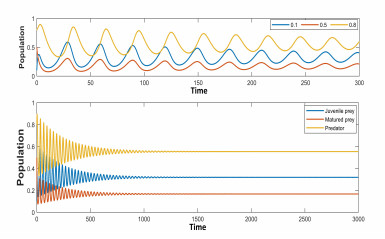
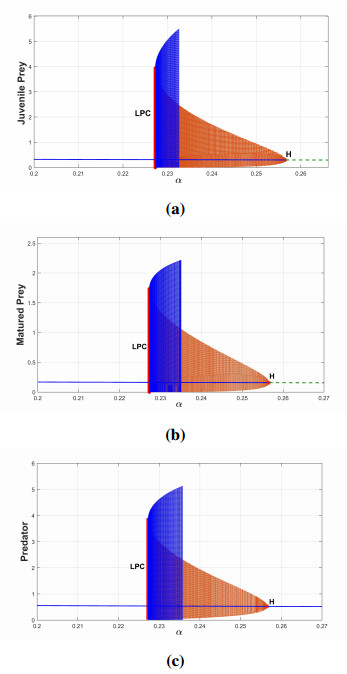
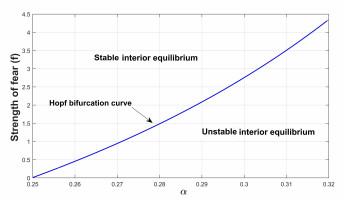
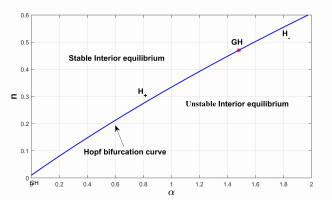
Collaborative hunting among predators is a common strategy that significantly improves the efficiency of the hunting process by increasing prey fear, consequently impacting their reproduction rate. This work investigated a predator-prey interaction system with a stage-structured prey population. The conversion from juvenile to matured prey was assumed to be density-dependent. We also assumed that predators benefit from hunting cooperation and that mature prey are capable of defending in groups against predators. All possible biologically feasible equilibrium states of the model were determined, and their stabilities were analyzed. The role of various important factors, e.g., hunting cooperation rate, predation rate, and rate of fear, on the system dynamics were discussed. Populations within the ecosystem exhibit chaotic dynamics with varying predator mortality rates. In addition, a stable stock of predator population was observed with its increasing mortality rate, showing a positive hydra effect.
Citation: Ankur Jyoti Kashyap, Fengde Chen, Fanitsha Mohan, Anuradha Devi, Hemanta Kumar Sarmah. Combined effects of antipredator behaviors and cooperative hunting in a stage-structured predator-prey model[J]. Mathematical Modelling and Control, 2025, 5(4): 338-354. doi: 10.3934/mmc.2025023
Collaborative hunting among predators is a common strategy that significantly improves the efficiency of the hunting process by increasing prey fear, consequently impacting their reproduction rate. This work investigated a predator-prey interaction system with a stage-structured prey population. The conversion from juvenile to matured prey was assumed to be density-dependent. We also assumed that predators benefit from hunting cooperation and that mature prey are capable of defending in groups against predators. All possible biologically feasible equilibrium states of the model were determined, and their stabilities were analyzed. The role of various important factors, e.g., hunting cooperation rate, predation rate, and rate of fear, on the system dynamics were discussed. Populations within the ecosystem exhibit chaotic dynamics with varying predator mortality rates. In addition, a stable stock of predator population was observed with its increasing mortality rate, showing a positive hydra effect.

| [1] |
B. Ghosh, O. L. Zhdanova, B. Barman, E. Y. Frisman, Dynamics of stage-structure predator-prey systems under density-dependent effect and mortality, Ecol. Complex., 41 (2020), 100812. https://doi.org/10.1016/j.ecocom.2020.100812 doi: 10.1016/j.ecocom.2020.100812

|
| [2] |
S. K. Sasmal, Y. Takeuchi, Dynamics of a predator-prey system with fear and group defence, J. Math. Anal. Appl., 481 (2020), 123471. https://doi.org/10.1016/j.jmaa.2019.123471 doi: 10.1016/j.jmaa.2019.123471
|
| [3] |
S. Pal, N. Pal, S. Samanta, J. Chattopadhyay, Effect of hunting cooperation and fear in a predator-prey model, Ecol. Complex., 39 (2019), 100770. https://doi.org/10.1016/j.ecocom.2019.100770 doi: 10.1016/j.ecocom.2019.100770
|
| [4] |
S. Creel, D. Christianson, S. Liley, J. A. Winnie, Predation risk affects reproductive physiology and demography of elk, Science, 315 (2007), 960–960. https://doi.org/10.1126/science.1135918 doi: 10.1126/science.1135918
|
| [5] |
S. D. Peacor, B. L. Peckarsky, G. C. Trussell, J. R. Vonesh, Costs of predator-induced phenotypic plasticity: a graphical model for predicting the contribution of nonconsumptive and consumptive effects of predators on prey, Oecologia, 171 (2013), 1–10. https://doi.org/10.1007/s00442-012-2394-9 doi: 10.1007/s00442-012-2394-9
|
| [6] |
N. Mondal, D. Barman, S. Alam, Impact of adult predator incited fear in a stage-structured prey-predator model, Environ. Dev. Sustain., 23 (2021), 9280–9307. https://doi.org/10.1007/s10668-020-01024-1 doi: 10.1007/s10668-020-01024-1
|
| [7] |
M. Das, G. P. Samanta, A prey-predator fractional order model with fear effect and group defence, Int. J. Dyn. Control, 9 (2021), 334–349. https://doi.org/10.1007/s40435-020-00626-x doi: 10.1007/s40435-020-00626-x
|
| [8] |
L. Y. Zanette, A. F. White, M. C. Allen, M. Clinchy, Perceived predation risk reduces the number of offspring songbirds produce per year, Science, 334 (2011), 1398–1401. https://doi.org/10.1126/science.1210908 doi: 10.1126/science.1210908
|
| [9] |
K. H. Elliott, G. S. Betini, I. Dworkin, D. R. Norris, Experimental evidence for within- and cross-seasonal effects of fear on survival and reproduction, J. Anim. Ecol., 85 (2016), 507–515. https://doi.org/10.1111/1365-2656.12487 doi: 10.1111/1365-2656.12487
|
| [10] |
X. Wang, L. Zanette, X. Zou, Modelling the fear effect in predator–prey interactions, J. Math. Biol., 73 (2016), 1179–1204. https://doi.org/10.1007/s00285-016-0989-1 doi: 10.1007/s00285-016-0989-1
|
| [11] |
C. Feh, T. Boldsukh, C. Tourenq, Are family groups in equids a response to cooperative hunting by predators? The case of Mongolian kulans (Equus hemionus luteus Matschie), Revue D'écologie, 49 (1994), 11–20. https://doi.org/10.3406/revec.1994.2123 doi: 10.3406/revec.1994.2123
|
| [12] |
P. A. Schmidt, L. D. Mech, Wolf pack size and food acquisition, Am. Nat., 150 (1997), 513–517. https://doi.org/10.1086/286079 doi: 10.1086/286079
|
| [13] |
W. J. Ripple, E. J. Larsen, Historic aspen recruitment, elk, and wolves in northern Yellowstone National Park, USA, Biol. Conserv., 95 (2000), 361–370. https://doi.org/10.1016/S0006-3207(00)00014-8 doi: 10.1016/S0006-3207(00)00014-8
|
| [14] |
S. Creel, J. Winnie Jr, B. Maxwell, K. Hamlin, M. Creel, Elk alter habitat selection as an antipredator response to wolves, Ecology, 86 (2005), 3387–3397. https://doi.org/10.1890/05-0032 doi: 10.1890/05-0032
|
| [15] |
P. E. Stander, Cooperative hunting in lions: the role of the individual, Behav. Ecol. Sociobiol., 29 (1992), 445–454. https://doi.org/10.1007/BF00170175 doi: 10.1007/BF00170175
|
| [16] |
J. Duarte, C. Januário, N. Martins, J. Sardanyés, Chaos and crises in a model for cooperative hunting: a symbolic dynamics approach, Chaos, 19 (2009), 043102. https://doi.org/10.1063/1.3243924 doi: 10.1063/1.3243924
|
| [17] |
L. Berec, Impacts of foraging facilitation among predators on predator-prey dynamics, Bull. Math. Biol., 72 (2010), 94–121. https://doi.org/10.1007/s11538-009-9439-1 doi: 10.1007/s11538-009-9439-1
|
| [18] |
S. Saha, G. P. Samanta, Analysis of a tri-trophic food chain model with fear effect incorporating prey refuge, Filomat, 35 (2021), 4971–4999. https://doi.org/10.2298/FIL2115971S doi: 10.2298/FIL2115971S
|
| [19] |
S. Saha, G. P. Samanta, A prey-predator system with disease in prey and cooperative hunting strategy in predator, J. Phys. A: Math. Theor., 53 (2020), 485601. https://doi.org/10.1088/1751-8121/abbc7b doi: 10.1088/1751-8121/abbc7b
|
| [20] |
M. T. Alves, F. M. Hilker, Hunting cooperation and Allee effects in predators, J. Theor. Biol., 419 (2017), 13–22. https://doi.org/10.1016/j.jtbi.2017.02.002 doi: 10.1016/j.jtbi.2017.02.002
|
| [21] |
A. J. Kashyap, Q. Zhu, H. K. Sarmah, D. Bhattacharjee, Dynamical study of a predator–prey system with Michaelis–Menten type predator-harvesting, Int. J. Biomath., 16 (2023), 2250135. https://doi.org/10.1142/S1793524522501352 doi: 10.1142/S1793524522501352
|
| [22] | J. S. Tener, Muskoxen in Canada: a biological and taxonomic review, Ottawa: Queen's Printer, 1965. |
| [23] |
W. Cresswell, J. Quinn, Faced with a choice, sparrowhawks more often attack the more vulnerable prey group, Oikos, 104 (2004), 71–76. https://doi.org/10.1111/j.0030-1299.2004.12814.x doi: 10.1111/j.0030-1299.2004.12814.x
|
| [24] |
J. Krause, J. G. J. Godin, Predator preferences for attacking particular prey group sizes: consequences for predator hunting success and prey predation risk, Anim. Behav., 50 (1995), 465–473. https://doi.org/10.1006/anbe.1995.0260 doi: 10.1006/anbe.1995.0260
|
| [25] |
D. Scheel, Profitability, encounter rates, and prey choice of African lions, Behav. Ecol., 4 (1993), 90–97. https://doi.org/10.1093/beheco/4.1.90 doi: 10.1093/beheco/4.1.90
|
| [26] |
M. Ono, T. Igarashi, E. Ohno, M. Sasaki, Unusual thermal defence by a honeybee against mass attack by hornets, Nature, 377 (1995), 334–336. https://doi.org/10.1038/377334a0 doi: 10.1038/377334a0
|
| [27] |
H. I. Freedman, G. S. K. Wolkowicz, Predator-prey systems with group defence: the paradox of enrichment revisited, J. Math. Biol., 48 (1986), 493–508. https://doi.org/10.1007/BF02462320 doi: 10.1007/BF02462320
|
| [28] |
J. F. Andrews, A mathematical model for the continuous culture of microorganisms utilizing inhibitory substrates, Biotechnol. Bioeng., 10 (1968), 707–723. https://doi.org/10.1002/bit.260100602 doi: 10.1002/bit.260100602
|
| [29] |
V. Ajraldi, M. Pittavino, E. Venturino, Modeling herd behavior in population systems, Nonlinear Anal.: Real World Appl., 12 (2011), 2319–2338. https://doi.org/10.1016/j.nonrwa.2011.02.002 doi: 10.1016/j.nonrwa.2011.02.002
|
| [30] |
E. Venturino, A minimal model for ecoepidemics with group defense, J. Biol. Syst., 19 (2011), 763–785. https://doi.org/10.1142/S0218339011004184 doi: 10.1142/S0218339011004184
|
| [31] |
M. Griesser, T. N. Suzuki, Naive juveniles are more likely to become breeders after witnessing predator mobbing, Am. Nat., 189 (2017), 58–66. https://doi.org/10.1086/689477 doi: 10.1086/689477
|
| [32] |
P. Panday, N. Pal, S. Samanta, P. Tryjanowski, J. Chattopadhyay, Dynamics of a stage-structured predator-prey model: cost and benefit of fear-induced group defense, J. Theor. Biol., 528 (2021), 110846. https://doi.org/10.1016/j.jtbi.2021.110846 doi: 10.1016/j.jtbi.2021.110846
|
| [33] |
P. Panja, S. Jana, S. K. Mondal, Dynamics of a stage structure prey-predator model with ratio-dependent functional response and anti-predator behavior of adult prey, Numer. Algebra Control Optim., 11 (2021), 391–405. https://doi.org/10.3934/naco.2020033 doi: 10.3934/naco.2020033
|
| [34] |
Y. Du, B. Niu, J. Wei, A predator-prey model with cooperative hunting in the predator and group defense in the prey, Discrete Contin. Dyn. Syst.-B, 27 (2022), 5845–5881. https://doi.org/10.3934/dcdsb.2021298 doi: 10.3934/dcdsb.2021298
|
| [35] |
S. Roy, P. K. Tiwari, H. Nayak, M. Martcheva, Effects of fear, refuge and hunting cooperation in a seasonally forced eco-epidemic model with selective predation, Eur. Phys. J. Plus, 137 (2022), 528. https://doi.org/10.1140/epjp/s13360-022-02751-2 doi: 10.1140/epjp/s13360-022-02751-2
|
| [36] |
S. Biswas, P. K. Tiwari, S. Pal, Delay-induced chaos and its possible control in a seasonally forced eco-epidemiological model with fear effect and predator switching, Nonlinear Dyn., 104 (2021), 2901–2930. https://doi.org/10.1007/s11071-021-06396-1 doi: 10.1007/s11071-021-06396-1
|
| [37] |
S. S. Maity, P. K. Tiwari, S. Pal, An ecoepidemic seasonally forced model for the combined effects of fear, additional foods and selective predation, J. Biol. Syst., 30 (2022), 285–321. https://doi.org/10.1142/S0218339022500103 doi: 10.1142/S0218339022500103
|
| [38] | P. Abrams, The hydra effect is no myth, New Sci., 226 (2015), 28–29. https://doi.org/10.1016/S0262-4079(15)30463-2 |
| [39] |
P. A. Abrams, H. Matsuda, The effect of adaptive change in the prey on the dynamics of an exploited predator population, Can. J. Fish. Aquat. Sci., 62 (2005), 758–766. https://doi.org/10.1139/f05-051 doi: 10.1139/f05-051
|
| [40] |
M. Sieber, F. M. Hilker, The hydra effect in predator-prey models, J. Math. Biol., 64 (2012), 341–360. https://doi.org/10.1007/s00285-011-0416-6 doi: 10.1007/s00285-011-0416-6
|
| [41] |
H. Matsuda, P. A. Abrams, Effects of predator-prey interactions and adaptive change on sustainable yield, Can. J. Fish. Aquat. Sci., 61 (2004), 175–184. https://doi.org/10.1139/f03-147 doi: 10.1139/f03-147
|
| [42] |
A. Schröder, A. van Leeuwen, T. C. Cameron, When less is more: positive population-level effects of mortality, Trends Ecol. Evol., 29 (2014), 614–624. https://doi.org/10.1016/j.tree.2014.08.006 doi: 10.1016/j.tree.2014.08.006
|
| [43] |
P. A. Abrams, C. Quince, The impact of mortality on predator population size and stability in systems with stage-structured prey, Theor. Popul. Biol., 68 (2005), 253–266. https://doi.org/10.1016/j.tpb.2005.05.004 doi: 10.1016/j.tpb.2005.05.004
|
| [44] | G. Birkhoff, G. C. Rota, Ordinary differential equations, 4 Eds., John Wiley & Sons, 1989. |
| [45] | L. Perko, Differential equations and dynamical systems, Springer, 2001. https://doi.org/10.1007/978-1-4613-0003-8 |
| [46] |
A. Dhooge, W. Govaerts, Y. A. Kuznetsov, H. G. E. Meijer, B. Sautois, New features of the software MatCont for bifurcation analysis of dynamical systems, Math. Comput. Model. Dyn. Syst., 14 (2008), 147–175. https://doi.org/10.1080/13873950701742754 doi: 10.1080/13873950701742754
|
Figures(12) / Tables(1)
Ankur Jyoti Kashyap, Fengde Chen, Fanitsha Mohan, Anuradha Devi, Hemanta Kumar Sarmah. Combined effects of antipredator behaviors and cooperative hunting in a stage-structured predator-prey model[J]. Mathematical Modelling and Control, 2025, 5(4): 338-354. doi: 10.3934/mmc.2025023




 DownLoad: