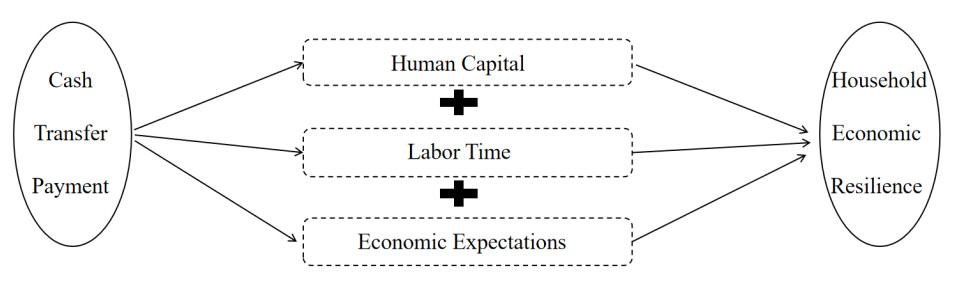
Cash transfers, as a fundamental form of social assistance, provide timely support to disadvantaged rural households and strengthen economic resilience among disadvantaged rural households. Strengthening economic resilience is crucial for poverty alleviation and enhancing rural households' capacity to withstand economic risks. Few studies have systematically analyzed how different types of cash transfers influence rural household economic resilience, particularly within the context of China's ongoing rural development and poverty reduction efforts. This research drew on data from the CHFS2019 to investigate the impact of both conditional and unconditional cash transfers on the economic resilience of rural households. Benchmark regression results present that conditional cash transfers significantly enhance household economic resilience in rural areas of China, while unconditional cash transfers have a significant inhibitory effect, with the stronger effect being less resonant than the latter. Heterogeneity analysis suggests that the influence of both conditional and unconditional cash transfers on household economic resilience is concentrated primarily in western regions. The mechanism analysis demonstrates that cash transfers can strengthen household economic resilience through two primary channels: Fostering human capital accumulation and elevating households' long-term economic expectations. However, these positive effects are partially offset by a reduction in labor supply incentives, indicative of welfare dependency, a phenomenon empirically documented in prior studies on social assistance programs. This study highlights the significance of cash transfers in strengthening rural households' economic resilience and offers key policy insights for sustaining poverty alleviation efforts and advancing common prosperity.
Citation: Wenxing Li, Weiying Ping, Jia Wang, Biaobiao Zhang. How conditional and unconditional cash transfers affect rural household economic resilience: Evidence from the China Household Finance Survey[J]. Urban Resilience and Sustainability, 2025, 3(3): 172-194. doi: 10.3934/urs.2025008
Cash transfers, as a fundamental form of social assistance, provide timely support to disadvantaged rural households and strengthen economic resilience among disadvantaged rural households. Strengthening economic resilience is crucial for poverty alleviation and enhancing rural households' capacity to withstand economic risks. Few studies have systematically analyzed how different types of cash transfers influence rural household economic resilience, particularly within the context of China's ongoing rural development and poverty reduction efforts. This research drew on data from the CHFS2019 to investigate the impact of both conditional and unconditional cash transfers on the economic resilience of rural households. Benchmark regression results present that conditional cash transfers significantly enhance household economic resilience in rural areas of China, while unconditional cash transfers have a significant inhibitory effect, with the stronger effect being less resonant than the latter. Heterogeneity analysis suggests that the influence of both conditional and unconditional cash transfers on household economic resilience is concentrated primarily in western regions. The mechanism analysis demonstrates that cash transfers can strengthen household economic resilience through two primary channels: Fostering human capital accumulation and elevating households' long-term economic expectations. However, these positive effects are partially offset by a reduction in labor supply incentives, indicative of welfare dependency, a phenomenon empirically documented in prior studies on social assistance programs. This study highlights the significance of cash transfers in strengthening rural households' economic resilience and offers key policy insights for sustaining poverty alleviation efforts and advancing common prosperity.

| [1] | Walker B, Holling CS, Carpenter SR, et al. (2004) Resilience, adaptability and transformability in social-ecological systems. Ecol Soc 9: 5. Available from: https://www.jstor.org/stable/26267673. |
| [2] |
Martin R, Sunley P, Gardiner B, et al. (2016) How regions react to recessions: Resilience and the role of economic structure. Reg Stud 50: 561–585. https://doi.org/10.1080/00343404.2015.1136410 doi: 10.1080/00343404.2015.1136410

|
| [3] |
Cui Z, Li E, Li Y, et al. (2023) The impact of poverty alleviation policies on rural economic resilience in impoverished areas: A case study of Lankao County, China. J Rural Stud 99: 92–106. https://doi.org/10.1016/j.jrurstud.2023.03.007 doi: 10.1016/j.jrurstud.2023.03.007
|
| [4] |
Liu Y, Liu J, Zhou Y (2017) Spatio-temporal patterns of rural poverty in China and targeted poverty alleviation strategies. J Rural Stud 52: 66–75. https://doi.org/10.1016/j.jrurstud.2017.04.002 doi: 10.1016/j.jrurstud.2017.04.002
|
| [5] |
Zhou Y, Guo Y, Liu Y, et al. (2018) Targeted poverty alleviation and land policy innovation: Some practice and policy implications from China. Land Use Policy 74: 53–65. https://doi.org/10.1016/j.landusepol.2017.04.037 doi: 10.1016/j.landusepol.2017.04.037
|
| [6] |
Van den Berg M, Cuong NV (2011) Impact of public and private cash transfers on poverty and inequality: Evidence from Vietnam. Dev Policy Rev 29: 689–728. https://doi.org/10.1111/j.1467-7679.2011.00553.x doi: 10.1111/j.1467-7679.2011.00553.x
|
| [7] |
Chakrabarti A, Handa S, Natali L, et al. (2020) More evidence on the relationship between cash transfers and child height. J Dev Eff 12: 14–37. https://doi.org/10.1080/19439342.2020.1731568 doi: 10.1080/19439342.2020.1731568
|
| [8] |
Doepke M, Zilibotti F (2008) Occupational choice and the spirit of capitalism. Q J Econ 123: 747–793. https://doi.org/10.1162/qjec.2008.123.2.747 doi: 10.1162/qjec.2008.123.2.747
|
| [9] |
Mostafavi-Dehzooei MH, Heshmatpour M (2024) Cash transfers, time discounting, and agricultural inputs utilization in lesotho. World Dev 184: 106738. https://doi.org/10.1016/j.worlddev.2024.106738 doi: 10.1016/j.worlddev.2024.106738
|
| [10] |
Gertler P (2004) Do conditional cash transfers improve child health? Evidence from PROGRESA's control randomized experiment. Am Econ Rev 94: 336–341. https://doi.org/10.1257/0002828041302109 doi: 10.1257/0002828041302109
|
| [11] |
Prifti E, Daidone S, Davis B (2019) Causal pathways of the productive impacts of cash transfers: Experimental evidence from Lesotho. World Dev 115: 258–268. https://doi.org/10.1016/j.worlddev.2018.11.020 doi: 10.1016/j.worlddev.2018.11.020
|
| [12] |
Skoufias E, Di Maro V (2008) Conditional cash transfers, adult work incentives, and poverty. J Dev Stud 44: 935–960. https://doi.org/10.1080/00220380802150730 doi: 10.1080/00220380802150730
|
| [13] |
Todd JE, Winters P, Stecklov G (2012) Evaluating the impact of conditional cash transfer programs on fertility: The case of the Red de Protección Social in Nicaragua. J Popul Econ 25: 267–290. https://doi.org/10.1007/s00148-010-0337-5 doi: 10.1007/s00148-010-0337-5
|
| [14] |
Robson M, Vollmer F, Doğan BB, et al. (2024) Distributional impacts of cash transfers on the multidimensional poverty of refugees: The Emergency Social Safety Net in Turkey. World Dev 179: 106599. https://doi.org/10.1016/j.worlddev.2024.106599 doi: 10.1016/j.worlddev.2024.106599
|
| [15] |
Oconnor C (2024) Do conditional cash transfers create resilience against poverty? Long-run evidence from Jamaica. World Dev 176: 106513. https://doi.org/10.1016/j.worlddev.2023.106513 doi: 10.1016/j.worlddev.2023.106513
|
| [16] |
Karlan D, Osei R, Osei-Akoto I, et al. (2014) Agricultural decisions after relaxing credit and risk constraints. Q J Econ 129: 597–652. https://doi.org/10.1093/qje/qju002 doi: 10.1093/qje/qju002
|
| [17] |
Haushofer J, Shapiro J (2016) The short-term impact of unconditional cash transfers to the poor: Experimental evidence from Kenya. Q J Econ 131: 1973–2042. https://doi.org/10.1093/qje/qjw025 doi: 10.1093/qje/qjw025
|
| [18] |
Ardington C, Case A, Hosegood V (2009) Labor supply responses to large social transfers: Longitudinal evidence from South Africa. Am Econ J Appl Econ 1: 22–48. https://doi.org/10.1257/app.1.1.22 doi: 10.1257/app.1.1.22
|
| [19] |
Egger D, Haushofer J, Miguel E, et al. (2022) General equilibrium effects of cash transfers: Experimental evidence from Kenya. Econometrica 90: 2603–2643. https://doi.org/10.3982/ECTA17945 doi: 10.3982/ECTA17945
|
| [20] |
Bianchi M, Bobba M (2013) Liquidity, risk, and occupational choices. Revi Econ Stud 80: 491–511. https://doi.org/10.1093/restud/rds031 doi: 10.1093/restud/rds031
|
| [21] |
Cahyadi N, Hanna R, Olken B A, et al. (2020) Cumulative impacts of conditional cash transfer programs: Experimental evidence from Indonesia. Am Econ J Econ Policy 12: 88–110. https://doi.org/10.1257/pol.20190245 doi: 10.1257/pol.20190245
|
| [22] |
Churchill SA, Iqbal N, Nawaz S, et al. (2021) Unconditional cash transfers, child labour and education: Theory and evidence. J Econ Behav Organ 186: 437–457. https://doi.org/10.1016/j.jebo.2021.04.012 doi: 10.1016/j.jebo.2021.04.012
|
| [23] |
Parker SW, Vogl T (2023) Do conditional cash transfers improve economic outcomes in the next generation? Evidence from Mexico. Econ J 133: 2775–2806. https://doi.org/10.1093/ej/uead049 doi: 10.1093/ej/uead049
|
| [24] |
Banerjee AV, Hanna R, Kreindler GE, et al. (2017) Debunking the stereotype of the lazy welfare recipient: Evidence from cash transfer programs. World Bank Res Obser 32: 155–184. https://doi.org/10.1093/wbro/lkx002 doi: 10.1093/wbro/lkx002
|
| [25] |
Bandiera O, Burgess R, Das N, et al. (2017) Labor markets and poverty in village economies. Q J Econ 132: 811–870. https://doi.org/10.1093/qje/qjx003 doi: 10.1093/qje/qjx003
|
| [26] |
Salehi-Isfahani D, Mostafavi-Dehzooei MH (2018) Cash transfers and labor supply: Evidence from a large-scale program in Iran. J Dev Econ 135: 349–367. https://doi.org/10.1016/j.jdeveco.2018.08.005 doi: 10.1016/j.jdeveco.2018.08.005
|
| [27] |
Handa S, Natali L, Seidenfeld D, et al. (2018) Can unconditional cash transfers raise long-term living standards? Evidence from Zambia. J Dev Econ 133: 42–65. https://doi.org/10.1016/j.jdeveco.2018.01.008 doi: 10.1016/j.jdeveco.2018.01.008
|
| [28] |
Bhorat H, Köhler T (2025) The labour market effects of cash transfers to the unemployed: Evidence from South Africa. World Dev 188: 106889. https://doi.org/10.1016/j.worlddev.2024.106889 doi: 10.1016/j.worlddev.2024.106889
|
| [29] |
Abel M (2019) Unintended labor supply effects of cash transfer programs: New evidence from South Africa's pension. J Afr Econ 28: 558–581. https://doi.org/10.1093/jae/ejz009 doi: 10.1093/jae/ejz009
|
| [30] |
Luna Z, Luker K (2013) Reproductive justice. Annu Rev Law Soc Sci 9: 327–352. https://doi.org/10.1146/annurev-lawsocsci-102612-134037 doi: 10.1146/annurev-lawsocsci-102612-134037
|
| [31] |
Parker SW, Ryu S (2023) Do conditional cash transfers reduce fertility? Nationwide evidence from Mexico. Popul Dev Rev 49: 599–616. https://doi.org/10.1111/padr.12576 doi: 10.1111/padr.12576
|
| [32] |
Awaworyi Churchill S, Iqbal N, Nawaz S, et al. (2024) Do unconditional cash transfers increase fertility? Lessons from a large-scale program. Econ Inq 62: 74–96. https://doi.org/10.1111/ecin.13187 doi: 10.1111/ecin.13187
|
| [33] |
Stecklov G, Winters P, Todd J, et al. (2007) Unintended effects of poverty programmes on childbearing in less developed countries: Experimental evidence from Latin America. Popul Stud 61: 125–140. https://doi.org/10.1080/00324720701300396 doi: 10.1080/00324720701300396
|
| [34] |
Wang Y, Zhang Q, Li Q, et al. (2021) Role of social networks in building household livelihood resilience under payments for ecosystem services programs in a poor rural community in China. J Rural Stud 86: 208–225. https://doi.org/10.1080/00343404.2021.1872779 doi: 10.1080/00343404.2021.1872779
|
| [35] |
Huang Z, Wang L, Meng J (2024) Does rural e-commerce improve the economic resilience of family farms? Int Rev Econ Finance 95: 103505. https://doi.org/10.1016/j.iref.2024.103505 doi: 10.1016/j.iref.2024.103505
|
| [36] |
Stotten R, Schermer M, Wilson GA (2021) Lock-ins and community resilience: Two contrasting development pathways in the Austrian Alps. J Rural Stud 84: 124–133. https://doi.org/10.1016/j.jrurstud.2021.04.001 doi: 10.1016/j.jrurstud.2021.04.001
|
| [37] |
Lee CC, Wang F (2022) How does digital inclusive finance affect carbon intensity? Econ Anal Policy 75: 174–190. https://doi.org/10.1016/j.eap.2022.05.010 doi: 10.1016/j.eap.2022.05.010
|
| [38] |
Wang Z, Wei W (2021) Regional economic resilience in China: Measurement and determinants. Reg Stud 55: 1228–1239. https://doi.org/10.1080/00343404.2021.1872779 doi: 10.1080/00343404.2021.1872779
|
| [39] |
Gao Q, Sun M, Chen L (2024) The impact of digital inclusive finance on agricultural economic resilience. Finance Res Lett 66: 105679. https://doi.org/10.1016/j.frl.2024.105679 doi: 10.1016/j.frl.2024.105679
|
| [40] |
Finger R (2023) Digital innovations for sustainable and resilient agricultural systems. Eur Rev Agric Econ 50: 1277–1309. https://doi.org/10.1093/erae/jbad021 doi: 10.1093/erae/jbad021
|
| [41] |
Xie S, Zhang J, Li X, et al. (2024) The effect of agricultural insurance participation on rural households' economic resilience to natural disasters: Evidence from China. J Cleaner Prod 434: 140123. https://doi.org/10.1016/j.jclepro.2023.140123 doi: 10.1016/j.jclepro.2023.140123
|
| [42] |
Sun Y, Tang X (2022) The impact of digital inclusive finance on sustainable economic growth in China. Finance Res Lett 50: 103234. https://doi.org/10.1016/j.frl.2022.103234 doi: 10.1016/j.frl.2022.103234
|
| [43] |
Zhou L, Shi X, Bao Y, et al. (2023) Explainable artificial intelligence for digital finance and consumption upgrading. Finance Res Lett 58: 104489. https://doi.org/10.1016/j.frl.2023.104489 doi: 10.1016/j.frl.2023.104489
|
| [44] |
Tori D, Onaran Ö (2018) The effects of financialization on investment: Evidence from firm-level data for the UK. Camb J Econ 42: 1393–1416. https://doi.org/10.1093/cje/bex085 doi: 10.1093/cje/bex085
|
| [45] |
Wu Y, Zhang J (2025) Digital inclusive finance and rural households' economic resilience. Financ Res Lett 74: 106706. https://doi.org/10.1016/j.frl.2024.106706 doi: 10.1016/j.frl.2024.106706
|
| [46] |
Du Y, Wang Q, Zhou J (2023) How does digital inclusive finance affect economic resilience: Evidence from 285 cities in China. Int Rev Financ Anal 88: 102709. https://doi.org/10.1016/j.irfa.2023.102709 doi: 10.1016/j.irfa.2023.102709
|
| [47] |
Lai JT, Yan IKM, Yi X, et al. (2020) Digital financial inclusion and consumption smoothing in China. China World Econ 28: 64–93. https://doi.org/10.1111/cwe.12312 doi: 10.1111/cwe.12312
|
| [48] |
Tripathy N (2019) Does measure of financial development matter for economic growth in India. Quant Financ Econ 3: 508–525. https://doi.org/10.3934/QFE.2019.3.508 doi: 10.3934/QFE.2019.3.508
|
| [49] |
Zhang H, Xu Z, Zhou Y, et al. (2021) Optimal subsidy reduction strategies for photovoltaic poverty alleviation in China: A cost-benefit analysis. Resour Conserv Recycl 166: 105352. https://doi.org/10.1016/j.resconrec.2020.105352 doi: 10.1016/j.resconrec.2020.105352
|
| [50] |
Zhou Y, Gu H (2025) Enhancing rural resilience through the rural revitalisation strategy in rural China: Evidence from Wushi Village, Hunan Province. J Rural Stud 113: 103493. https://doi.org/10.1016/j.jrurstud.2024.103493 doi: 10.1016/j.jrurstud.2024.103493
|
| [51] |
Roberts E, Anderson BA, Skerratt S, et al. (2017) A review of the rural-digital policy agenda from a community resilience perspective. J Rural Stud 54: 372–385. https://doi.org/10.1016/j.jrurstud.2016.03.001 doi: 10.1016/j.jrurstud.2016.03.001
|
| [52] |
Huang X, Li H, Zhang X, et al. (2018) Land use policy as an instrument of rural resilience–The case of land withdrawal mechanism for rural homesteads in China. Ecol Indic 87: 47–55. https://doi.org/10.1016/j.ecolind.2017.12.043 doi: 10.1016/j.ecolind.2017.12.043
|
| [53] |
Banerjee A, Duflo E, Goldberg N, et al. (2015) A multifaceted program causes lasting progress for the very poor: Evidence from six countries. Science 348: 1260799. https://doi.org/10.1126/science.1260799 doi: 10.1126/science.1260799
|
| [54] |
Couharde C, Mouhoud S (2020) Fossil fuel subsidies, income inequality, and poverty: Evidence from developing countries. J Econ Surv 34: 981–1006. https://doi.org/10.1111/joes.12384 doi: 10.1111/joes.12384
|
| [55] | Gan L, Yin Z, Jia N, et al. (2013) Data You Need to Know about China: Research Report of China Household Finance Survey, Berlin: Springer, 66–78. |
| [56] |
Li Y (2023) A systematic review of rural resilience. China Agric Econ Rev 15: 66–77. https://doi.org/10.1108/CAER-03-2022-0048 doi: 10.1108/CAER-03-2022-0048
|
Figures(1) / Tables(7)
Wenxing Li, Weiying Ping, Jia Wang, Biaobiao Zhang. How conditional and unconditional cash transfers affect rural household economic resilience: Evidence from the China Household Finance Survey[J]. Urban Resilience and Sustainability, 2025, 3(3): 172-194. doi: 10.3934/urs.2025008





 DownLoad: