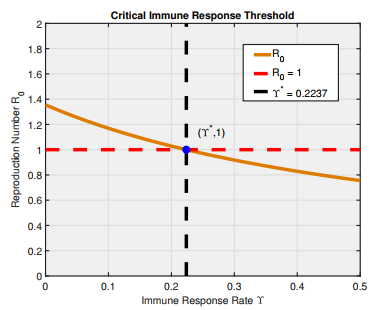
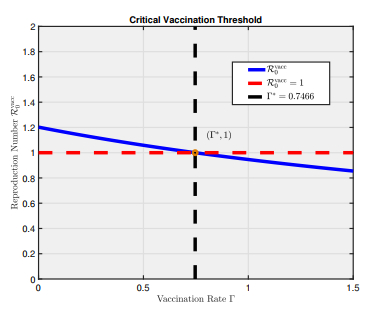
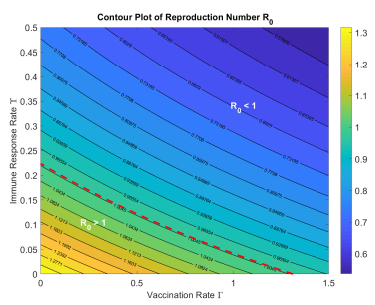
Hepatitis B virus (HBV) infection can progress from acute infection to chronic liver disease, posing a major public health concern. In this work, a mathematical model incorporating immune response and vaccination is developed using susceptible, infected, chronic, and recovered populations. Positivity and boundedness of solutions are established, and disease-free and endemic equilibria are analyzed. The basic reproduction numbers and stability conditions are derived using the next-generation matrix and Jacobian methods. Critical thresholds are obtained as $ \Upsilon^* = 0.2237 $ for immune response and $ \Gamma^* = 0.7466 $ for vaccination. Numerical simulations using the fourth-order Runge–Kutta method demonstrate that enhanced immune response and vaccination can reduce HBV infection and chronic cases. The findings provide quantitative evidence on the role of immune response and vaccination in controlling HBV transmission and disease progression.
Citation: Thangavel Megala, Thangaraj Nandha Gopal, Mehmet Yavuz, Muthurathinam Sivabalan, Manickasundaram Siva Pradeep. Impact of vaccination and immune response in reducing Hepatitis B-related liver disease model[J]. Networks and Heterogeneous Media, 2026, 21(5): 1987-2006. doi: 10.3934/nhm.2026075
Hepatitis B virus (HBV) infection can progress from acute infection to chronic liver disease, posing a major public health concern. In this work, a mathematical model incorporating immune response and vaccination is developed using susceptible, infected, chronic, and recovered populations. Positivity and boundedness of solutions are established, and disease-free and endemic equilibria are analyzed. The basic reproduction numbers and stability conditions are derived using the next-generation matrix and Jacobian methods. Critical thresholds are obtained as $ \Upsilon^* = 0.2237 $ for immune response and $ \Gamma^* = 0.7466 $ for vaccination. Numerical simulations using the fourth-order Runge–Kutta method demonstrate that enhanced immune response and vaccination can reduce HBV infection and chronic cases. The findings provide quantitative evidence on the role of immune response and vaccination in controlling HBV transmission and disease progression.

| [1] | World Health Organization, Global Health Sector Strategies on, respectively, HIV, Viral Hepatitis and Sexually Transmitted Infections for the period 2022–2030, World Health Organization, 2022. |
| [2] |
J. J. Ott, G. A. Stevens, J. Groeger, S. T. Wiersma, Global epidemiology of Hepatitis B virus infection: New estimates of age-specific HBsAg seroprevalence and endemicity, Vaccine, 30 (2012), 2212–2219. https://doi.org/10.1016/j.vaccine.2011.12.116 doi: 10.1016/j.vaccine.2011.12.116

|
| [3] |
M. T. Hoang, O. F. Egbelowo, On the global asymptotic stability of a hepatitis B epidemic model and its solutions by nonstandard numerical schemes, Bol. Soc. Mat. Mex., 26 (2020), 1113–1134. https://doi.org/10.1007/s40590-020-00275-2 doi: 10.1007/s40590-020-00275-2
|
| [4] | World Health Organization, Hepatitis B vaccines: WHO position paper–July 2017, Weekly Epidemiological Record, 92 (2017), 369–392. |
| [5] |
A. Schweitzer, J. Horn, R. T. Mikolajczyk, G. Krause, J. J. Ott, Estimations of worldwide prevalence of chronic hepatitis B virus infection: A systematic review of data published between 1965 and 2013, The Lancet, 386 (2015), 1546–1555. https://doi.org/10.1016/S0140-6736(15)61412-X doi: 10.1016/S0140-6736(15)61412-X
|
| [6] | Q. T. Ain, Nonlinear stochastic cholera epidemic model under the influence of noise, J. Math. Tech. Model., 1 (2024), 52–74. |
| [7] |
P. Driessche, J. Watmough, Reproduction numbers and sub-threshold endemic equilibria for compartmental models of disease transmission, Math. Biosci., 180 (2002), 29–48. https://doi.org/10.1016/S0025-5564(02)00108-6 doi: 10.1016/S0025-5564(02)00108-6
|
| [8] |
A. Din, Bifurcation analysis of a delayed stochastic HBV epidemic model: Cell-to-cell transmission, Chaos, Solitons Fractals, 181 (2024), 114714. https://doi.org/10.1016/j.chaos.2024.114714 doi: 10.1016/j.chaos.2024.114714
|
| [9] |
World Health Organization, Hepatitis B vaccines: WHO position paper, July 2017–Recommendations, Vaccine, 37 (2019), 223–225. https://doi.org/10.1016/j.vaccine.2017.07.046 doi: 10.1016/j.vaccine.2017.07.046
|
| [10] | L. Allen, An Introduction to Mathematical Biology, Pearson Prentice Hall, Upper Saddle River, New Jersey, 2007. |
| [11] | B. Dubey, P. Dubey, U. S. Dubey, Dynamics of an SIR model with nonlinear incidence and treatment rate, Appl. Appl. Math. (AAM), 10 (2015), 5. |
| [12] |
K. Bruxvoort, J. Slezak, R. Huang, B. Ackerson, L. S. Sy, L. Qian, et al., Association of number of doses with Hepatitis B vaccine series completion in US adults, JAMA Netw. Open, 3 (2020), e2027577. https://doi.org/10.1001/jamanetworkopen.2020.27577 doi: 10.1001/jamanetworkopen.2020.27577
|
| [13] |
A. S. Lok, B. J. McMahon, Chronic Hepatitis B: Update 2009, Hepatology, 50 (2009), 661–662. https://doi.org/10.1002/hep.23190 doi: 10.1002/hep.23190
|
| [14] |
A. Sow, C. Diallo, H. Cherifi, Interplay between vaccines and treatment for dengue control: An epidemic model, Plos one, 19 (2024), e0295025. https://doi.org/10.1371/journal.pone.0295025 doi: 10.1371/journal.pone.0295025
|
| [15] |
S. T. Goldstein, F. Zhou, S. C. Hadler, B. P. Bell, E. E. Mast, H. S. Margolis, A mathematical model to estimate global hepatitis B disease burden and vaccination impact, Int. J. Epidemiol., 34 (2005), 1329–1339. https://doi.org/10.1093/ije/dyi206 doi: 10.1093/ije/dyi206
|
| [16] |
B. Dubey, A. Patra, P. Srivastava, U. S. Dubey, Modeling and analysis of an SEIR model with different types of nonlinear treatment rates, J. Biol. Syst., 21 (2013), 1350023. https://doi.org/10.1142/S021833901350023X doi: 10.1142/S021833901350023X
|
| [17] |
B. Shulgin, L. Stone, Z. Agur, Pulse vaccination strategy in the SIR epidemic model, Bull. Math. Biol., 60 (1998), 1123–1148. https://doi.org/10.1006/S0092-8240(98)90005-2 doi: 10.1006/S0092-8240(98)90005-2
|
| [18] |
J. Guedj, L. Rong, H. Dahari, A. S. Perelson, A perspective on modelling Hepatitis C virus infection, J. Viral Hepatitis, 17 (2010), 825–833. https://doi.org/10.1111/j.1365-2893.2010.01348.x doi: 10.1111/j.1365-2893.2010.01348.x
|
| [19] |
T. Megala, T. Nandha Gopal, M. Siva Pradeep, M. Sivabalan, A. Yasotha, Dynamics of re-infection in a Hepatitis B virus epidemic model with constant vaccination and preventive measures, J. Appl. Math. Comput., 71 (2025), 5669–5695. https://doi.org/10.1007/s12190-025-02431-1 doi: 10.1007/s12190-025-02431-1
|
| [20] |
J. R. Beddington, Mutual interference between parasites or predators and its effect on searching efficiency, J. Anim. Ecol., 42 (1975), 331–340. https://doi.org/10.2307/3866 doi: 10.2307/3866
|
| [21] |
D. L. DeAngelis, R. A. Goldstein, R. V. O'Neill, A model for trophic interaction, Ecology, 56 (1975), 881–892. https://doi.org/10.2307/1936298 doi: 10.2307/1936298
|
| [22] |
M. Gumus, K. Turk, Dynamical behavior of a hepatitis B epidemic model and its NSFD scheme, J. Appl. Math. Comput., 70 (2024), 3767–3788. https://doi.org/10.1007/s12190-024-02103-6 doi: 10.1007/s12190-024-02103-6
|
| [23] |
A. Kaddar, Stability analysis in a delayed SIR epidemic model with a saturated incidence rate, Nonlinear Anal.-Model. Control, 15 (2010), 299–306. https://doi.org/10.15388/NA.15.3.14325 doi: 10.15388/NA.15.3.14325
|
| [24] | A. Kaddar, On the dynamics of a delayed SIR epidemic model with a modified saturated incidence rate, Electron. J. Differ. Equ. (EJDE), 2009 (2009), 1–7. |
| [25] |
M. Farhan, Z. Ling, Z. Shah, S. Islam, M. H. Alshehri, E. Antonescu, A multi-layer neural network approach for the stability analysis of the hepatitis B model, Comput. Biol. Chem., 113 (2024), 108256. https://doi.org/10.1016/j.compbiolchem.2024.108256 doi: 10.1016/j.compbiolchem.2024.108256
|
| [26] |
M. Farhan, Z. Shah, Z. Ling, K. Shah, T. Abdeljawad, S. Islam, et al., Global dynamics and computational modeling for analyzing and controlling hepatitis B: A novel epidemic approach, Plos One, 19 (2024), e0304375. https://doi.org/10.1371/journal.pone.0304375 doi: 10.1371/journal.pone.0304375
|
| [27] |
M. Farhan, Waseem, A. Thaljaoui, M. U. Rahman, Data-driven investigation of an epidemic model under saturated incidence rate using deep neural networks, J. Appl. Math. Comput., 71 (2025), 7983–8017. https://doi.org/10.1007/s12190-025-02639-1 doi: 10.1007/s12190-025-02639-1
|
| [28] |
L. Lengiteng'i, I. S. Mbalawata, L. Luboobi, S. S. Mirau, N. Nyerere, Mathematical model for the control of HIV/TB coinfection incorporating dual stigma, Bull. Biomath., 4 (2026), 70–112. https://doi.org/10.59292/bulletinbiomath.1686572 doi: 10.59292/bulletinbiomath.1686572
|
| [29] |
M. Yavuz, N. B. Bayraktar, K. Akyüz, F. N. Özdemir, A new mathematical model for hepatitis-B and the effect of vertical transmission in the model, FEN ve Mühendislik Bilimleri Dergisi, 7 (2025), 214–227. https://doi.org/10.47112/neufmbd.2025.87 doi: 10.47112/neufmbd.2025.87
|
| [30] |
M. Yavuz, K. Akyüz, N. B. Bayraktar, F. N. Özdemir, Hepatitis-B disease modelling of fractional order and parameter calibration using real data from the USA, AIMS Biophys., 11 (2024), 378–402. https://doi.org/10.3934/biophy.2024021 doi: 10.3934/biophy.2024021
|
| [31] |
P. A. Naik, M. Yavuz, S. Qureshi, K. M. Owolabi, A. Soomro, A. H. Ganie, Memory impacts in hepatitis C: A global analysis of a fractional-order model with an effective treatment, Comput. Methods Programs Biomed., 254 (2024), 108306. https://doi.org/10.1016/j.cmpb.2024.108306 doi: 10.1016/j.cmpb.2024.108306
|
| [32] |
A. Kiemtore, W. O. Sawadogo, P. O. F. Ouédraogo, F. Aqel, H. Alaa, K. S. Somda, et al., Mathematical modelling of the impact of vaccination, treatment and media awareness on the hepatitis B epidemic in Burkina Faso, Math. Model. Numer. Simul. Appl., 4 (2024), 139–164. https://doi.org/10.53391/mmnsa.1528691 doi: 10.53391/mmnsa.1528691
|
| [33] |
U. T. Mustapha, Y. U. Ahmad, A. Yusuf, S. Qureshi, S. S. Musa, Transmission dynamics of an age-structured hepatitis-B infection with differential infectivity, Bull. Biomath., 1 (2023), 124–152. https://doi.org/10.59292/bulletinbiomath.2023007 doi: 10.59292/bulletinbiomath.2023007
|
| [34] |
P. H. Crowley, E. K. Martin, Functional responses and interference within and between year classes of a dragonfly population, J. N. Am. Benthological Soc., 8 (1989), 211–221. https://doi.org/10.2307/1467324 doi: 10.2307/1467324
|
| [35] |
T. Megala, T. Nandha Gopal, M. Siva Pradeep, A. Yasotha, A diseased three-species harvesting food web model with various response functions, Biol. Life Sci. Forum, 30 (2024), 17. https://doi.org/10.3390/IOCAG2023-16876 doi: 10.3390/IOCAG2023-16876
|
| [36] | T. Megala, T. Nandha Gopal, Y. Khan, M. Siva Pradeep, M. Sivabalan, A. Yasotha, Dynamical behaviorism of hepatitis B epidemic model with Crowley-Martin perspective, Boletim da Sociedade Paranaense de Matemática, 43 (2025), 1–17. |
| [37] | T. Megala, T. Nandha Gopal, M. Siva Pradeep, M. Sivabalan, A. Yasotha, Dynamical analysis of a three-species diseased food web model with different functional responses, in International Conference on Nonlinear Dynamics and Applications, Cham: Springer Nature Switzerland, (2024), 235–252. https://doi.org/10.1007/978-3-031-69134-8_16 |
| [38] |
M. Thangavel, N. G. Thangaraj, S. P. Manickasundaram, Y. Arunachalam, An eco-epidemiological model involving prey refuge and prey harvesting with Beddington–DeAngelis, Crowley–Martin and Holling type Ⅱ functional responses, Eng. Proc., 56 (2023), 325. https://doi.org/10.3390/ASEC2023-15812 doi: 10.3390/ASEC2023-15812
|
| [39] |
R. Geetha, M. Sivabalan, M. Yavuz, T. Megala, M. S. Pradeep, Biodiversity and ecosystem stability in a four-species prey-predator food chain with meta-communities, AIMS Bioeng., 12 (2025), 530–555. https://doi.org/10.3934/bioeng.2025025 doi: 10.3934/bioeng.2025025
|
| [40] |
T. Megala, M. Siva Pradeep, M. Yavuz, T. Nandha Gopal, M. Sivabalan, A role of fear on diseased food web model with multiple functional response, Phys. Biol., 22 (2025), 016004. https://doi.org/10.1088/1478-3975/ad9261 doi: 10.1088/1478-3975/ad9261
|
| [41] | P. Van den Driessche, J. Watmough, Further notes on the basic reproduction number, Math. Epidemiol., Springer, Berlin, Heidelberg, (2008), 159–178. https://doi.org/10.1007/978-3-540-78911-6_6 |
Figures(6) / Tables(4)
Thangavel Megala, Thangaraj Nandha Gopal, Mehmet Yavuz, Muthurathinam Sivabalan, Manickasundaram Siva Pradeep. Impact of vaccination and immune response in reducing Hepatitis B-related liver disease model[J]. Networks and Heterogeneous Media, 2026, 21(5): 1987-2006. doi: 10.3934/nhm.2026075




 DownLoad: