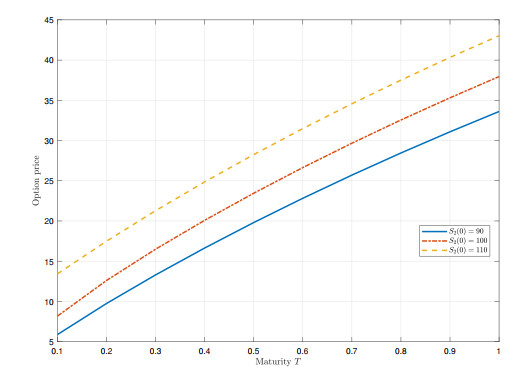
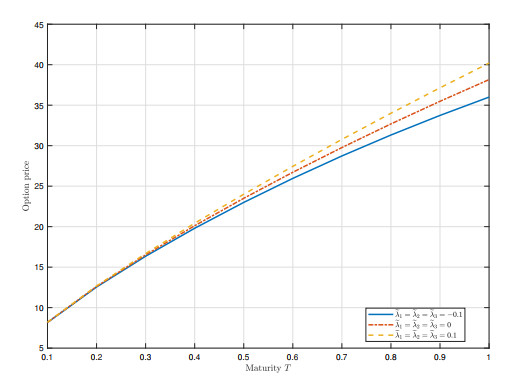
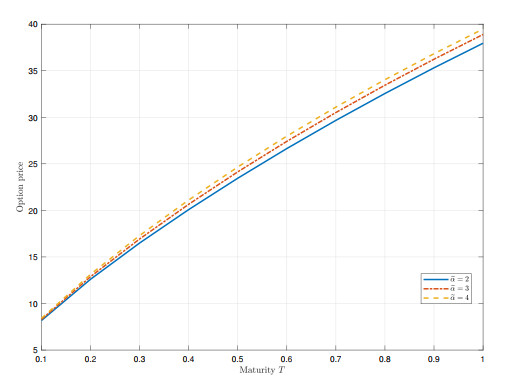
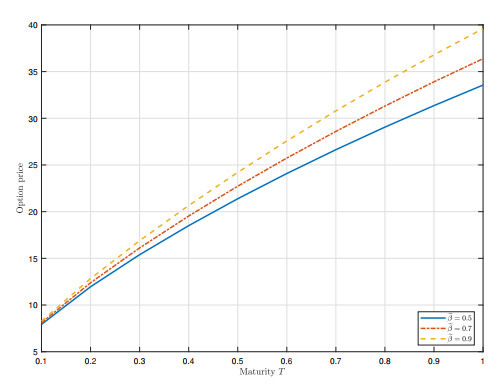
This paper proposes a semi-analytical valuation framework for a European call option on the maximum of two assets under a two-factor stochastic volatility model that incorporates both stochastic long-term means and stochastic liquidity risk. By applying the Feynman–Kac theorem, the joint characteristic function of the two liquidity-adjusted log-prices is explicitly derived. Using this joint characteristic function, a semi-analytical pricing formula for the option is obtained through measure changes and bivariate Fourier inversion techniques. The formula is validated against Monte Carlo simulation, and comparisons with nested benchmark models quantify the incremental pricing effects of stochastic liquidity and the stochastic long-term mean. Finally, through various numerical examples, a sensitivity analysis is conducted to illustrate how changes in significant parameters affect the option's price.
Citation: Eunho Koo, Geonwoo Kim. Semi-analytical valuation of an option on the maximum of two assets under a stochastic volatility model with stochastic long-term mean and stochastic liquidity[J]. Networks and Heterogeneous Media, 2026, 21(4): 1580-1599. doi: 10.3934/nhm.2026060
This paper proposes a semi-analytical valuation framework for a European call option on the maximum of two assets under a two-factor stochastic volatility model that incorporates both stochastic long-term means and stochastic liquidity risk. By applying the Feynman–Kac theorem, the joint characteristic function of the two liquidity-adjusted log-prices is explicitly derived. Using this joint characteristic function, a semi-analytical pricing formula for the option is obtained through measure changes and bivariate Fourier inversion techniques. The formula is validated against Monte Carlo simulation, and comparisons with nested benchmark models quantify the incremental pricing effects of stochastic liquidity and the stochastic long-term mean. Finally, through various numerical examples, a sensitivity analysis is conducted to illustrate how changes in significant parameters affect the option's price.

| [1] |
R. M. Stulz, Options on the minimum or the maximum of two risky assets: Analysis and applications, J. Financ. Econ., 10 (1982), 161–185. https://doi.org/10.1016/0304-405X(82)90011-3 doi: 10.1016/0304-405X(82)90011-3

|
| [2] |
H. Johnson, Options on the maximum or the minimum of several assets, J. Financ. Quant. Anal., 22 (1987), 277–283. https://doi.org/10.2307/2330963 doi: 10.2307/2330963
|
| [3] |
J. Zhang, K. Zhou. Pricing options on the maximum or the minimum of several assets with default risk, N. Am. J. Econ. Finance, 75 (2025), 102272. https://doi.org/10.1016/j.najef.2024.102272 doi: 10.1016/j.najef.2024.102272
|
| [4] |
R. Wang, G. Deng, Pricing geometric Asian extremum options under mixed fractional Brownian motion with jumps, Jpn. J. Ind. Appl. Math., 42 (2025), 2233–2261. https://doi.org/10.1007/s13160-025-00723-4 doi: 10.1007/s13160-025-00723-4
|
| [5] |
F. Black, M. Scholes, The pricing of options and corporate liabilities, J. Political Econ., 81 (1973), 637–654. https://doi.org/10.1086/260062 doi: 10.1086/260062
|
| [6] |
S. L. Heston, A closed-form solution for options with stochastic volatility with applications to bond and currency options, Rev. Financ. Stud., 6 (1993), 327–343. https://doi.org/10.1093/rfs/6.2.327 doi: 10.1093/rfs/6.2.327
|
| [7] |
P. Christoffersen, S. Heston, K. Jacobs, The shape and term structure of the index option smirk: Why multifactor stochastic volatility models work so well, Manag. Sci., 55 (2009), 1914–1932. https://doi.org/10.1287/mnsc.1090.1065 doi: 10.1287/mnsc.1090.1065
|
| [8] |
X. J. He, W. Chen, A closed-form pricing formula for European options under a new stochastic volatility model with a stochastic long-term mean, Math. Financ. Econ., 15 (2021), 381–396. https://doi.org/10.1007/s11579-020-00281-y doi: 10.1007/s11579-020-00281-y
|
| [9] |
S. Y. Cho, G. Kim, Analytical valuation of vulnerable options under a stochastic volatility model with a stochastic long-term mean, AIMS Math., 10 (2025), 20219–20234. https://doi.org/10.3934/math.2025903 doi: 10.3934/math.2025903
|
| [10] |
Y. Wang, Y. Bai, European option pricing under the approximate fractional Heston jump–diffusion model with a stochastic long-term mean, Alex. Eng. J., 123 (2025), 145–156. https://doi.org/10.1016/j.aej.2025.03.045 doi: 10.1016/j.aej.2025.03.045
|
| [11] |
J. Gatheral, T. Jaisson, M. Rosenbaum, Volatility is rough, Quant. Finance, 18 (2018), 933–949. https://doi.org/10.1080/14697688.2017.1393551 doi: 10.1080/14697688.2017.1393551
|
| [12] |
X. Wang, W. Xiao, J. Yu, Modeling and forecasting realized volatility with the fractional Ornstein–Uhlenbeck process, J. Econom., 232 (2023), 389–415. https://doi.org/10.1016/j.jeconom.2021.08.001 doi: 10.1016/j.jeconom.2021.08.001
|
| [13] | X. Wang, W. Xiao, J. Yu, C. Zhang, Maximum likelihood estimation of fractional Ornstein–Uhlenbeck process with discretely sampled data, Working Paper No. 202527, Faculty of Business Administration, University of Macau, 2025. Available from: https://ideas.repec.org/p/boa/wpaper/202527.html. |
| [14] |
S. P. Feng, M. W. Hung, Y. H. Wang, Option pricing with stochastic liquidity risk: Theory and evidence, J. Financ. Mark., 18 (2014), 77–95. https://doi.org/10.1016/j.finmar.2013.05.002 doi: 10.1016/j.finmar.2013.05.002
|
| [15] |
X. J. He, S. D. Huang, S. Lin, A closed-form solution for pricing European-style options under the Heston model with credit and liquidity risks, Commun. Nonlinear Sci. Numer. Simul., 143 (2025), 108595. https://doi.org/10.1016/j.cnsns.2025.108595 doi: 10.1016/j.cnsns.2025.108595
|
| [16] |
J. Jeon, G. Kim, Analytically pricing a vulnerable option under a stochastic liquidity risk model with stochastic volatility, Mathematics, 12 (2024), 2642. https://doi.org/10.3390/math12172642 doi: 10.3390/math12172642
|
| [17] |
B. Wang, X. Wang, M. Zhao, Valuing vulnerable basket options with stochastic liquidity risk in reduced-form models, Comput. Econ., 66 (2025), 2439–2455. https://doi.org/10.1007/s10614-024-10794-z doi: 10.1007/s10614-024-10794-z
|
| [18] |
X. J. He, H. Chen, S. Lin, Analytically pricing European options under two-factor stochastic volatility with stochastic liquidity risks, J. Futures Mark., 46 (2026), 1423–1439. https://doi.org/10.1002/fut.70114 doi: 10.1002/fut.70114
|
| [19] |
X. J. He, D. Yan, S. Lin, A new analytical approach for pricing variance and volatility swaps: Incorporating liquidity and self-exciting jumps, J. Futures Mark., (2026), e70120. https://doi.org/10.1002/fut.70120 doi: 10.1002/fut.70120
|
| [20] |
S. Y. Cho, G. Kim, Analytically pricing vulnerable options under the stochastic volatility model with stochastic long-term mean and stochastic liquidity, Commun. Nonlinear Sci. Numer. Simul., 161 (2026), 110130. https://doi.org/10.1016/j.cnsns.2026.110130 doi: 10.1016/j.cnsns.2026.110130
|
| [21] |
N. G. Shephard, From characteristic function to distribution function: A simple framework for the theory, Econom. Theory, 7 (1991), 519–529. https://doi.org/10.1017/S0266466600004746 doi: 10.1017/S0266466600004746
|
| [22] |
S. Lin, X. J. He, Closed-form formulae for variance and volatility swaps under stochastic volatility with stochastic liquidity risks, J. Futures Mark., 44 (2024), 1447–1461. https://doi.org/10.1002/fut.22531 doi: 10.1002/fut.22531
|
Figures(6) / Tables(4)
Eunho Koo, Geonwoo Kim. Semi-analytical valuation of an option on the maximum of two assets under a stochastic volatility model with stochastic long-term mean and stochastic liquidity[J]. Networks and Heterogeneous Media, 2026, 21(4): 1580-1599. doi: 10.3934/nhm.2026060




 DownLoad: