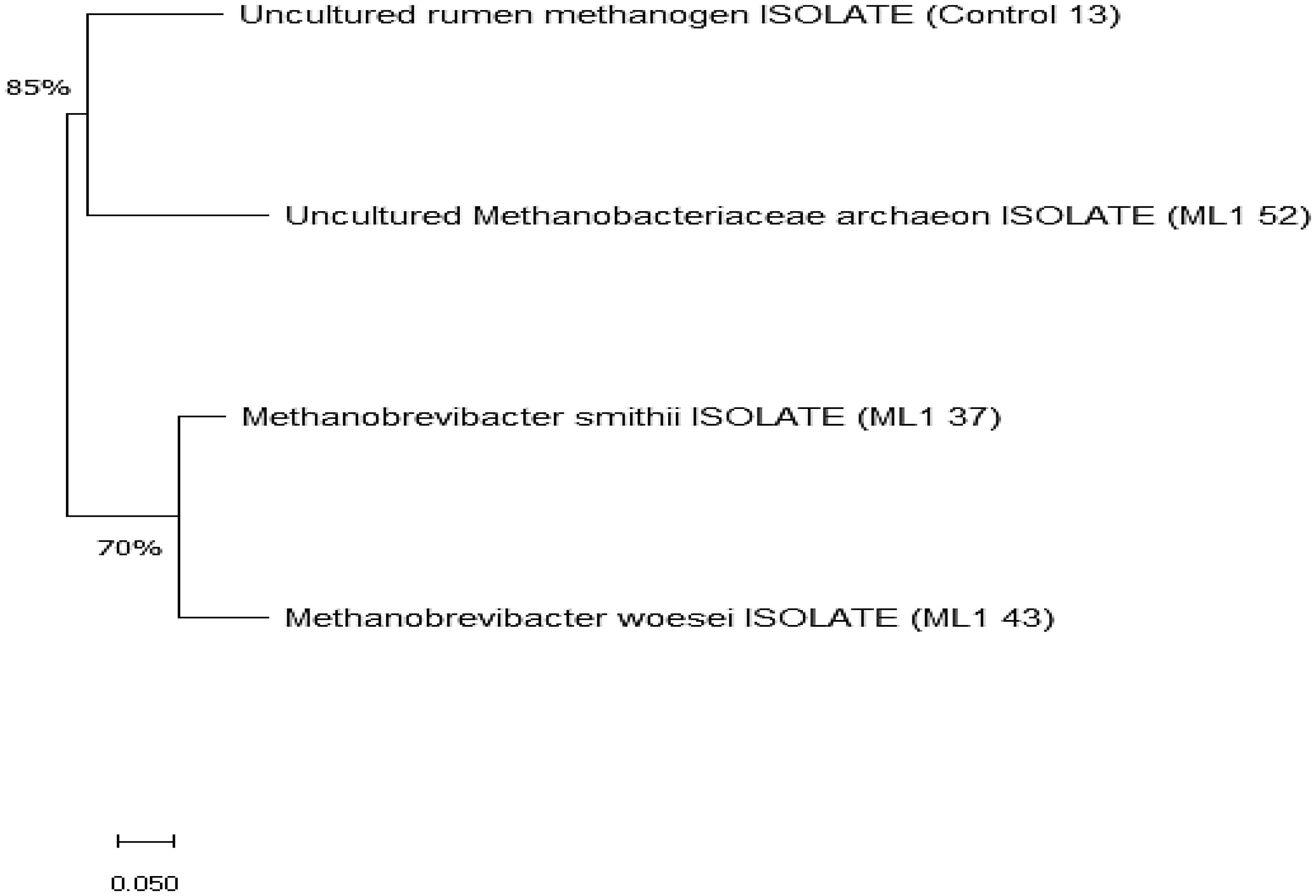
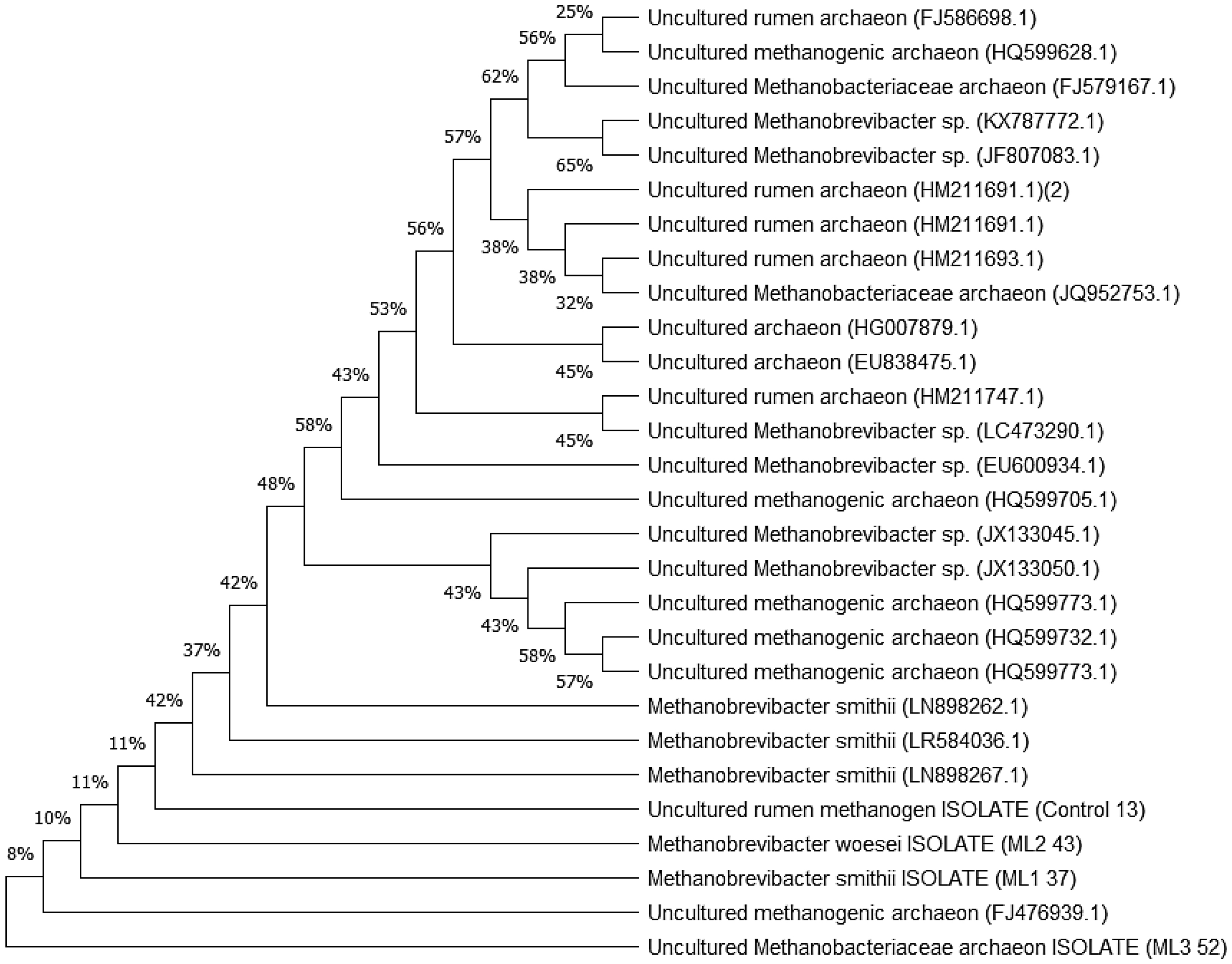
The development of innovative feed resources for livestock is crucial for ensuring nutrient adequacy while reducing greenhouse gas emissions. We aimed to evaluate the effects of Moringa oleifera leaf extract (ML) supplementation on in vitro nutrient degradability, net gas production (GP), ruminal fermentation, methane (CH4) emissions, and methanogen community structure using a semi-automated in vitro gas production system. Methanogen-specific 16S rRNA genes were amplified through nested PCR and then sequenced with Sanger sequencing. Microbial analyses were conducted using 16S rRNA sequencing. A basal diet (50% concentrate and 50% forage) was incubated in vitro for 24 h as a control (no additives) and compared to diets supplemented with ML at 1.0, 2.0, and 3.0 mL/100 g dry matter (DM), designated ML1, ML2, and ML3, respectively. GC-MS profiling of ML revealed that glycerin (82.08%), unsaturated fatty acid derivatives such as linoleic acid, and minor bioactive sulfur- and nitrogen-containing compounds (e.g., L-cystathionine, homocysteine derivatives) were the major constituents. These compounds exert antimicrobial, membrane-disrupting, and redox-modulating effects, which provide the basis for the proposed mechanisms by which ML influences rumen fermentation and methanogenesis. Supplementation with ML significantly reduced net GP (linear, P < 0.001; quadratic, P = 0.002) and CH4 production (linear, P = 0.033) across all levels. Similarly, truly degradable dry matter (TDDM; linear, P = 0.038) and truly degradable organic matter (TDOM; linear, P = 0.016) decreased, whereas the partitioning factor increased with ML1 and ML2 supplementation (quadratic, P = 0.002). Ruminal pH and ammonia nitrogen (NH3-N) concentrations remained unaffected. However, ML treatments reduced total volatile fatty acids (linear, P = 0.009; quadratic, P = 0.003) and butyrate concentrations (linear, P < 0.001). Acetate and propionate concentrations were reduced by ML1 and ML2 (quadratic, P = 0.005). In contrast, ML3 increased isobutyrate (linear, P = 0.004; quadratic, P = 0.012) and isovalerate (linear, P = 0.023; quadratic, P = 0.012) levels. Protozoal enumeration showed that Diplodinium spp. counts decreased with ML (linear, P = 0.008), while Epidinium spp. counts were reduced by ML1 (quadratic, P = 0.048). Phylogenetic analysis of 16S rRNA gene sequences indicated that ML supplementation altered the rumen methanogen community, with distinct shifts toward Methanobrevibacter smithii and M. woesei in ML2 and ML3, respectively. These findings suggest that ML selectively inhibits methanogenic archaea, potentially contributing to reduced CH4 emissions and altered fermentation profiles.
Citation: Amr E. El-Nile, Marwa F. A. Attia, Mahmoud A. Elazab, Mohamed N. El-Gendy, Ahmed E. Kholif, Raed A. Aburawash, Elsayed E. Hafez, Sobhy M.A. Sallam. Moringa oleifera leaf extract enhances rumen degradability and modifies methanogen communities in vitro[J]. AIMS Microbiology, 2025, 11(4): 963-983. doi: 10.3934/microbiol.2025043
The development of innovative feed resources for livestock is crucial for ensuring nutrient adequacy while reducing greenhouse gas emissions. We aimed to evaluate the effects of Moringa oleifera leaf extract (ML) supplementation on in vitro nutrient degradability, net gas production (GP), ruminal fermentation, methane (CH4) emissions, and methanogen community structure using a semi-automated in vitro gas production system. Methanogen-specific 16S rRNA genes were amplified through nested PCR and then sequenced with Sanger sequencing. Microbial analyses were conducted using 16S rRNA sequencing. A basal diet (50% concentrate and 50% forage) was incubated in vitro for 24 h as a control (no additives) and compared to diets supplemented with ML at 1.0, 2.0, and 3.0 mL/100 g dry matter (DM), designated ML1, ML2, and ML3, respectively. GC-MS profiling of ML revealed that glycerin (82.08%), unsaturated fatty acid derivatives such as linoleic acid, and minor bioactive sulfur- and nitrogen-containing compounds (e.g., L-cystathionine, homocysteine derivatives) were the major constituents. These compounds exert antimicrobial, membrane-disrupting, and redox-modulating effects, which provide the basis for the proposed mechanisms by which ML influences rumen fermentation and methanogenesis. Supplementation with ML significantly reduced net GP (linear, P < 0.001; quadratic, P = 0.002) and CH4 production (linear, P = 0.033) across all levels. Similarly, truly degradable dry matter (TDDM; linear, P = 0.038) and truly degradable organic matter (TDOM; linear, P = 0.016) decreased, whereas the partitioning factor increased with ML1 and ML2 supplementation (quadratic, P = 0.002). Ruminal pH and ammonia nitrogen (NH3-N) concentrations remained unaffected. However, ML treatments reduced total volatile fatty acids (linear, P = 0.009; quadratic, P = 0.003) and butyrate concentrations (linear, P < 0.001). Acetate and propionate concentrations were reduced by ML1 and ML2 (quadratic, P = 0.005). In contrast, ML3 increased isobutyrate (linear, P = 0.004; quadratic, P = 0.012) and isovalerate (linear, P = 0.023; quadratic, P = 0.012) levels. Protozoal enumeration showed that Diplodinium spp. counts decreased with ML (linear, P = 0.008), while Epidinium spp. counts were reduced by ML1 (quadratic, P = 0.048). Phylogenetic analysis of 16S rRNA gene sequences indicated that ML supplementation altered the rumen methanogen community, with distinct shifts toward Methanobrevibacter smithii and M. woesei in ML2 and ML3, respectively. These findings suggest that ML selectively inhibits methanogenic archaea, potentially contributing to reduced CH4 emissions and altered fermentation profiles.

| [1] |
Kholif AE, Gouda GA, Morsy TA, et al. (2022) Dietary date palm leaves ensiled with fibrolytic enzymes decreased methane production, and improved feed degradability and fermentation kinetics in a ruminal in vitro system. Waste Biomass Valorization 13: 3475-3488. https://doi.org/10.1007/s12649-022-01752-7 
|
| [2] |
Oliveira IST de, Fernandes T, Santos ARD, et al. (2025) Phytochemical composition and effects of aqueous extracts from Moringa oleifera leaves on in vitro ruminal fermentation parameters. Ruminants 5: 4. https://doi.org/10.3390/ruminants5010004
|
| [3] |
El-Nile AE, Morsy AS, El-Zaiat HM, et al. (2023) Can a blend of integrated feed additives modulate ruminal fermentation patterns and performance of growing lambs? In vitro and in vivo assessments. Anim Biotechnol 34: 935-946. https://doi.org/10.1080/10495398.2021.2003806
|
| [4] |
Ku-Vera JC, Jiménez-Ocampo R, Valencia-Salazar SS, et al. (2020) Role of secondary plant metabolites on enteric methane mitigation in ruminants. Front Vet Sci 7: 584. https://doi.org/10.3389/fvets.2020.00584
|
| [5] |
Abd-El Rahman MA, Mohamed NH, El-Nile AE, et al. (2024) Vegetative growth response and in vitro evaluation of three multipurpose fodder tree leaves and shrubs as potential feeds for farm animals. Agrofor Syst 98: 3019-3033. https://doi.org/10.1007/s10457-024-01071-x
|
| [6] |
Biswas D, Nandy S, Mukherjee A, et al. (2020) Moringa oleifera Lam. and derived phytochemicals as promising antiviral agents: A review. S Afr J Bot 129: 272-282. https://doi.org/10.1016/j.sajb.2019.07.049
|
| [7] | Owon M, Osman M, Ibrahim A, et al. (2021) Characterisation of different parts from Moringa oleifera regarding protein, lipid composition and extractable phenolic compounds. OCL-Oilseeds Fats Crops Lipids 28: 45. https://doi.org/10.1051/ocl/2021035 |
| [8] |
Mahato DK, Kargwal R, Kamle M, et al. (2022) Ethnopharmacological properties and Nutraceutical potential of Moringa oleifera. Phytomedicine Plus 2. https://doi.org/10.1016/j.phyplu.2021.100168
|
| [9] |
Morsy TA, Gouda GA, Kholif AE (2022) In vitro fermentation and production of methane and carbon dioxide from rations containing Moringa oleifera leave silage as a replacement of soybean meal: in vitro assessment. Environ Sci Pollut Res 29: 69743-69752. https://doi.org/10.1007/s11356-022-20622-2
|
| [10] |
Kholif AE, Gouda GA, Morsy TA, et al. (2023) Associative effects between Chlorella vulgaris microalgae and Moringa oleifera leaf silage used at different levels decreased in vitro ruminal greenhouse gas production and altered ruminal fermentation. Environ Sci Pollut Res 30: 6001-6020. https://doi.org/10.1007/s11356-022-22559-y
|
| [11] |
Kholif AE, Morsy TA, Gouda GA, et al. (2016) Effect of feeding diets with processed Moringa oleifera meal as protein source in lactating Anglo-Nubian goats. Anim Feed Sci Technol 217: 45-55. https://doi.org/10.1016/j.anifeedsci.2016.04.012
|
| [12] |
Kholif AE, Olafadehan OA (2021) Essential oils and phytogenic feed additives in ruminant diet: chemistry, ruminal microbiota and fermentation, feed utilization and productive performance. Phytochem Rev 20: 1087-1108. https://doi.org/10.1007/s11101-021-09739-3
|
| [13] | Kholif AE (2023) A review of effect of saponins on ruminal fermentation, health and performance of ruminants. Vet Sci 10: 450. https://doi.org/10.3390/vetsci10070450 |
| [14] |
Goel G, Makkar HPS (2012) Methane mitigation from ruminants using tannins and saponins. Trop Anim Health Prod 44: 729-739. https://doi.org/10.1007/s11250-011-9966-2
|
| [15] |
Fonseca NVB, Cardoso A da S, Bahia ASR de S, et al. (2023) Additive tannins in ruminant nutrition: an alternative to achieve sustainability in animal production. Sustainability 15: 4162. https://doi.org/10.3390/su15054162
|
| [16] |
Zeru AE, Hassen A, Apostolides Z, et al. (2022) Relationships between agronomic traits of moringa accessions and in vitro gas production characteristics of a test feed incubated with or without moringa plant leaf extracts. Plants 11: 2901. https://doi.org/10.3390/plants11212901
|
| [17] |
Kholif AE, Gouda GA, Olafadehan OA, et al. (2018) Effects of replacement of Moringa oleifera for berseem clover in the diets of Nubian goats on feed utilisation, and milk yield, composition and fatty acid profile. Animal 12: 964-972. https://doi.org/10.1017/S1751731117002336
|
| [18] |
Bueno ICS, Cabral Filho SLS, Gobbo SP, et al. (2005) Influence of inoculum source in a gas production method. Anim Feed Sci Technol 123–124: 95-105. https://doi.org/10.1016/j.anifeedsci.2005.05.003
|
| [19] |
Onodera R, Henderson C (1980) Growth factors of bacterial origin for the culture of the rumen oligotrich protozoon, Entodinium caudatum. J Appl Bacteriol 48: 125-134. https://doi.org/10.1111/j.1365-2672.1980.tb05214.x
|
| [20] |
Tavendale MH, Meagher LP, Pacheco D, et al. (2005) Methane production from in vitro rumen incubations with Lotus pedunculatus and Medicago sativa, and effects of extractable condensed tannin fractions on methanogenesis. Anim Feed Sci Technol 123–124: 403-419. https://doi.org/10.1016/j.anifeedsci.2005.04.037
|
| [21] |
Van Soest PJ, Robertson JB, Lewis BA (1991) Methods for dietary fiber, neutral detergent fiber, and nonstarch polysaccharides in relation to animal nutrition. J Dairy Sci 74: 3583-3597. https://doi.org/10.3168/jds.S0022-0302(91)78551-2
|
| [22] |
Blümmel M, Makkar HPS, Becker K (1997) In vitro gas production: a technique revisited. J Anim Physiol Anim Nutr (Berl) 77: 24-34. https://doi.org/10.1111/j.1439-0396.1997.tb00734.x
|
| [23] |
Dehority BA, Damron WS, McLaren JB (1983) Occurrence of the rumen ciliate Oligoisotricha bubali in domestic cattle (Bos taurus). Appl Environ Microbiol 45: 1394-1397. https://doi.org/10.1128/aem.45.4.1394-1397.1983
|
| [24] |
Palmquist DL, Conrad HR (1971) Origin of plasma fatty acids in lactating cows fed high grain or high fat diets. J Dairy Sci 54: 1025-1033. https://doi.org/10.3168/jds.S0022-0302(71)85966-0
|
| [25] |
Konitzer K, Voigt S (1963) Determination of ammonium in blood and tissue extracts. Clinica Chimica Acta 8: 5-11. https://doi.org/10.1016/0009-8981(63)90192-X
|
| [26] |
Wright A-DG, Pimm C (2003) Improved strategy for presumptive identification of methanogens using 16S riboprinting. J Microbiol Methods 55: 337-349. https://doi.org/10.1016/S0167-7012(03)00169-6
|
| [27] |
Watanabe T, Asakawa S, Nakamura A, et al. (2004) DGGE method for analyzing 16S rDNA of methanogenic archaeal community in paddy field soil. FEMS Microbiol Lett 232: 153-163. https://doi.org/10.1016/S0378-1097(04)00045-X
|
| [28] |
Zhou M, Hernandez-Sanabria E, Le LG (2009) Assessment of the microbial ecology of ruminal methanogens in cattle with different feed efficiencies. Appl Environ Microbiol 75: 6524-6533. https://doi.org/10.1128/AEM.02815-08
|
| [29] |
Kholif AE (2019) Glycerol use in dairy diets: A systemic review. Anim Nutr 5: 209-216. https://doi.org/10.1016/j.aninu.2019.06.002
|
| [30] |
McWilliams CJ, Pereira MN, Duffield TF, et al. (2024) Effect of glycerol supplementation in early lactation on metabolic health, milking activity, and production of dairy cows in automated milking system herds. J Dairy Sci 107: 9360-9378. https://doi.org/10.3168/jds.2024-24785
|
| [31] |
Sallam SAM, El-Sherif MMA, Attia MFA, et al. (2025) Performance of early-lactating Holstein cows fed diets supplemented with encapsulated essential oils. Ger J Vet Res 5: 140-155. https://doi.org/10.51585/gjvr.2025.1.0127
|
| [32] |
Ebeid HM, Mengwei L, Kholif AE, et al. (2020) Moringa oleifera oil modulates rumen microflora to mediate in vitro fermentation kinetics and methanogenesis in total mix rations. Curr Microbiol 77: 1271-1282. https://doi.org/10.1007/s00284-020-01935-2
|
| [33] |
Xie X, Cao Y, Li Q, et al. (2025) Mitigating enteric methane emissions: An overview of methanogenesis, inhibitors and future prospects. Anim Nutr 21: 84-96. https://doi.org/10.1016/j.aninu.2025.02.001
|
| [34] |
Cifuente JO, Colleoni C, Kalscheuer R, et al. (2024) Architecture, function, regulation, and evolution of α-glucans metabolic enzymes in prokaryotes. Chem Rev 124: 4863-4934. https://doi.org/10.1021/acs.chemrev.3c00811
|
| [35] |
Kholif AE, Gouda GA, Anele UY, et al. (2018) Extract of Moringa oleifera leaves improves feed utilization of lactating Nubian goats. Small Ruminant Res 158: 69-75. https://doi.org/10.1016/j.smallrumres.2017.10.014
|
| [36] |
Leitanthem VK, Chaudhary P, Bhakat M, et al. (2022) Impact of Moringa oleifera on rumen fermentation and methane emission under in vitro condition. AMB Express 12: 141. https://doi.org/10.1186/s13568-022-01480-0
|
| [37] |
Bashar M, Huque K, Sarker N, et al. (2020) Quality assessment and feeding impact of Moringa feed on intake, digestibility, enteric CH4 emission, rumen fermentation, and milk yield. J Adv Vet Anim Res 7: 521. https://doi.org/10.5455/javar.2020.g449
|
| [38] |
Sultana N, Das NG, Kabir MA, et al. (2021) Metabolic benefit of bulls being fed Moringa leaves twigs and branches as a major concentrate ingredient. Front Anim Sci 2: 712919. https://doi.org/10.3389/fanim.2021.712919
|
| [39] |
Verma S, Akpensuen TT, Wolffram S, et al. (2024) Investigating the efficacy of purified tannin extracts from underutilized temperate forages in reducing enteric methane emissions in vitro. Sci Rep 14: 12578. https://doi.org/10.1038/s41598-024-63434-9
|
| [40] |
Dong L, Zhang T, Diao Q (2019) Effect of dietary supplementation of Moringa oleifera on the production performance and fecal methanogenic community of lactating dairy cows. Animals 9: 262. https://doi.org/10.3390/ani9050262
|
| [41] | Kholif AE, Olafadehan OL, Kholif AMM, et al. (2025) The role of encapsulated essential oils in reducing methane production from ruminant animals–a review. Ann Anim Sci . In press. https://doi.org/10.2478/aoas-2025-0054 |
| [42] |
Mitchell KE, Wenner BA, Lee C, et al. (2023) Supplementing branched-chain volatile fatty acids in dual-flow cultures varying in dietary forage and corn oil concentrations. I: Digestibility, microbial protein, and prokaryotic community structure. J Dairy Sci 106: 7530-7547. https://doi.org/10.3168/jds.2022-23165
|
| [43] |
Abdel-Raheem SM, Hassan EH (2021) Effects of dietary inclusion of Moringa oleifera leaf meal on nutrient digestibility, rumen fermentation, ruminal enzyme activities and growth performance of buffalo calves. Saudi J Biol Sci 28: 4430-4436. https://doi.org/10.1016/j.sjbs.2021.04.037
|
Figures(2) / Tables(5)

Amr E. El-Nile, Marwa F. A. Attia, Mahmoud A. Elazab, Mohamed N. El-Gendy, Ahmed E. Kholif, Raed A. Aburawash, Elsayed E. Hafez, Sobhy M.A. Sallam. Moringa oleifera leaf extract enhances rumen degradability and modifies methanogen communities in vitro[J]. AIMS Microbiology, 2025, 11(4): 963-983. doi: 10.3934/microbiol.2025043





 DownLoad: