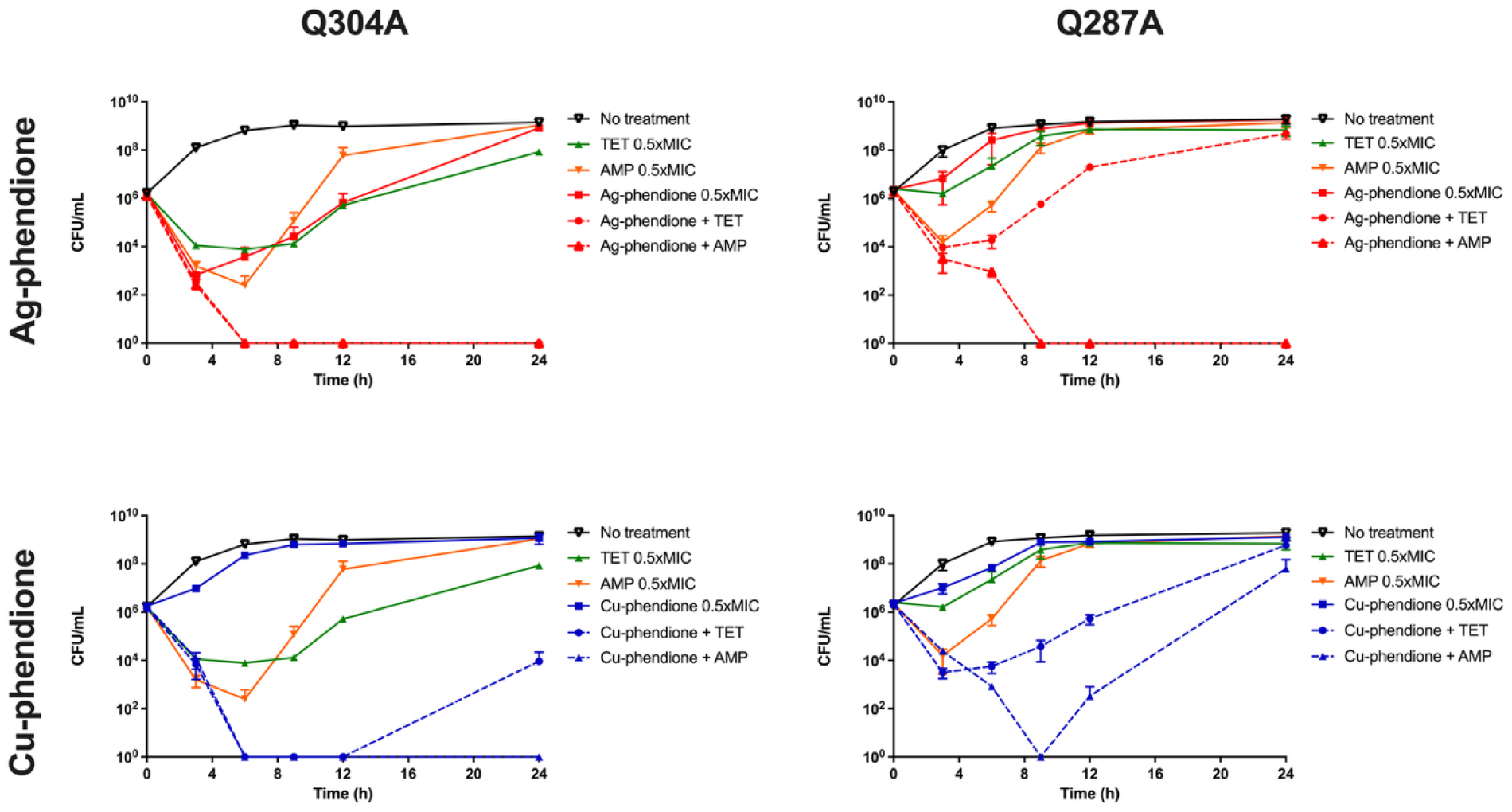
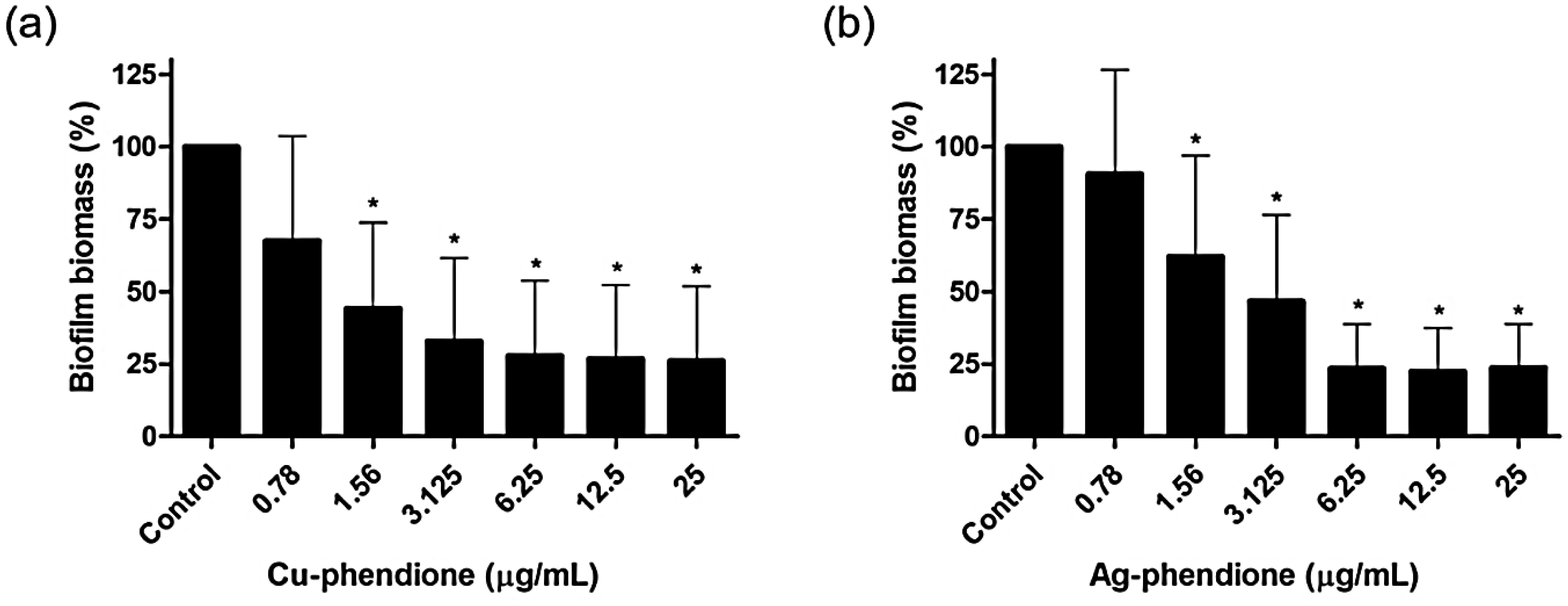
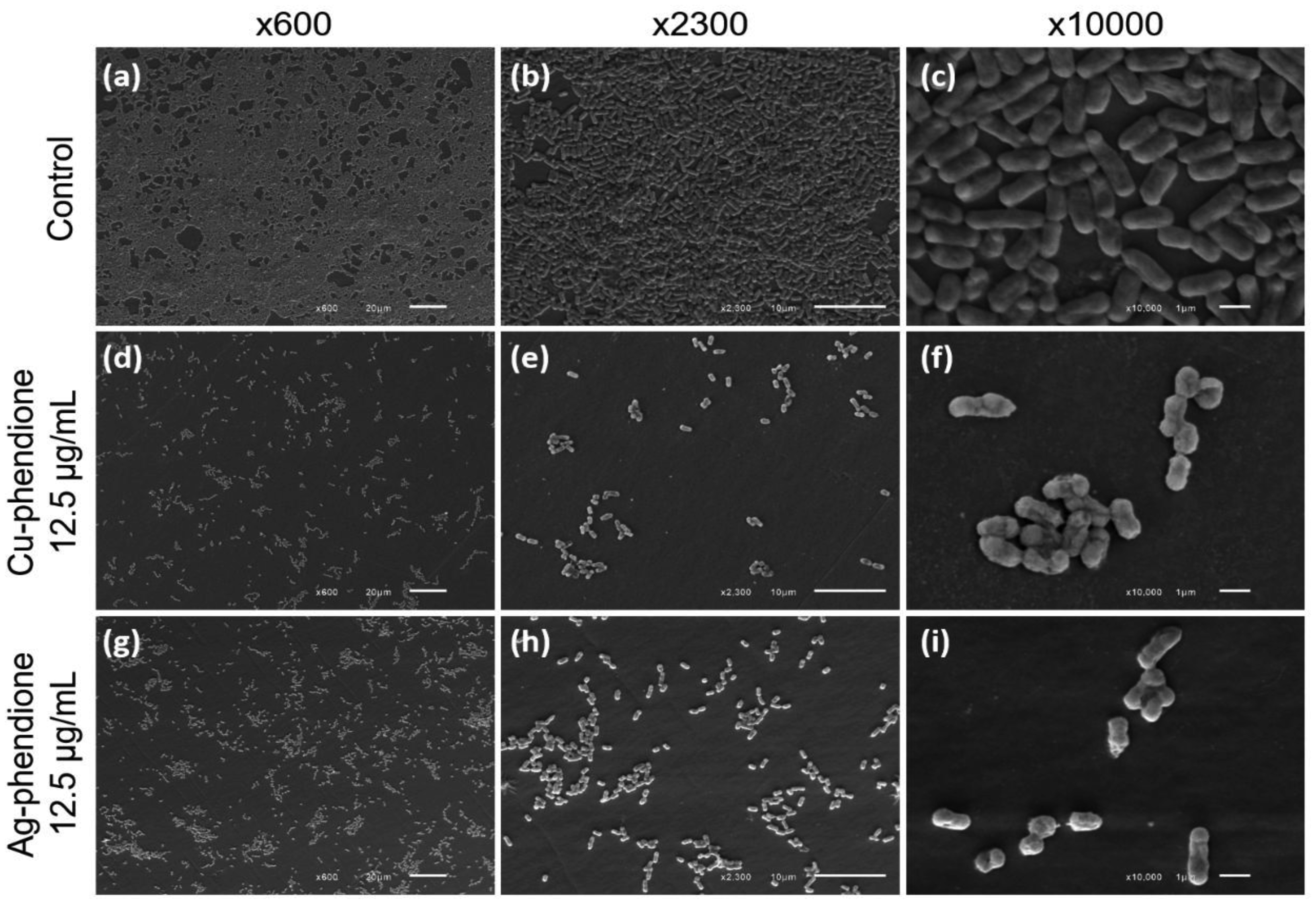
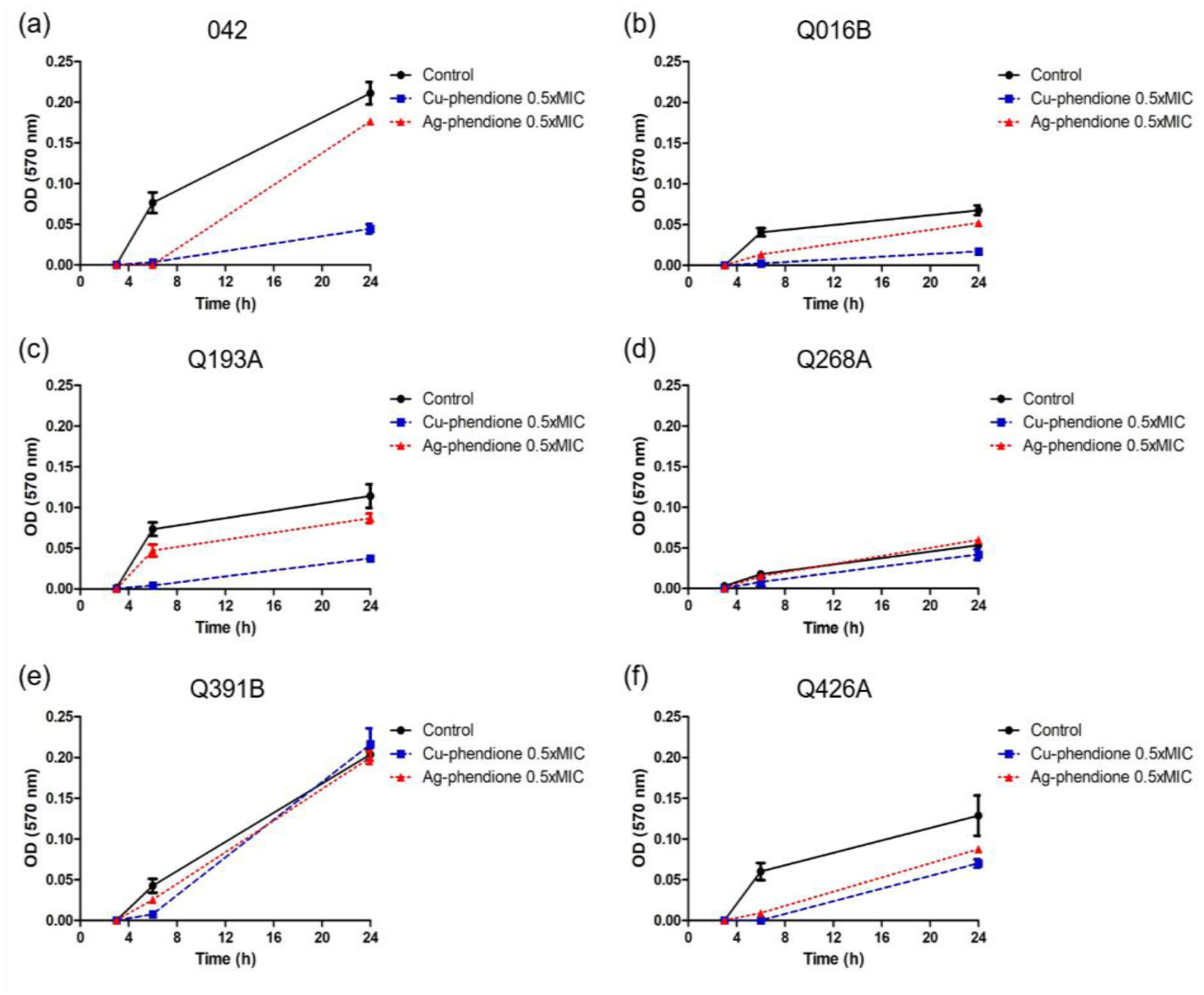
Enteroaggregative Escherichia coli (EAEC) causes acute and persistent diarrhea. Its antimicrobial resistance and strong biofilm formation hinder treatment, highlighting the need for new therapies. This study evaluated the antimicrobial efficacy of 1,10-phenanthroline-5,6-dione (phendione) and its copper [Cu(phendione)3](ClO4)2.4H2O (Cu-phendione) and silver [Ag(phendione)2]ClO4 (Ag-phendione) complexes against planktonic and biofilm-forming EAEC cells. The minimum inhibitory concentration (MIC) and minimum bactericidal concentration (MBC) values were determined for planktonic cells of 35 clinical EAEC isolates, revealing potent antibacterial activity by all test compounds, with Cu-phendione showing the greatest efficacy, followed by Ag-phendione and phendione. Most combinations of Cu-phendione or Ag-phendione with either ampicillin or tetracycline exhibited additive effects through checkerboard assays, whereas time-kill experiments revealed synergistic interactions between the complexes and those classical antibacterial agents. Minimum biofilm inhibitory concentration (MBIC) analysis identified Cu-phendione as the most effective compound for disarticulating biofilm formation (geometric MBIC = 14.61 µM), followed by Ag-phendione (24.69 µM) and phendione (67.08 µM). Notably, Cu-phendione eradicated biofilms in 24 isolates (68.6%), while Ag-phendione and phendione achieved eradication in 11 (31.4%) and 6 (17.1%) isolates, respectively. Furthermore, the test complexes were able to disrupt established mature biofilms, as demonstrated by the crystal violet assay and scanning electron microscopy. In combination therapy, complete biofilm eradication was achieved in all clinical isolates tested when Cu-phendione was paired with cefoxitin, tobramycin, tetracycline, or ciprofloxacin. Collectively, phendione-derived complexes, particularly Cu-phendione, represent promising candidates for the treatment of EAEC infections in planktonic and biofilm-associated states.
Citation: Caroline Gastaldi Guerrieri, Mariane Vedovatti Monfardini Sagrillo, Solange Alves Vinhas, Michael Devereux, Malachy McCann, Thaís Pereira de Mello, Liliana Cruz Spano, André Luis Souza dos Santos. Combating Enteroaggregative Escherichia coli: Dual antibacterial and antibiofilm effects of silver- and copper-1,10-phenanthroline-5,6-dione complexes[J]. AIMS Microbiology, 2025, 11(4): 855-876. doi: 10.3934/microbiol.2025036
Enteroaggregative Escherichia coli (EAEC) causes acute and persistent diarrhea. Its antimicrobial resistance and strong biofilm formation hinder treatment, highlighting the need for new therapies. This study evaluated the antimicrobial efficacy of 1,10-phenanthroline-5,6-dione (phendione) and its copper [Cu(phendione)3](ClO4)2.4H2O (Cu-phendione) and silver [Ag(phendione)2]ClO4 (Ag-phendione) complexes against planktonic and biofilm-forming EAEC cells. The minimum inhibitory concentration (MIC) and minimum bactericidal concentration (MBC) values were determined for planktonic cells of 35 clinical EAEC isolates, revealing potent antibacterial activity by all test compounds, with Cu-phendione showing the greatest efficacy, followed by Ag-phendione and phendione. Most combinations of Cu-phendione or Ag-phendione with either ampicillin or tetracycline exhibited additive effects through checkerboard assays, whereas time-kill experiments revealed synergistic interactions between the complexes and those classical antibacterial agents. Minimum biofilm inhibitory concentration (MBIC) analysis identified Cu-phendione as the most effective compound for disarticulating biofilm formation (geometric MBIC = 14.61 µM), followed by Ag-phendione (24.69 µM) and phendione (67.08 µM). Notably, Cu-phendione eradicated biofilms in 24 isolates (68.6%), while Ag-phendione and phendione achieved eradication in 11 (31.4%) and 6 (17.1%) isolates, respectively. Furthermore, the test complexes were able to disrupt established mature biofilms, as demonstrated by the crystal violet assay and scanning electron microscopy. In combination therapy, complete biofilm eradication was achieved in all clinical isolates tested when Cu-phendione was paired with cefoxitin, tobramycin, tetracycline, or ciprofloxacin. Collectively, phendione-derived complexes, particularly Cu-phendione, represent promising candidates for the treatment of EAEC infections in planktonic and biofilm-associated states.

| [1] |
Spano LC, Cunha KF, Monfardini MV, et al. (2017) High prevalence of diarrheagenic Escherichia coli carrying toxin-encoding genes isolated from children and adults in southeastern Brazil. BMC Infect Dis 17: 773. https://doi.org/10.1186/s12879-017-2872-0 
|
| [2] |
Levine MM, Nasrin D, Acacio S, et al. (2020) Diarrhoeal disease and subsequent risk of death in infants and children residing in low-income and middle-income countries: Analysis of the GEMS case-control study and 12-month GEMS-1A follow-on study. Lancet Glob Health 8: e204-e214. https://doi.org/10.1016/S2214-109X(19)30541-8
|
| [3] |
Van Nederveen V, Melton-Celsa AR (2025) Enteroaggregative Escherichia coli (EAEC). EcoSal Plus 30: eesp00112024. https://doi.org/10.1128/ecosalplus.esp-0011-2024
|
| [4] | Jenkins C (2018) Enteroaggregative Escherichia coli. Current Topics in Microbiology and Immunology . Cham: Springer 27-50. https://doi.org/10.1007/82_2018_105 |
| [5] |
Macesic N, Uhlemann AC, Peleg AY (2025) Multidrug-resistant Gram-negative bacterial infections. Lancet 405: 257-272. https://doi.org/10.1016/S0140-6736(24)02081-6
|
| [6] |
Raju B, Ballal M (2009) Multidrug resistant enteroaggregative Escherichia coli diarrhea in rural southern Indian population. Scand J Infect Dis 41: 105-108. https://doi.org/10.1080/00365540802641856
|
| [7] |
Ali MM, Ahmed SF, Klena JD, et al. (2014) Enteroaggregative Escherichia coli in diarrheic children in Egypt: Molecular characterization and antimicrobial susceptibility. J Infect Dev Countr 8: 589-596. https://doi.org/10.3855/jidc.4077
|
| [8] |
Amin M, Sirous M, Javaherizadeh H, et al. (2018) Antibiotic resistance pattern and molecular characterization of extended-spectrum β-lactamase producing enteroaggregative Escherichia coli isolates in children from southwest Iran. Infect Drug Resist 11: 1097-1104. https://doi.org/10.2147/IDR.S167271
|
| [9] |
Eltai NO, Thani AAA, Hadidi SHA, et al. (2020) Antibiotic resistance and virulence patterns of pathogenic Escherichia coli strains associated with acute gastroenteritis among children in Qatar. BMC microbiol 20: 54. https://doi.org/10.1186/s12866-020-01732-8
|
| [10] |
Guerrieri CG, Gonçalves MT, da Silva AF, et al. (2023) Remarkable antibiofilm activity of ciprofloxacin, cefoxitin, and tobramycin, by themselves or in combination, against enteroaggregative Escherichia coli in vitro. Diagn Microbiol Infect Dis 107: 116048. https://doi.org/10.1016/j.diagmicrobio.2023.116048
|
| [11] |
Viganor L, Galdino ACM, Nunes APF, et al. (2016) Anti-Pseudomonas aeruginosa activity of 1,10-phenanthroline-based drugs against both planktonic- and biofilm-growing cells. J Antimicrob Chemother 71: 128-134. https://doi.org/10.1093/jac/dkv292
|
| [12] |
Ventura RF, Galdino ACM, Viganor L, et al. (2020) Antimicrobial action of 1,10-phenanthroline-based compounds on carbapenemase-producing Acinetobacter baumannii clinical strains: Efficacy against planktonic- and biofilm-growing cells. Braz J Microbiol 51: 1703-1710. https://doi.org/10.1007/s42770-020-00351-9
|
| [13] |
Vianez Peregrino I, Ferreira Ventura R, Borghi M, et al. (2021) Antibacterial activity and carbapenem re-sensitizing ability of 1,10-phenanthroline-5,6-dione and its metal complexes against KPC-producing Klebsiella pneumoniae clinical strains. Lett Appl Microbiol 73: 139-148. https://doi.org/10.1111/lam.13485
|
| [14] |
McCann M, Santos ALS, Silva BA, et al. (2012) In vitro and in vivo studies into the biological activities of 1,10-phenanthroline, 1,10-phenanthroline-5,6-dione and its copper(II) and silver(I) complexes. Toxicol Res 1: 47-54. https://doi.org/10.1039/c2tx00010e
|
| [15] |
Santos ALS, Sodre CL, Valle RS, et al. (2012) Antimicrobial action of chelating agents: Repercussions on the microorganism development, virulence and pathogenesis. Curr Med Chem 19: 2715-2737. https://doi.org/10.2174/092986712800609788
|
| [16] |
Galdino ACM, Viganor L, Castro AA, et al. (2019) Disarming Pseudomonas aeruginosa virulence by the inhibitory action of 1,10-phenanthroline-5,6-dione-based compounds: Elastase B (lasB) as a chemotherapeutic target. Front Microbiol 10: 1701. https://doi.org/10.3389/fmicb.2019.01701
|
| [17] |
Galdino ACM, Viganor L, Pereira MM, et al. (2022) Copper(II) and silver(I)-1,10-phenanthroline-5,6-dione complexes interact with double-stranded DNA: further evidence of their apparent multi-modal activity towards Pseudomonas aeruginosa. J Biol Inorg Chem 27: 201-213. https://doi.org/10.1007/s00775-021-01922-3
|
| [18] |
McCarron P, McCann M, Devereux M, et al. (2018) Unprecedented in vitro antitubercular activitiy of manganese(II) complexes containing 1,10-phenanthroline and dicarboxylate ligands: Increased activity, superior selectivity, and lower toxicity in comparison to their copper(II) analogs. Front Microbiol 9: 1432. https://doi.org/10.3389/fmicb.2018.01432
|
| [19] |
Gandra R, McCarron P, Viganor L, et al. (2020) In vivo activity of copper(II), manganese(II), and silver(I) 1,10-phenanthroline chelates against Candida haemulonii using the Galleria mellonella model. Front Microbiol 11: 470. https://doi.org/10.3389/fmicb.2020.00470
|
| [20] |
Granato MQ, Mello TP, Nascimento RS, et al. (2021) Silver(I) and copper(II) complexes of 1,10-phenanthroline-5,6-dione against Phialophora verrucosa: A focus on the interaction with human macrophages and Galleria mellonella larvae. Front Microbiol 12: 641258. https://doi.org/10.3389/fmicb.2021.641258
|
| [21] |
Lima AKC, Elias CGR, Oliveira SSC, et al. (2021) Anti-Leishmania braziliensis activity of 1,10-phenanthroline-5,6-dione and its Cu(II) and Ag(I) complexes. Parasitol Res 120: 3273-3285. https://doi.org/10.1007/s00436-021-07265-x
|
| [22] |
Giovanini L, Casemiro AL, Corrêa LS, et al. (2025) Toxicity assessment and antifungal potential of copper(II) and silver(I) complexes with 1,10-phenanthroline-5,6-dione against drug-resistant clinical isolates of Cryptococcus gattii and Cryptococcus neoformans. J Fungi (Basel) 11: 436. https://doi.org/10.3390/jof11060436
|
| [23] | Santos ALS, Lima AKC, Oliveira SSC, et al. (2022) Decoding the anti-Leishmania braziliensis activity of 1, 10-phenanthroline-5,6-dione and its silver-and copper-based complexes: In vitro and in vivo approaches. Eur J Med Chem Rep 6: 100093. https://doi.org/10.1016/j.ejmcr.2022.100093 |
| [24] |
McCann M, Coyle B, McKay S, et al. (2004) Synthesis and X-ray crystal structure of [Ag(phendio)2]ClO4 (phendio = 1,10-phenanthroline-5,6-dione) and its effects on fungal and mammalian cells. BioMetals 17: 635-645. https://doi.org/10.1007/s10534-004-1229-5
|
| [25] | Clinical and Laboratory Standards InstitutePerformance Standards for Antimicrobial Susceptibility Testing (2023). CLSI supplement M100 |
| [26] |
da Silva DAV, Dieckmann R, Makarewicz O, et al. (2023) Biocide susceptibility and antimicrobial resistance of Escherichia coli isolated from swine feces, pork meat and humans in Germany. Antibiotics 12: 823. https://doi.org/10.3390/antibiotics12050823
|
| [27] |
Pillai SK, Moellering RC, Eliopoulos GM (2005) Antimicrobial combinations. Antibiotics in Laboratory Medicin . Philadelphia: the Lippincott Williams & Wilkins Co 365-440. |
| [28] |
Ceri H, Olson ME, Stremick C, et al. (1999) The Calgary biofilm device: new technology for rapid determination of antibiotic susceptibilities of bacterial biofilms. J Clin Microbiol 37: 1771-1776. https://doi.org/10.1128/jcm.37.6.1771-1776.1999
|
| [29] |
Sheikh J, Hicks S, Dalll'agnol M, et al. (2001) Roles for Fis and Yafk in biofilm formation by enteroaggregative Escherichia coli. Mol Microbiol 41: 983-997. https://doi.org/10.1046/j.1365-2958.2001.02512.x
|
| [30] |
Moskowitz SM, Foster JM, Emerson J, et al. (2004) Clinically feasible biofilm susceptibility assay for isolates of Pseudomonas aeruginosa from patients with cystic fibrosis. J Clin Microbiol 5: 1915-1922. https://doi.org/10.1128/jcm.42.5.1915-1922.2004
|
| [31] |
Hebbelstrup Jensen B, Olsen KEP, Struve C, et al. (2014) Epidemiology and clinical manifestations of enteroaggregative Escherichia coli. Clin Microbiol Rev 27: 614-630. https://doi.org/10.1128/cmr.00112-13
|
| [32] |
Morones-Ramirez JR, Winkler JA, Spina CS, et al. (2013) Silver enhances antibiotic activity against gram-negative bacteria. Sci Transl Med 5: 1-7. https://doi.org/10.1126/scitranslmed.3006276
|
| [33] |
Ng SN, Leverett P, Hibbs DE, et al. (2013) The antimicrobial properties of some copper(II) and platinum(II) 1,10-phenanthroline complexes. Dalton Trans 42: 3196-3209. https://doi.org/10.1039/C2DT32392C
|
| [34] |
Liu Y, Li R, Xiao X, et al. (2019) Antibiotic adjuvants: an alternative approach to overcome multi-drug resistant Gram-negative bacteria. Crit Rev Microbiol 45: 301-314. https://doi.org/10.1080/1040841X.2019.1599813
|
| [35] |
Coates ARM, Hu Y, Holt J, et al. (2020) Antibiotic combination therapy against resistant bacterial infections: Synergy, rejuvenation and resistance reduction. Expert Rev Anti Infect Ther 18: 5-15. https://doi.org/10.1080/14787210.2020.1705155
|
| [36] |
Beeton ML, Aldrich-Wright JR, Bolhuis A (2014) The antimicrobial and antibiofilm activities of copper(II) complexes. J Inorg Biochem 140: 167-172. https://doi.org/10.1016/j.jinorgbio.2014.07.012
|
| [37] |
Lebeaux D, Ghigo JM, Beloin C (2014) Biofilm-related infections: bridging the gap between clinical management and fundamental aspects of recalcitrance toward antibiotics. Microbiol Mol Biol Rev 78: 510-543. https://doi.org/10.1128/mmbr.00013-14
|
| [38] |
Soares A, Roussel K, Pestel-Caron M, et al. (2019) Understanding ciprofloxacin failure in Pseudomonas aeruginosa biofilm: Persister cells survive matrix disruption. Front Microbiol 10: 2603. https://doi.org/10.3389/fmicb.2019.02603
|
| [39] |
Claudel M, Schwarte JV, Fromm KM (2020) New antimicrobial strategies based on metal complexes. Chemistry 2: 849-899. https://doi.org/10.3390/chemistry2040056
|
Figures(4) / Tables(6)

Caroline Gastaldi Guerrieri, Mariane Vedovatti Monfardini Sagrillo, Solange Alves Vinhas, Michael Devereux, Malachy McCann, Thaís Pereira de Mello, Liliana Cruz Spano, André Luis Souza dos Santos. Combating Enteroaggregative Escherichia coli: Dual antibacterial and antibiofilm effects of silver- and copper-1,10-phenanthroline-5,6-dione complexes[J]. AIMS Microbiology, 2025, 11(4): 855-876. doi: 10.3934/microbiol.2025036




 DownLoad: