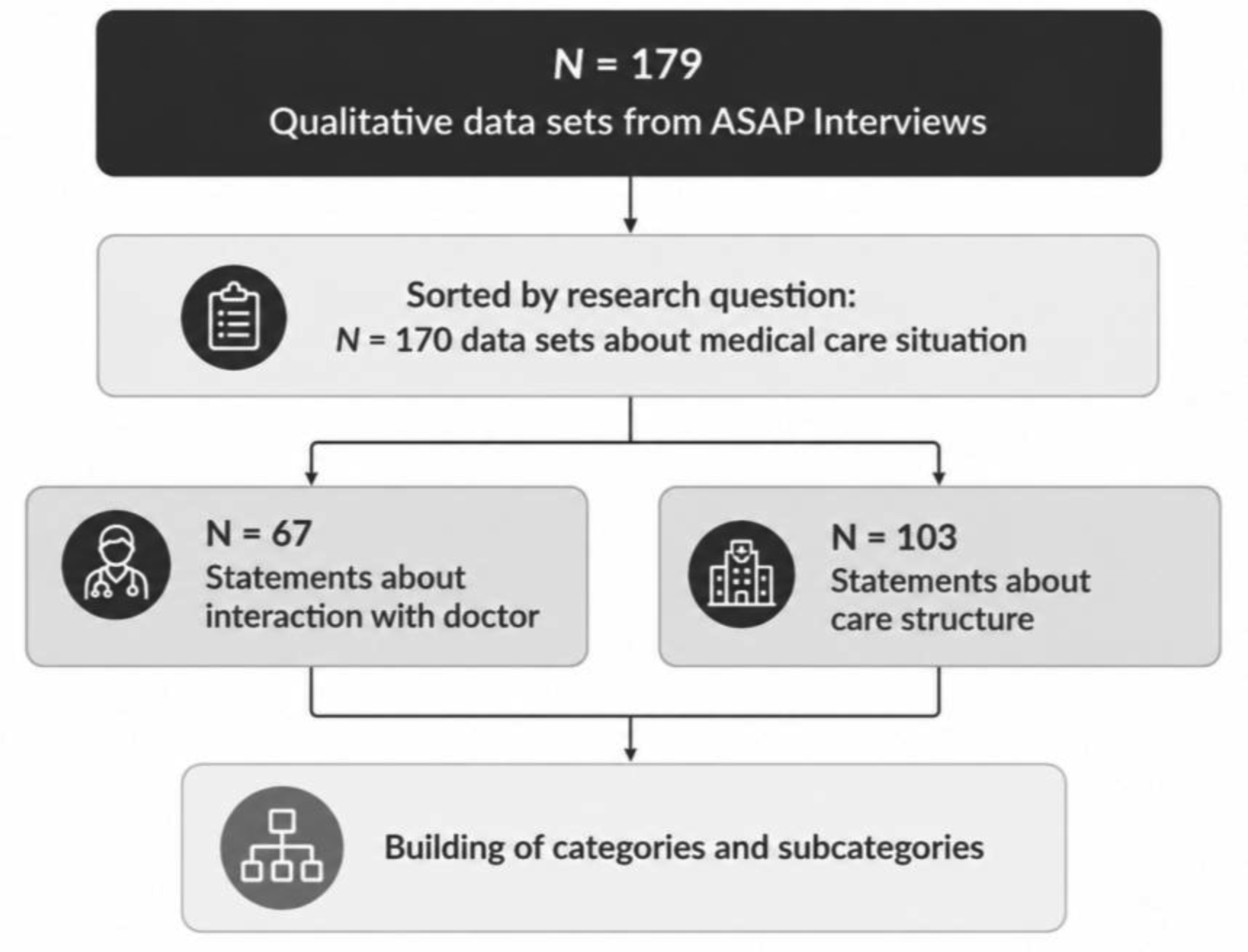
To investigate doctor–patient interactions and care from the patient's perspective, qualitative data from interviews with N = 179 long-COVID patients were analyzed and compared with existing guidelines. The findings revealed that most patients expressed dissatisfaction with their interactions due to a lack of understanding and insufficient information about their symptoms. Communication was often inadequate, leading to feelings of uncertainty. Guideline-compliant treatment of physical symptoms, limited capacity, and insufficient provision of information for further treatment were noteworthy issues. The core problem was not only a lack of knowledge or treatment options, but how uncertainty was managed and communicated. Based on these findings, enhancing patient-centered interactions is essential to facilitate the recovery process through empowerment. This should include implementing training for doctors in interpersonal communication and improving healthcare structures. Future studies should consider dyadic approaches and observational methods to deepen the exploration of discrepancies between external and self-perceptions.
Citation: Sybille Schulz, Robin Rinn, Alina Dahmen, Carina Kolb, Sonia Lippke. Evaluation of doctor-patient interaction and care structure from the perspective of long-COVID and post-COVID patients: a qualitative study with 179 long-COVID patients in Germany[J]. AIMS Medical Science, 2026, 13(4): 251-267. doi: 10.3934/medsci.2026018
To investigate doctor–patient interactions and care from the patient's perspective, qualitative data from interviews with N = 179 long-COVID patients were analyzed and compared with existing guidelines. The findings revealed that most patients expressed dissatisfaction with their interactions due to a lack of understanding and insufficient information about their symptoms. Communication was often inadequate, leading to feelings of uncertainty. Guideline-compliant treatment of physical symptoms, limited capacity, and insufficient provision of information for further treatment were noteworthy issues. The core problem was not only a lack of knowledge or treatment options, but how uncertainty was managed and communicated. Based on these findings, enhancing patient-centered interactions is essential to facilitate the recovery process through empowerment. This should include implementing training for doctors in interpersonal communication and improving healthcare structures. Future studies should consider dyadic approaches and observational methods to deepen the exploration of discrepancies between external and self-perceptions.
doctor patient interaction
post-acute COVID syndrome
National Institute for Health and Care Excellence

We thank all involved individuals and institutions for helping with data collection and patients for their participation. Special thanks are extended to all participants for their valuable cooperation and willingness to participate in this study. Parts of this manuscript were conducted as part of the Rehabilitation Research Priority Professorship in cooperation with the Deutsche Rentenversicherung Bund (DRV Bund/German Pension Insurance), funded by the Bundesministerium für Forschung, Technologie und Raumfahrt (BMFTR/Federal Ministry of Research, Technology and Space) and the Behörde für Wissenschaft, Forschung und Gleichstellung (BWFG/Hamburg Department of Science, Research, and Equality) as part of the federal-state program “FH-Personal” (go-2-prof:in project at HAW Hamburg). We would like to thank Alyssa Maria Chavarria Gallardo for proofreading and editing the manuscript.
Ethics approval was granted by the Ethics Committee of Constructor University Bremen (formerly known as Jacobs University Bremen). Application No.: 2021_08. The project was registered on ClinicalTrials.gov (NCT05238415). All participants were informed about the study and invited to give written consent. Only those who provided written consent were included. All data were pseudonymized.
The authors declare no conflicts of interest.
| [1] |
Alves-Nogueira AC, Góis AC, Pereira M, et al. (2024) The associations between physician-patient communication and adjustment outcomes of patients and physicians: A systematic review and meta-analysis of correlations. Health Commun 39: 1781-1794. https://doi.org/10.1080/10410236.2023.2243043 
|
| [2] |
Svyntozelska O, Suarez NRE, Demers J, et al. (2025) Socioeconomic and demographic factors influencing interpersonal communication between patients with chronic conditions and family physicians: A systematic review. Patient Educ Couns 131: 108548. https://doi.org/10.1016/j.pec.2024.108548
|
| [3] |
Tan Z, Sun Z, Lin Y (2026) How physician communication style shapes patient trust: A systematic review. Health Commun 6: 1-19. https://doi.org/10.1080/10410236.2026.2699907
|
| [4] |
Street RL, Makoul G, Arora NK, et al. (2009) How does communication heal? Pathways linking clinician–patient communication to health outcomes. Patient Educ Couns 74: 295-301. https://doi.org/10.1016/j.pec.2008.11.015
|
| [5] |
Dibbelt S, Schaidhammer M, Fleischer C, et al. (2009) Patient–doctor interaction in rehabilitation: The relationship between perceived interaction quality and long-term treatment results. Patient Educ Couns 76: 328-335. https://doi.org/10.1016/j.pec.2009.07.031
|
| [6] |
Brown K, Yahyouche A, Haroon S, et al. (2022) Long COVID and self-management. Lancet 399: 355. https://doi.org/10.1016/S0140-6736(21)02798-7
|
| [7] |
Habermann-Horstmeier L, Horstmeier LM (2023) Auswirkungen der qualität der arzt-patient-beziehung auf die gesundheit von erwachsenen ME/CFS-Erkrankten: Eine qualitative public-health-studie aus patientensicht. MMW Fortschr Med 165: 16-27. https://doi.org/10.1007/s15006-023-2894-z
|
| [8] |
Auschra C, Möller J, Berthod O, et al. (2020) Communicating test results in a comprehensible manner: A randomized controlled trial of word usage in doctor-patient communication. Z Evid Fortbild Qual Gesundhwes 156–157: 40-49. https://doi.org/10.1016/j.zefq.2020.07.007
|
| [9] |
Gopichandran V, Sakthivel K (2021) Doctor-patient communication and trust in doctors during COVID 19 times—A cross sectional study in Chennai, India. PLoS One 16: e0253497. https://doi.org/10.1371/journal.pone.0253497
|
| [10] |
Klement A, Oemler M, Wienke A, et al. (2015) (Erwartete) Konsultationsdauer, psychische (ko-)morbidität und zufriedenheit mit dem ärztlichen gespräch in der hausarztpraxis. Z Evid Fortbild Qual Gesundhwes 109: 560-569. https://doi.org/10.1016/j.zefq.2015.08.005
|
| [11] |
Rushforth A, Ladds E, Wieringa S, et al. (2021) Long covid – the illness narratives. Soc Sci Med 286: 114326. https://doi.org/10.1016/j.socscimed.2021.114326
|
| [12] |
Patra M, Hamiduzzaman M, McLaren H, et al. (2024) A scoping review of changes to patient-doctor communication during COVID-19. Health Commun 39: 25-48. https://doi.org/10.1080/10410236.2022.2152225
|
| [13] |
Brennan A, Broughan J, McCombe G, et al. (2022) Enhancing the management of long COVID in general practice: a scoping review. BJGP Open 6: BJGPO.2021.0178. https://doi.org/10.3399/BJGPO.2021.0178
|
| [14] | Robert Koch InstitutCOVID-19 Fallzahlen in Deutschland und Weltweit 2022 (2022). [cited 2026 November 09]. Available from: https://infektionsradar.rki.de/de/covid/inzidenz |
| [15] |
Ballering AV, van Zon SKR, Olde Hartman TC, et al. (2022) Persistence of somatic symptoms after COVID-19 in the Netherlands: an observational cohort study. Lancet 400: 452-461. https://doi.org/10.1016/S0140-6736(22)01214-4
|
| [16] |
Davis HE, Assaf GS, McCorkell L, et al. (2021) Characterizing long COVID in an international cohort: 7 months of symptoms and their impact. eClinicalMedicine 38: 101019. https://doi.org/10.1016/j.eclinm.2021.101019
|
| [17] |
O'Connor RJ, Preston N, Parkin A, et al. (2022) The COVID-19 Yorkshire Rehabilitation Scale (C19-YRS): Application and psychometric analysis in a post-COVID-19 syndrome cohort. J Med Virol 94: 1027-1034. https://doi.org/10.1002/jmv.27415
|
| [18] |
Humphreys H, Kilby L, Kudiersky N, et al. (2021) Long COVID and the role of physical activity: a qualitative study. BMJ Open 11: e047632. https://doi.org/10.1136/bmjopen-2020-047632
|
| [19] | AWMF OnlineS1 Leitlinie Long/Post Covid- Living Guideline (2024). [cited 2026 November 09]. Available from: https://register.awmf.org/de/leitlinien/detail/020-027 |
| [20] | BundesärztekammerBekanntmachung: Post-Covid-Syndrom (PCS) (2022). [cited 2026 November 09]. Available from: https://www.bundesaerztekammer.de/fileadmin/user_upload/BAEK/Themen/Medizin_und_Ethik/BAEK_Stellungnahme_Post-COVID-Syndrom_ONLINE.pdf |
| [21] | National Institute for Health and Care Excellence (NICE)Covid-19: RDPId guideline: Managing the long-term effects of Covid-19 (2025). [cited 2025 June 16]. Available from: https://app.magicapp.org/#/guideline/EQpzKn/section/L6qOzj |
| [22] |
Stengel S, Hoffmann M, Koetsenruijter J, et al. (2022) Long COVID: Care and support needs from the perspective of “long-haul” patients and primary care practitioners - a mixed-methods study from Baden-Wuerttemberg. Z Evid Fortbild Qual Gesundhwes 172: 61-70. https://doi.org/10.1016/j.zefq.2022.02.005
|
| [23] | Patzer KH (2021) Neu: S1-Leitlinie zu Long- und Post-COVID. MMW Fortschr Med 163: 19. https://doi.org/10.1007/s15006-021-0326-5 |
| [24] | Li J, Xia W, Zhan C, et al. A telerehabilitation programme in post-discharge COVID-19 patients (TERECO): a randomised controlled trial (2022)77: 697-706. https://doi.org/10.1136/thoraxjnl-2021-217382 |
| [25] |
Koczulla AR, Ankermann T, Behrends U, et al. (2022) S1-Leitlinie Long-/Post-COVID. Pneumologie 76: 855-907. https://doi.org/10.1055/a-1946-3230
|
| [26] |
Dahmen A, Keller FM, Derksen C, et al. (2022) Screening and assessment for post-acute COVID-19 syndrome (PACS), guidance by personal pilots and support with individual digital trainings within intersectoral care: a study protocol of a randomized controlled trial. BMC Infect Dis 22: 693. https://doi.org/10.1186/s12879-022-07584-z
|
| [27] |
Schreier M, Weydmann N (2026) Qualitative inhaltsanalyse in der gesundheitsforschung. Qualitative Methoden in der Gesundheitsforschung . Wiesbaden: Springer Fachmedien 185-202. https://doi.org/10.1007/978-3-658-49487-2_10
|
| [28] |
Bengtsson M (2016) How to plan and perform a qualitative study using content analysis. NursingPlus Open 2: 8-14. https://doi.org/10.1016/j.npls.2016.01.001
|
| [29] | Gläser J, Laudel G (2019) The discovery of causal mechanisms: Extractive qualitative content analysis as a tool for process tracing. Forum Qual Sozialforschung Forum Qual Soc Res 20. https://doi.org/10.17169/fqs-20.3.3386 |
| [30] | Schreier M (2014) Varianten qualitativer Inhaltsanalyse: Ein wegweiser im dickicht der Begrifflichkeiten. Forum Qual Sozialforschung Forum Qual Soc Res 15. |
| [31] | Komor M, Grzyb K (2023) Qualitative content analysis – A research method in social science. Przegląd Badań Eduk Educ Stud Rev 2: 143-163. https://doi.org/10.12775/PBE.2023.032 |
| [32] | Miles MB, Huberman AM, Saldana J Qualitative Data Analysis: A Methods Sourcebook (2013). |
| [33] |
O'Mahoney LL, Routen A, Gillies C, et al. (2022) The prevalence and long-term health effects of Long Covid among hospitalised and non-hospitalised populations: a systematic review and meta-analysis. eClinicalMedicine 55: 101762. https://doi.org/10.1016/j.eclinm.2022.101762
|
| [34] |
MacEwan SR, Rahurkar S, Tarver WL, et al. (2024) Patient experiences navigating care coordination for long COVID: A qualitative study. J Gen Intern Med 39: 1294-1300. https://doi.org/10.1007/s11606-024-08622-z
|
| [35] |
Rutakumwa R, Mugisha JO, Bernays S, et al. (2020) Conducting in-depth interviews with and without voice recorders: a comparative analysis. Qual Res 20: 565-581. https://doi.org/10.1177/1468794119884806
|
| [36] |
Busetto L, Wick W, Gumbinger C (2020) How to use and assess qualitative research methods. Neurol Res Pract 2: 14. https://doi.org/10.1186/s42466-020-00059-z
|
 medsci-13-04-018-s001.pdf |
 |
Figures(2) / Tables(2)

Sybille Schulz, Robin Rinn, Alina Dahmen, Carina Kolb, Sonia Lippke. Evaluation of doctor-patient interaction and care structure from the perspective of long-COVID and post-COVID patients: a qualitative study with 179 long-COVID patients in Germany[J]. AIMS Medical Science, 2026, 13(4): 251-267. doi: 10.3934/medsci.2026018





 DownLoad: