Rehabilitation therapists increasingly encounter patients with palliative care needs, yet structured palliative care training for this group remains limited. E-learning has demonstrated effectiveness in healthcare education, but evidence specific to rehabilitation therapists is scarce. This study examined the effectiveness of an animated e-learning intervention in improving therapists' knowledge, attitudes, and confidence toward palliative care.
A pre-post cohort study was used. Rehabilitation therapists from two hospitals completed an e-learning intervention consisting of a 12-part animated palliative care video series (Powerfacts). Knowledge (25-item quiz), attitudes (Frommelt Attitude Toward Care Of the Dying Scale), and confidence (single Likert item) were assessed before and after the intervention. Baseline differences and change scores were compared across experience and exposure. Paired and independent t-tests were conducted.
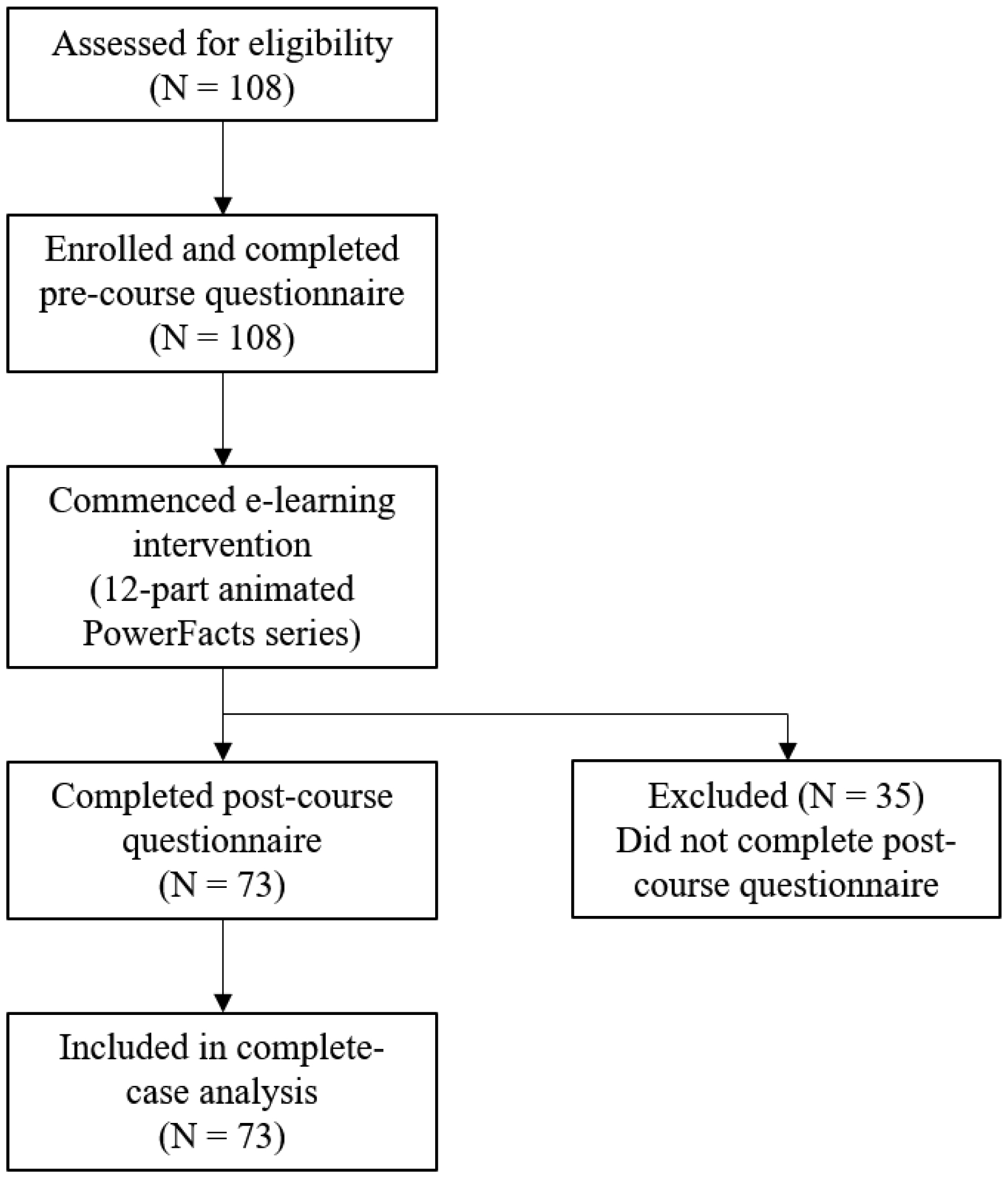
Of 108 participants who started the intervention, 73 completed both assessments. Baseline scores indicated gaps in knowledge, attitudes, and confidence, with significantly higher knowledge (mean difference −2.37) and confidence (mean difference −0.79) among therapists with prior exposure to palliative care. Following the intervention, significant improvements were observed in knowledge (mean difference −3.92; p < 0.001), attitudes (mean difference −6.98; p = 0.004), and confidence (mean difference −0.90; p < 0.001). Change scores did not differ significantly across experience or exposure groups, indicating consistent benefits across demographic subgroups.
Animated e-learning significantly improved rehabilitation therapists' knowledge, attitudes, and confidence in palliative care, addressing foundational gaps identified at baseline. E-learning is well-suited for basic palliative care training and may complement blended approaches for more advanced competencies. Integrating digital modules within multimodal educational frameworks may enhance the preparedness of rehabilitation therapists to support patients with serious illness.
Citation: Melissa Xin Yi Ng, Josiah Geng Xiang Koh, Qian Ci Tang, Halim Zul Fahmi, Xin Yi Lam, Wei Lin Teoh, Bernice Lip Lin Soon, Mona Oh Yak Mok, Xin Mei Ng, Chalani Udhyami Ubeynarayana, Laurence Lean Chin Tan. Use of e-learning in improving the knowledge, attitudes and confidence of rehabilitation therapists towards palliative care[J]. AIMS Medical Science, 2026, 13(4): 238-250. doi: 10.3934/medsci.2026017
Rehabilitation therapists increasingly encounter patients with palliative care needs, yet structured palliative care training for this group remains limited. E-learning has demonstrated effectiveness in healthcare education, but evidence specific to rehabilitation therapists is scarce. This study examined the effectiveness of an animated e-learning intervention in improving therapists' knowledge, attitudes, and confidence toward palliative care.
A pre-post cohort study was used. Rehabilitation therapists from two hospitals completed an e-learning intervention consisting of a 12-part animated palliative care video series (Powerfacts). Knowledge (25-item quiz), attitudes (Frommelt Attitude Toward Care Of the Dying Scale), and confidence (single Likert item) were assessed before and after the intervention. Baseline differences and change scores were compared across experience and exposure. Paired and independent t-tests were conducted.
Of 108 participants who started the intervention, 73 completed both assessments. Baseline scores indicated gaps in knowledge, attitudes, and confidence, with significantly higher knowledge (mean difference −2.37) and confidence (mean difference −0.79) among therapists with prior exposure to palliative care. Following the intervention, significant improvements were observed in knowledge (mean difference −3.92; p < 0.001), attitudes (mean difference −6.98; p = 0.004), and confidence (mean difference −0.90; p < 0.001). Change scores did not differ significantly across experience or exposure groups, indicating consistent benefits across demographic subgroups.
Animated e-learning significantly improved rehabilitation therapists' knowledge, attitudes, and confidence in palliative care, addressing foundational gaps identified at baseline. E-learning is well-suited for basic palliative care training and may complement blended approaches for more advanced competencies. Integrating digital modules within multimodal educational frameworks may enhance the preparedness of rehabilitation therapists to support patients with serious illness.

| [1] | World Health OrganizationPalliative Care (2020). [cited 2025 April 24]. Available from: https://www.who.int/news-room/fact-sheets/detail/palliative-care |
| [2] |
Barawid E, Covarrubias N, Tribuzio B, et al. (2015) The benefits of rehabilitation for palliative care patients. Am J Hosp Palliat Care 32: 34-43. https://doi.org/10.1177/1049909113514474 
|
| [3] | The Straits TimesMost Health Professionals Feel Unprepared to Give Palliative Care, Survey Finds (2021). [cited 2025 April 25]. Available from: https://www.straitstimes.com/singapore/health/most-health-professionals-feel-unprepared-to-give-palliative-care-survey-finds |
| [4] | World Health OrganizationStrengthening of Palliative Care As a Component of Comprehensive Care Throughout The Life Course (2014). [cited 2025 April 24]. Available from: https://apps.who.int/gb/ebwha/pdf_files/wha67/a67_r19-en.pdf |
| [5] | Gamondi C, Larkin C, Payne S (2013) Core competencies in palliative care: An EAPC white paper on palliative care education—Part 1. Eur J Palliat 20: 86-91. |
| [6] |
Stadlinger B, Jepsen S, Chapple I, et al. (2021) Technology-enhanced learning: a role for video animation. Br Dent J 230: 93-96. https://doi.org/10.1038/s41415-020-2588-1
|
| [7] |
Sinclair PM, Kable A, Levett-Jones T, et al. (2016) The effectiveness of internet-based e-learning on clinician behaviour and patient outcomes: A systematic review. Int J Nurs Stud 57: 70-81. https://doi.org/10.1016/j.ijnurstu.2016.01.011
|
| [8] |
Lahti M, Kontio R, Pitkanen A, et al. (2014) Knowledge transfer from an e-learning course to clinical practice. Nurse Educ Today 34: 842-847. https://doi.org/10.1016/j.nedt.2013.09.003
|
| [9] |
Gibbins J, Williams J, Cooke J, et al. (2012) Can e-learning help surface or change medical students' attitudes towards palliative care, death and dying?. BMJ Support Palliat 2: A32. https://doi.org/10.1136/bmjspcare-2012-000196.94
|
| [10] |
Schulz-Quach C, Wenzel-Meyburg U, Fetz K (2018) Can elearning be used to teach palliative care? – medical students' acceptance, knowledge, and self-estimation of competence in palliative care after elearning. BMC Med Educ 18: 82. https://doi.org/10.1186/s12909-018-1186-2
|
| [11] |
Pelayo M, Cebrian D, Areosa A, et al. (2011) Effects of online palliative care training on knowledge, attitude and satisfaction of primary care physicians. BMC Fam Pract 12: 37. https://doi.org/10.1186/1471-2296-12-37
|
| [12] |
Neo YL, Hassan N, Koh J, et al. (2025) “How do I practise palliative care when I don't know how?” Exploring the impact of EPAN, an online educational intervention on general nurses in Singapore: An evaluation study. J Palliat Care 40: 205-214. https://doi.org/10.1177/08258597241264454
|
| [13] |
Mayer RE (2017) Using multimedia for e-learning. J Comput Assist Lear 33: 403-423. https://doi.org/10.1111/jcal.12197
|
| [14] |
Sweller J (2011) Cognitive load theory. The Psychology of Learning and Motivation: Cognition in Education . Elsevier Academic Press 37-76. https://doi.org/10.1016/B978-0-12-387691-1.00002-8
|
| [15] |
Frommelt KH (2003) Attitudes toward care of the terminally ill: an educational intervention. The Am J Hosp Palliat Care 20: 13-22. https://doi.org/10.1177/104990910302000108
|
| [16] |
Lakens D (2013) Calculating and reporting effect sizes to facilitate cumulative science: a practical primer for t-tests and ANOVAs. Front Psychol 4: 863. https://doi.org/10.3389/fpsyg.2013.00863
|
| [17] | Kamis C, Lynch SM (2020) Central Limit Theorem. SAGE Research Methods Foundation. [cited 2025 April 20]. Available from: https://methods.sagepub.com/foundations/central-limit-theorem#_ |
| [18] |
Kim JS, Kim J, Gelegjamts D (2020) Knowledge, attitude and self-efficacy towards palliative care among nurses in Mongolia: a cross-sectional descriptive study. PLoS One 15: e0236390. https://doi.org/10.1371/journal.pone.0236390
|
| [19] |
Iranmanesh S, Axelsson K, Savenstedt S, et al. (2010) Caring for dying and meeting death: experiences of Iranian and Swedish nurses. Indian J Palliat Care 16: 90-96. https://doi.org/10.4103/0973-1075.68405
|
| [20] |
Chua KLM, Chan JQV, Tan LLC, et al. (2025) Facts to snacks. Evaluating the effectiveness of bite-sized animations in teaching palliative care to medical students. Am J Hosp Palliat Care 42: 32-40. https://doi.org/10.1177/10499091241240053
|
| [21] |
Lim Y, Toh E, Tan L, et al. (2024) Video training of nursing home healthcare workers in palliative care. BMJ Support Palliat Care 14: e2864-e2871. https://doi.org/10.1136/spcare-2023-004684
|
| [22] |
Slotnick HB (2000) Physicians' learning strategies. Chest 118: 18S-23S. https://doi.org/10.1378/chest.118.2_suppl.18s
|
| [23] |
Curran VR, Fleet L (2005) A review of evaluation outcomes of web-based continuing medical education. Med Educ 39: 561-567. https://doi.org/10.1111/j.1365-2929.2005.02173.x
|
| [24] |
Ellman MS, Schulman-Green D, Blatt L, et al. (2012) Using online learning and interactive simulation to teach spiritual and cultural aspects of palliative care to interprofessional students. J Palliat Med 15: 1240-1247. https://doi.org/10.1089/jpm.2012.0038
|
| [25] |
Phillips JL, Heneka N, Hickman L, et al. (2014) Impact of a novel online learning module on specialist palliative care nurses' pain assessment competencies and patients' reports of pain: Results from a quasi-experimental pilot study. Palliat Med 28: 521-529. https://doi.org/10.1177/0269216314527780
|
| [26] |
Wong KTC, Chow AYM, Chan IKN (2022) Effectiveness of educational programs on palliative and end-of-life care in promoting perceived competence among health and social care professionals. Am J Hosp Palliat Care 39: 45-53. https://doi.org/10.1177/10499091211038501
|
| [27] |
Mollman S, Gierach M, Sedlacek A (2024) Palliative care knowledge following an interdisciplinary palliative care seminar. Am J Hosp Palliat Care 41: 501-507. https://doi.org/10.1177/10499091231184623
|
| [28] |
Stjernsward J, Foley KM, Ferris FD (2007) The public health strategy for palliative care. J Pain Symptom Manage 33: 486-493. https://doi.org/10.1016/j.jpainsymman.2007.02.016
|
| [29] | African Palliative Care AssociationA framework of core competencies for palliative care providers in Africa (2012). [cited 2025 May 02]. Available from: https://www.africanpalliativecare.org/sites/default/files/2024-02/Palliative%20Care%20Competency.pdf |
| [30] | Downing J, Julia L, Franca B, et al. (2014) A summary of the EAPC White Paper on core competencies for education in paediatric palliative care. Eur J Palliat Care 21: 245-249. |
| [31] | Vaona A, Banzi R, Kwag KH, et al. (2018) E-learning for health professionals. Cochrane Database Syst Rev 1: CD011736. https://doi.org/10.1002/14651858.CD011736.pub2 |
| [32] |
Papadakos CT, Stringer T, Papadakos J, et al. (2021) Effectiveness of a multiprofessional, online and simulation-based difficult conversations training program on self-perceived competence of oncology healthcare provider trainees. J Cancer Educ 36: 1030-1038. https://doi.org/10.1007/s13187-020-01729-x
|
| [33] |
Hayley DC, Kalender-Rich JL, Mack J, et al. (2018) Development of a hybrid simulated patient experience to practice care of the dying older adult. MedEdPORTAL 14: 10777. https://doi.org/10.15766/mep_2374-8265.10777
|
| [34] |
Farrington CJ (2014) Blended e-learning and end of life care in nursing homes: a small-scale mixed-methods case study. BMC Palliat Care 13: 31. https://doi.org/10.1186/1472-684X-13-31
|
| [35] |
Atreya S, Salins N (2023) End-of-life care education as blended learning approach for general practitioners: a scoping review. J Cancer Educ 38: 1440-1458. https://doi.org/10.1007/s13187-023-02358-w
|
 medsci-13-04-017-s001.pdf |
 |
Figures(1) / Tables(4)

Melissa Xin Yi Ng, Josiah Geng Xiang Koh, Qian Ci Tang, Halim Zul Fahmi, Xin Yi Lam, Wei Lin Teoh, Bernice Lip Lin Soon, Mona Oh Yak Mok, Xin Mei Ng, Chalani Udhyami Ubeynarayana, Laurence Lean Chin Tan. Use of e-learning in improving the knowledge, attitudes and confidence of rehabilitation therapists towards palliative care[J]. AIMS Medical Science, 2026, 13(4): 238-250. doi: 10.3934/medsci.2026017





 DownLoad: