This manuscript presents a mathematical model and a description of a numerical simulation of the electrochemical processes surrounding transmuting DNA origami nanostructures within a capacitance-signaling biosensor. A modified Poisson-Boltzmann equation is employed to predict the electric potential about a single DNA origami nanostructure, represented by variability of permittivity and background charge within the domain. Differential capacitance is used to determine the capacitance signal from model variables. The solution to the model, as well as the capacitance, is numerically approximated using finite differencing. Nonsmooth and smooth nanostructure treatments are motivated and analyzed, suggesting that while the nonsmooth treatment introduces large numerical error and loses an order of accuracy, the difference in capacitance between the two treatments is far less significant, though still apparent. A parameter study informs numerical refinement choices and demonstrates the variability in solution caused by the modification of ions species in solution as well as maximum ion concentrations. Preliminary observations on device sensitivity are also provided, suggesting that nanostructures placed away from the bottom surface of the device can cause a reduction in sensitivity and some nanostructure designs are more advantageous for capacitance signaling.
Citation: Allison M. Carson, Wes Caldwell, Ryan M. Evans, Anthony J. Kearsley. Mathematical model of electrochemical signaling from transmuting DNA origami nanostructures within biosensors[J]. Mathematical Biosciences and Engineering, 2026, 23(11): 3211-3240. doi: 10.3934/mbe.2026111
This manuscript presents a mathematical model and a description of a numerical simulation of the electrochemical processes surrounding transmuting DNA origami nanostructures within a capacitance-signaling biosensor. A modified Poisson-Boltzmann equation is employed to predict the electric potential about a single DNA origami nanostructure, represented by variability of permittivity and background charge within the domain. Differential capacitance is used to determine the capacitance signal from model variables. The solution to the model, as well as the capacitance, is numerically approximated using finite differencing. Nonsmooth and smooth nanostructure treatments are motivated and analyzed, suggesting that while the nonsmooth treatment introduces large numerical error and loses an order of accuracy, the difference in capacitance between the two treatments is far less significant, though still apparent. A parameter study informs numerical refinement choices and demonstrates the variability in solution caused by the modification of ions species in solution as well as maximum ion concentrations. Preliminary observations on device sensitivity are also provided, suggesting that nanostructures placed away from the bottom surface of the device can cause a reduction in sensitivity and some nanostructure designs are more advantageous for capacitance signaling.

| [1] |
M. T. Amen, T. T. T. Pham, E. Cheah, D. P. Tran, B. Thierry, Metal-oxide FET biosensor for point-of-care testing: Overview and perspective, Molecules, 27 (2022), 7952. https://doi.org/10.3390/molecules27227952 doi: 10.3390/molecules27227952
|
| [2] |
I. Nastasijevic, I. Kundacina, S. Jaric, Z. Pavlovic, M. Radovic, V. Radonic, Recent advances in biosensor technologies for meat production chain, Foods, 14 (2025), 744. https://doi.org/10.3390/foods14050744 doi: 10.3390/foods14050744
|
| [3] |
Q. Wang, Z. A. Zhao, K. Y. Yao, Y. L. Cheng, D. S. H. Wong, D. W. C. Wong, et al., The versatility of biological field-effect transistor-based biosensors (BioFETs) in point-of-care diagnostics: Applications and future directions for peritoneal dialysis monitoring, Biosensors, 15 (2025), 193. https://doi.org/10.3390/bios15030193 doi: 10.3390/bios15030193
|
| [4] |
B. M. Paddle, Biosensors for chemical and biological agents of defence interest, Biosens. Bioelecton., 11 (1996), 1079–1113. https://doi.org/10.1016/0956-5663(96)82333-5 doi: 10.1016/0956-5663(96)82333-5
|
| [5] |
S. T. Le, S. Cho, C. A. Richter, A. Balijepalli, Optimal field-effect transistor operation for high-resolution biochemical measurements, Rev. Sci. Instrum., 92 (2021), 030901. https://doi.org/10.1063/5.0025847 doi: 10.1063/5.0025847
|
| [6] |
S. T. Le, S. Cho, A. Zaslavsky, C. A. Richter, A. Balijepalli, High-performance dual-gate graphene pH sensors, Appl. Phys. Lett., 120 (2022), 263701. https://doi.org/10.1063/5.0086049 doi: 10.1063/5.0086049
|
| [7] |
S. Cho, A. Zaslavsky, C. A. Richter, J. M. Majikes, J. A. Liddle, F. Andrieu, et al., High-resolution DNA binding kinetics measurements with double gate FD-SOI transistors, in 2022 International Electron Devices Meeting (IEDM), 2022. https://doi.org/10.1109/IEDM45625.2022.10019493 |
| [8] |
M. Pandey, M. Bhaiyya, P. Rewatkar, J. B. Zalke, N. P. Narkhede and H. Haick, Advanced materials for biological field-effect transistors (Bio-FETs) in precision healthcare and biosensing, Adv. Healthc. Mater., 14 (2025). https://doi.org/10.1002/adhm.202500400 doi: 10.1002/adhm.202500400
|
| [9] |
N. Shafi, J. S. Parmaar, A. Porwal, A. M. Bhat, C. Sahu, C. Periasamy, Gate all around junctionless dielectric modulated BioFET based hybrid biosensor, Silicon, 13 (2021), 2041–2052. https://doi.org/10.1007/s12633-020-00583-2 doi: 10.1007/s12633-020-00583-2
|
| [10] |
M. K. Anvarifard, A. A. Orouji, Design of a novel high-sensitive SOI-junctionless BioFET overcoming sensitivity degradation problems, Sci. Rep., 14 (2024), 18395. https://doi.org/10.1038/s41598-024-69383-7 doi: 10.1038/s41598-024-69383-7
|
| [11] |
J. Majikes, S. Cho, T. E. Cleveland, J. A. Liddle, A. Balijepalli, Variable gain DNA origami charge amplifiers for biosensing, Nanoscale, 16 (2024), 20893–20902. https://doi.org/10.1039/d4nr02959c doi: 10.1039/d4nr02959c
|
| [12] |
P. W. K. Rothemund, Folding DNA to create nanoscale shapes and patterns, Nature, 440 (2006), 297–302. https://doi.org/10.1038/nature04586 doi: 10.1038/nature04586
|
| [13] |
M. S. Sajal, K. C. Lin, Y. Gilpin, V. Walawalkar, F. Dehghandehnavi, R. E. Taylor, et al., Towards CMOS capacitance sensors for DNA origami characterization, in 2023 International Electron Devices Meeting (IEDM), 2023. https://doi.org/10.1109/IEDM45741.2023.10413681 |
| [14] |
A. C. Stelson, M. Liu, C. A. E. Little, C. J. Long, N. D. Orloff, N. Stephanopoulos, et al., Label-free detection of conformational changes in switchable DNA nanostructures with microwave microfluidics, Nat. Commun., 10 (2019), 1174. https://doi.org/10.1038/s41467-019-09017-z doi: 10.1038/s41467-019-09017-z
|
| [15] |
F. Kroener, A. Heerwig, W. Kaiser, M. Mertig, U. Rant, Electrical actuation of a DNA origami nanolever on an electrode, J. Am. Chem. Soc., 139 (2017), 16510–16513. https://doi.org/10.1021/jacs.7b10862 doi: 10.1021/jacs.7b10862
|
| [16] |
F. Kroener, L. Traxler, A. Heerwig, U. Rant, M. Mertig, Magnesium-dependent electrical actuation and stability of DNA origami rods, Appl. Mater. Interfaces, 11 (2018), 2295–2301. https://doi.org/10.1021/acsami.8b18611 doi: 10.1021/acsami.8b18611
|
| [17] |
N. Arroyo-Currás, M. Sadeia, A. K. Ng, Y. Fyodorova, N. Williams, T. Afif, et al., An electrochemical biosensor exploiting binding-induced changes in electron transfer of electrode-attached DNA origami to detect hundred nanometer-scale targets, Nanoscale, 12 (2020), 13907–13911. https://doi.org/10.1039/d0nr00952k doi: 10.1039/d0nr00952k
|
| [18] |
N. Smoliak, N. Kumar, P. M. Parreira, C. Macdonald, V. Georgiev, A hybrid analytical and machine learning model of BioFETs for the detection of peptides, IEEE Sens. Lett., 9 (2025). https://doi.org/10.1109/LSENS.2025.3606612 doi: 10.1109/LSENS.2025.3606612
|
| [19] |
S. Baumgartner, M. Vasicek, A. Bulyha, C. Heitzinger, Optimization of nanowire DNA sensor sensitivity using self-consistent simulation, Nanotechnology, 22 (2011). https://doi.org/10.1088/0957-4484/22/42/425503 doi: 10.1088/0957-4484/22/42/425503
|
| [20] |
C. Heitzinger, N. J. Mauser, C. Ringhofer, Multiscale modeling of planar and nanowire field-effect biosensors, SIAM J. Appl. Math, 70 (2010), 1634–1654. https://doi.org/10.1137/080725027 doi: 10.1137/080725027
|
| [21] |
A. Bulyha, C. Heitzinger, An algorithm for three-dimensional Monte-Carlo simulation of charge distribution at biofunctionalized surfaces, Nanoscale, 3 (2011), 1608–1617. https://doi.org/10.1039/c0nr00791a doi: 10.1039/c0nr00791a
|
| [22] |
R. M. Evans, A. Balijepalli, A. J. Kearsley, Transport phenomena in biological field effect transistors, SIAM J. Appl. Math., 80 (2020), 2586–2607. https://doi.org/10.1137/19M1255495 doi: 10.1137/19M1255495
|
| [23] |
L. A. Melara, R. M. Evans, S. Cho, A. Balijepalli, A. J. Kearsley, Optimal bandwidth selection in stochastic regression of Bio-FET measurements, J. Math. Biol., textbf91 (2025), 9. https://doi.org/10.1007/s00285-025-02231-y doi: 10.1007/s00285-025-02231-y
|
| [24] |
G. Lin, Effects of multi-component small permanent charges on the dynamics of Poisson-Nernst-Planck models, Math. Biosci. Eng., 23 (2026), 636–677. https://doi.org/10.3934/mbe.2026025 doi: 10.3934/mbe.2026025
|
| [25] |
D. Tripathi, A. Yadav, O. A. Bég, Electro-kinetically driven peristaltic transport of viscoelastic physiological fluids through a finite length capillary: Mathematical modeling, Math. Biosci., 283 (2017), 155–168. https://doi.org/10.1016/j.mbs.2016.11.017 doi: 10.1016/j.mbs.2016.11.017
|
| [26] |
J. Wu, Understanding the electric double-layer structure, capacitance, and charging dynamics, Chem. Rev., 122 (2022), 10821–10859. https://doi.org/10.1021/acs.chemrev.2c00097 doi: 10.1021/acs.chemrev.2c00097
|
| [27] |
A. Ebrahimijahan, M. Abbaszadeh, M. Dehghan, Numerical solutions for the Poisson-Nernst-Planck system using integrated radial basis function and moving least squares techniques with reduced order method, Eng. Comput., 41 (2025), 4757–4798. https://doi.org/10.1007/s00366-025-02198-w doi: 10.1007/s00366-025-02198-w
|
| [28] |
N. Baker, M. Holst, F. Wang, Adaptive multilevel finite element solution of the Poisson-Boltzmann equation Ⅱ. Refinement at solvent-accessible surfaces in biomolecular systems, J. Comput. Chem., 21 (2004), 1343–1352. https://doi.org/10.1002/1096-987X(20001130)21:15<1343::AID-JCC2>3.0.CO;2-K doi: 10.1002/1096-987X(20001130)21:15<1343::AID-JCC2>3.0.CO;2-K
|
| [29] |
B. Lu, D. Zhang, J. A. McCammon, Computation of electrostatic forces between solvated molecules determined by the Poisson-Boltzmann equation using a boundary element method, J. Chem. Phys., 122 (2005), 214102. https://doi.org/10.1063/1.1924448 doi: 10.1063/1.1924448
|
| [30] |
M. Bosy, M. W. Scroggs, T. Betcke, E. Burman, C. D. Cooper, Coupling finite and boundary element methods to solve the Poisson–Boltzmann equation for electrostatics in molecular solvation, J. Comput. Chem., 45 (2023), 787–797. https://doi.org/10.1002/jcc.27262 doi: 10.1002/jcc.27262
|
| [31] |
J. López-García, J. Horno, C. Grosse, Differential capacitance of the diffuse double layer at electrode-electrolyte interfaces considering ions as dielectric spheres: Part Ⅰ. Binary electrolyte solutions, J. Colloid Interface Sci., 496 (2017), 531–539. https://doi.org/10.1016/j.jcis.2017.02.043 doi: 10.1016/j.jcis.2017.02.043
|
| [32] |
M. Born, Volumen und hydratationswärme der ionen, Z. Phys., 1 (1920), 45–48. |
| [33] |
J. Bikerman, XXXIX. Structure and capacity of electrical double layer, London, Edinburgh Dublin Philos. Mag. J. Sci., 33 (1942), 384–397. https://doi.org/10.1080/14786444208520813 doi: 10.1080/14786444208520813
|
| [34] |
B. J. Kirby, Mirco- and Nanoscale Fluid Mechanics, Cambridge University Press, New York, NY, 2010. |
| [35] |
G. Valette, Double layer on silver single crystal electrodes in contact with electrolytes having anions which are slightly specifically adsorbed: Part Ⅱ. The (100) face, J. Electroanal. Chem. Interfacial Electrochem., 138 (1982), 37–54. https://doi.org/10.1016/0022-0728(82)87126-X doi: 10.1016/0022-0728(82)87126-X
|
| [36] |
R. Sundararaman, K. Letchworth-Weaver, K. Schwarz, Improving accuracy of electrochemical capacitance and solvation energetics in first-principles calculations, J. Chem. Phys., (2018), 148. https://doi.org/10.1063/1.5024219 doi: 10.1063/1.5024219
|
| [37] |
M. S. Shibata, Y. Morimoto, I. V. Zenyuk, A. Z. Weber, Parameter-fitting-free continuum modeling of electric double layer in aqueous electrolyte, J. Chem. Theory Comput., 20 (2024), 6184–6196. https://doi.org/10.1021/acs.jctc.4c00408 doi: 10.1021/acs.jctc.4c00408
|
| [38] |
X. Wang, K. Liu, J. Wu, Demystifying the Stern layer at a metal–electrolyte interface: Local dielectric constant, specific ion adsorption, and partial charge transfer, J. Chem. Phys., 154 (2021), 124701. https://doi.org/10.1063/5.0043963 doi: 10.1063/5.0043963
|
| [39] |
M. Y. Kiriukhin, K. D. Collins, Dynamic hydration numbers for biologically important ions, Biophys. Chem., 99 (2002), 155–168. https://doi.org/10.1016/S0301-4622(02)00153-9 doi: 10.1016/S0301-4622(02)00153-9
|
| [40] |
S. Wang, E. Alexov, S. Zhao, On regularization of charge singularities in solving the poisson-boltzmann equation with a smooth solute-solvent boundary, Math. Biosci. Eng., 18 (2021), 1370–1405. https://doi.org/10.3934/mbe.2021072 doi: 10.3934/mbe.2021072
|
| [41] |
A. Cuervo, P. D. Dans, J. L. Carrascosa, M. Orozco, G. Gomila, F. Laura, Direct measurement of the dielectric polarization properties of DNA, Proc. Natl. Acad. Sci. U.S.A., 111 (2014), E3624–E3630. https://doi.org/10.1073/pnas.1405702111 doi: 10.1073/pnas.1405702111
|
| [42] |
J. Yoo, A. Aksimentiev, In situ structure and dynamics of DNA origami determined through molecular dynamics simulations, Proc. Natl. Acad. Sci. U.S.A., 110 (2013), 20099–20104. https://doi.org/10.1073/pnas.1316521110 doi: 10.1073/pnas.1316521110
|
| [43] |
I. L. Chern, J. G. Liu, W. C. Wang, Accurate evaluation of electrostatics for macromolecules in solution, Methods Appl. Anal., 10 (2003), 309–328. |
| [44] |
Q. Cai, M. J. Hsieh, J. Wang, R. Luo, Performance of nonlinear finite-difference Poisson-Boltzmann solvers, J. Chem. Theory Comput., 6 (2010), 203–211. https://doi.org/10.1021/ct900381r doi: 10.1021/ct900381r
|
| [45] |
L. Armijo, Minimization of functions having Lipschitz continuous first partial derivatives, Pac. J. Math., 19 (1966), 1–3. https://doi.org/10.2140/pjm.1966.16.1 doi: 10.2140/pjm.1966.16.1
|
| [46] |
D. M. Kolb, J. Schneider, The study of reconstructed electrode surfaces: Au(100)-(5×20), Surf. Sci., 162 (1985), 764–775. https://doi.org/10.1016/0039-6028(85)90977-X doi: 10.1016/0039-6028(85)90977-X
|
| [47] |
A. J. Kearsely, Projections onto order simplexes and isotonic regression, J. Res. Natl. Inst. Stand. Technol., 111 (2006), 121–125. https://doi.org/10.6028/jres.111.011 doi: 10.6028/jres.111.011
|
| [48] |
G. Leoni, A First Course in Sobolev Spaces, American Mathematical Society, Providence, Rhode Island, 2009. |
| [49] |
B. Dacorogna, Direct Methods in the Calculus of Variations, 2nd edition, Springer, New York, NY, 2008. https://doi.org/10.1007/978-0-387-55249-1 |
| [50] |
Z. Huang, B. Li, Variational analysis of the classical and ionic size-modified Poisson–Boltzmann electrostatics, SIAM J. Math. Anal., 58 (2026), 991–1016. https://doi.org/10.1137/25M1769314 doi: 10.1137/25M1769314
|
| [51] |
B. Li, Continuum electrostatics for ionic solutions with non-uniform ionic sizes, Nonlinearity, 5228 (2009), 811–833. https://doi.org/10.1088/0951-7715/22/4/007 doi: 10.1088/0951-7715/22/4/007
|
| [52] |
B. Li, Minimization of electrostatic free energy and the Poisson–Boltzmann equation for molecular solvation with implicit solvent, SIAM J. Math. Anal., 40 (2009), 2536–2566. https://doi.org/10.1137/080712350 doi: 10.1137/080712350
|


Figures(19) / Tables(5)

Allison M. Carson, Wes Caldwell, Ryan M. Evans, Anthony J. Kearsley. Mathematical model of electrochemical signaling from transmuting DNA origami nanostructures within biosensors[J]. Mathematical Biosciences and Engineering, 2026, 23(11): 3211-3240. doi: 10.3934/mbe.2026111

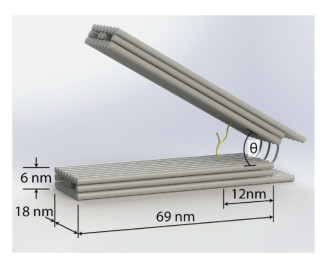
An artistic rendition of a contorting DNA origami nanostructure. Each gray rod represents a double strand of DNA, with two yellow connected strands representing aptamers that limit how wide the nanostructure's upper arm may open. The analyte of interest, if present within the patient's sample, would replace the binding of one of the aptamers, untethering the two such that the upper arm is able to open to a wider angle. The displacement of the DNA alters the established electric field, thus causing device signaling
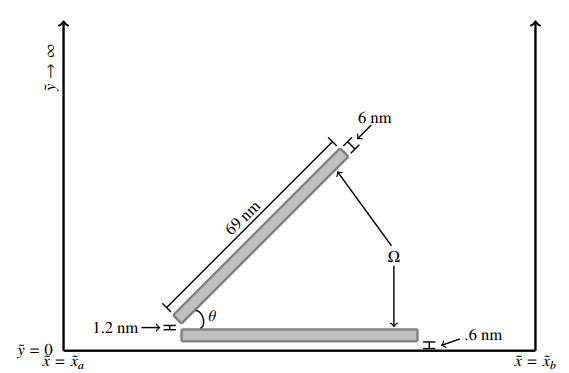
Schematic of modeled domain (not to scale)
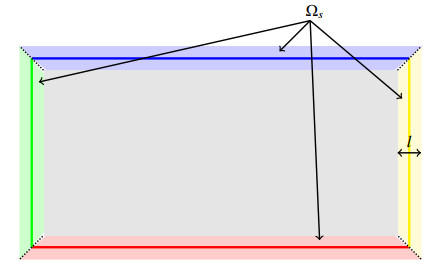
Smoothing regions for an example rectangle. The rectangle boundaries are shown in red, yellow, blue, and green, which outline $ \Omega_{DNA} $. The associated smoothing region of each rectangle segment is highlighted in the corresponding lighter color (e.g. the light red region corresponds to the red segment). The smoothing regions are separated along diagonal axes highlighted by the black dotted lines
Example numerical solutions highlighting solution variability. Computations took $ N_x = 2560 $, 12.5 mM MgCl$ _2 $, $ \theta = 0 $, and the smoothing treatment of the nanostructure
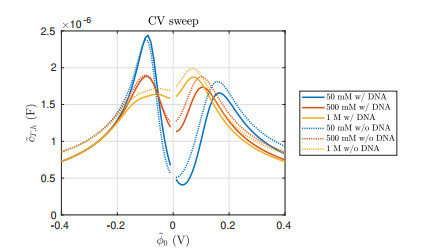
Capacitance curves from CV sweeps calculated with (w/) and without (w/o) the DNA origami nanostructure. Three cases of ionic strength are plotted, given as molarity of NaCl in the legend. Computations took $ N_x = 2560 $, 12.5 mM MgCl$ _2 $, $ \theta = 0 $, and the smoothing treatment of the nanostructure
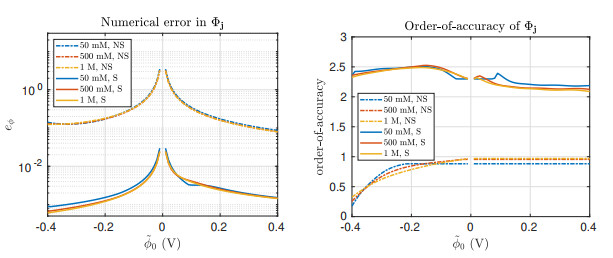
Distribution of $ e_{\phi} $ (left) and its discretization order-of-accuracy (right) computed across applied voltage and ionic strength, listed as molarity of NaCl in the legend. Results for the smooth nanostructure treatment (S) are plotted in solid lines and the nonsmooth (NS) dashed lines
Estimated error $ e_{\phi} $ associated with $ \tilde \phi_0 = .4 $ V and 50 mM of NaCl for the nonsmooth (left) and smooth (right) nanostructure treatments
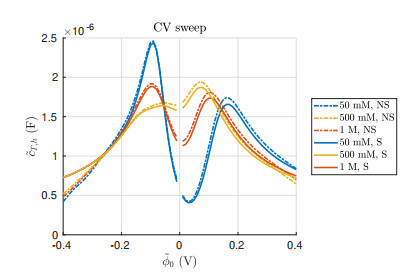
Capacitance calculated with the nonsmooth (NS) and smooth (S) nanostructure treatments as a function of applied voltage and ionic strength, given as molarity of NaCl in the legend
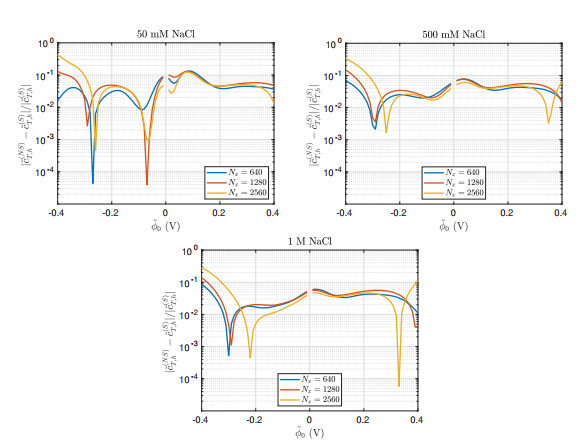
Magnitude of the relative difference between capacitance curves from CV sweeps with the nonsmooth $ \left(\tilde c_{T, h}^{(NS)}\right) $ and smooth $ \left(\tilde c_{T, h}^{(S)}\right) $ nanostructure treatments as the computational grid is refined. Three cases of ionic strength are plotted, given as molarity of NaCl in each title
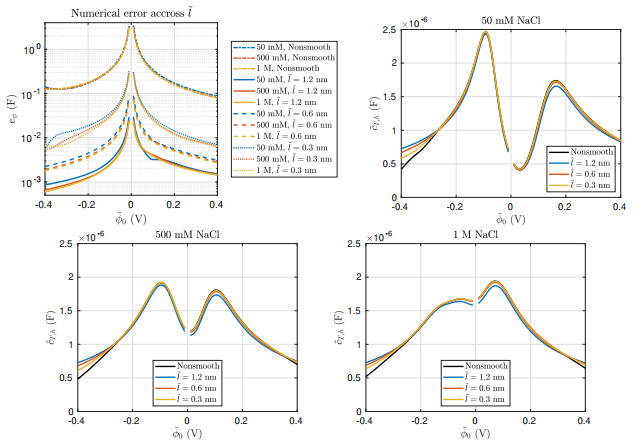
The top left plot shows the estimated numerical error $ e_{\phi} $ across applied voltage and ionic strength. Computations taking $ N_x = 1280, 2560 $ were used in the estimation. All other plots show capacitance curves from CV sweeps with decreasing $ \tilde l $. Three cases of ionic strength are plotted, given as molarity of NaCl in each title. Capacitance curves associated with the nonsmooth nanostructure are plotted in black for comparison
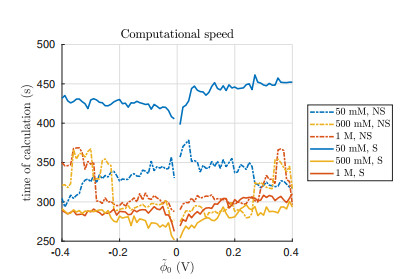
Plot of average time elapsed over five computations for each capacitance calculation across applied voltage and ionic strength, given as molarity of NaCl in the legend. The nonsmooth (NS) nanostructure treatment is plotted with the dashed lines and the smooth (S) treatment is plotted with the solid lines. Computations took $ N_x = 2560 $, $ tol = 10^{-8} $, and $ y_b = 0.5 $, and were run in serial using an Intel Xeon 3.6GHz processor with the gcc compiler and -O3 optimization flag
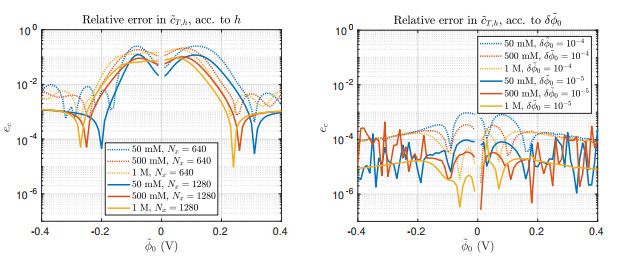
Distribution of $ e_c $ according to $ h $ (left) and $ \delta\tilde\phi_0 $ (right) computed across applied voltage and ionic strength, listed as molarity of NaCl in the legend. Absolute errors may be thought of the relative error multiplied by a factor of $ 10^{-6} $
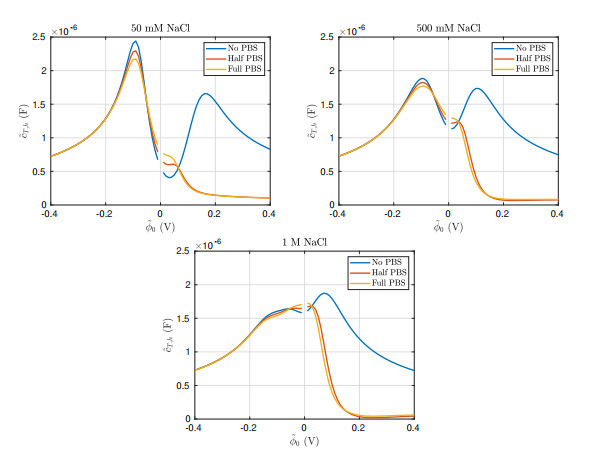
Capacitance curves from CV sweeps calculated with no, half-concentration, and full-concentration of PBS. Three cases of ionic strength are plotted, given as molarity of NaCl in each plot title
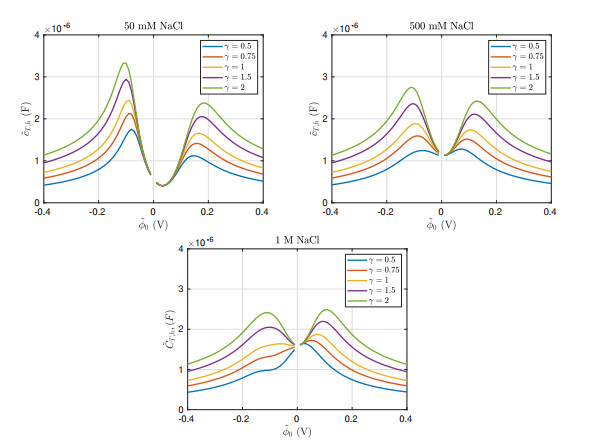
Capacitance curves from CV sweeps calculated with different values of $ \gamma $. Three cases of ionic strength are plotted, given as molarity of NaCl in each plot title
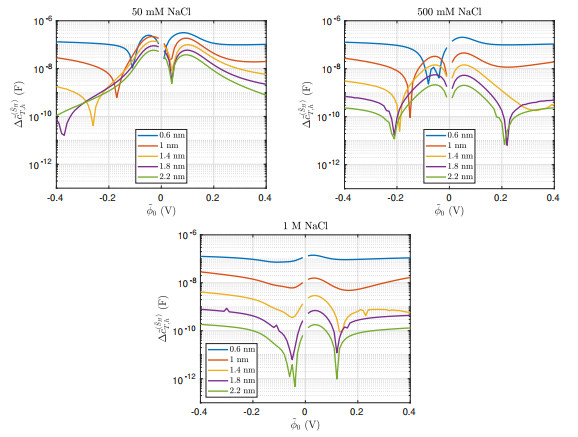
Difference in capacitance between a computation of stilt height $ \tilde S_H $ and a computation without the DNA origami nanostructure. Values in the legend are provided in nanometers
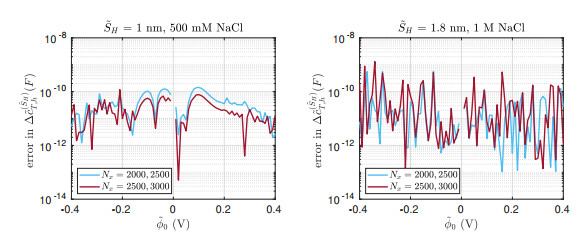
Estimated error in $ \Delta \tilde c_{T, h}^{(\tilde S_H)} $ for the case of $ \tilde S_H = 1 $ nm and 500 mM of NaCl (left) as well as $ \tilde S_H = 1.8 $ nm and 1 M of NaCl (right). Error for a coarse grid, computed with $ N_x = 2000, 2500 $ and a fine grid, $ N_x = 2500, 3000 $, are shown
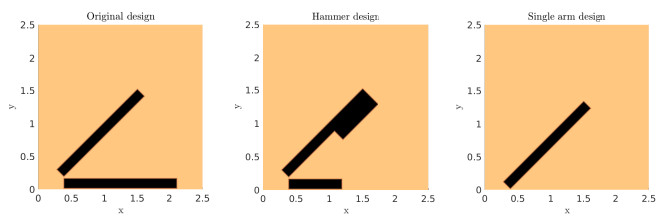
The three candidate nanostructure designs, shown at $ \theta = \frac{\pi}{4} $
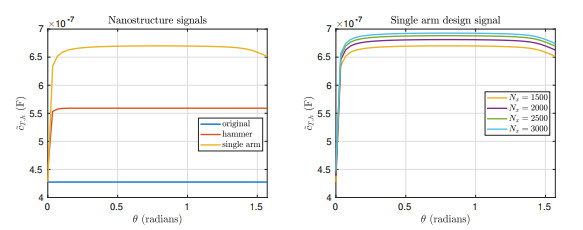
LEFT: Example capacitance signal of each nanostructure design over the range of nanostructure angle. RIGHT: Capacitance signal of the single arm design as the computational grid is refined
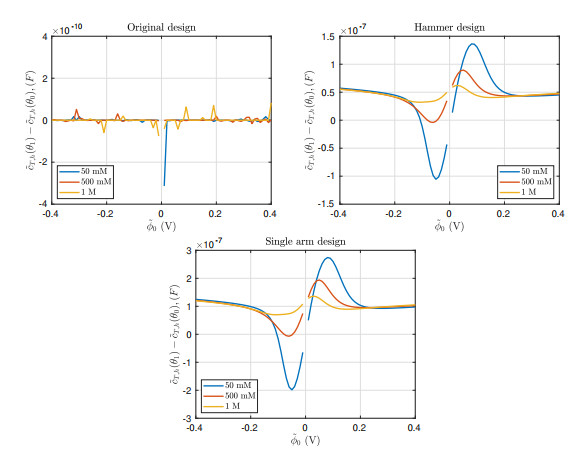
Representation of nanostructure shape signals over CV sweeps with varying ionic strength, which is given as molarity of NaCl in the legend




 DownLoad: