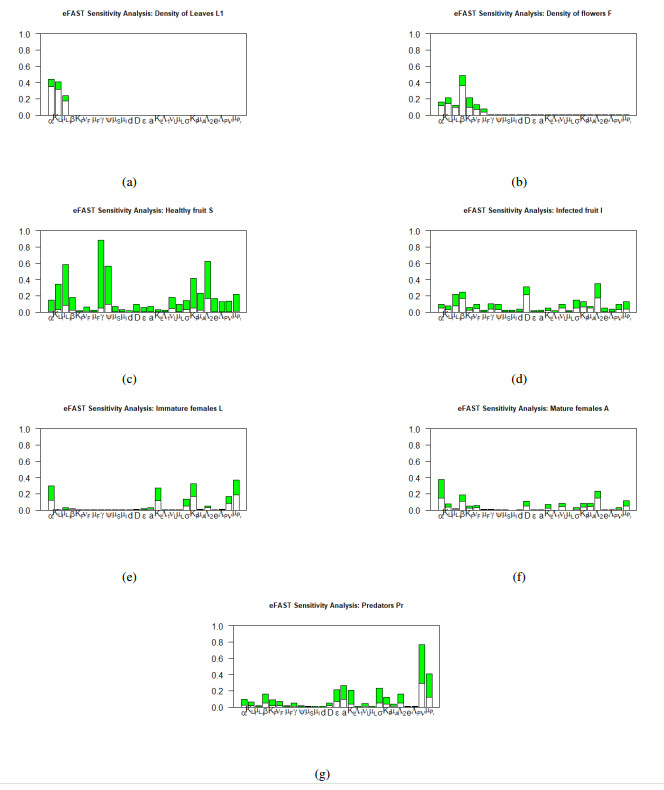
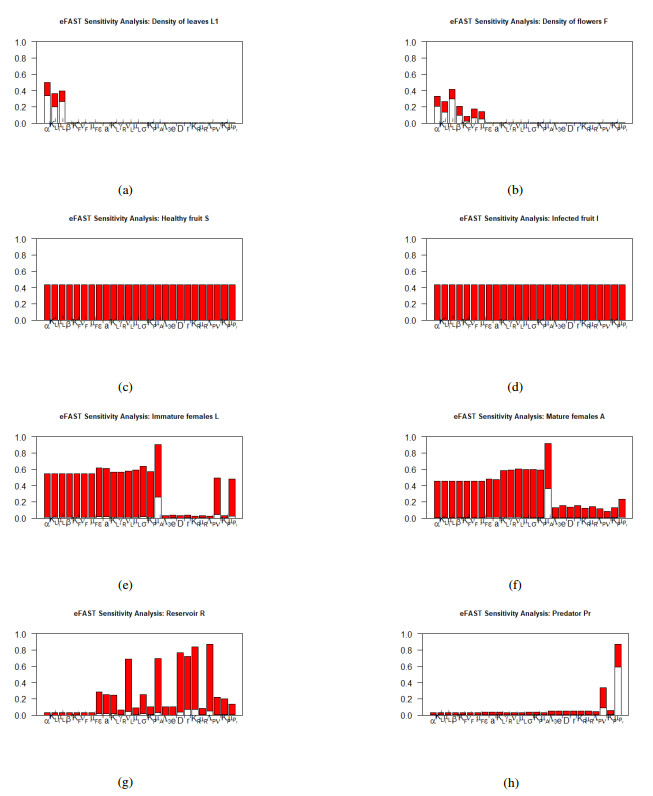
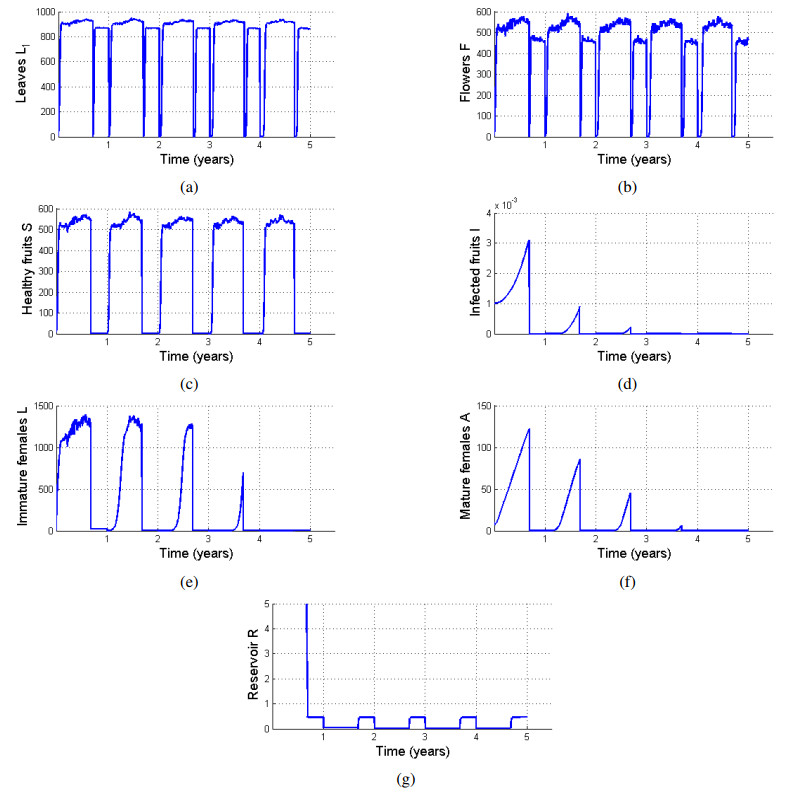
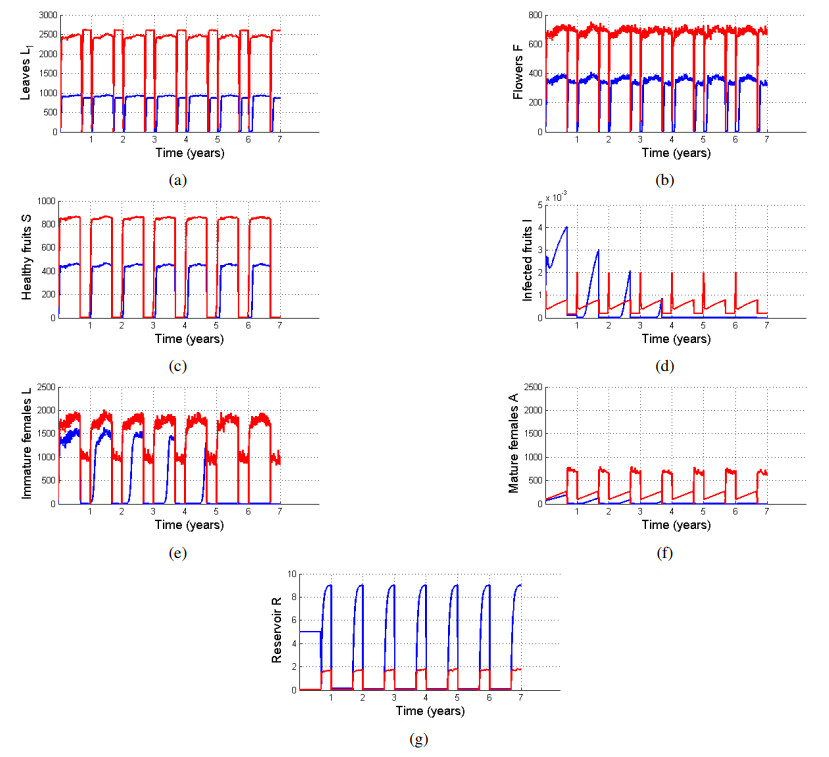
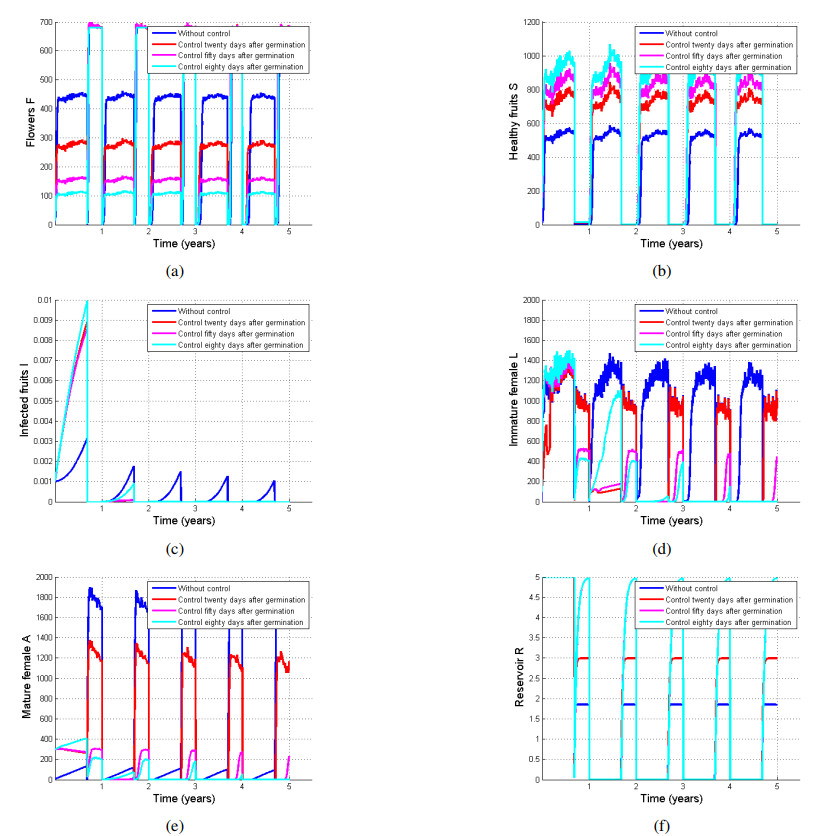
The papaya mealybug, Paracoccus marginatus, has emerged as a formidable threat to global tropical agriculture, capable of inducing devastating yield losses through its invasive sap-sucking behavior. While conventional models often overlook environmental complexities, in this study, we introduced a sophisticated multi-seasonal mathematical framework designed to unravel the intricate interplay between mealybug population dynamics, fluctuating climatic conditions, and the persistence of off-season natural reservoirs. Sensitivity analysis highlighted how parameter influences shift across seasons, while our qualitative analysis revealed a dual-threshold mechanism, governed by the local offspring number $ \mathcal{N}_0 $ and the global stability threshold $ \mathcal{N}_g $, as the definitive driver of the system's long-term evolution. While $ \mathcal{N}_0 < 1 $ analytically ensures local asymptotic stability, our theoretical discussion suggested the existence of a conjectured regime of bistability within the threshold range $ \mathcal{N}_g < \mathcal{N}_0 < 1 $. This finding highlighted a critical regime where the success of eradication efforts is strictly contingent upon the initial infestation levels. Furthermore, by employing uniform persistence theory, we proved that the pest inevitably establishes a permanent foothold whenever $ \mathcal{N}_0 > 1 $. To mitigate these agricultural losses, we evaluated the efficacy of two distinct intervention frameworks: (ⅰ) Pulsed biological control via impulsive parasitoid releases and (ⅱ) a synergistic integrated pest management (IPM) strategy combining biopesticides with natural enemies. Our simulations demonstrated that while impulsive parasitoid releases alone achieved substantial suppression, reducing immature and mature female populations by 89.35% and 93.04%, respectively, and recovering 75.92% of papaya production, the integrated approach proved transformative. By synchronizing biopesticide applications with parasitoid pulses, mealybug populations were nearly decimated, with reduction rates reaching 99.70% for immatures and an exhaustive 99.90% for adults. Although this intensive suppression yielded a 44.92% increase in net productivity, its primary value lies in providing a robust, non-linear pathway toward total pest eradication, effectively breaking the cycle of reinfestation.
Citation: Martin Dountio, Maximilien Onana, Samuel Bowong. Multi-seasonal modelling of Carica papaya and Paracoccus marginatus interactions under climate change[J]. Mathematical Biosciences and Engineering, 2026, 23(8): 2516-2580. doi: 10.3934/mbe.2026092
The papaya mealybug, Paracoccus marginatus, has emerged as a formidable threat to global tropical agriculture, capable of inducing devastating yield losses through its invasive sap-sucking behavior. While conventional models often overlook environmental complexities, in this study, we introduced a sophisticated multi-seasonal mathematical framework designed to unravel the intricate interplay between mealybug population dynamics, fluctuating climatic conditions, and the persistence of off-season natural reservoirs. Sensitivity analysis highlighted how parameter influences shift across seasons, while our qualitative analysis revealed a dual-threshold mechanism, governed by the local offspring number $ \mathcal{N}_0 $ and the global stability threshold $ \mathcal{N}_g $, as the definitive driver of the system's long-term evolution. While $ \mathcal{N}_0 < 1 $ analytically ensures local asymptotic stability, our theoretical discussion suggested the existence of a conjectured regime of bistability within the threshold range $ \mathcal{N}_g < \mathcal{N}_0 < 1 $. This finding highlighted a critical regime where the success of eradication efforts is strictly contingent upon the initial infestation levels. Furthermore, by employing uniform persistence theory, we proved that the pest inevitably establishes a permanent foothold whenever $ \mathcal{N}_0 > 1 $. To mitigate these agricultural losses, we evaluated the efficacy of two distinct intervention frameworks: (ⅰ) Pulsed biological control via impulsive parasitoid releases and (ⅱ) a synergistic integrated pest management (IPM) strategy combining biopesticides with natural enemies. Our simulations demonstrated that while impulsive parasitoid releases alone achieved substantial suppression, reducing immature and mature female populations by 89.35% and 93.04%, respectively, and recovering 75.92% of papaya production, the integrated approach proved transformative. By synchronizing biopesticide applications with parasitoid pulses, mealybug populations were nearly decimated, with reduction rates reaching 99.70% for immatures and an exhaustive 99.90% for adults. Although this intensive suppression yielded a 44.92% increase in net productivity, its primary value lies in providing a robust, non-linear pathway toward total pest eradication, effectively breaking the cycle of reinfestation.

| [1] | C. L. Chia, M. S. Nishina, D. O. Evans, Papaya, Commodity Fact Sheet PA-3(A), College of Tropical Agriculture and Human Resources, University of Hawaï, Honolulu, USA, 1989. Available from: http://hdl.handle.net/10125/15083. |
| [2] |
A. F. Maffo, E. L. M. Ngonkeu, C. Chaintreuil, C. N. Temegne, G. N. Ntsefong, F. Fall, et al., Morphological and molecular diversity of arbuscular mycorrhizal fungi associated to Carica papaya L. rhizosphere in two agro-ecological zones in Cameroon, Afr. J. Agric. Res., 18 (2022), 632–646. https://doi.org/10.5897/AJAR2022.16072 doi: 10.5897/AJAR2022.16072

|
| [3] | P. L. Saran, I. S. Solanki, R. Choudhary, Papaya: Biology, Cultivation, Production and Uses, CRC Press/Taylor & Francis, 2016. https://doi.org/10.1201/b18955 |
| [4] |
D. Gonsalves, Control of papaya ringspot virus in papaya: A case study, Annu. Rev. Phytopathol., 36 (1998), 415–437. https://doi.org/10.1146/annurev.phyto.36.1.415 doi: 10.1146/annurev.phyto.36.1.415
|
| [5] | R. K. Tanwar, P. Jeyakumar, D. Monga, Mealybugs and Their Management, National Centre for Integrated Pest Management, New Delhi, India, 2007. Available from: https://nriipm.res.in/NCIPMPDFs/Publication/BulletinMealybugsEnglish_.pdf. |
| [6] | IPPC, Outbreak and Control of Papaya Mealy Bug (Paracoccus marginatus), Official Pest Report, 2024. Available from: https://www.ippc.int/fr/countries/india/pestreports/2024/07/outbreak-and-control-of-papaya-mealy-bug-paracoccus-marginatus–1/. |
| [7] |
K. G. Amarasekare, C. M. Mannion, L. S. Osborne, N. D. Epsky, Life history of Paracoccus marginatus (Hemiptera: Pseudococcidae) on four host plant species under laboratory conditions, Environ. Entomol., 37 (2008), 630–635. https://doi.org/10.1603/0046-225X(2008)37[630:LHOPMH]2.0.CO;2 doi: 10.1603/0046-225X(2008)37[630:LHOPMH]2.0.CO;2
|
| [8] | R. A. Larson, Introduction to Floriculture, 2nd edition, Academic Press, San Diego, USA, 1992. Available from: https://www.sciencedirect.com/book/edited-volume/9780124376519/introduction-to-floriculture. |
| [9] |
R. Muniappan, B. M. Shepard, G. W. Watson, G. R. Carner, A. Rauf, D. Sartiami, et al., New records of invasive insects (Hemiptera: Sternorrhyncha) in Southeast Asia and West Africa, J. Agric. Urban Entomol., 26 (2009), 167–174. https://doi.org/10.3954/1523-5475-26.4.167 doi: 10.3954/1523-5475-26.4.167
|
| [10] |
R. W. Mwanauta, P. A. Ndakidemi, P. B. Venkataramana, Biopesticide efficacy of four plant essential oils against papaya mealybug, Paracoccus marginatus Williams and Granara de Willink (Hemiptera: Pseudococcidae), Heliyon, 9 (2023), e14162. https://doi.org/10.1016/j.heliyon.2023.e14162 doi: 10.1016/j.heliyon.2023.e14162
|
| [11] | A. Piragalathan, K. Pakeerathan, G. Thirukkumaran, G. Mikunthan, Efficacy of different insecticides and bio-rationals against papaya mealybug, Paracoccus marginatus (Hemiptera: Pseudococcidae) infestation in home gardens, Middle East J. Sci. Res., 21 (2014), 1689–1693. Available from: http://repo.lib.jfn.ac.lk/ujrr/handle/123456789/932. |
| [12] | D. E. Meyerdirk, R. Muniappan, R. Warkentin, J. Bamba, G. V. P. Reddy, Biological control of the papaya mealybug, Paracoccus marginatus (Hemiptera: Pseudococcidae) in Guam, Plant Prot. Q., 19 (2004), 110–114. Available from: https://caws.org.nz/PPQ1819/PPQ%2019-3%20pp110-114%20Meyerdirk.pdf. |
| [13] |
J. C. Franco, P. Suma, E. B. da Silva, D. Blumberg, Z. Mendel, Management of mealybugs pests of citrus in mediterranean countries, Phytoparasitica, 32 (2004), 507–522. https://doi.org/10.1007/BF02980445 doi: 10.1007/BF02980445
|
| [14] |
K. G. Amarasekare, J. H. Chong, N. D. Epsky, C. M. Mannion, Effect of temperature on the life history of the mealybug Paracoccus marginatus (Hemiptera: Pseudococcidae), J. Econ. Entomol., 101 (2008), 1798–1804. https://doi.org/10.1603/0022-0493-101.6.1798 doi: 10.1603/0022-0493-101.6.1798
|
| [15] | P. Auger, C. Lett, J. C. Poggiale, Modélisation Mathématique en Écologie: Cours et Exercices Corrigés, 2nd ed, Paris: Dunod, 2015. Available from: https://www.dunod.com/sciences-techniques/modelisation-mathematique-en-ecologie-cours-et-exercices-corriges. |
| [16] |
I. Tankam, S. Touzeau, L. Mailleret, J. Tewa, F. Grognard, Modelling and control of a banana soil-borne pest in a multi-seasonal framework, Math. Biosci., 322 (2020), 108324. https://doi.org/10.1016/j.mbs.2020.108324 doi: 10.1016/j.mbs.2020.108324
|
| [17] |
M. Dountio, A. N. Yankam, S. Bowong, Theoretical assessment of the impact on the population dynamics of Paracoccus marginatus, Bol. Soc. Mat. Mex., 30 (2024), 5. https://doi.org/10.1007/s40590-023-00566-4 doi: 10.1007/s40590-023-00566-4
|
| [18] |
M. Dountio, A. N. Yankam, S. Bowong, Exploring the impact of biocontrol and temperature variations on the population dynamics of Paracoccus marginatus, Appl. Math. Model., 130 (2024), 346–377. https://doi.org/10.1016/j.apm.2024.02.035 doi: 10.1016/j.apm.2024.02.035
|
| [19] |
L. F. M. Marcelis, E. Heuvelink, J. Goudriaan, Modelling biomass production and yield of horticultural crops: A review, Sci. Hortic., 74 (1998), 83–111. https://doi.org/10.1016/S0304-4238(98)00083-1 doi: 10.1016/S0304-4238(98)00083-1
|
| [20] | E. Heuvelink, M. Dorais, Growth and yield, in Tomatoes, CABI Publishing, (2005), 85–144. https://doi.org/10.1079/9780851993966.0085 |
| [21] | V. M. Jimenez, E. Mora-Newcomer, M. V. Gutiérrez-Soto, Biology of the papaya plant, in Genetics and Genomics of Papaya, Springer, (2014), 17–33. https://doi.org/10.1007/978-1-4614-8087-7_2 |
| [22] |
P. Allan, Phenology and production of Carica papaya Honey Gold under cool subtropical conditions, Acta Hortic., 740 (2007), 217–223. https://doi.org/10.17660/ActaHortic.2007.740.26 doi: 10.17660/ActaHortic.2007.740.26
|
| [23] |
L. Zhou, M. Q. R. Eloisa, E. P. Robert, Papaya (Carica papaya L) leaf area estimation and single-leaf net photosynthetic CO$^{2}$ assimilation rate following leaf defoliation and fruit thinning, HortScience, 55 (2020), 1861–1864. https://doi.org/10.21273/HORTSCI15345-20 doi: 10.21273/HORTSCI15345-20
|
| [24] | S. Mitra, The Papaya: Botany, Production and Uses, CABI, Wallingford, Oxfordshire, UK, 2020. Available from: https://www.cabidigitallibrary.org/doi/book/10.1079/9781789241907.0000. |
| [25] |
A. Lacointe, Carbon allocation among tree organs: A review of basic processes and representation in functional-structural tree models, Ann. For. Sci., 57 (2000), 521–533. https://doi.org/10.1051/forest:2000139 doi: 10.1051/forest:2000139
|
| [26] | W. Montas, P. A. Moon, J. H. Crane, J. Colee, Effect of ratooning X17-2 $\times$ T5 papaya plants on crop yield and survival, Proc. Fla. State Hort. Soc., 130 (2017), 32–34. Available from: https://www.cabidigitallibrary.org/doi/full/10.5555/20193451510. |
| [27] |
E. Campostrini, D. M. Glenn, Ecophysiology of papaya: A review, Braz. J. Plant Physiol., 19 (2007), 413–424. https://doi.org/10.1590/S1677-04202007000400010 doi: 10.1590/S1677-04202007000400010
|
| [28] | A. Seni, A. K. Sahoo, Weather factors influencing population of papaya mealybug, Paracoccus marginatus (Hemiptera: Pseudococcidae), J. Plant Pest Sci., 2 (2015), 41–47. Available from: https://www.researchgate.net/publication/309735722_Weather_factors_influencing_population_of_papaya_mealybug_Paracoccus_marginatus_Hemiptera_Pseudococcidae. |
| [29] | M. Mani, C. Shivaraju, A. N. Shylesha, Paracoccus marginatus, an invasive mealybug of papaya and its biological control, an overview, J. Biol. Control., 26 (2012), 201–216. Available from: https://www.informaticsjournals.co.in/index.php/jbc/article/view/3491. |
| [30] |
P. Shi, F. Ge, A comparison of different thermal performance functions describing temperature-dependent development rates, J. Therm. Biol., 35 (2010), 225–231. https://doi.org/10.1016/j.jtherbio.2010.05.005 doi: 10.1016/j.jtherbio.2010.05.005
|
| [31] |
M. Li, R. Guo, W. Ding, J. Ma, Temperature dependent developmental time for the larva stage of Aedes aegypti, Math. Biosci. Eng., 19 (2022), 4396–4406. https://doi.org/10.3934/mbe.2022203 doi: 10.3934/mbe.2022203
|
| [32] | L. M. Carvalho, C. J. Struchiner, L. S. Bastos, Bayesian inference of deterministic population growth models, in Interdisciplinary Bayesian Statistics, Springer, (2015), 217–228. https://doi.org/10.1007/978-3-319-12454-4_18 |
| [33] | I. Rodriguez-Iturbe, A. Porporato, Ecohydrology of Water-Controlled Ecosystems: Soil Moisture and Plant Dynamics, Cambridge University Press, Cambridge, 2005. https://doi.org/10.1017/CBO9780511535727 |
| [34] |
G. Floquet, Sur les équations différentielles linéaires à coefficients périodiques, Ann. Sci. Éc. Norm. Supér., 12 (1883), 47–88. https://doi.org/10.24033/asens.220 doi: 10.24033/asens.220
|
| [35] |
J. P. Tian, J. Wang, Some results in Floquet theory, with application to periodic epidemic models, Appl. Anal., 94 (2015), 1128–1152. https://doi.org/10.1080/00036811.2014.918606 doi: 10.1080/00036811.2014.918606
|
| [36] | H. L. Smith, Monotone Dynamical Systems: An Introduction to the Theory of Competitive and Cooperative Systems, American Mathematical Society, 1995. Available from: https://pubs.ams.org/ebooks/surv/041/. |
| [37] |
A. Daghar, H. Marzougui, Dynamics of monotone maps on regular curves, Topol. Appl., 324 (2023), 108352. https://doi.org/10.1016/j.topol.2022.108352 doi: 10.1016/j.topol.2022.108352
|
| [38] |
Y. Dumont, J. Thuilliez, Human behaviors: A threat to mosquito control?, Math. Biosci., 281 (2016), 9–23. https://doi.org/10.1016/j.mbs.2016.08.011 doi: 10.1016/j.mbs.2016.08.011
|
| [39] |
S. T. O. Othim, S. Opisa, I. Rwomushana, B. Luke, Unleashing nature's defenders: Farmer-managed natural enemies field reservoirs (NEFRs) enhance management of the invasive papaya mealybug (Paracoccus marginatus) in coastal Kenya, Biol. Control, 193 (2024), 105528. https://doi.org/10.1016/j.biocontrol.2024.105528 doi: 10.1016/j.biocontrol.2024.105528
|
| [40] |
R. Srinivasan, Integrating biopesticides in pest management strategies for tropical vegetable production, J. Biopestic., 5 (2012), 36–45. https://doi.org/10.57182/jbiopestic.5.0.36-45 doi: 10.57182/jbiopestic.5.0.36-45
|
| [41] |
P. Magal, X. Q. Zhao, Global attractors and steady states for uniformly persistent dynamical systems, SIAM J. Math. Anal., 37 (2005), 251–275. https://doi.org/10.1137/S0036141003439173 doi: 10.1137/S0036141003439173
|
| [42] |
C. L. Encina, M. L. Granero, J. J. Regalado, In vitro long-term cultures of papaya (Carica papaya L. cv. Solo), Horticulturae, 9 (2023), 671. https://doi.org/10.3390/horticulturae9060671 doi: 10.3390/horticulturae9060671
|


Figures(14) / Tables(6)

Martin Dountio, Maximilien Onana, Samuel Bowong. Multi-seasonal modelling of Carica papaya and Paracoccus marginatus interactions under climate change[J]. Mathematical Biosciences and Engineering, 2026, 23(8): 2516-2580. doi: 10.3934/mbe.2026092





 DownLoad: