In this paper, we propose two accelerated inertial Tseng-type iterative methods for solving variational inclusion problems. The first method incorporates an inertial term into a viscosity-based Tseng iteration, and the second combines an inertial term with a Mann-type approximation at the initial stage of the iterative process. This design distinguishes the proposed methods from conventional viscosity and Mann-type Tseng methods and provides an effective mechanism for exploiting previous iterates to enhance convergence. Under appropriate assumptions, we prove the strong convergence of the generated sequences to solutions of the variational inclusion problems. Applications to variational inequality and optimization problems are presented to illustrate the applicability of the proposed methods. Finally, numerical experiments demonstrate their effectiveness, enhanced computational performance, and practical potential.
Citation: Mohammad Dilshad, Fahad M. Alamrani, Yasser Alzahrani, Nifeen H. Altaweel, Mona Y. Alfefi. Modified inertial viscosity and Mann-type Tseng methods for variational inclusion problems[J]. AIMS Mathematics, 2026, 11(11): 39548-39572. doi: 10.3934/math.20261523
In this paper, we propose two accelerated inertial Tseng-type iterative methods for solving variational inclusion problems. The first method incorporates an inertial term into a viscosity-based Tseng iteration, and the second combines an inertial term with a Mann-type approximation at the initial stage of the iterative process. This design distinguishes the proposed methods from conventional viscosity and Mann-type Tseng methods and provides an effective mechanism for exploiting previous iterates to enhance convergence. Under appropriate assumptions, we prove the strong convergence of the generated sequences to solutions of the variational inclusion problems. Applications to variational inequality and optimization problems are presented to illustrate the applicability of the proposed methods. Finally, numerical experiments demonstrate their effectiveness, enhanced computational performance, and practical potential.

| [1] |
D. Filali, M. Dilshad, M. Akram, M. Falahat, S. S. Irfan, Hybrid inertial viscosity-type forward-backward splitting algorithms for variational inclusion problems. AIMS Math., 10 (2025), 28829–28860. https://doi.org/10.3934/math.20251269 |
| [2] |
M. Dilshad, I. Al-Dayel, E. Alshaban, M. Nasiruzzaman, Some modified Mann-type inertial forward–backward iterative methods for monotone inclusion problems. Mathematics, 13 (2025), 4000. https://doi.org/10.3390/math13244000 |
| [3] |
M. Akram, M. Dilshad, A. K. Rajpoot, F. Babu, R. Ahmad, J. C. Yao, Modified iterative schemes for a fixed point problem and a split variational inclusion problem, Mathematics, 10 (2022), 2098. https://doi.org/10.3390/math10122098 doi: 10.3390/math10122098
|
| [4] |
V. H. Dang, P. K. Anh, D. M. Le, Modified forward-backward splitting method for variational inclusions, 4OR, 19 (2021), 127–151. https://doi.org/10.1007/s10288-020-00440-3 doi: 10.1007/s10288-020-00440-3
|
| [5] |
W. Mann, Mean value methods in iteration, P. Am. Math. Soc., 4 (1953), 506–510. https://doi.org/10.1090/S0002-9939-1953-0054846-3 doi: 10.1090/S0002-9939-1953-0054846-3
|
| [6] |
D. Filali, A. Ali, Z. Ali, M. Akram, M. Dilshad, Atangana–Baleanu–Caputo differential equations with mixed delay terms and integral boundary conditions, Math. Method. Appl. Sci. 46 (2023), 10435–10449. https://doi.org/10.1002/mma.9131 |
| [7] |
K. H. Alam, Y. Rohen, S. S. Singh, Analysis of a refined iterative method with a new setting and applications to various models of partial differential equations, Numer. Algorithms, 102 (2026), 875–900. https://doi.org/10.1007/s11075-025-02159-w doi: 10.1007/s11075-025-02159-w
|
| [8] |
K. H. Alam, Y. Rohen, A. Tomar, Approximating the solutions of fractional differential equations with a novel and more efficient iteration procedure, J. Supercomput., 81 (2025), 1084. https://doi.org/10.1007/s11227-025-07562-7 doi: 10.1007/s11227-025-07562-7
|
| [9] |
P. L. Lions, B. Mercier, Splitting algorithms for the sum of two nonlinear operators, SIAM J. Numer. Anal., 16 (1979), 964–979. https://doi.org/10.1137/0716071 doi: 10.1137/0716071
|
| [10] |
A. Moudafi, M. Oliny, Convergence of a splitting inertial proximal method for monotone operators, J. Comput. Appl. Math., 155 (2003), 447–454. http://dx.doi.org/10.1016/S0377-0427(02)00906-8 doi: 10.1016/S0377-0427(02)00906-8
|
| [11] |
A. Moudafi, M. Théra, Finding a zero of the sum of two maximal monotone operators, J. Optimiz. Theory App., 94 (1997), 425–448. https://doi.org/10.1023/A:1022643914538 doi: 10.1023/A:1022643914538
|
| [12] |
D. Lorenz, T. Pock, An inertial forward-backward algorithm for monotone inclusions, J. Math. Imaging Vis., 51 (2015), 311–325. http://dx.doi.org/10.1007/s10851-014-0523-2 doi: 10.1007/s10851-014-0523-2
|
| [13] |
Y. Malitsky, M. K. Tam, A forward-backward splitting method for monotone inclusions without cocoercivity, SIAM J. Optimiz., 30 (2020), 1451–1472. https://doi.org/10.1137/18M1207260 doi: 10.1137/18M1207260
|
| [14] |
P. Tseng, A modified forward-backward splitting method for maximal monotone mappings, SIAM J. Control Optim., 38 (2000), 431–446. https://doi.org/10.1137/S0363012998338806 doi: 10.1137/S0363012998338806
|
| [15] |
P. Cholamjiak, D. V. Hieu, Y. J. Cho, Relaxed forward-backward splitting methods for solving variational inclusions and applications, J. Sci. Comput., 88 (2021), 85. https://doi.org/10.1007/s10915-021-01608-7 doi: 10.1007/s10915-021-01608-7
|
| [16] |
A. Gibali; D. V. Thong, Tseng type methods for solving inclusion problems and its applications, Calcolo, 55 (2018), 49. https://doi.org/10.1007/s10092-018-0292-1 doi: 10.1007/s10092-018-0292-1
|
| [17] |
B. Tan, X. Qin, Two relaxed inertial forward-backward-forward algorithms for solving monotone inclusions and an application to compressed sensing, Can. J. Math., 78 (2026), 572–592. https://doi.org/10.4153/S0008414X24000889 doi: 10.4153/S0008414X24000889
|
| [18] |
G. AlNemer, M. Farid, R. Ali, A new resolvent-based method for solving generalized variational inclusions and its application to image deblurring, J. Math., 2026 (2026) 6454645. https://doi.org/10.1155/jom/6454645 |
| [19] |
K. R. Kazmi, R. Ali, D. Yousuf, M. Shahzad, A hybrid iterative algorithm for solving monotone variational inclusion and hierarchical fixed point problems, Berlin, Heidelberg: Springer-Verlag, 56 (2019), 1–19. https://doi.org/10.1007/s10092-019-0331-6 |
| [20] |
M. Dilshad, F. M. Alamrani, A. Alamer, E. Alshaban, M. G. Alshehri, Viscosity-type inertial iterative methods for variational inclusion and fixed point problems, AIMS Math., 9 (2024), 18553–18573. https://doi.org/10.3934/math.2024903 doi: 10.3934/math.2024903
|
| [21] |
S. Reich, A. Taiwo, Fast hybrid iterative schemes for solving variational inclusion problems, Math. Method. Appl. Sci., 46 (2023), 17177–17198. http://dx.doi.org/10.1002/mma.9494 doi: 10.1002/mma.9494
|
| [22] |
B. T. Polyak, Some methods of speeding up the convergence of iterative methods, USSR Comp. Math. Math. Phys., 4, (1964), 1–17. https://doi.org/10.1016/0041-5553(64)90137-5 |
| [23] |
F. Alvarez, H. Attouch, An inertial proximal method for maximal monotone operators via discretization of a nonlinear oscillator with damping, Set-Valued Anal. 9 (2001), 3–11. https://doi.org/10.1023/A: 1011253113155 |
| [24] |
B. Tan, S. Y. Cho, Strong convergence of inertial forward–backward methods for solving monotone inclusions, Appl. Anal., 101 (2022), 5386–5414. https://doi.org/10.1080/00036811.2021.1892080 doi: 10.1080/00036811.2021.1892080
|
| [25] |
B. Tan, X. Qin, On relaxed inertial projection and contraction algorithms for solving monotone inclusion problems, Adv. Comput. Math., 50 (2024), 59. https://doi.org/10.1007/s10444-024-10156-1 doi: 10.1007/s10444-024-10156-1
|
| [26] |
L. Mokaba, H. A. Abass, A. Adamu, Two step inertial Tseng method for solving monotone variational inclusion problem, Results Appl. Math., 25 (2025), 100545. https://doi.org/10.1016/j.rinam.2025.100545 doi: 10.1016/j.rinam.2025.100545
|
| [27] |
Y. Tang, H. Lin, A. Gibali, Y. J. Cho, Convergence analysis and applications of the inertial algorithm solving inclusion problems, Appl. Numer. Math., 175 (2022), 1–17. https://doi.org/10.1016/j.apnum.2022.01.016 doi: 10.1016/j.apnum.2022.01.016
|
| [28] |
F. E. Browder, Nonlinear mappings of nonexpansive and accretive-type in Banach spaces, B. Am. Math. Soc., 73 (1967), 875–882. https://doi.org/10.1090/S0002-9904-1967-11823-8 doi: 10.1090/S0002-9904-1967-11823-8
|
| [29] |
G. J. Minty, Monotone (nonlinear) operators in Hilbert space, Duke Math. J., 29 (1962), 341–346. https://doi.org/10.1215/S0012-7094-62-02933-2 doi: 10.1215/S0012-7094-62-02933-2
|
| [30] |
H. H. Bauschke, P. L. Combettes, Convex analysis and monotone operator theory in Hilbert space, New York: Springer, 2017. https://doi.org/10.1007/978-3-319-48311-5 |
| [31] |
I. Yamada, The hybrid steepest descent method for the variational inequality problem over the intersection of fixed point sets of nonexpansive mappings, Stud. Comput. Math., 8, (2001), 473–504. https://doi.org/10.1016/S1570-579X(01)80028-8 |
| [32] |
H. K. Xu, Another control condition in an iterative method for nonexpansive mappings, B. Aust. Math. Soc., 65 (2002), 109–113. https://doi.org/10.1017/S0004972700020116 doi: 10.1017/S0004972700020116
|
| [33] |
Z. Opial, Weak convergence of the sequence of successive approximations of nonexpansive mappings, B. Am. Math. Soc., 73 (1976), 591–597. https://doi.org/10.1090/S0002-9904-1967-11761-0 doi: 10.1090/S0002-9904-1967-11761-0
|
| [34] |
P. E. Mainge, Strong convergence of projected subgradient methods for nonsmooth and nonstrictly convex minimization, Set-Valued Anal., 16 (2008), 899–912. https://doi.org/10.1007/s11228-008-0102-z doi: 10.1007/s11228-008-0102-z
|
| [35] |
R. Rockafellar, On the maximal monotonicity of subdifferential mappings, Pac. J. Math., 33 (1970), 209–216. http://dx.doi.org/10.2140/pjm.1970.33.209 doi: 10.2140/pjm.1970.33.209
|
Figures(4) / Tables(4)

Mohammad Dilshad, Fahad M. Alamrani, Yasser Alzahrani, Nifeen H. Altaweel, Mona Y. Alfefi. Modified inertial viscosity and Mann-type Tseng methods for variational inclusion problems[J]. AIMS Mathematics, 2026, 11(11): 39548-39572. doi: 10.3934/math.20261523

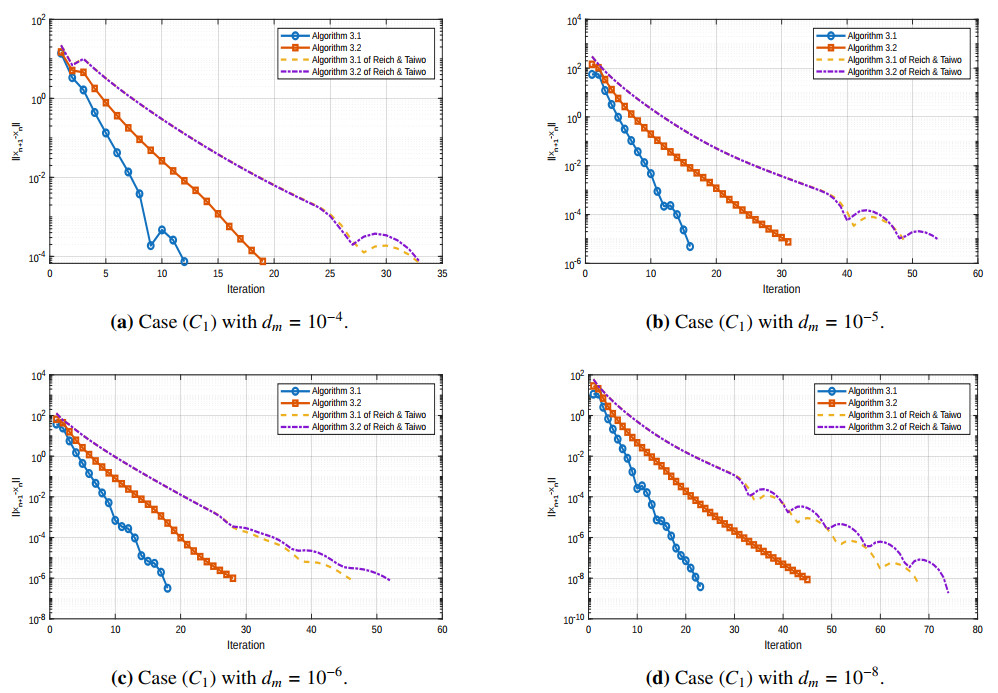
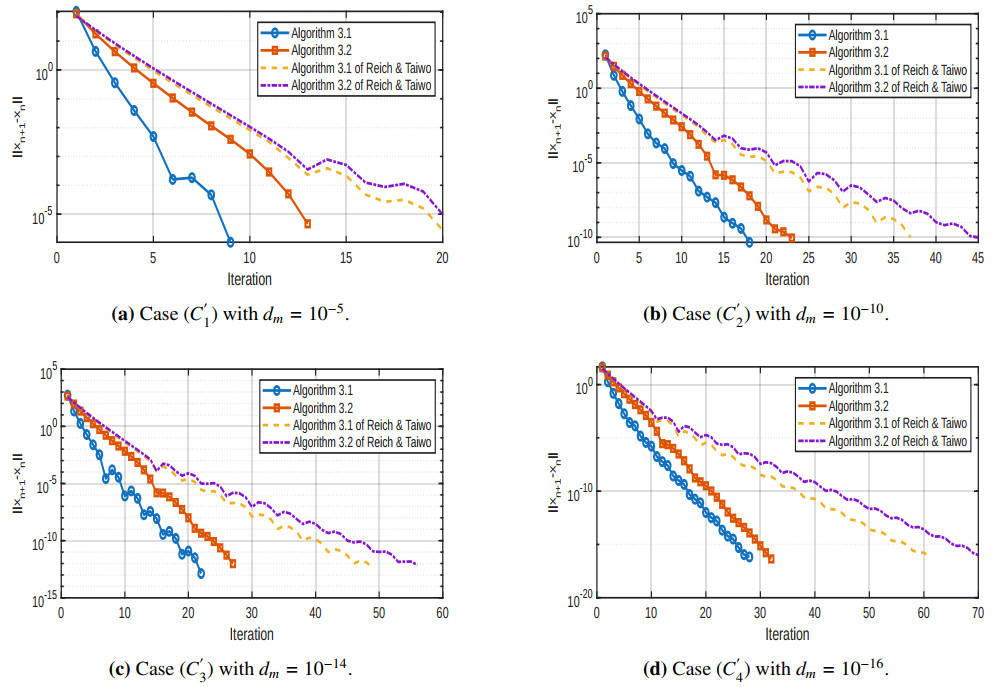
Convergence behavior of algorithms under different initial value cases and tolerances
Convergence behavior of algorithms under different initial value cases and tolerances
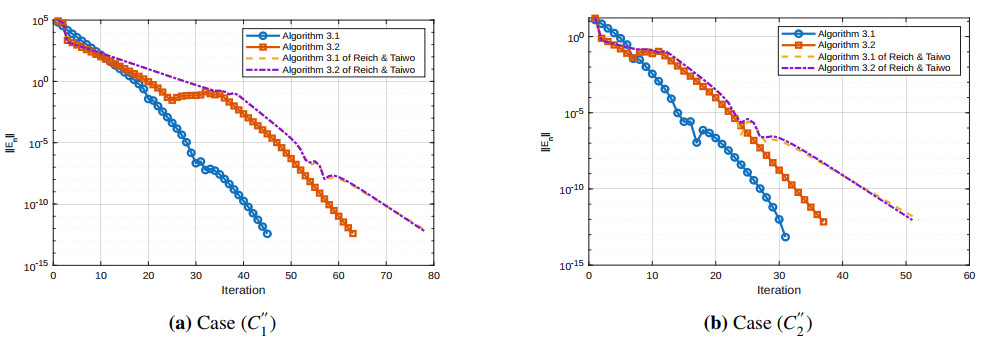
Convergence behavior of algorithms with tolerance $ 0.5\|x_m-R_{\mu}^{G}(x_{m}-\mu Fx_{m})\|\leq $ $ 10^{-12} $
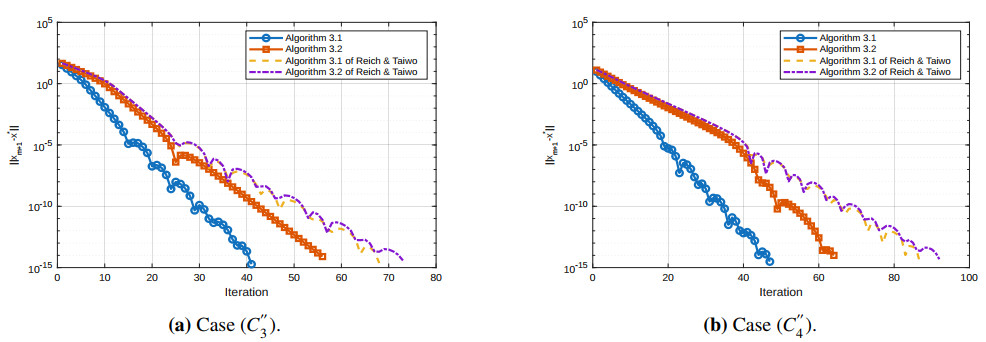
Convergence behavior of algorithms with tolerance $ 0.5\|x_{m+1}-\Phi\|\leq 10^{-14} $




 DownLoad: