We presented an online goal-oriented estimator of reduction errors in silicon sheet charge and its common-gate bias derivative for a self-consistent Schrödinger–Poisson model. A charge-trained compressed augmented adjoint uses one dual operator for both outputs. The method combines established tangent and dual-weighted-residual constructions with an empirical tolerance controller. We selected the controller from 12,100 candidates and validated it independently on 1024 physical tuples (8192 algorithmic states). The frozen primary rule produced 1 false acceptance and 6 false rejections; the historical comparator produced 0 false acceptances and 58 false rejections. In the independent 0.5–2% capacitance-error band (737 states), effectivity ranged from 0.533 to 1.363. Rank-nine derivative-adjoint projection error reached 7.56% on 25 diagnostic cases. Measured median paired latency reductions were 5.84%–13.80% on three cases. A separate interval procedure using full-model information verified selected output statements, including capacitance-dominated failures just above the 1% tolerance. All numerical evidence used explicitly spin-degenerate occupations and rebuilt offline assets. These certificates and sampled decisions did not establish uniform controller reliability or continuum accuracy.
Citation: Ahmed Alqurashi. Oracle-free goal-oriented reliability for charge and gate capacitance in reduced Schrödinger–Poisson models via a compressed dual operator[J]. AIMS Mathematics, 2026, 11(11): 38963-38993. doi: 10.3934/math.20261502
We presented an online goal-oriented estimator of reduction errors in silicon sheet charge and its common-gate bias derivative for a self-consistent Schrödinger–Poisson model. A charge-trained compressed augmented adjoint uses one dual operator for both outputs. The method combines established tangent and dual-weighted-residual constructions with an empirical tolerance controller. We selected the controller from 12,100 candidates and validated it independently on 1024 physical tuples (8192 algorithmic states). The frozen primary rule produced 1 false acceptance and 6 false rejections; the historical comparator produced 0 false acceptances and 58 false rejections. In the independent 0.5–2% capacitance-error band (737 states), effectivity ranged from 0.533 to 1.363. Rank-nine derivative-adjoint projection error reached 7.56% on 25 diagnostic cases. Measured median paired latency reductions were 5.84%–13.80% on three cases. A separate interval procedure using full-model information verified selected output statements, including capacitance-dominated failures just above the 1% tolerance. All numerical evidence used explicitly spin-degenerate occupations and rebuilt offline assets. These certificates and sampled decisions did not establish uniform controller reliability or continuum accuracy.

| [1] |
P. Benner, S. Gugercin, K. Willcox, A survey of projection-based model reduction methods for parametric dynamical systems, SIAM Rev., 57 (2015), 483–531. https://doi.org/10.1137/130932715 doi: 10.1137/130932715
|
| [2] |
J. S. Hesthaven, G. Rozza, B. Stamm, Certified Reduced Basis Methods for Parametrized Partial Differential Equations, Cham: Springer, 2016. https://doi.org/10.1007/978-3-319-22470-1 |
| [3] |
C. Prud'homme, D. V. Rovas, K. Veroy, L. Machiels, Y. Maday, A. T. Patera, et al., Reliable real-time solution of parametrized partial differential equations: Reduced-basis output bound methods, J. Fluids Eng., 124 (2002), 70–80. https://doi.org/10.1115/1.1448332 doi: 10.1115/1.1448332
|
| [4] |
G. S. H. Pau, Reduced basis method for simulation of nanodevices, Phys. Rev. B, 78 (2008), 155425. https://doi.org/10.1103/PhysRevB.78.155425 doi: 10.1103/PhysRevB.78.155425
|
| [5] |
H. Li, G. Li, Component mode synthesis approaches for quantum mechanical electrostatic analysis of nanoscale devices, J. Comput. Electron., 10 (2011), 300–313. https://doi.org/10.1007/s10825-011-0366-7 doi: 10.1007/s10825-011-0366-7
|
| [6] |
M. D. Ganeriwala, C. Yadav, F. G. Ruiz, E. G. Marin, Y. S. Chauhan, N. R. Mohapatra, Modeling of quantum confinement and capacitance in Ⅲ–Ⅴ gate-all-around 1-D transistors, IEEE Trans. Electron Devices, 64 (2017), 4889–4896. https://doi.org/10.1109/TED.2017.2766693 doi: 10.1109/TED.2017.2766693
|
| [7] |
B. Peng, Y. Jiao, H. Zhong, Z. Rong, Z. Wang, Y. Xiao, et al., Compact modeling of quantum confinements in nanoscale gate-all-around MOSFETs, Fundam. Res., 4 (2024), 1306–1313. https://doi.org/10.1016/j.fmre.2022.09.035 doi: 10.1016/j.fmre.2022.09.035
|
| [8] |
R. Becker, R. Rannacher, An optimal control approach to a posteriori error estimation in finite element methods, Acta Numer., 10 (2001), 1–102. https://doi.org/10.1017/S0962492901000010 doi: 10.1017/S0962492901000010
|
| [9] |
M. Yano, Goal-oriented model reduction of parametrized nonlinear partial differential equations: Application to aerodynamics, Int. J. Numer. Methods Eng., 121 (2020), 5200–5226. https://doi.org/10.1002/nme.6395 doi: 10.1002/nme.6395
|
| [10] |
M. K. Sleeman, M. Yano, Goal-oriented model reduction for parametrized time-dependent nonlinear partial differential equations, Comput. Methods Appl. Mech. Eng., 388 (2022), 114206. https://doi.org/10.1016/j.cma.2021.114206 doi: 10.1016/j.cma.2021.114206
|
| [11] |
P. J. Blonigan, E. J. Parish, Evaluation of dual-weighted residual and machine learning error estimation for projection-based reduced-order models of steady partial differential equations, Comput. Methods Appl. Mech. Eng., 409 (2023), 115988. https://doi.org/10.1016/j.cma.2023.115988 doi: 10.1016/j.cma.2023.115988
|
| [12] |
H. Fischer, J. Roth, T. Wick, L. Chamoin, A. Fau, MORe DWR: Space–time goal-oriented error control for incremental POD-based ROM for time-averaged goal functionals, J. Comput. Phys., 504 (2024), 112863. https://doi.org/10.1016/j.jcp.2024.112863 doi: 10.1016/j.jcp.2024.112863
|
| [13] |
B. N. Granzow, D. T. Seidl, S. D. Bond, Linearization errors in discrete goal-oriented error estimation, Comput. Methods Appl. Mech. Eng., 416 (2023), 116364. https://doi.org/10.1016/j.cma.2023.116364 doi: 10.1016/j.cma.2023.116364
|
| [14] |
A. Janon, M. Nodet, C. Prieur, Goal-oriented error estimation for the reduced basis method, with application to sensitivity analysis, J. Sci. Comput., 68 (2016), 21–41. https://doi.org/10.1007/s10915-015-0127-z doi: 10.1007/s10915-015-0127-z
|
| [15] |
M. Guo, H. Zhong, Strict upper and lower bounds for quantities of interest in static response sensitivity analysis, Appl. Math. Model., 49 (2017), 17–34. https://doi.org/10.1016/j.apm.2017.04.029 doi: 10.1016/j.apm.2017.04.029
|
| [16] |
D. J. BenDaniel, C. B. Duke, Space-charge effects on electron tunneling, Phys. Rev., 152 (1966), 683–692. https://doi.org/10.1103/PhysRev.152.683 doi: 10.1103/PhysRev.152.683
|
| [17] |
F. Stern, Self-consistent results for n-type Si inversion layers, Phys. Rev. B, 5 (1972), 4891–4899. https://doi.org/10.1103/PhysRevB.5.4891 doi: 10.1103/PhysRevB.5.4891
|
| [18] |
T. Ando, A. B. Fowler, F. Stern, Electronic properties of two-dimensional systems, Rev. Mod. Phys., 54 (1982), 437–672. https://doi.org/10.1103/RevModPhys.54.437 doi: 10.1103/RevModPhys.54.437
|
| [19] |
A. Trellakis, A. T. Galick, A. Pacelli, U. Ravaioli, Iteration scheme for the solution of the two-dimensional Schrödinger–Poisson equations in quantum structures, J. Appl. Phys., 81 (1997), 7880–7884. https://doi.org/10.1063/1.365396 doi: 10.1063/1.365396
|
| [20] |
W. Liu, X. Jin, Y. King, C. Hu, An efficient and accurate compact model for thin-oxide-MOSFET intrinsic capacitance considering the finite charge layer thickness, IEEE Trans. Electron Devices, 46 (1999), 1070–1072. https://doi.org/10.1109/16.760418 doi: 10.1109/16.760418
|
| [21] |
M. Rewieński, A. Lamecki, M. Mrozowski, A goal-oriented error estimator for reduced basis method modeling of microwave devices, IEEE Microw. Wirel. Compon. Lett., 25 (2015), 208–210. https://doi.org/10.1109/LMWC.2015.2400937 doi: 10.1109/LMWC.2015.2400937
|
| [22] |
L. Feng, S. Chellappa, P. Benner, A posteriori error estimation for model order reduction of parametric systems, Adv. Model. Simul. Eng. Sci., 11 (2024), 5. https://doi.org/10.1186/s40323-024-00260-8 doi: 10.1186/s40323-024-00260-8
|
| [23] |
D. Blais, S. Nadarajah, C. Biondic, Goal-oriented adaptive sampling for projection-based reduced-order models, Comput. Fluids, 290 (2025), 106568. https://doi.org/10.1016/j.compfluid.2025.106568 doi: 10.1016/j.compfluid.2025.106568
|
| [24] |
A. Arnold, Mathematical concepts of open quantum boundary conditions, Transp. Theory Stat. Phys., 30 (2001), 561–584. https://doi.org/10.1081/TT-100105939 doi: 10.1081/TT-100105939
|
| [25] |
A. Arnold, N. Ben Abdallah, C. Negulescu, WKB-based schemes for the oscillatory 1D Schrödinger equation in the semi-classical limit, SIAM J. Numer. Anal., 49 (2011), 1436–1460. https://doi.org/10.1137/100800373 doi: 10.1137/100800373
|
| [26] |
W. Wang, C. W. Shu, The WKB local discontinuous Galerkin method for the simulation of Schrödinger equation in a resonant tunneling diode, J. Sci. Comput., 40 (2009), 360–374. https://doi.org/10.1007/s10915-008-9237-1 doi: 10.1007/s10915-008-9237-1
|
| [27] |
G. E. Aliffi, G. Nastasi, V. Romano, Ballistic electron transport described by a fourth-order Schrödinger equation, Z. Angew. Math. Phys., 76 (2025), 155. https://doi.org/10.1007/s00033-025-02535-5 doi: 10.1007/s00033-025-02535-5
|
| [28] |
G. E. Aliffi, G. Nastasi, V. Romano, Ballistic electron transport described by a generalized Schrödinger equation, J. Phys. A: Math. Theor., 59 (2026), 135201. https://doi.org/10.1088/1751-8121/ae5516 doi: 10.1088/1751-8121/ae5516
|
| [29] |
S. M. Rump, Verification methods: rigorous results using floating-point arithmetic, Acta Numer., 19 (2010), 287–449. https://doi.org/10.1017/S096249291000005X doi: 10.1017/S096249291000005X
|
| [30] |
Python-flint developers, Python-flint 0.9.0 documentation: arb and arb_mat, 2026. https://python-flint.readthedocs.io/en/latest/arb_mat.html (accessed 29 October 2026). |
| [31] |
C. J. Clopper, E. S. Pearson, The use of confidence or fiducial limits illustrated in the case of the binomial, Biometrika, 26 (1934), 404–413. https://doi.org/10.1093/biomet/26.4.404 doi: 10.1093/biomet/26.4.404
|
| [32] |
M. Drohmann, K. Carlberg, The ROMES method for statistical modeling of reduced-order-model error, SIAM/ASA J. Uncertain. Quantif., 3 (2015), 116–145. https://doi.org/10.1137/140969841 doi: 10.1137/140969841
|
| [33] |
K. Smetana, O. Zahm, A. T. Patera, Randomized residual-based error estimators for parametrized equations, SIAM J. Sci. Comput., 41 (2019), A900–A926. https://doi.org/10.1137/18M120364X doi: 10.1137/18M120364X
|
 math-11-11-1502-s001.rar |
 |
Figures(9) / Tables(14)

Ahmed Alqurashi. Oracle-free goal-oriented reliability for charge and gate capacitance in reduced Schrödinger–Poisson models via a compressed dual operator[J]. AIMS Mathematics, 2026, 11(11): 38963-38993. doi: 10.3934/math.20261502

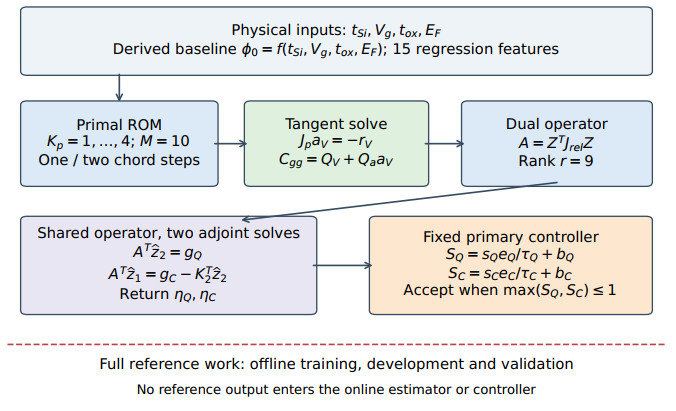
Online workflow. The uniform baseline φ0 is derived from the four physical inputs. The charge and derivative goals share one compressed operator; the timed implementation of Section 6.7 also reuses its lower–upper (LU) factorization. Reference outputs are excluded from online evaluation; they are used in offline construction, controller development, and post hoc validation. Primary controller parameters are fixed before both validation campaigns in Section 6.1
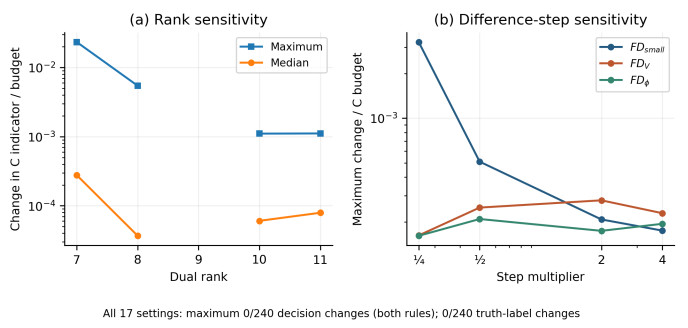
Internal finite-difference and dual-rank sensitivity after rebuilding the spin-degenerate model. Counts compare each perturbation with the nominal implementation on the same 240 states. Zero indicator changes are omitted on the logarithmic axes. Full row-level outputs and both historical and primary decisions are supplied
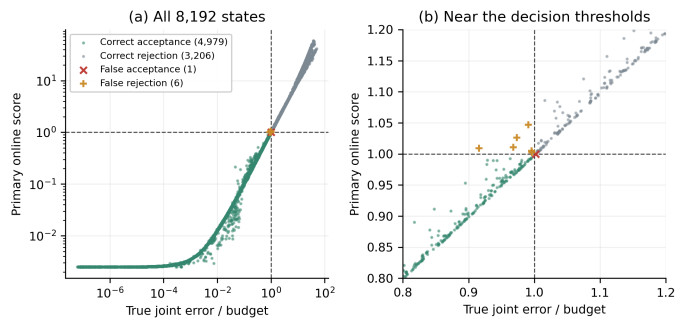
Frozen primary controller on the independent validation. A false acceptance lies to the right of the true-error threshold while remaining below the online-score threshold. The second panel enlarges the joint decision region; the complete first panel retains all states
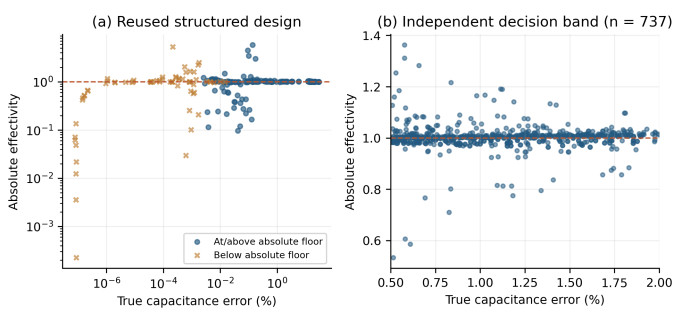
Corrected capacitance effectivity. Left: All 240 structured states, including small-error cases; marker style identifies the absolute-error reporting floor. Right: The independent 0.5–2% capacitance-error population. The horizontal line denotes unit effectivity
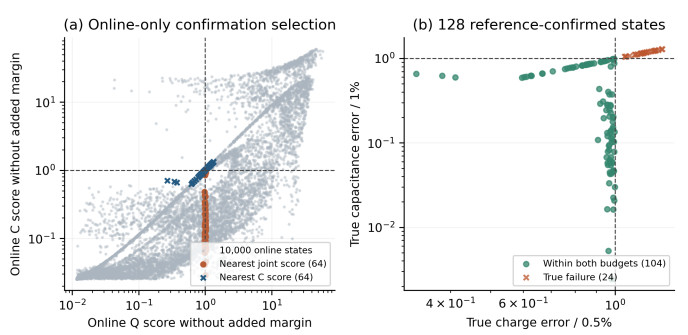
Corrected online prescreen and reference confirmation. Left: All prescreen states and the 128 selected states, using the historical multipliers and floors without the added margin for selection. Right: Confirmed charge and capacitance errors normalized by their respective budgets
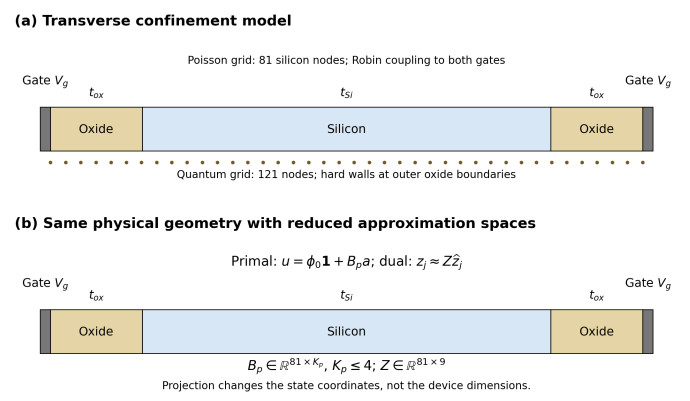
The same double-gate device in the full and reduced descriptions. The quantum grid extends across oxide–silicon–oxide; the Poisson unknowns occupy silicon with Robin gate coupling. POD and dual projection change the approximation spaces while preserving the geometry
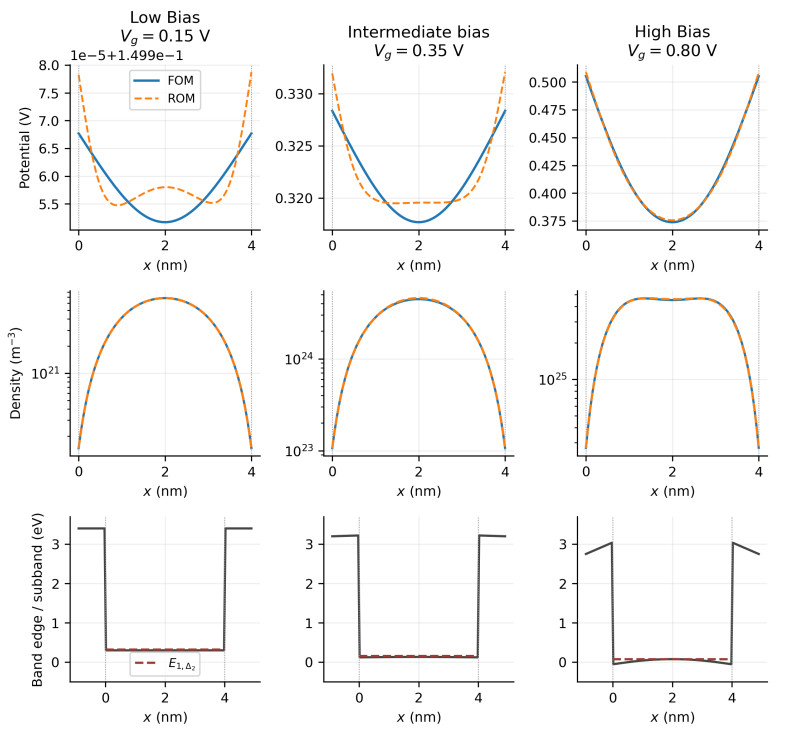
Corrected potential and logarithmic density profiles at low, intermediate, and high gate bias, followed by conduction-band edges and the first ∆2 subband. Vertical dotted lines mark the silicon interfaces. The fixed intermediate case exceeds the capacitance tolerance after the physical correction
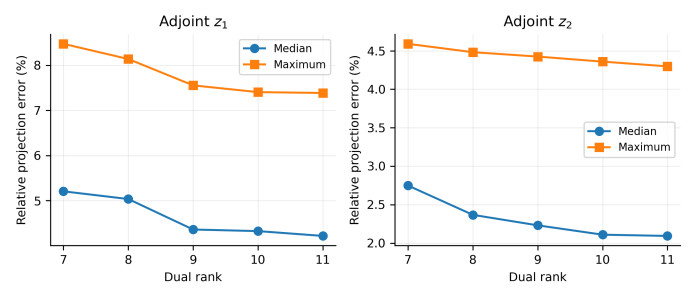
Direct Euclidean projection errors for the full derivative and charge adjoints on 25 diagnostic states. Increasing the retained rank reduces field error modestly; no uniform sufficiency threshold is inferred
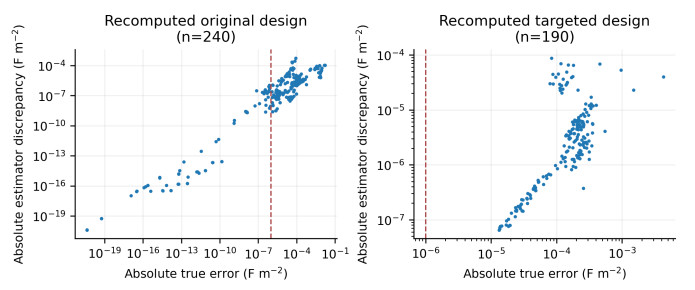
Absolute estimator discrepancy against absolute true capacitance error for both reused designs. The vertical line is the effectivity reporting floor. All points, including those below the floor, enter Table 10 and the controller classifications




 DownLoad: