Repeatedly evaluating option prices is required both for option valuation and for market calibration under the Heston model. To provide a reusable pricing model, we proposed a sensitivity-regularized physics-informed neural network, termed FiLM-MM-PINN, that integrates a moment-matching prior with feature-wise linear modulation. In the forward problem, a forward-normalized reformulation of the Heston partial differential equation was imposed as a physical constraint, yielding a unified pricing surrogate applicable within a prescribed state–parameter domain, with terminal and boundary conditions enforced and without reference option prices as training labels. The network employs the moment-matched Black–Scholes price as a prior and combines parameter encoding, operator-related features, and feature-wise linear modulation to learn price corrections; local parameter sensitivity constraints were further introduced to regularize parameter derivatives. In the inverse problem, the trained network weights were frozen and the Heston parameters, including the initial variance, were estimated from S & P 500 index option quotes via multi-start, multi-stage optimization. Numerical experiments evaluated pricing accuracy, parameter sensitivities, and synthetic parameter recovery. Ablation studies supported the respective contributions of the moment-matching prior, the operator-related features, and the feature-wise linear modulation to pricing accuracy and to the reduction of equation residuals. On an independent market validation set, the relative $ L^2 $ error was $ 0.3278\% $ and the coefficient of determination was $ 0.999968 $; the market fit error was lower than those obtained with the Fourier-cosine expansion method and the alternating direction implicit finite-difference method used as calibration benchmarks under the adopted calibration protocol. These results support the use of the proposed method for physics-constrained parametric pricing and market calibration through a frozen, differentiable pricing model.
Citation: Jina Li, Daiyuan Jia, Yanpei Zhen, Yaxin Li. FiLM-MM-PINN: A sensitivity-regularized physics-informed neural network for Heston option pricing and market calibration[J]. AIMS Mathematics, 2026, 11(11): 38933-38962. doi: 10.3934/math.20261501
Repeatedly evaluating option prices is required both for option valuation and for market calibration under the Heston model. To provide a reusable pricing model, we proposed a sensitivity-regularized physics-informed neural network, termed FiLM-MM-PINN, that integrates a moment-matching prior with feature-wise linear modulation. In the forward problem, a forward-normalized reformulation of the Heston partial differential equation was imposed as a physical constraint, yielding a unified pricing surrogate applicable within a prescribed state–parameter domain, with terminal and boundary conditions enforced and without reference option prices as training labels. The network employs the moment-matched Black–Scholes price as a prior and combines parameter encoding, operator-related features, and feature-wise linear modulation to learn price corrections; local parameter sensitivity constraints were further introduced to regularize parameter derivatives. In the inverse problem, the trained network weights were frozen and the Heston parameters, including the initial variance, were estimated from S & P 500 index option quotes via multi-start, multi-stage optimization. Numerical experiments evaluated pricing accuracy, parameter sensitivities, and synthetic parameter recovery. Ablation studies supported the respective contributions of the moment-matching prior, the operator-related features, and the feature-wise linear modulation to pricing accuracy and to the reduction of equation residuals. On an independent market validation set, the relative $ L^2 $ error was $ 0.3278\% $ and the coefficient of determination was $ 0.999968 $; the market fit error was lower than those obtained with the Fourier-cosine expansion method and the alternating direction implicit finite-difference method used as calibration benchmarks under the adopted calibration protocol. These results support the use of the proposed method for physics-constrained parametric pricing and market calibration through a frozen, differentiable pricing model.

| [1] |
F. Black, M. Scholes, The pricing of options and corporate liabilities, J. Polit. Econ., 81 (1973), 637–654. http://doi.org/10.1086/260062 doi: 10.1086/260062
|
| [2] |
R. C. Merton, Theory of rational option pricing, Bell J. Econ. Manag. Sci., 4 (1973), 141–183. http://doi.org/10.2307/3003143 doi: 10.2307/3003143
|
| [3] |
S. L. Heston, A closed-form solution for options with stochastic volatility with applications to bond and currency options, Rev. Financ. Stud., 6 (1993), 327–343. http://doi.org/10.1093/rfs/6.2.327 doi: 10.1093/rfs/6.2.327
|
| [4] |
J. Gatheral, The Volatility Surface: A Practitioner's Guide, Hoboken: John Wiley & Sons, 2011. http://doi.org/10.1002/9781119202073 |
| [5] |
P. Carr, D. B. Madan, Option valuation using the fast Fourier transform, J. Comput. Finance, 2 (1999), 61–73. http://doi.org/10.21314/JCF.1999.043 doi: 10.21314/JCF.1999.043
|
| [6] |
F. Fang, C. W. Oosterlee, A novel pricing method for European options based on Fourier–cosine series expansions, SIAM J. Sci. Comput., 31 (2009), 826–848. http://doi.org/10.1137/080718061 doi: 10.1137/080718061
|
| [7] |
H. Albrecher, P. A. Mayer, W. Schoutens, J. Tistaert, The little Heston trap, Wilmott, 1 (2007), 83–92. |
| [8] |
D. Tavella, C. Randall, Pricing Financial Instruments: The Finite Difference Method, New York: John Wiley & Sons, 2000. |
| [9] |
D. J. Duffy, Finite Difference Methods in Financial Engineering: A Partial Differential Equation Approach, Chichester: John Wiley & Sons, 2006. http://doi.org/10.1002/9781118673447 |
| [10] |
B. Düring, J. Miles, High-order ADI scheme for option pricing in stochastic volatility models, J. Comput. Appl. Math., 316 (2017), 109–121. http://doi.org/10.1016/j.cam.2016.09.040 doi: 10.1016/j.cam.2016.09.040
|
| [11] |
P. Glasserman, Monte Carlo Methods in Financial Engineering, New York: Springer, 2004. http://doi.org/10.1007/978-0-387-21617-1 |
| [12] |
L. Andersen, Simple and efficient simulation of the Heston stochastic volatility model, J. Comput. Finance, 11 (2008), 1–42. http://doi.org/10.21314/JCF.2008.189 doi: 10.21314/JCF.2008.189
|
| [13] |
R. Lord, R. Koekkoek, D. van Dijk, A comparison of biased simulation schemes for stochastic volatility models, Quant. Finance, 10 (2010), 177–194. http://doi.org/10.1080/14697680802392496 doi: 10.1080/14697680802392496
|
| [14] |
Y. Cui, S. del Baño Rollin, G. Germano, Full and fast calibration of the Heston stochastic volatility model, Eur. J. Oper. Res., 263 (2017), 625–638. http://doi.org/10.1016/j.ejor.2017.05.018 doi: 10.1016/j.ejor.2017.05.018
|
| [15] |
J. Sirignano, K. Spiliopoulos, DGM: A deep learning algorithm for solving partial differential equations, J. Comput. Phys., 375 (2018), 1339–1364. http://doi.org/10.1016/j.jcp.2018.08.029 doi: 10.1016/j.jcp.2018.08.029
|
| [16] |
J. Han, A. Jentzen, W. E, Solving high-dimensional partial differential equations using deep learning, Proc. Natl. Acad. Sci. USA, 115 (2018), 8505–8510. http://doi.org/10.1073/pnas.1718942115 doi: 10.1073/pnas.1718942115
|
| [17] |
M. Raissi, P. Perdikaris, G. E. Karniadakis, Physics-informed neural networks: A deep learning framework for solving forward and inverse problems involving nonlinear partial differential equations, J. Comput. Phys., 378 (2019), 686–707. http://doi.org/10.1016/j.jcp.2018.10.045 doi: 10.1016/j.jcp.2018.10.045
|
| [18] |
G. E. Karniadakis, I. G. Kevrekidis, L. Lu, P. Perdikaris, S. Wang, L. Yang, Physics-informed machine learning, Nat. Rev. Phys., 3 (2021), 422–440. http://doi.org/10.1038/s42254-021-00314-5 doi: 10.1038/s42254-021-00314-5
|
| [19] |
A. D. Jagtap, G. E. Karniadakis, Extended physics-informed neural networks (XPINNs): A generalized space-time domain decomposition based deep learning framework for nonlinear partial differential equations, Commun. Comput. Phys., 28 (2020), 2002–2041. http://doi.org/10.4208/cicp.OA-2020-0164 doi: 10.4208/cicp.OA-2020-0164
|
| [20] |
L. Lu, X. Meng, Z. Mao, G. E. Karniadakis, DeepXDE: A deep learning library for solving differential equations, SIAM Rev., 63 (2021), 208–228. http://doi.org/10.1137/19M1274067 doi: 10.1137/19M1274067
|
| [21] |
S. Cuomo, V. Schiano Di Cola, F. Giampaolo, G. Rozza, M. Raissi, F. Piccialli, Scientific machine learning through physics-informed neural networks: Where we are and what's next, J. Sci. Comput., 92 (2022), 88. http://doi.org/10.1007/s10915-022-01939-z doi: 10.1007/s10915-022-01939-z
|
| [22] |
A. Krishnapriyan, A. Gholami, S. Zhe, R. Kirby, M. W. Mahoney, Characterizing possible failure modes in physics-informed neural networks, In: Advances in Neural Information Processing Systems, 34 (2021), 26548–26560. |
| [23] |
S. Wang, Y. Teng, P. Perdikaris, Understanding and mitigating gradient flow pathologies in physics-informed neural networks, SIAM J. Sci. Comput., 43 (2021), A3055–A3081. http://doi.org/10.1137/20M1318043 doi: 10.1137/20M1318043
|
| [24] |
S. Wang, X. Yu, P. Perdikaris, When and why PINNs fail to train: A neural tangent kernel perspective, J. Comput. Phys., 449 (2022), 110768. http://doi.org/10.1016/j.jcp.2021.110768 doi: 10.1016/j.jcp.2021.110768
|
| [25] |
L. D. McClenny, U. M. Braga-Neto, Self-adaptive physics-informed neural networks, J. Comput. Phys., 474 (2023), 111722. http://doi.org/10.1016/j.jcp.2022.111722 doi: 10.1016/j.jcp.2022.111722
|
| [26] |
C. Wu, M. Zhu, Q. Tan, Y. Kartha, L. Lu, A comprehensive study of non-adaptive and residual-based adaptive sampling for physics-informed neural networks, Comput. Methods Appl. Mech. Eng., 403 (2023), 115671. http://doi.org/10.1016/j.cma.2022.115671 doi: 10.1016/j.cma.2022.115671
|
| [27] |
K. Tang, X. Wan, C. Yang, DAS-PINNs: A deep adaptive sampling method for solving high-dimensional partial differential equations, J. Comput. Phys., 476 (2023), 111868. http://doi.org/10.1016/j.jcp.2022.111868 doi: 10.1016/j.jcp.2022.111868
|
| [28] |
Z. Gao, L. Yan, T. Zhou, Failure-informed adaptive sampling for PINNs, SIAM J. Sci. Comput., 45 (2023), A1971–A1994. http://doi.org/10.1137/22M1527763 doi: 10.1137/22M1527763
|
| [29] |
Y. Bai, T. Chaolu, S. Bilige, The application of improved physics-informed neural network (IPINN) method in finance, Nonlinear Dyn., 107 (2022), 3655–3667. http://doi.org/10.1007/s11071-021-07146-z doi: 10.1007/s11071-021-07146-z
|
| [30] |
F. Gatta, V. Schiano Di Cola, F. Giampaolo, F. Piccialli, S. Cuomo, Meshless methods for American option pricing through physics-informed neural networks, Eng. Anal. Bound. Elem., 151 (2023), 68–82. http://doi.org/10.1016/j.enganabound.2023.02.040 doi: 10.1016/j.enganabound.2023.02.040
|
| [31] |
H. O. Bae, S. Kang, M. Lee, Option pricing and local volatility surface by physics-informed neural network, Comput. Econ., 64 (2024), 3143–3171. http://doi.org/10.1007/s10614-024-10551-2 doi: 10.1007/s10614-024-10551-2
|
| [32] |
D. Hainaut, A. Casas, Option pricing in the Heston model with physics inspired neural networks, Ann. Finance, 20 (2024), 353–376. http://doi.org/10.1007/s10436-024-00452-7 doi: 10.1007/s10436-024-00452-7
|
| [33] |
E. Perez, F. Strub, H. de Vries, V. Dumoulin, A. Courville, FiLM: Visual reasoning with a general conditioning layer, In: Proceedings of the AAAI Conference on Artificial Intelligence, 32 (2018), 3942–3951. http://doi.org/10.1609/aaai.v32i1.11671 |
| [34] |
L. Lu, P. Jin, G. Pang, Z. Zhang, G. E. Karniadakis, Learning nonlinear operators via DeepONet based on the universal approximation theorem of operators, Nat. Mach. Intell., 3 (2021), 218–229. http://doi.org/10.1038/s42256-021-00302-5 doi: 10.1038/s42256-021-00302-5
|
| [35] |
Z. Li, N. Kovachki, K. Azizzadenesheli, B. Liu, K. Bhattacharya, A. Stuart, et al., Fourier neural operator for parametric partial differential equations, In: Proceedings of the International Conference on Learning Representations, 2021. |
| [36] |
N. Kovachki, Z. Li, B. Liu, K. Azizzadenesheli, K. Bhattacharya, A. Stuart, et al., Neural operator: Learning maps between function spaces with applications to PDEs, J. Mach. Learn. Res., 24 (2023), 1–97. |
| [37] |
J. C. Cox, J. E. Ingersoll, S. A. Ross, A theory of the term structure of interest rates, Econometrica, 53 (1985), 385–407. http://doi.org/10.2307/1911242 doi: 10.2307/1911242
|
| [38] |
K. He, X. Zhang, S. Ren, J. Sun, Deep residual learning for image recognition, In: Proceedings of the IEEE Conference on Computer Vision and Pattern Recognition, 2016,770–778. http://doi.org/10.1109/CVPR.2016.90 |
| [39] |
N. Sukumar, A. Srivastava, Exact imposition of boundary conditions with distance functions in physics-informed deep neural networks, Comput. Methods Appl. Mech. Eng., 389 (2022), 114333. http://doi.org/10.1016/j.cma.2021.114333 doi: 10.1016/j.cma.2021.114333
|
| [40] |
M. A. Nabian, R. J. Gladstone, H. Meidani, Efficient training of physics-informed neural networks via importance sampling, Comput. Aided Civ. Infrastruct. Eng., 36 (2021), 962–977. http://doi.org/10.1111/mice.12685 doi: 10.1111/mice.12685
|
| [41] |
J. Yu, L. Lu, X. Meng, G. E. Karniadakis, Gradient-enhanced physics-informed neural networks for forward and inverse PDE problems, Comput. Methods Appl. Mech. Eng., 393 (2022), 114823. http://doi.org/10.1016/j.cma.2022.114823 doi: 10.1016/j.cma.2022.114823
|
Figures(8) / Tables(9)

Jina Li, Daiyuan Jia, Yanpei Zhen, Yaxin Li. FiLM-MM-PINN: A sensitivity-regularized physics-informed neural network for Heston option pricing and market calibration[J]. AIMS Mathematics, 2026, 11(11): 38933-38962. doi: 10.3934/math.20261501

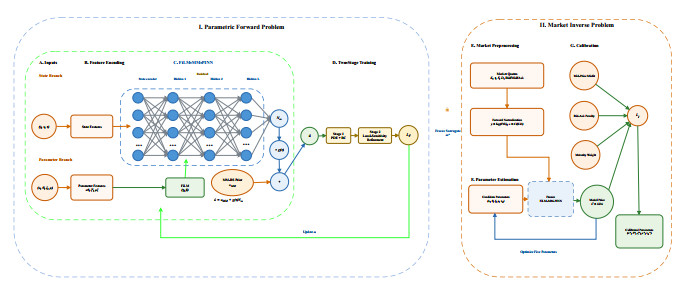
Unified FiLM-MM-PINN framework for parameterized Heston pricing and market calibration
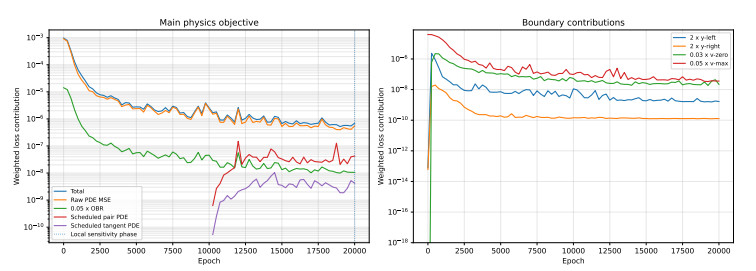
Evolution of the training-loss components for FiLM-MM-PINN
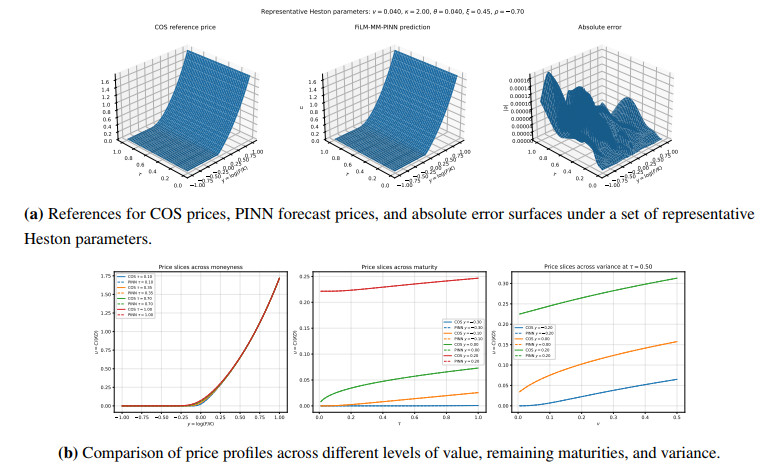
A comparison of the parameterized pricing model with the COS reference solution under a set of representative Heston parameters
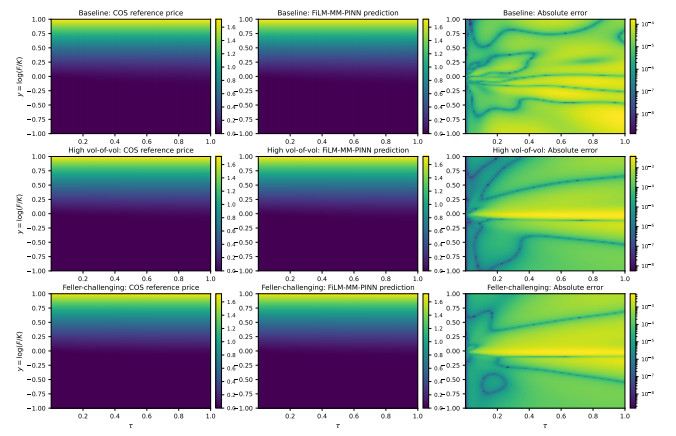
COS reference prices, PINN predicted prices, and the distribution of absolute errors under different parameter scenarios
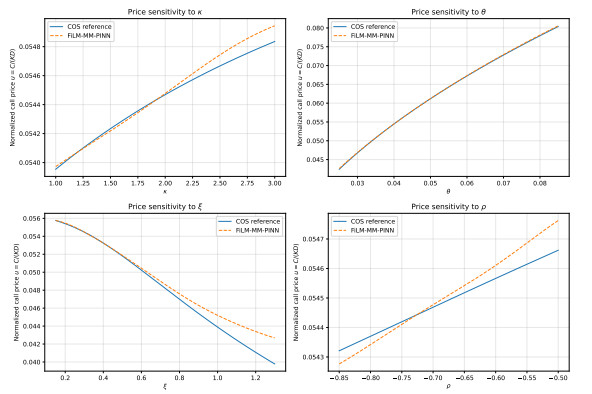
Normalized call-price slices with respect to the Heston parameters
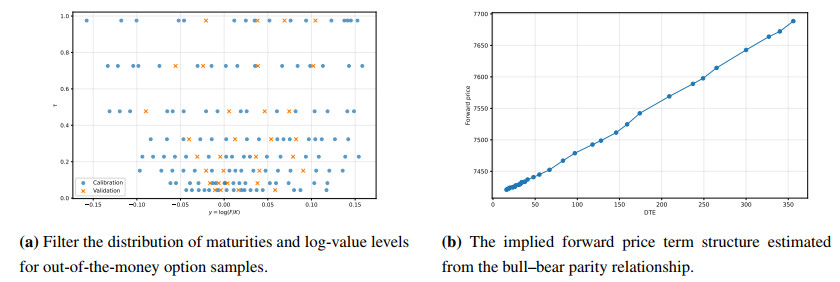
Key market characteristics of the SPX options sample after preprocessing
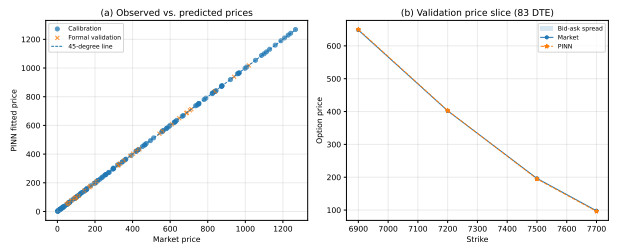
Results of the fit between the SPX market option mid-price and the prices predicted by the parametric Heston pricing model
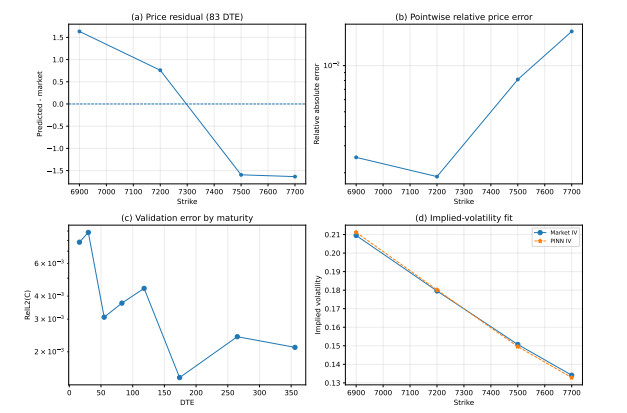
Price residuals, relative errors, maturity-wise errors, and implied-volatility fit on the held-out validation set




 DownLoad: