The clean graph $ Cl(R) $ of a ring $ R $ with identity is a simple graph whose vertices are of the form $ (e, u) $, where $ e $ is an idempotent and $ u $ is a unit of $ R $. Two distinct vertices $ (e_1, u_1) $ and $ (e_2, u_2) $ are adjacent if $ e_1e_2 = 0 = e_2e_1 $ or $ u_1u_2 = 1 = u_2u_1 $. The graph $ Cl_2(R) $ is a subgraph of $ Cl(R) $ induced by vertices $ (e, u) $, where $ e $ is a nonzero idempotent element. For any prime numbers $ p, q $ such that $ p\leq q $ and positive integers $ n, m $, two structures of $ Cl_2(\mathbb{F}_{p^n}\times \mathbb{F}_{q^m}) $ are introduced to determine the order, size, maximum degree, minimum degree, diameter, connectivity, and planarity of both $ Cl(\mathbb{F}_{p^n}\times \mathbb{F}_{q^m}) $ and $ Cl_2(\mathbb{F}_{p^n}\times \mathbb{F}_{q^m}) $. Additionally, the clique number, chromatic number, and independence number of $ Cl_2(\mathbb{F}_{p^n}\times \mathbb{F}_{q^m}) $ are investigated.
Citation: Khajee Jantarakhajorn, Borworn Khuhirun, Arnita Boonsawang. Subgraph induced by nonzero idempotent elements of clean graphs of some products of fields[J]. AIMS Mathematics, 2026, 11(11): 38362-38376. doi: 10.3934/math.20261481
The clean graph $ Cl(R) $ of a ring $ R $ with identity is a simple graph whose vertices are of the form $ (e, u) $, where $ e $ is an idempotent and $ u $ is a unit of $ R $. Two distinct vertices $ (e_1, u_1) $ and $ (e_2, u_2) $ are adjacent if $ e_1e_2 = 0 = e_2e_1 $ or $ u_1u_2 = 1 = u_2u_1 $. The graph $ Cl_2(R) $ is a subgraph of $ Cl(R) $ induced by vertices $ (e, u) $, where $ e $ is a nonzero idempotent element. For any prime numbers $ p, q $ such that $ p\leq q $ and positive integers $ n, m $, two structures of $ Cl_2(\mathbb{F}_{p^n}\times \mathbb{F}_{q^m}) $ are introduced to determine the order, size, maximum degree, minimum degree, diameter, connectivity, and planarity of both $ Cl(\mathbb{F}_{p^n}\times \mathbb{F}_{q^m}) $ and $ Cl_2(\mathbb{F}_{p^n}\times \mathbb{F}_{q^m}) $. Additionally, the clique number, chromatic number, and independence number of $ Cl_2(\mathbb{F}_{p^n}\times \mathbb{F}_{q^m}) $ are investigated.

| [1] |
S. Akbari, M. Habibi, A. Majidinya, R. Manaviyat, On the idempotent graph of a ring, J. Algebra Appl., 12 (2013), 1350003. https://doi.org/10.1142/S0219498813500035 doi: 10.1142/S0219498813500035
|
| [2] |
S. Akbari, D. Kiani, F. Mohammadi, S. Moradi, The total graph and regular graph of a commutative ring, J. Pure Appl. Algebra, 213 (2009), 2224–2228. https://doi.org/10.1016/j.jpaa.2009.03.013 doi: 10.1016/j.jpaa.2009.03.013
|
| [3] |
S. Akbari, A. Mohammadian, On zero-divisor graphs of finite rings, J. Algebra, 314 (2007), 168–184. https://doi.org/10.1016/j.jalgebra.2007.02.051 doi: 10.1016/j.jalgebra.2007.02.051
|
| [4] |
M. Habibi, E. Y. Celikel, C. Abdioglu, Clean graph of a ring, J. Algebra Appl., 20 (2021), 2150156. https://doi.org/10.1142/S0219498821501565 doi: 10.1142/S0219498821501565
|
| [5] |
W. K. Nicholson, Lifting idempotents and exchange rings, Trans. Amer. Math. Soc., 229 (1977), 269–278. https://doi.org/10.2307/1998510 doi: 10.2307/1998510
|
| [6] |
D. D. Anderson, V. P. Camillo, Commutative rings whose elements are a sum of a unit and idempotent, Commun. Algebra, 30 (2002), 3327–3336. https://doi.org/10.1081/AGB-120004490 doi: 10.1081/AGB-120004490
|
| [7] |
W. K. Nicholson, Y. Zhou, Rings in which elements are uniquely the sum of an idempotent and a unit, Glasgow Math. J., 46 (2004), 227–236. https://doi.org/10.1017/S0017089504001727 doi: 10.1017/S0017089504001727
|
| [8] |
W. K. Nicholson, Y. Zhou, Clean general rings, J. Algebra, 291 (2005), 297–311. https://doi.org/10.1016/j.jalgebra.2005.01.020 doi: 10.1016/j.jalgebra.2005.01.020
|
| [9] |
M. F. Atiyah, I. G. Macdonald, Introduction to commutative algebra, Massachusetts: Addison–Wesley Publishing Company, 1969. |
| [10] |
G. Chartrand, P. Zhang, A first course in graph theory, Massachusetts: Courier Corporation, 2013. |
Figures(8)

Khajee Jantarakhajorn, Borworn Khuhirun, Arnita Boonsawang. Subgraph induced by nonzero idempotent elements of clean graphs of some products of fields[J]. AIMS Mathematics, 2026, 11(11): 38362-38376. doi: 10.3934/math.20261481

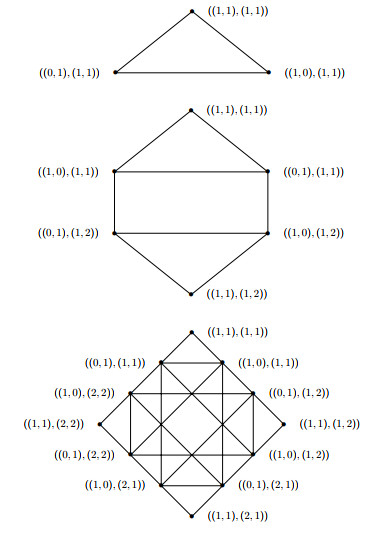
$ Cl_2(\mathbb{F}_2\times \mathbb{F}_2) $, $ Cl_2(\mathbb{F}_2\times \mathbb{F}_3) $, and $ Cl_2(\mathbb{F}_3\times \mathbb{F}_3) $, respectively
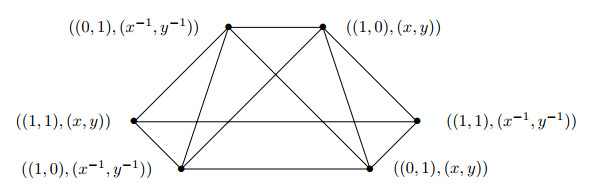
2-triangle graph
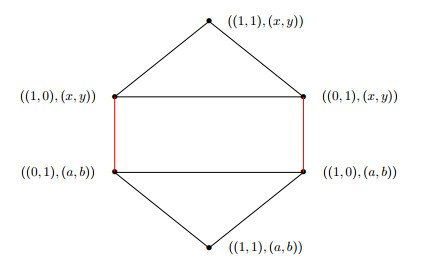
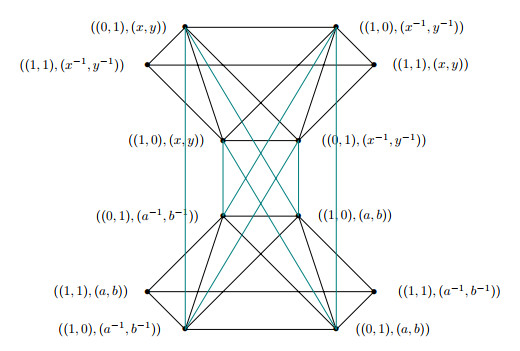
Subgraph induced by two triangles $ T(x, y) $ and $ T(a, b) $
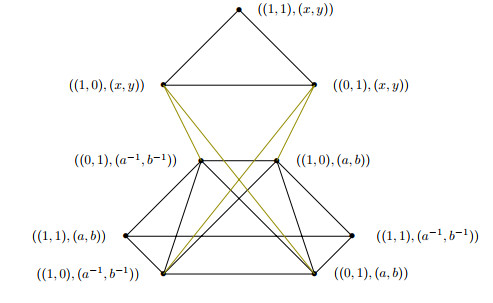
Subgraph induced by a triangle $ T(x, y) $ and a 2-triangle $ T(a, b) $
Subgraph induced by two 2-triangles $ T(x, y) $ and $ T(a, b) $
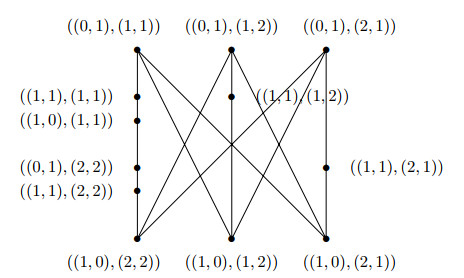
A subdivision of $ K_{3, 3} $ in $ Cl_2(\mathbb{F}_3\times \mathbb{F}_3) $
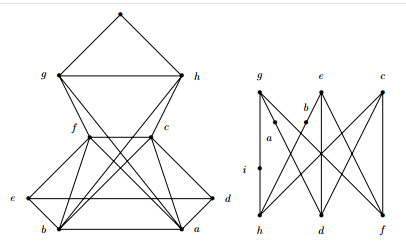
A subdivision of $ K_{3, 3} $ in $ Cl_2(\mathbb{F}_{p^n}\times \mathbb{F}_{q^m}) $
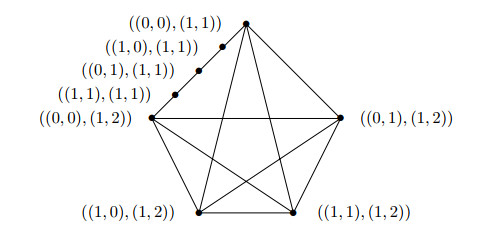
A subdivision of $ K_5 $ in $ Cl(\mathbb{F}_2\times \mathbb{F}_3) $




 DownLoad: