This paper investigates resilient sliding mode regulation with self-adjustable event transmission strategies for discrete-time singular networked plants (DTSNPs) suffering from deception cyberattacks. To counter malicious deception attacks, an integrated observer-aided sliding-mode regulation framework combined with event-based communication protocols is constructed to maintain the operational safety and satisfactory performance of DTSNPs. Using the singular value decomposition technique, novel linear matrix inequality-based sufficient conditions are derived to establish the regularity, causality, and uniform boundedness of the considered singular dynamic system. The elaborately derived sliding mode law further realizes finite-time convergence of all state trajectories toward a tiny bounded region near the system equilibrium point. A singular direct current (DC) motor system serving as an illustrative example verifies the state-estimation, disturbance-suppression, and actuator-attack-mitigation capabilities of the proposed resilient control scheme.
Citation: Zihan Zhao, Zhihao Wang, Xuetong Zhang, Chenglong Zhu, Guangming Zhuang. Anti-deception attack observer with self-adaptive event triggering for discrete singular networked control systems[J]. AIMS Mathematics, 2026, 11(11): 37954-37975. doi: 10.3934/math.20261467
This paper investigates resilient sliding mode regulation with self-adjustable event transmission strategies for discrete-time singular networked plants (DTSNPs) suffering from deception cyberattacks. To counter malicious deception attacks, an integrated observer-aided sliding-mode regulation framework combined with event-based communication protocols is constructed to maintain the operational safety and satisfactory performance of DTSNPs. Using the singular value decomposition technique, novel linear matrix inequality-based sufficient conditions are derived to establish the regularity, causality, and uniform boundedness of the considered singular dynamic system. The elaborately derived sliding mode law further realizes finite-time convergence of all state trajectories toward a tiny bounded region near the system equilibrium point. A singular direct current (DC) motor system serving as an illustrative example verifies the state-estimation, disturbance-suppression, and actuator-attack-mitigation capabilities of the proposed resilient control scheme.

| [1] |
P. Li, G. R. Duan, B. Zhang, L. M. Wang, Y. Z. Wang, Output position control of two-mass systems based on fully actuated system and singular perturbation approaches, IEEE/ASME Trans. Mech., 31 (2026), 1022–1033. https://doi.org/10.1109/TMECH.2025.3602374 doi: 10.1109/TMECH.2025.3602374
|
| [2] |
T. Saravanakumar, A. Stephen, X. S. Bai, Q. X. Zhu, T. W. Huang, New results on memory sampled-data control design for IT2 fuzzy singular systems with external disturbance, IEEE Trans. Cybern., 56 (2026), 788–801. https://doi.org/10.1109/TCYB.2025.3607281 doi: 10.1109/TCYB.2025.3607281
|
| [3] |
H. Liu, Z. X. Huang, S. Y. Xu, B. Niu, Z. A. Wei, Encrypted zonotopic set-based estimation for cyber-physical systems, IEEE Trans. Autom. Control, 71 (2026), 4834–4841. https://doi.org/10.1109/TAC.2026.3662529 doi: 10.1109/TAC.2026.3662529
|
| [4] |
Z. Lian, P. Shi, C. P. Lim, M. Saif, M. Chen, Designing optimal stealthy false data injection attacks in cyber-physical systems: leveraging historical data and Kullback-Leibler divergence constraints, IEEE Trans. Autom. Control, 71 (2026), 2316–2329. https://doi.org/10.1109/TAC.2025.3627271 doi: 10.1109/TAC.2025.3627271
|
| [5] |
G. L. Chen, J. W. Xia, G. M. Zhuang, J. S. Zhao, Improved delay-dependent stabilization for a class of networked control systems with nonlinear perturbations and two delay components, Appl. Math. Comput., 316 (2018), 1–17. https://doi.org/10.1016/j.amc.2017.07.072 doi: 10.1016/j.amc.2017.07.072
|
| [6] |
T. Yang, G. L. Chen, J. W. Xia, Z. Wang, Q. Sun, Robust $H_\infty$ filtering for polytopic uncertain stochastic systems under quantized sampled outputs, Appl. Math. Comput., 347 (2019), 688–701. https://doi.org/10.1016/j.amc.2018.11.035 doi: 10.1016/j.amc.2018.11.035
|
| [7] |
L. F. Qiu, J. S. Zhao, Adaptive designated-time fuzzy event-triggered tracking of constrained nonlinear systems and its applications in robotic systems, AIMS Math., 11 (2026), 15691–15715. https://doi.org/10.3934/math.2026645 doi: 10.3934/math.2026645
|
| [8] |
F. Amato, L. Y. Qiu, M. Tanveer, S. Cuomo, D. Annunziata, F. Giampaolo, et al., Towards one-shot federated learning: advances, challenges, and future directions, Neurocomputing, 664 (2026), 132088. https://doi.org/10.1016/j.neucom.2025.132088 doi: 10.1016/j.neucom.2025.132088
|
| [9] |
X. Wang, G. M. Zhuang, G. L. Chen, Q. Ma, J. W. Lu, Asynchronous mixed $H_\infty$ and passive control for fuzzy singular delayed Markovian jump system via hidden Markovian model mechanism, Appl. Math. Comput., 429 (2022), 127253. https://doi.org/10.1016/j.amc.2022.127253 doi: 10.1016/j.amc.2022.127253
|
| [10] |
Y. F. Chen, J. W. Xia, J. Zhang, J. H. Park, Q. Ma, Adaptive event-triggered resilient formation collision avoidance control for high-order nonlinear multiagent systems under DoS attacks, IEEE Trans. Reliab., 75 (2026), 3293–3304. https://doi.org/10.1109/TR.2026.3730000 doi: 10.1109/TR.2026.3730000
|
| [11] |
K. J. Fan, G. C. Pang, X. Y. Chen, J. D. Cao, J. L. Qiu, Fault-tolerant control of multi-agent systems using a Fourier series observer under DoS attacks and periodic intermittent faults, Syst. Control Lett., 211 (2026), 106397. https://doi.org/10.1016/j.sysconle.2026.106397 doi: 10.1016/j.sysconle.2026.106397
|
| [12] |
Y. J. Pang, G. M. Zhuang, J. W. Xia, X. P. Xie, $H_\infty$ security control for singular jump systems with actuator faults and DoS attacks under switching-like adaptive trigger and application to OCCP, IEEE Trans. Autom. Sci. Eng., 22 (2025), 7955–7966. https://doi.org/10.1109/TASE.2024.3475374 doi: 10.1109/TASE.2024.3475374
|
| [13] |
Y. Gao, W. Sun, S. F. Su, Prescribed-time adaptive output feedback tracking control for nonlinear systems with quantized input, Appl. Math. Comput., 463 (2024), 128370. https://doi.org/10.1016/j.amc.2023.128370 doi: 10.1016/j.amc.2023.128370
|
| [14] |
Z. H. Wang, X. T. Zhang, Z. H. Zhao, G. M. Zhuang, Observer-based neural integral sliding mode control for singular Markovian jump systems against actuator spoofing attacks, AIMS Math., 11 (2026), 30280–30303. https://doi.org/10.3934/math.20261200 doi: 10.3934/math.20261200
|
| [15] |
M. J. Hao, G. M. Zhuang, G. Z. Cui, J. W. Xia, Observer-based dynamic event-triggered finite-time switching control for networked discrete implicit DC circuit systems under aperiodic DoS attacks, IEEE Trans. Autom. Sci. Eng., 22 (2025), 22925–22937. https://doi.org/10.1109/TASE.2025.3624969 doi: 10.1109/TASE.2025.3624969
|
| [16] |
X. Y. Liang, J. W. Xia, G. L. Chen, H. S. Zhang, Z. Wang, Dissipativity-based sampled-data control for fuzzy Markovian jump systems, Appl. Math. Comput., 361 (2019), 552–564. https://doi.org/10.1016/j.amc.2019.05.038 doi: 10.1016/j.amc.2019.05.038
|
| [17] |
Y. L. Deng, H. S. Zhang, Y. Z. Dai, Y. Li, Interval stability/stabilization for linear stochastic switched systems with time-varying delay, Appl. Math. Comput., 428 (2022), 127201. https://doi.org/10.1016/j.amc.2022.127201 doi: 10.1016/j.amc.2022.127201
|
| [18] |
Y. Q. Lin, G. M. Zhuang, W. Sun, J. S. Zhao, Y. M. Chu, Resilient $H_\infty$ dynamic output feedback controller design for USJSs with time-varying delays, Appl. Math. Comput., 395 (2021), 125875. https://doi.org/10.1016/j.amc.2020.125875 doi: 10.1016/j.amc.2020.125875
|
| [19] |
G. L. Chen, L. Y. Wang, T. Yang, J. W. Xia, J. H. Park, Differentially private mean-square output consensus for heterogeneous multiagent systems: an asynchronous sampled-data interactions scheme, IEEE Trans. Inf. Forensics Secur., 20 (2025), 10189–10202. https://doi.org/10.1109/TIFS.2025.3613051 doi: 10.1109/TIFS.2025.3613051
|
| [20] |
G. L. Chen, M. Y. Tang, T. Yang, J. W. Xia, J. H. Park, Large delay-dependent nonuniform sampling load frequency control: a novel discrete-time feedback interconnection model approach, IEEE Trans. Control Syst. Technol., 34 (2026), 2781–2793. https://doi.org/10.1109/TCST.2026.3714907 doi: 10.1109/TCST.2026.3714907
|
| [21] |
T. Binazadeh, E. Jafari, Synchronization of chaotic fractional-order systems with input saturation and non-vanishing perturbations: ultimate boundedness analysis and transient behavior improvement, Int. J. Dyn. Control, 13 (2025), 134. https://doi.org/10.1007/s40435-025-01633-6 doi: 10.1007/s40435-025-01633-6
|
| [22] |
Y. Li, H. S. Zhang, T. T. Zhang, H. Geng, Interval stability/stabilization and $H_\infty$ feedback control for linear impulsive stochastic systems, Appl. Math. Comput., 437 (2023), 127552. https://doi.org/10.1016/j.amc.2022.127552 doi: 10.1016/j.amc.2022.127552
|
| [23] |
J. W. Xia, H. R. Yue, J. Zhang, J. H. Park, Fully distributed optimization algorithm for nonlinear multiagent systems under stochastic event-triggered mechanism, IEEE Trans. Ind. Inform., 21 (2025), 8248–8257. https://doi.org/10.1109/TII.2025.3586059 doi: 10.1109/TII.2025.3586059
|
| [24] |
Y. Liu, G. C. Pang, J. L. Qiu, X. Y. Chen, J. D. Cao, Fault-tolerant control for output regulation in multi-agent systems based on prescribed-time observers, IEEE Trans. Signal Inf. Process. Netw., 10 (2024), 729–739. https://doi.org/10.1109/TSIPN.2024.3458789 doi: 10.1109/TSIPN.2024.3458789
|
| [25] |
G. L. Chen, G. X. Du, J. W. Xia, X. P. Xie, Z. C. Wang, Aperiodic sampled-data $H_\infty$ control of vehicle active suspension system: an uncertain discrete-time model approach, IEEE Trans. Ind. Inform., 20 (2024), 6739–6750. https://doi.org/10.1109/TII.2024.3353856 doi: 10.1109/TII.2024.3353856
|
| [26] |
H. S. Zhang, G. M. Zhuang, W. Sun, Y. M. Li, J. W. Lu, $pth$ moment asymptotic interval stability and stabilization of linear stochastic systems via generalized $\mathscr{H}$-representation, Appl. Math. Comput., 386 (2020), 125520. https://doi.org/10.1016/j.amc.2020.125520 doi: 10.1016/j.amc.2020.125520
|
| [27] |
G. L. Chen, X. R. Liu, X. Q. Ren, J. W. Xia, J. H. Park, Asynchronous-based countermeasure for stealthy attack on aperiodic sampled-data control systems, IEEE Trans. Autom. Control, 70 (2025), 6159–6166. https://doi.org/10.1109/TAC.2025.3552745 doi: 10.1109/TAC.2025.3552745
|
| [28] |
X. Q. Wu, W. Sun, Adaptive fault tolerant optimal control for high-order fully actuated system and its application in spacecraft attitude tracking using reinforcement learning, Appl. Math. Comput., 512 (2026), 129774. https://doi.org/10.1016/j.amc.2025.129774 doi: 10.1016/j.amc.2025.129774
|
| [29] |
Y. F. Wu, G. M. Zhuang, M. M. Jiang, Y. Q. Wang, $H_\infty$ adaptive ETF control for degenerate jump systems under actuator faults and impulsive deception attacks with application to DCMIP device, Appl. Math. Comput., 489 (2025), 129158. https://doi.org/10.1016/j.amc.2024.129158 doi: 10.1016/j.amc.2024.129158
|
| [30] |
M. Q. Xing, Y. Q. Wang, G. M. Zhuang, F. Chen, Event-based asynchronous and resilient filtering for singular Markov jump LPV systems against deception attacks, Appl. Math. Comput., 403 (2021), 126176. https://doi.org/10.1016/j.amc.2021.126176 doi: 10.1016/j.amc.2021.126176
|
| [31] |
R. Shang, W. Sun, Y. G. Sun, Preassigned finite-time load frequency control of power systems with gain learning and deferred prescribed performance, IEEE Trans. Consum. Electron., 2026. https://doi.org/10.1109/TCE.2026.3730422 doi: 10.1109/TCE.2026.3730422
|
| [32] |
G. L. Chen, C. C. Fan, J. Sun, J. W. Xia, Mean square exponential stability analysis for Itô stochastic systems with aperiodic sampling and multiple time-delays, IEEE Trans. Autom. Control, 67 (2022), 2473–2480. https://doi.org/10.1109/TAC.2021.3074848 doi: 10.1109/TAC.2021.3074848
|
| [33] |
C. L. Zhu, X. L. Ma, W. P. Ding, W. Pedrycz, J. M. Zhan, Long-term prediction model for fuzzy granular time series based on trend filter decomposition and ensemble learning, IEEE Trans. Cybern., 55 (2025), 4514–4527. https://doi.org/10.1109/TCYB.2025.3582771 doi: 10.1109/TCYB.2025.3582771
|
| [34] |
W. J. Yang, J. W. Xia, M. Yu, N. Zhang, Decentralized adaptive funnel control of uncertain large-scale interconnected nonlinear system, Appl. Math. Comput., 441 (2023), 127694. https://doi.org/10.1016/j.amc.2022.127694 doi: 10.1016/j.amc.2022.127694
|
| [35] |
C. L. Zhu, X. L. Ma, P. D'Urso, Y. H. Qian, W. P. Ding, J. M. Zhan, Long-term multivariate time-series forecasting model based on Gaussian fuzzy information granules, IEEE Trans. Fuzzy Syst., 32 (2024), 6424–6438. https://doi.org/10.1109/TFUZZ.2024.3449769 doi: 10.1109/TFUZZ.2024.3449769
|
| [36] |
F. Basile, G. De Tommasi, S. Dubbioso, F. Fiorenza, A sequence-based approach for the verification of current-state opacity in bounded discrete event systems, IEEE Trans. Autom. Control, 71 (2026), 4340–4354. https://doi.org/10.1109/TAC.2026.3653378 doi: 10.1109/TAC.2026.3653378
|
| [37] |
J. S. Zhao, L. F. Qiu, X. P. Xie, Z. Y. Sun, Finite-time stabilization of stochastic nonlinear systems and its applications in ship maneuvering systems, IEEE Trans. Fuzzy Syst., 32 (2024), 1023–1035. https://doi.org/10.1109/TFUZZ.2023.3317177 doi: 10.1109/TFUZZ.2023.3317177
|
| [38] |
H. S. Zhang, Y. Z. Dai, C. L. Zhu, Region stability analysis and precise tracking control of linear stochastic systems, Appl. Math. Comput., 465 (2024), 128402. https://doi.org/10.1016/j.amc.2023.128402 doi: 10.1016/j.amc.2023.128402
|
| [39] |
J. S. Zhao, Y. X. Yuan, Z. Y. Sun, X. P. Xie, Applications to the dynamics of the suspension system of fast finite time stability in probability of p-norm stochastic nonlinear systems, Appl. Math. Comput., 457 (2023), 128221. https://doi.org/10.1016/j.amc.2023.128221 doi: 10.1016/j.amc.2023.128221
|
| [40] |
A. R. Wu, H. S. Zhang, J. W. Xia, Interval stabilization for switched stochastic positive systems: a state-dependent switching scheme with convergence rate constraint, IEEE Trans. Consum. Electron., 72 (2026), 3456–3466. https://doi.org/10.1109/TCE.2026.3683018 doi: 10.1109/TCE.2026.3683018
|
| [41] |
M. Q. Cheng, J. S. Zhao, X. P. Xie, Z. Y. Sun, A novel finite-time stability criteria and controller design for nonlinear impulsive systems, Appl. Math. Comput., 479 (2024), 128876. https://doi.org/10.1016/j.amc.2024.128876 doi: 10.1016/j.amc.2024.128876
|
| [42] |
D. X. Ren, G. C. Pang, X. J. Mou, X. Y. Chen, J. L. Qiu, J. D. Cao, Simultaneous fault-tolerant consensus control and disturbance suppression for multi-agent systems with polynomial form fault under switching topology, Syst. Control Lett., 193 (2024), 105946. https://doi.org/10.1016/j.sysconle.2024.105946 doi: 10.1016/j.sysconle.2024.105946
|
| [43] |
Y. Q. Liu, G. M. Zhuang, J. S. Zhao, J. W. Lu, Z. K. Wang, $H_\infty$ admissibilization for time-varying delayed nonlinear singular impulsive jump systems based on memory state-feedback control, Appl. Math. Comput., 447 (2023), 127921. https://doi.org/10.1016/j.amc.2023.127921 doi: 10.1016/j.amc.2023.127921
|
| [44] |
X. R. Li, H. S. Zhang, S. F. Su, W. Sun, Control performance orientated region stabilization and $H_\infty$ control of discrete stochastic systems: a data-driven approach, IEEE Trans. Autom. Sci. Eng., 22 (2025), 21376–21386. https://doi.org/10.1109/TASE.2025.3610951 doi: 10.1109/TASE.2025.3610951
|
| [45] |
J. S. Zhao, X. Zhang, Z. Y. Sun, W. H. Zhang, Event-triggered-based adaptive neural network secure strategy for stochastic networked nonlinear systems under DoS attacks, IEEE Trans. Autom. Sci. Eng., 22 (2025), 18920–18932. https://doi.org/10.1109/TASE.2025.3592216 doi: 10.1109/TASE.2025.3592216
|
| [46] |
L. X. Zhu, Y. Q. Wang, G. M. Zhuang, G. F. Song, Dynamic-memory event-based asynchronous dissipative filtering for T-S fuzzy singular semi-Markov jump systems against multi-cyber attacks, Appl. Math. Comput., 431 (2022), 127352. https://doi.org/10.1016/j.amc.2022.127352 doi: 10.1016/j.amc.2022.127352
|
| [47] |
J. H. Yuan, W. Sun, Y. Sun, S. F. Su, Mask privacy preservation prescribed-time consensus control for nonlinear multi-agent systems, IEEE Trans. Autom. Sci. Eng., 22 (2025), 11554–11563. https://doi.org/10.1109/TASE.2025.3535924 doi: 10.1109/TASE.2025.3535924
|
| [48] |
G. M. Zhuang, Y. J. Pang, G. D. Zong, J. W. Xia, NN-based dynamic adaptive triggered security compensation feedback control for implicit power systems subjected to FDI attacks, IEEE Int. Things J., 12 (2025), 50493–50502. https://doi.org/10.1109/JIOT.2025.3609853 doi: 10.1109/JIOT.2025.3609853
|
| [49] |
E. Jafari, T. Binazadeh, A novel event-triggered nonlinear control approach for descriptor systems with time-varying delay and input saturation constraints, Eur. J. Control, 86 (2025), 101384. https://doi.org/10.1016/j.ejcon.2025.101384 doi: 10.1016/j.ejcon.2025.101384
|
| [50] |
F. Amato, G. De Tommasi, S. Dubbioso, F. Fiorenza, D. G. Lui, Finite-time stability and stabilization for linear time-varying descriptor systems, IFAC PapersOnLine, 59 (2025), 61–66. https://doi.org/10.1016/j.ifacol.2025.09.525 doi: 10.1016/j.ifacol.2025.09.525
|
| [51] |
G. M. Zhuang, Y. R. Fu, J. W. Xia, Y. Q. Wang, Estimator-based attack-tolerant compensation control for discrete singular systems under FDI attacks and hybrid IDVs-dependent event-triggered mechanism, IEEE Trans. Autom. Sci. Eng., 22 (2025), 23620–23630. https://doi.org/10.1109/TASE.2025.3629330 doi: 10.1109/TASE.2025.3629330
|
| [52] |
W. Zhang, G. C. Pang, X. Y. Chen, X. J. Mou, J. L. Qiu, J. D. Cao, Projective group consensus fault-tolerant control for multi-agent systems under time-varying polynomial faults and input constraints, Commun. Nonlinear Sci. Numer. Simul., 161 (2026), 110208. https://doi.org/10.1016/j.cnsns.2026.110208 doi: 10.1016/j.cnsns.2026.110208
|
| [53] |
Y. J. Zhao, G. C. Pang, X. Y. Chen, J. L. Qiu, J. D. Cao, Robust fault-tolerant control for switched systems based on adaptive unknown input observer, Commun. Nonlinear Sci. Numer. Simul., 140 (2025), 108416. https://doi.org/10.1016/j.cnsns.2024.108416 doi: 10.1016/j.cnsns.2024.108416
|
| [54] |
Z. R. Cao, Y. Niu, J. Song, Finite-time sliding-mode control of Markovian jump cyber-physical systems against randomly occurring injection attacks, IEEE Trans. Autom. Control, 65 (2020), 1264–1271. https://doi.org/10.1109/TAC.2019.2926156 doi: 10.1109/TAC.2019.2926156
|
Figures(11) / Tables(1)

Zihan Zhao, Zhihao Wang, Xuetong Zhang, Chenglong Zhu, Guangming Zhuang. Anti-deception attack observer with self-adaptive event triggering for discrete singular networked control systems[J]. AIMS Mathematics, 2026, 11(11): 37954-37975. doi: 10.3934/math.20261467

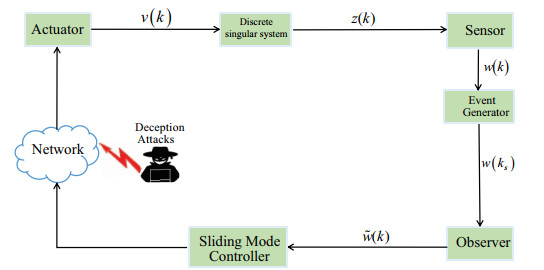
Framework of event-triggered observer sliding mode control for discrete singular networked systems subject to deception attacks
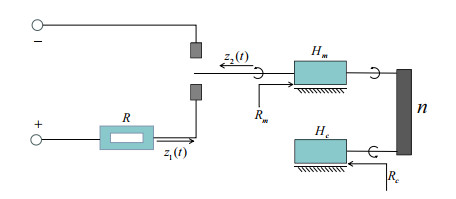
Block diagram of a DC motor singular system
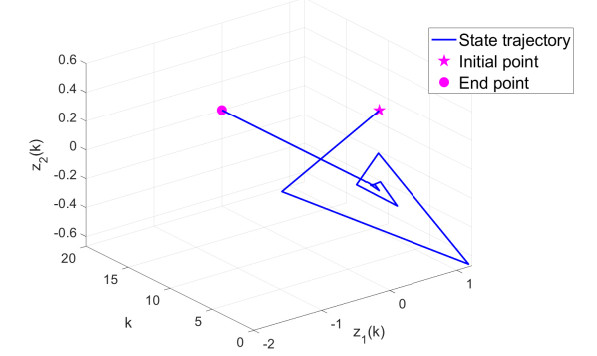
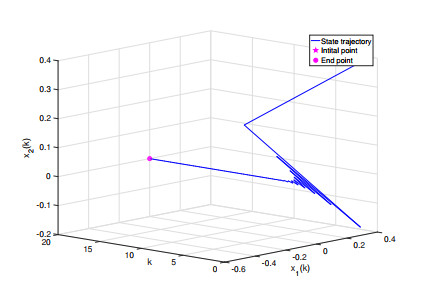
3D trajectory of system state $ z(k) $
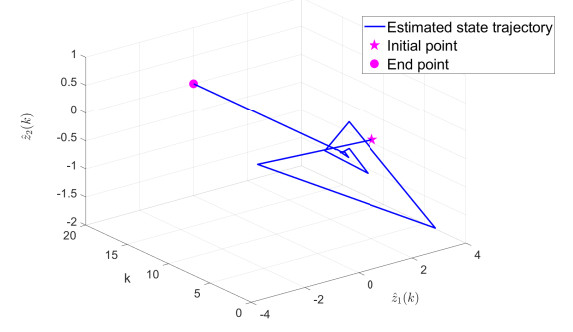
3D trajectory of estimated state $ \hat{z}(k) $
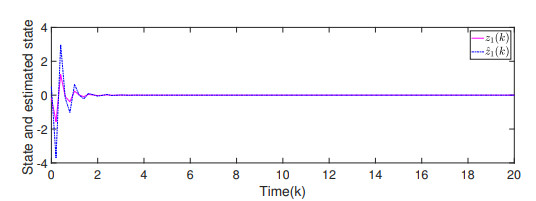
Curves of $ z_1(k) $ and its estimate $ \hat{z}_1(k) $
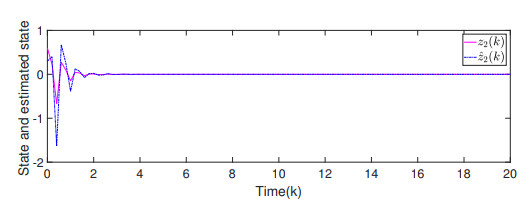
Curves of $ z_2(k) $ and its estimate $ \hat{z}_2(k) $
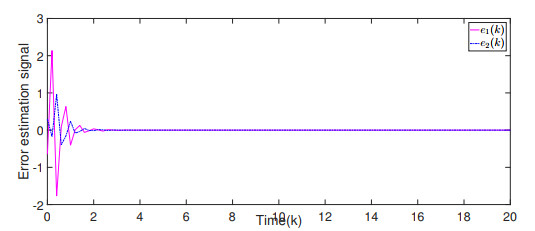
State estimation errors $ e_1(k) $ and $ e_2(k) $
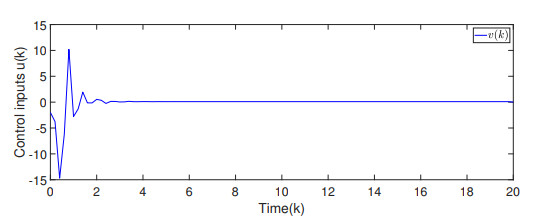
Response curve of control input $ v(k) $
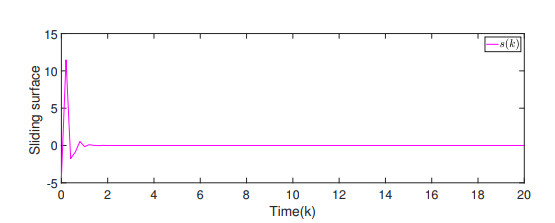
Response curve of sliding surface $ s(k) $
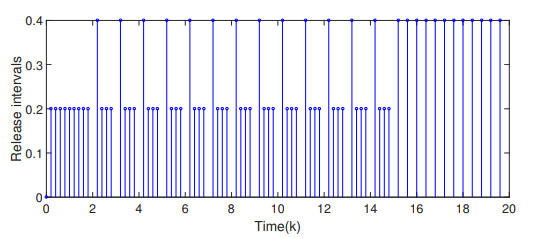
Event-triggered release instants and intervals
Static time-triggered release instants and intervals




 DownLoad: