The exponentiated-G family provides a convenient framework for introducing additional shape parameters into flexible lifetime distributions. In this study, we proposed a new two-parameter Exponentiated QLindley (EQL) distribution as an extension of the QLindley model. The proposed distribution exhibits a wide range of density and hazard rate shapes while retaining a tractable parametric structure, with the QLindley distribution obtained as the special case $ \alpha = 1 $. We derived several mathematical properties of the EQL distribution, including its quantile function, moments, generalized order statistics, reliability characteristics, and actuarial risk measures. We considered both classical and Bayesian estimation methods and conducted a comprehensive Monte Carlo simulation study to investigate their finite-sample performance under different parameter configurations and sample sizes. We illustrated the empirical applicability of the EQL model using four real datasets involving reliability, customer waiting times, air pollution in Delhi, India, and COVID-19 mortality in the Netherlands. We compared the proposed distribution with several well-known competing models using information criteria and goodness-of-fit statistics. The results showed that the EQL distribution provides a competitive, flexible alternative for modeling positive, right-skewed data, with the additional shape parameter significantly improving fit relative to the QLindley submodel in all four applications.
Citation: Sajadul Hussain, Partha Jyoti Hazarika, Ankur Chakraborty, Diego I. Gallardo. An exponentiated QLindley distribution: properties, inference, and applications[J]. AIMS Mathematics, 2026, 11(11): 37322-37354. doi: 10.3934/math.20261444
The exponentiated-G family provides a convenient framework for introducing additional shape parameters into flexible lifetime distributions. In this study, we proposed a new two-parameter Exponentiated QLindley (EQL) distribution as an extension of the QLindley model. The proposed distribution exhibits a wide range of density and hazard rate shapes while retaining a tractable parametric structure, with the QLindley distribution obtained as the special case $ \alpha = 1 $. We derived several mathematical properties of the EQL distribution, including its quantile function, moments, generalized order statistics, reliability characteristics, and actuarial risk measures. We considered both classical and Bayesian estimation methods and conducted a comprehensive Monte Carlo simulation study to investigate their finite-sample performance under different parameter configurations and sample sizes. We illustrated the empirical applicability of the EQL model using four real datasets involving reliability, customer waiting times, air pollution in Delhi, India, and COVID-19 mortality in the Netherlands. We compared the proposed distribution with several well-known competing models using information criteria and goodness-of-fit statistics. The results showed that the EQL distribution provides a competitive, flexible alternative for modeling positive, right-skewed data, with the additional shape parameter significantly improving fit relative to the QLindley submodel in all four applications.

| [1] |
N. Eugene, C. Lee, F. Famoye, Beta-normal distribution and its applications, Commun. Stat. Theory Methods, 31 (2002), 497–512. https://doi.org/10.1081/STA-120003130 doi: 10.1081/STA-120003130
|
| [2] |
M. Bourguignon, R. B. Silva, G. M. Cordeiro, The Weibull-G family of probability distributions, J. Data Sci., 12 (2014), 53–68. https://doi.org/10.6339/JDS.2014.12(1).1210 doi: 10.6339/JDS.2014.12(1).1210
|
| [3] |
S. A. Lone, T. N. Sindhu, A. Shafiq, F. Jarad, A novel extended Gumbel Type Ⅱ model with statistical inference and Covid-19 applications, Results Phys., 35 (2022), 105377. https://doi.org/10.1016/j.rinp.2022.105377 doi: 10.1016/j.rinp.2022.105377
|
| [4] |
J. T. Eghwerido, L. C. Nzei, A. E. Omotoye, F. I. Agu, The Teissier-G family of distributions: properties and applications, Math. Slovaca, 72 (2022), 1301–1318. https://doi.org/10.1515/ms-2022-0089 doi: 10.1515/ms-2022-0089
|
| [5] |
O. H. Odhah, H. M. Alshanbari, Z. Ahmad, G. S. Rao, A weighted cosine-G family of distributions: properties and illustration using time-to-event data, Axioms, 12 (2023), 849. https://doi.org/10.3390/axioms12090849 doi: 10.3390/axioms12090849
|
| [6] |
H. Al-Mofleh, M. Elgarhy, A. Afify, M. Zannon, Type Ⅱ exponentiated half logistic generated family of distributions with applications, Electron. J. Appl. Stat. Anal., 13 (2020), 536–561. https://doi.org/10.1285/i20705948v13n2p536 doi: 10.1285/i20705948v13n2p536
|
| [7] |
S. M. Alghamdi, M. Shrahili, A. S. Hassan, R. E. Mohamed, I. Elbatal, M. Elgarhy, Analysis of milk production and failure data: using unit exponentiated half logistic power series class of distributions, Symmetry, 15 (2023), 714. https://doi.org/10.3390/sym15030714 doi: 10.3390/sym15030714
|
| [8] |
M. A. Aldahlan, F. Jamal, C. Chesneau, I. Elbatal, M. Elgarhy, Exponentiated power generalized Weibull power series family of distributions: properties, estimation and applications, PLoS One, 15 (2020), e0230004. https://doi.org/10.1371/journal.pone.0230004 doi: 10.1371/journal.pone.0230004
|
| [9] |
A. Ahmad, A. Ahmad, Y. A. Tashkandy, M. E. Bakr, G. T. Mekiso, O. S. Balogun, et al., A study on the new logarithmic-G family with statistical properties, simulations, and different data analysis, Sci. Rep., 15 (2025), 15069. https://doi.org/10.1038/s41598-025-99525-4 doi: 10.1038/s41598-025-99525-4
|
| [10] |
S. Zacks, Estimating the shift to wear-out of systems having exponential-Weibull life distributions, Oper. Res., 32 (1984), 741–749. https://doi.org/10.1287/opre.32.3.741 doi: 10.1287/opre.32.3.741
|
| [11] |
G. S. Mudholkar, D. K. Srivastava, Exponentiated Weibull family for analyzing bathtub failure-rate data, IEEE Trans. Reliab., 42 (1993), 299–302. https://doi.org/10.1109/24.229504 doi: 10.1109/24.229504
|
| [12] |
S. A. Lone, Q. Ramzan, L. A. AL-Essa, The exponentiated Ailamujia distribution: properties and application, Alexandria Eng. J., 108 (2024), 1–15. https://doi.org/10.1016/j.aej.2024.09.036 doi: 10.1016/j.aej.2024.09.036
|
| [13] |
S. Nadarajah, S. Kotz, The exponentiated Fréchet distribution, Interstat Electron. J., 14 (2003), 01–07. |
| [14] |
S. Nadarajah, The exponentiated Gumbel distribution with climate application, Environmetrics, 17 (2006), 13–23. https://doi.org/10.1002/env.739 doi: 10.1002/env.739
|
| [15] |
S. Nadarajah, H. S. Bakouch, R. Tahmasbi, A generalized Lindley distribution, Sankhya B, 73 (2011), 331–359. https://doi.org/10.1007/s13571-011-0025-9 doi: 10.1007/s13571-011-0025-9
|
| [16] |
M. Nassar, S. Dey, D. Kumar, A new generalization of the exponentiated Pareto distribution with an application, Am. J. Math. Manag. Sci., 37 (2018), 217–242. https://doi.org/10.1080/01966324.2017.1396942 doi: 10.1080/01966324.2017.1396942
|
| [17] |
H. M. Salem, The exponentiated Lomax distribution: different estimation methods, Am. J. Appl. Math. Stat., 2 (2014), 364–368. https://doi.org/10.12691/ajams-2-6-2 doi: 10.12691/ajams-2-6-2
|
| [18] |
B. Peng, Z. Xu, M. Wang, The exponentiated Lindley geometric distribution with applications, Entropy, 21 (2019), 510. https://doi.org/10.3390/e21050510 doi: 10.3390/e21050510
|
| [19] |
A. M. Alomair, M. Ahmed, S. Tariq, M. Ahsan-ul-Haq, J. Talib, An exponentiated XLindley distribution with properties, inference and applications, Heliyon, 10 (2024), e25472. https://doi.org/10.1016/j.heliyon.2024.e25472 doi: 10.1016/j.heliyon.2024.e25472
|
| [20] |
S. M. T. K. MirMostafaee, The exponentiated new XLindley distribution: properties and applications, J. Data Sci. Model., 2 (2024), 185–208. https://doi.org/10.22054/jdsm.2024.81152.1051 doi: 10.22054/jdsm.2024.81152.1051
|
| [21] |
E. S. Alotaibi, An exponentiated ZLindley distribution with application to breast cancer and radiotherapy data, J. Radiat. Res. Appl. Sci., 18 (2025), 101755. https://doi.org/10.1016/j.jrras.2025.101755 doi: 10.1016/j.jrras.2025.101755
|
| [22] |
A. M. Sarhan, A. S. M. Al Luhayb, R. Alotaibi, M. E. Sobh, The exponentiated modified Lindley distribution with diverse biomedical and epidemiological applications, AIMS Math., 11 (2026), 2313–2340. https://doi.org/10.3934/math.2026093 doi: 10.3934/math.2026093
|
| [23] |
N. Saaidia, R. Pakyari, H. Zeghdoudi, The Q-Lindley distribution: goodness-of-fit tests, modeling, inference, and applications, J. Stat. Theory Appl., 25 (2026), 6. https://doi.org/10.1007/s44199-025-00148-5 doi: 10.1007/s44199-025-00148-5
|
| [24] |
R. Elbarougy, J. Das, P. J. Hazarika, M. S. Eliwa, The bimodal two-piece skew-normal distribution: mathematical theory, reliability aging measures, and simulation-oriented decision analysis, AIMS Math., 11 (2026), 511–542. https://doi.org/10.3934/math.2026022 doi: 10.3934/math.2026022
|
| [25] |
R. Jiang, P. Ji, X. Xiao, Aging property of unimodal failure rate models, Reliab. Eng. Syst. Saf., 79 (2003), 113–116. https://doi.org/10.1016/S0951-8320(02)00175-8 doi: 10.1016/S0951-8320(02)00175-8
|
| [26] |
B. Efron, Bootstrap methods: another look at the jackknife, In: Breakthroughs in statistics: methodology and distribution, New York: Springer, 1992. https://doi.org/10.1007/978-1-4612-4380-9_41 |
| [27] |
M. E. Ghitany, D. K. Al-Mutairi, N. Balakrishnan, L. J. Al-Enezi, Power Lindley distribution and associated inference, Comput. Stat. Data Anal., 64 (2013), 20–33. https://doi.org/10.1016/j.csda.2013.02.026 doi: 10.1016/j.csda.2013.02.026
|
| [28] |
S. Sen, S. S. Maiti, N. Chandra, The xgamma distribution: statistical properties and application, J. Mod. Appl. Stat. Methods, 15 (2016), 38. https://doi.org/10.22237/jmasm/1462077420 doi: 10.22237/jmasm/1462077420
|
| [29] |
C. Chesneau, V. Kumar, M. Khetan, M. Arshad, On a modified weighted exponential distribution with applications, Math. Comput. Appl., 27 (2022), 17. https://doi.org/10.3390/mca27010017 doi: 10.3390/mca27010017
|
| [30] |
M. G. M. Ghazal, H. M. Hasaballah, Exponentiated rayleigh distribution: a Bayes study using MCMC approach based on unified hybrid censored data, J. Adv. Math., 12 (2017), 6863–6880. |
| [31] |
S. Chouia, H. Zeghdoudi, The XLindley distribution: properties and application, J. Stat. Theory Appl., 20 (2021), 318–327. https://doi.org/10.2991/jsta.d.210607.001 doi: 10.2991/jsta.d.210607.001
|
| [32] |
M. Elgarhy, Garhy distribution with different estimation methods and applications to engineering and medical data, Rev. Int. Métodos Numér. Cálc. Diseño Ing., 42 (2026), 90. Available from: https://www.scipedia.com/public/Elgarhy_2026a |
| [33] |
O. J. Obulezi, Obulezi distribution: a novel one-parameter distribution for lifetime data modeling, Mod. J. Stat., 2 (2025), 32–74. https://doi.org/10.64389/mjs.2026.02140 doi: 10.64389/mjs.2026.02140
|
| [34] |
H. A. Khogeer, An improved one-parameter weighted distribution with mathematical properties, estimation, and applications, Alex. Eng. J., 104 (2024), 222–234. https://doi.org/10.1016/j.aej.2024.06.005 doi: 10.1016/j.aej.2024.06.005
|
| [35] |
A. M. Abd Al-Fattah, A. A. El-Helbawy, G. R. Al-Dayian, Inverted Kumaraswamy distribution: properties and estimation, Pak. J. Statist., 33 (2017), 37–61. |
| [36] |
S. Nadarajah, F. Haghighi, An extension of the exponential distribution, Statistics, 45 (2011), 543–558. https://doi.org/10.1080/02331881003678678 doi: 10.1080/02331881003678678
|
| [37] |
D. N. P. Murthy, M. Xie, R. Jiang, Weibull models, New York: John Wiley & Sons, 2004. https://doi.org/10.1002/047147326X |
| [38] |
M. E. Ghitany, B. Atieh, S. Nadarajah, Lindley distribution and its application, Math. Comput. Simul., 78 (2008), 493–506. https://doi.org/10.1016/j.matcom.2007.06.007 doi: 10.1016/j.matcom.2007.06.007
|
| [39] |
H. M. Almongy, E. M. Almetwally, H. M. Aljohani, A. S. Alghamdi, E. H. Hafez, A new extended Rayleigh distribution with applications of COVID-19 data, Results Phys., 23 (2021), 104012. https://doi.org/10.1016/j.rinp.2021.104012 doi: 10.1016/j.rinp.2021.104012
|
 math-11-11-1444 -supplementary.pdf |
 |
Figures(6) / Tables(6)

Sajadul Hussain, Partha Jyoti Hazarika, Ankur Chakraborty, Diego I. Gallardo. An exponentiated QLindley distribution: properties, inference, and applications[J]. AIMS Mathematics, 2026, 11(11): 37322-37354. doi: 10.3934/math.20261444

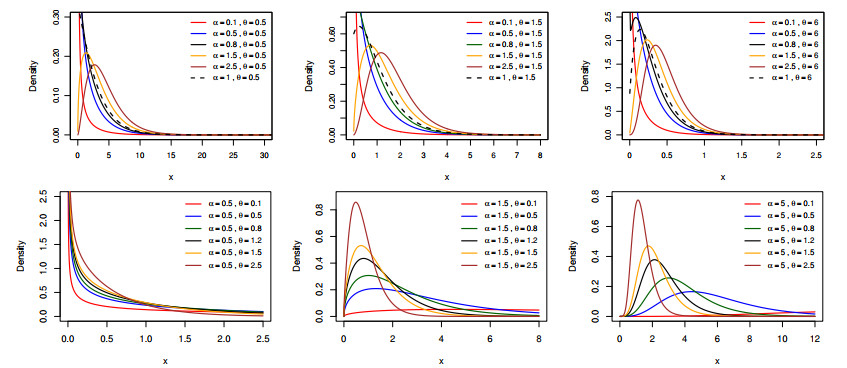
Density shapes of the EQL distribution for selected combinations of the parameters $ \alpha $ and $ \theta $
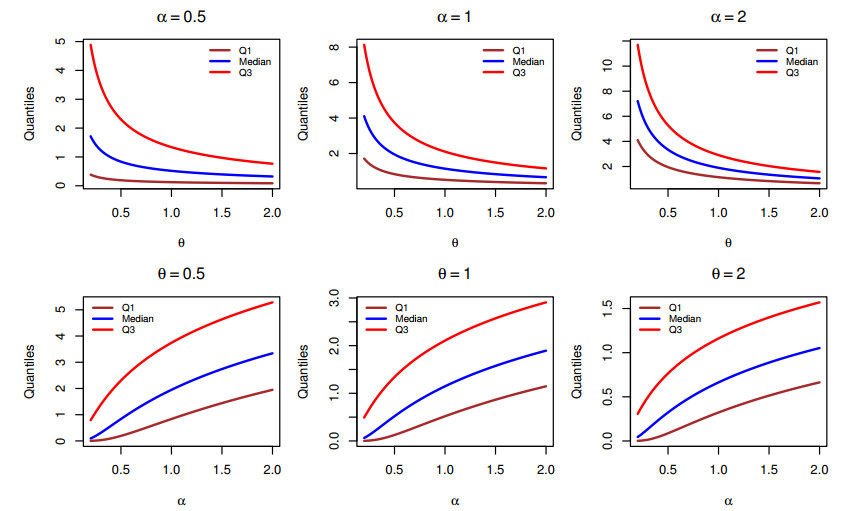
First quartile, median, and third quartile of the EQL distribution for different combinations of $ \alpha $ and $ \theta $
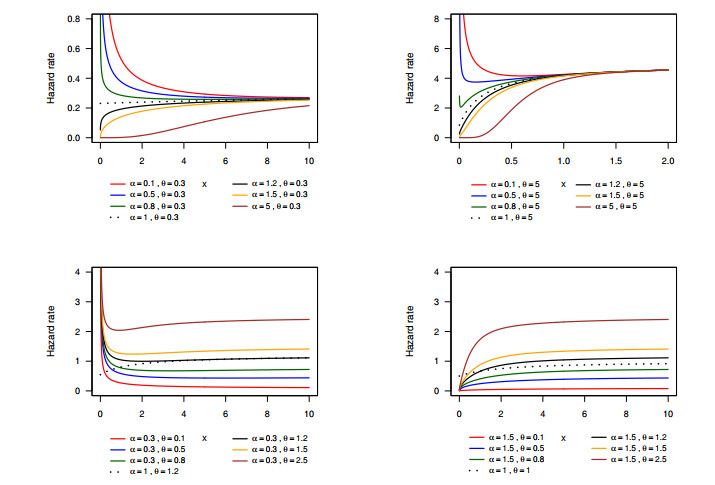
Hazard rate functions of the EQL distribution for selected combinations of $ \alpha $ and $ \theta $
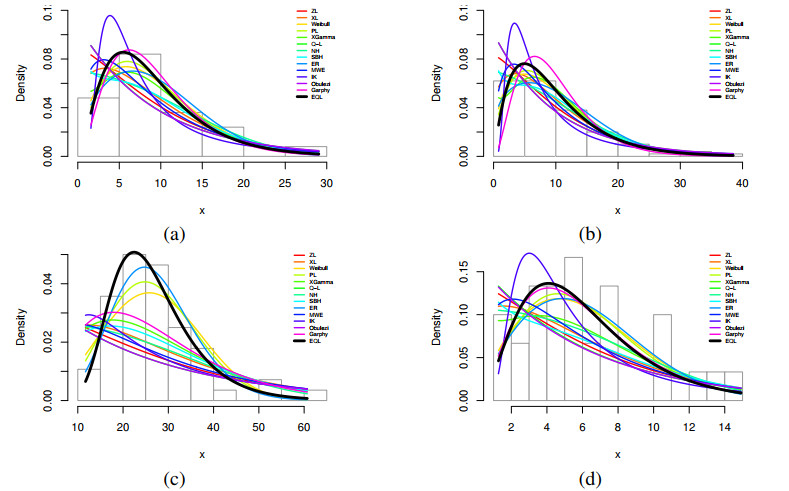
Histograms and fitted EQL densities for (a) Dataset Ⅰ, (b) Dataset Ⅱ, (c) Dataset Ⅲ, and (d) Dataset Ⅳ
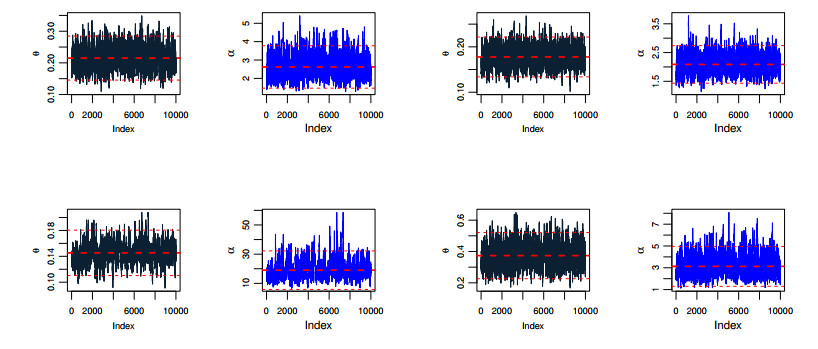
MCMC trace plots for $ \alpha $ and $ \theta $ for the four datasets. Datasets Ⅰ and Ⅱ are shown in the top row and Datasets Ⅲ and Ⅳ in the bottom row
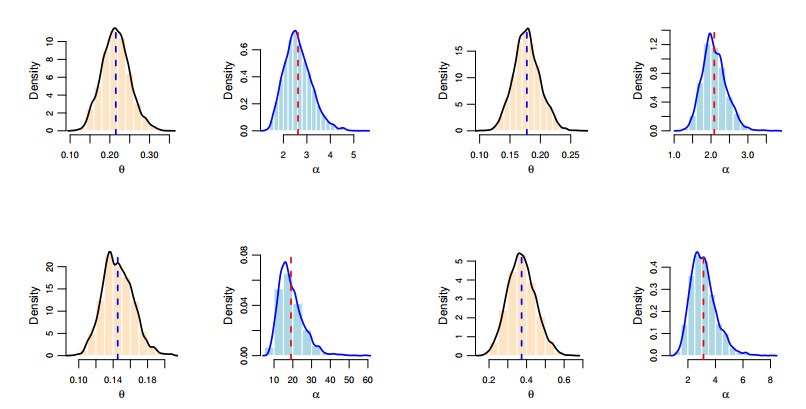
Posterior density plots for $ \alpha $ and $ \theta $ for the four datasets




 DownLoad: