In this paper, we investigated the asymptotic stability of a class of linear difference systems with multiple arithmetic delays. The considered system extends earlier two-delay models involving an additional parameter $ a\in(0, 1) $ to the case of $ N $ arithmetic delays. We analyzed the location of the characteristic roots with respect to the open unit disk. The arithmetic structure of the delays enables the delayed terms to be represented through a finite delay polynomial. Based on this structure, critical parameter values determining the stability boundary were obtained. The results provide a sharp stability threshold and also yield a simple sufficient stability bound. Numerical illustrations were presented to demonstrate the difference between the sharp stability boundary and the sufficient stability region. Furthermore, an application to a nonlinear discrete-time population model with distributed delays and an Allee-type saturating feedback function was presented, showing how the obtained sharp stability threshold can be interpreted as a critical bound for the local stability of a positive population equilibrium.
Citation: Serbun Ufuk Değer. Sharp stability boundaries for discrete-time linear delay systems with multiple arithmetic delays[J]. AIMS Mathematics, 2026, 11(11): 37099-37132. doi: 10.3934/math.20261434
In this paper, we investigated the asymptotic stability of a class of linear difference systems with multiple arithmetic delays. The considered system extends earlier two-delay models involving an additional parameter $ a\in(0, 1) $ to the case of $ N $ arithmetic delays. We analyzed the location of the characteristic roots with respect to the open unit disk. The arithmetic structure of the delays enables the delayed terms to be represented through a finite delay polynomial. Based on this structure, critical parameter values determining the stability boundary were obtained. The results provide a sharp stability threshold and also yield a simple sufficient stability bound. Numerical illustrations were presented to demonstrate the difference between the sharp stability boundary and the sufficient stability region. Furthermore, an application to a nonlinear discrete-time population model with distributed delays and an Allee-type saturating feedback function was presented, showing how the obtained sharp stability threshold can be interpreted as a critical bound for the local stability of a positive population equilibrium.

| [1] |
S. N. Elaydi, R. J. Sacker, Population models with Allee effect: A new model, J. Biol. Dyn., 4 (2010), 397–408. https://doi.org/10.1080/17513750903377434 doi: 10.1080/17513750903377434
|
| [2] |
S. A. Levin, R. M. May, A note on difference-delay equations, Theor. Popul. Biol., 9 (1976), 178–187. https://doi.org/10.1016/0040-5809(76)90043-5 doi: 10.1016/0040-5809(76)90043-5
|
| [3] |
C. W. Clark, A delayed-recruitment model of population dynamics, with an application to baleen whale populations, J. Math. Biol., 3 (1976), 381–391. |
| [4] |
S. A. Kuruklis, The asymptotic stability of $x_{n+1}-ax_n+bx_{n-k} = 0$, J. Math. Anal. Appl., 188 (1994), 719–731. https://doi.org/10.1006/jmaa.1994.1457 doi: 10.1006/jmaa.1994.1457
|
| [5] |
H. Matsunaga, T. Hara, The asymptotic stability of a two-dimensional linear delay difference equation, Dyn. Contin. Discrete Impuls. Syst., 6 (1999), 465–473. |
| [6] |
H. Matsunaga, Stability regions for a class of delay difference systems, In: Difference and Differential Equations, Providence: American Mathematical Society, 42 (2004), 273–283. |
| [7] |
S. U. Değer, Y. Bolat, Stability conditions for a class of linear delay difference systems, Cogent Math., 4 (2017), 1294445. https://doi.org/10.1080/23311835.2017.1294445 doi: 10.1080/23311835.2017.1294445
|
| [8] |
R. Ogita, H. Matsunaga, T. Hara, Asymptotic stability condition for a class of linear delay difference equations of higher order, J. Math. Anal. Appl., 248 (2000), 83–96. https://doi.org/10.1006/jmaa.2000.6868 doi: 10.1006/jmaa.2000.6868
|
| [9] |
Y. Nagabuchi, Asymptotic stability for a linear difference system with two delays, Nonlinear Anal.-Theory Methods Appl., 47 (2001), 4117–4128. https://doi.org/10.1016/S0362-546X(01)00529-6 doi: 10.1016/S0362-546X(01)00529-6
|
| [10] |
M. M. Kipnis, V. V. Malygina, The stability cone for a matrix delay difference equation, IJMMS, 2011 (2011), 860326. https://doi.org/10.1155/2011/860326 doi: 10.1155/2011/860326
|
| [11] |
S. A. Ivanov, M. M. Kipnis, V. V. Malygina, The stability cone for a difference matrix equation with two delays, ISRN Appl. Math., 2011 (2011), 910936. https://doi.org/10.5402/2011/910936 doi: 10.5402/2011/910936
|
| [12] |
J. Čermák, J. Jánský, Stability and periodic investigations of linear planar difference systems, Math. Methods Appl. Sci., 39 (2016), 5343–5354. https://doi.org/10.1002/mma.3919 doi: 10.1002/mma.3919
|
| [13] |
P. He, H. Zhang, S. F. Su, A sliding mode control method with variable convergence rate for nonlinear impulsive stochastic systems, IEEE Trans. Cybern., 55 (2025), 2213–2222. https://doi.org/10.1109/TCYB.2025.3551668 doi: 10.1109/TCYB.2025.3551668
|
| [14] |
H. Geng, H. Zhang, S. F. Su, Asynchronously switched control with variable convergence rate for switched nonlinear systems: A persistent Dwell-time scheme, IEEE Trans. Fuzzy Syst., 32 (2024), 6695–6707. https://doi.org/10.1109/TFUZZ.2024.3459860 doi: 10.1109/TFUZZ.2024.3459860
|
| [15] |
A. Wu, H. Zhang, J. Xia, Interval stabilization for switched stochastic positive systems: A statedependent switching scheme With convergence rate constraint, IEEE Trans. Consumer Elect., 72 (2026), 3456–3466. https://doi.org/10.1109/TCE.2026.3683018 doi: 10.1109/TCE.2026.3683018
|
| [16] |
H. Liu, D. Tong, Q. Chen, W. Zhou, Adaptive predefined-time intralayer and interlayer synchronization of multilayer networks, IEEE Trans. Syst. Man Cybern. Syst., 56 (2026), 6467–6478. https://doi.org/10.1109/TSMC.2026.3713217 doi: 10.1109/TSMC.2026.3713217
|
| [17] |
X. Ye, Q. Chen, D. Tong, Event-triggered exponential synchronization for delayed multi-agent systems with privacy-preserving, Commun. Nonlinear Sci. Numer. Simul., 162 (2026), 110444. https://doi.org/10.1016/j.cnsns.2026.110444 doi: 10.1016/j.cnsns.2026.110444
|
| [18] |
Y. Nagabuchi, Asymptotic behaviors of a linear difference system with multiple delays, Funkc. Ekvacioj, 46 (2003), 89–119. https://doi.org/10.1619/fesi.46.89 doi: 10.1619/fesi.46.89
|
| [19] |
S. U. Değer, Y. Bolat, Stability conditions for linear difference system with two delays, Azerbaijan J. Math., 11 (2021), 11–27. |
| [20] |
L. De Carli, A. Echezabal, M. Laporta, Complete homogeneous symmetric polynomials and generalized Vieta's formulas, Results Math., 81 (2026), 81. https://doi.org/10.1007/s00025-026-02632-5 doi: 10.1007/s00025-026-02632-5
|
| [21] |
S. N. Elaydi, An Introduction to Difference Equations, 3 Eds, New York: Springer-Verlag, 2005. |
Figures(8) / Tables(1)

Serbun Ufuk Değer. Sharp stability boundaries for discrete-time linear delay systems with multiple arithmetic delays[J]. AIMS Mathematics, 2026, 11(11): 37099-37132. doi: 10.3934/math.20261434

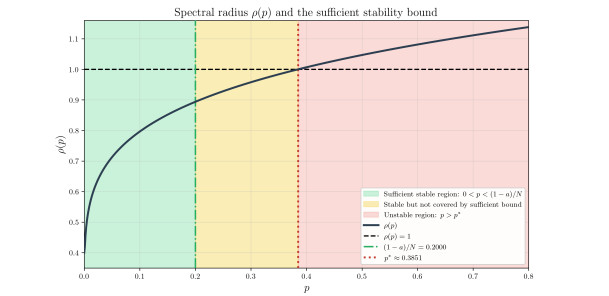
Variation of the spectral radius $ \rho \left(p\right) $ as a function of $ p $ for $ a = 0.4 $, $ N = 3 $, $ k_{1} = 1 $, $ d = 2, $ and $ \theta = \pi /6 $
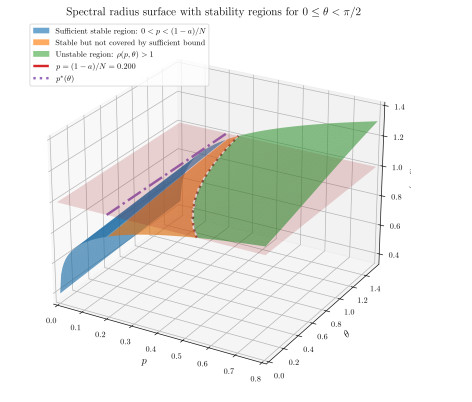
The spectral radius surface $ \rho \left(p, \theta \right) $ on the interval $ 0\leq \theta < \pi /2 $
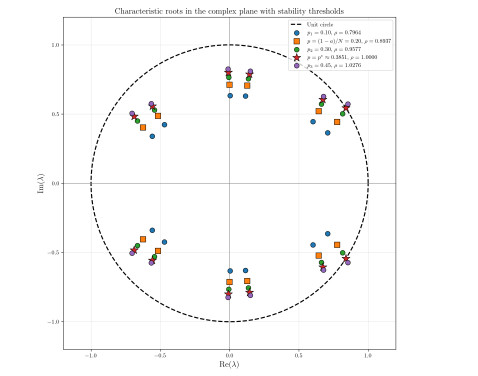
Locations of the characteristic roots in the complex plane for the values $ p_{1} = 0.10 $, $ p_{2} = 0.30, $ and $ p_{3} = 0.45 $
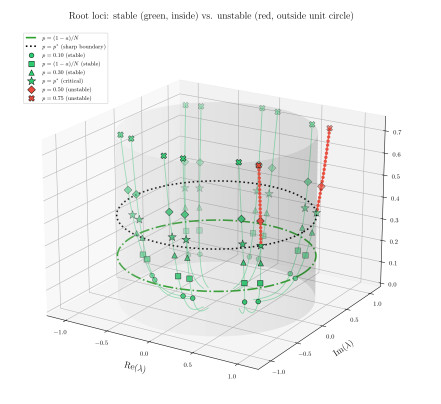
Characteristic root loci with respect to $ p $ and stability boundaries
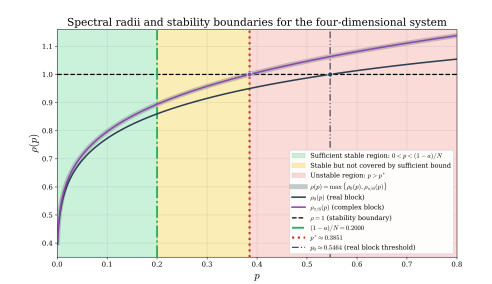
Spectral radii and stability boundaries for the four-dimensional non-diagonalizable system
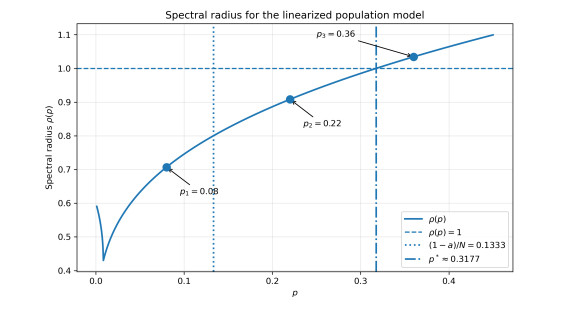
Spectral radius of the linearized population model
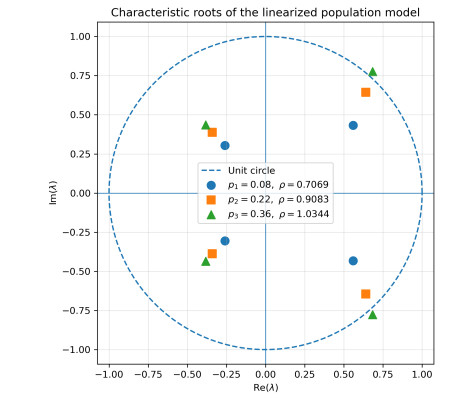
Characteristic roots for selected feedback levels
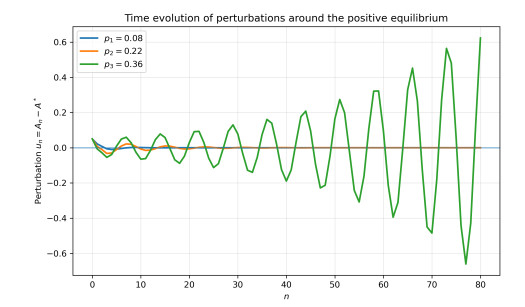
Perturbation dynamics around the positive equilibrium




 DownLoad: