In this paper, we introduced a new Markov-switching extension of the recently proposed logarithmic generalized autoregressive conditional heteroskedasticity (logGARCH) stochastic volatility model by allowing all model coefficients to evolve according to an unobserved finite-state Markov chain. The proposed specification extended the classical logGARCH stochastic volatility framework by incorporating regime-dependent volatility dynamics while preserving its logarithmic structure and latent stochastic volatility formulation. The probabilistic properties of the proposed model were investigated in detail. Sufficient conditions were established for the existence of a unique causal, strictly stationary, and ergodic solution. Additional spectral-radius conditions were derived to guarantee the existence of finite second-order and higher-order moments, and explicit representations of the stationary solution and its unconditional moments were obtained. To estimate the model parameters, a Generalized Method of Moments procedure was developed based on the theoretical moment conditions implied by the stationary distribution of the process. Finally, an extensive Monte Carlo simulation study was conducted under different parameter configurations, innovation distributions, and sample sizes.
Citation: Omar Alzeley. A Markov-switching logGARCH stochastic volatility model: Probabilistic properties and GMM estimation[J]. AIMS Mathematics, 2026, 11(11): 36980-37003. doi: 10.3934/math.20261428
In this paper, we introduced a new Markov-switching extension of the recently proposed logarithmic generalized autoregressive conditional heteroskedasticity (logGARCH) stochastic volatility model by allowing all model coefficients to evolve according to an unobserved finite-state Markov chain. The proposed specification extended the classical logGARCH stochastic volatility framework by incorporating regime-dependent volatility dynamics while preserving its logarithmic structure and latent stochastic volatility formulation. The probabilistic properties of the proposed model were investigated in detail. Sufficient conditions were established for the existence of a unique causal, strictly stationary, and ergodic solution. Additional spectral-radius conditions were derived to guarantee the existence of finite second-order and higher-order moments, and explicit representations of the stationary solution and its unconditional moments were obtained. To estimate the model parameters, a Generalized Method of Moments procedure was developed based on the theoretical moment conditions implied by the stationary distribution of the process. Finally, an extensive Monte Carlo simulation study was conducted under different parameter configurations, innovation distributions, and sample sizes.

| [1] |
R. F. Engle, Autoregressive conditional heteroscedasticity with estimates of the variance of united kingdom inflation, Econometrica, 50 (1982), 987–1007. |
| [2] |
T. Bollerslev, Generalized autoregressive conditional heteroskedasticity, J. Econometrics, 31 (1986), 307–327. https://doi.org/10.1016/0304-4076(86)90063-1 doi: 10.1016/0304-4076(86)90063-1
|
| [3] |
M. Cavicchioli, I. Zemmouri, On the existence of stationary threshold bilinear processes, Stat Pap., 65 (2024), 3739–3767. https://doi.org/10.1007/s00362-024-01539-z doi: 10.1007/s00362-024-01539-z
|
| [4] |
O. Alzeley, On an asymmetric multivariate stochastic difference volatility: Structure and estimation, AIMS Math., 9 (2024), 18528–18552. https://doi.org/10.3934/math.2024902 doi: 10.3934/math.2024902
|
| [5] |
S. J. Taylor, Financial returns modelled by the product of two stochastic processes–-A study of the daily sugar prices 1961-75, In: Time Series Analysis: Theory and Practice, Vol. 1, North-Holland, 1982,203–226. |
| [6] |
M. A. Carnero, D. Pea, E. Ruiz, Persistence and kurtosis in GARCH and stochastic volatility models, J. Financ. Econ., 2 (2004), 319–342. https://doi.org/10.1093/jjfinec/nbh012 doi: 10.1093/jjfinec/nbh012
|
| [7] |
F. Black, Noise, J. Financ., 41 (1986), 528–543. https://doi.org/10.1111/j.1540-6261.1986.tb04513.x |
| [8] |
E. Jacquier, N. G. Polson, P. E. Rossi, Bayesian analysis of stochastic volatility models with fat-tails and correlation errors, J. Econ., 122 (2004), 185–212. https://doi.org/10.2307/1392199 doi: 10.2307/1392199
|
| [9] |
Z. Ding, C. W. Granger, R. F. Engle, A long memory property of stock market returns and a new model, J. Empir. Financ., 1 (1993), 83–106. |
| [10] |
A. C. Harvey, Long memory in stochastic volatility, In: Forecasting Volatility in the Financial Markets, Butterworth-Heinemann, 2007,351–363. https://doi.org/10.1016/B978-075066942-9.50018-2 |
| [11] |
A. Harvey, E. Ruiz, N. Shephard, Multivariate stochastic variance models, Rev. Econ. Stud., 61 (1994), 247–264. https://doi.org/10.2307/2297980 doi: 10.2307/2297980
|
| [12] |
G. Sucarrat, A. Escribano, Estimation of logGARCH models in the presence of zero returns, Eur. J. Financ., 24 (2018), 809–827. https://doi.org/10.1080/1351847X.2017.1336452 doi: 10.1080/1351847X.2017.1336452
|
| [13] |
C. Francq, G. Sucarrat, An exponential chi-squared QMLE for logGARCH models via the ARMA representation, J. Financ. Econ., 16 (2018), 129–154. |
| [14] |
G. Sucarrat, The logGARCH model via ARMA representations, In: Financial Mathematics, Volatility and Covariance Modelling, Routledge, 2019,336–359. |
| [15] |
A. Ghezal, QMLE for periodic time-varying asymmetric logGARCH models, Commun. Math. Stat., 9 (2021), 273–297. https://doi.org/10.1007/s40304-019-00193-4 doi: 10.1007/s40304-019-00193-4
|
| [16] |
T. Bollerslev, E. Ghysels, Periodic autoregressive conditional heteroskedasticity, J. Bus. Econ. Stat., 14 (1996), 139–151. |
| [17] |
A. Bibi, A. Ghezal, QMLE of periodic bilinear models and of PARMA models with periodic bilinear innovations, Kybernetika, 54 (2018), 375–399. https://doi.org/10.14736/kyb-2018-2-0375 doi: 10.14736/kyb-2018-2-0375
|
| [18] |
A. Bibi, A. Ghezal, QMLE of periodic time-varying bilinear GARCH models, Commun. Stat.-Theor. M., 48 (2019), 3291–3310. https://doi.org/10.1080/03610926.2018.1476703 doi: 10.1080/03610926.2018.1476703
|
| [19] |
A. Bibi, A. Ghezal, On periodic time-varying bilinear processes: Structure and asymptotic inference, Stat. Method. Appl., 25 (2016), 395–420. https://doi.org/10.1007/s10260-015-0344-5 doi: 10.1007/s10260-015-0344-5
|
| [20] |
O. Alzeley, Probabilistic properties and estimation methods for periodic threshold autoregressive stochastic volatility, AIMS Math., 9 (2024), 11805–11832. https://doi.org/10.3934/math.2024578 doi: 10.3934/math.2024578
|
| [21] |
A. Ghezal, I. Zemmouri, M-estimation in periodic threshold GARCH models: Consistency and asymptotic normality, Miskolc Math. Notes, 26 (2025), 229–242. https://doi.org/10.18514/MMN.2025.4747 doi: 10.18514/MMN.2025.4747
|
| [22] |
A. Bibi, A. Ghezal, On the Markov-switching bilinear processes: Stationarity, higher-ordermoments and $\beta$-mixing, Stochastics: Int. J. Prob. Stoch. Processes, 87 (2015), 919–945. https://doi.org/10.1080/17442508.2015.1019881 doi: 10.1080/17442508.2015.1019881
|
| [23] |
A. Bibi, Consistency of quasi-maximum likelihood estimator for Markov-switching bilinear time series models, Stat. Probab. Lett., 100 (2015), 192–202. https://doi.org/10.1016/j.spl.2015.02.010 doi: 10.1016/j.spl.2015.02.010
|
| [24] |
A. Bibi, Minimum distance estimation of Markov switching bilinear processes, Statistics, 50 (2016), 1290–1309. https://doi.org/10.1080/02331888.2016.1229783 doi: 10.1080/02331888.2016.1229783
|
| [25] |
A. Ghezal, Spectral representation of Markov-switching bilinear processes, Sao Paulo J. Math. Sci., 18 (2024), 459–479. https://doi.org/10.1007/s40863-023-00380-w doi: 10.1007/s40863-023-00380-w
|
| [26] |
A. Ghezal, A doubly Markov switching AR model: Some probabilistic properties and strong consistency, J. Math. Sci., 271 (2023), 66–75. https://doi.org/10.1007/s10958-023-06262-y doi: 10.1007/s10958-023-06262-y
|
| [27] |
A. Bibi, Markov-switching BILINEAR-GARCH models: Structure and estimation, Commun. Stat.-Theor. M., 47 (2018), 307–323. https://doi.org/10.1080/03610926.2017.1303732 doi: 10.1080/03610926.2017.1303732
|
| [28] |
M. Cavicchioli, A. Ghezal, I. Zemmouri, (Bi)spectral analysis of Markov switching bilinear time series, Stat. Method. Appl., 35 (2026), 319–348. https://doi.org/10.1007/s10260-025-00826-9 doi: 10.1007/s10260-025-00826-9
|
| [29] |
A. Ghezal, I. Zemmouri, On Markov-switching asymmetric logGARCH models: Stationarity and estimation, Filomat, 37 (2023), 9879–9897. https://doi.org/10.2298/FIL2329879G doi: 10.2298/FIL2329879G
|
| [30] |
A. Ghezal, I. Zemmouri, On the Markov-switching autoregressive stochastic volatility processes, SeMA, 81 (2024), 413–427. https://doi.org/10.1007/s40324-023-00329-1 doi: 10.1007/s40324-023-00329-1
|
| [31] |
M. Balegh, I. Zemmouri, Markov-switching threshold stochastic volatility models with regime changes, AIMS Math., 9 (2024), 3895–3910. https://doi.org/10.3934/math.2024192 doi: 10.3934/math.2024192
|
| [32] |
R. Alraddadi, The Markov-switching threshold BLGARCH model, AIMS Math., 10 (2025), 18838–18860. https://doi.org/10.3934/math.2025842 doi: 10.3934/math.2025842
|
| [33] |
R. Alraddadi, The logTG-SV model: A threshold-based volatility framework with logarithmic shocks for exchange rate dynamics, AIMS Math., 10 (2025), 19495–19511. https://doi.org/10.3934/math.2025870 doi: 10.3934/math.2025870
|
| [34] |
H. Guerbyenne, F. Hamdi, M. Hamrat, The logGARCH stochastic volatility model, Stat. Probab. Lett., 214 (2024), 110185. https://doi.org/10.1016/j.spl.2024.110185 doi: 10.1016/j.spl.2024.110185
|
| [35] |
D. Harris, L. Mátyás, Introduction to the generalized method of moments estimation, In: Generalized method of moments estimation, Cambridge: University Press, 1999, 3–30. https://doi.org/10.1017/CBO9780511625848.002 |
Figures(2) / Tables(2)

Omar Alzeley. A Markov-switching logGARCH stochastic volatility model: Probabilistic properties and GMM estimation[J]. AIMS Mathematics, 2026, 11(11): 36980-37003. doi: 10.3934/math.20261428

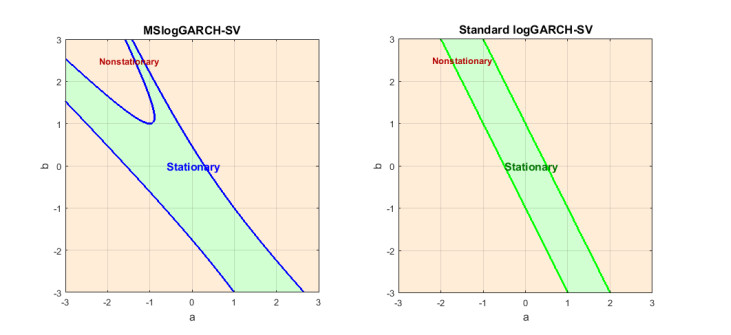
Comparison of the strict stationarity regions for the proposed MSlogGARCH-SV model and the standard logGARCH-SV model
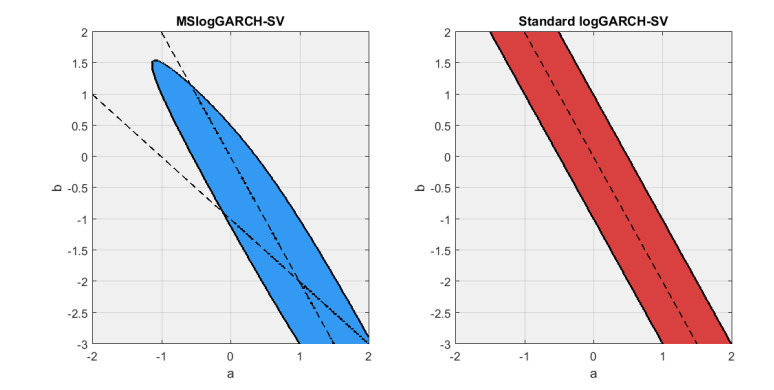
Second-order stationarity regions of the proposed MSlogGARCH-SV model and the standard logGARCH-SV model




 DownLoad: