Adaptive driving policies can increase information demand as their adoption changes interactions between traffic roles. This study developed a deterministic mean-field evolutionary model of adaptive and fixed policies in left-turning and straight-going connected autonomous vehicle populations, coupled to an endogenous information-quality state. Market penetration is an external parameter, distinct from the policy shares. The payoff coefficients represent aggregate behavioral and resource sensitivities rather than a calibrated intersection game. We established positive invariance, characterized feasible interior equilibria, and derived a relative-entropy sufficient condition for global asymptotic stability. A Jacobian-based local criterion identified stable equilibria outside that sufficient region. Signed cross-role interactions and a common monotone nonlinear information benefit were examined to clarify the scope of the stability argument. Boundary linearization gave local invasion criteria and candidate policy invasion thresholds. A synthetic parameter family linked small invasion rates to prolonged relaxation and algebraic decay at the policy invasion threshold. Numerical experiments examined these mechanisms across parameter variations, including cases beyond the global sufficient condition. Information recovery can change equilibrium quality, whereas uniform scaling of the quality equation preserves equilibria while altering transients. These results describe policy–information feedback in the specified model; traffic calibration and independent safety evaluation are needed for engineering interpretation.
Citation: Shih-Lin Lin. Evolutionary dynamics and stability of connected autonomous driving policies with information quality feedback[J]. AIMS Mathematics, 2026, 11(11): 36835-36869. doi: 10.3934/math.20261424
Adaptive driving policies can increase information demand as their adoption changes interactions between traffic roles. This study developed a deterministic mean-field evolutionary model of adaptive and fixed policies in left-turning and straight-going connected autonomous vehicle populations, coupled to an endogenous information-quality state. Market penetration is an external parameter, distinct from the policy shares. The payoff coefficients represent aggregate behavioral and resource sensitivities rather than a calibrated intersection game. We established positive invariance, characterized feasible interior equilibria, and derived a relative-entropy sufficient condition for global asymptotic stability. A Jacobian-based local criterion identified stable equilibria outside that sufficient region. Signed cross-role interactions and a common monotone nonlinear information benefit were examined to clarify the scope of the stability argument. Boundary linearization gave local invasion criteria and candidate policy invasion thresholds. A synthetic parameter family linked small invasion rates to prolonged relaxation and algebraic decay at the policy invasion threshold. Numerical experiments examined these mechanisms across parameter variations, including cases beyond the global sufficient condition. Information recovery can change equilibrium quality, whereas uniform scaling of the quality equation preserves equilibria while altering transients. These results describe policy–information feedback in the specified model; traffic calibration and independent safety evaluation are needed for engineering interpretation.

| [1] |
R. Li, Y. Liu, J. Sun, Y. Tian, Cooperative or competitive? Resolving social dilemmas in autonomous vehicles through evolutionary game theory, Accid. Anal. Prev., 228 (2026), 108402. https://doi.org/10.1016/j.aap.2026.108402 doi: 10.1016/j.aap.2026.108402
|
| [2] |
S. -L. Lin, Y. -H. Chen, Deep learning–aided frequency-modulated continuous-wave radar for around-the-corner non-line-of-sight perception at urban intersections, Comput. Model. Eng. Sci., 147 (2026), 37. https://doi.org/10.32604/cmes.2026.078862 doi: 10.32604/cmes.2026.078862
|
| [3] |
S. -L. Lin, W. Wan, Intelligent connected vehicles, Vehicles, 8 (2026), 70. https://doi.org/10.3390/vehicles8040070 doi: 10.3390/vehicles8040070
|
| [4] |
S. -L. Lin, An edge-assisted Internet-of-Vehicles computing framework for fair tail-risk allocation in cooperative autonomous driving, Comput. Mater. Contin., 88 (2026), 11. https://doi.org/10.32604/cmc.2026.084571 doi: 10.32604/cmc.2026.084571
|
| [5] |
J. S. Weitz, C. Eksin, K. Paarporn, S. P. Brown, W. C. Ratcliff, An oscillating tragedy of the commons in replicator dynamics with game-environment feedback, Proc. Natl. Acad. Sci. U. S. A., 113 (2016), E7518–E7525. https://doi.org/10.1073/pnas.1604096113 doi: 10.1073/pnas.1604096113
|
| [6] |
A. R. Tilman, J. B. Plotkin, E. Akçay, Evolutionary games with environmental feedbacks, Nat. Commun., 11 (2020), 915. https://doi.org/10.1038/s41467-020-14531-6 doi: 10.1038/s41467-020-14531-6
|
| [7] |
H. Gong, H. Xiang, Y. Wang, H. Gao, X. Meng, Strategy evolution of a novel cooperative game model induced by reward feedback and a time delay, AIMS Mathematics, 9 (2024), 33161–33184. https://doi.org/10.3934/math.20241583 doi: 10.3934/math.20241583
|
| [8] |
M. Perc, A. Szolnoki, Coevolutionary games—A mini review, BioSystems, 99 (2010), 109–125. https://doi.org/10.1016/j.biosystems.2009.10.003 doi: 10.1016/j.biosystems.2009.10.003
|
| [9] |
M. Perc, J. J. Jordan, D. G. Rand, Z. Wang, S. Boccaletti, A. Szolnoki, Statistical physics of human cooperation, Phys. Rep., 687 (2017), 1–51. https://doi.org/10.1016/j.physrep.2017.05.004 doi: 10.1016/j.physrep.2017.05.004
|
| [10] |
M. Jusup, P. Holme, K. Kanazawa, M. Takayasu, I. Romić, Z. Wang, et al., Social physics, Phys. Rep., 948 (2022), 1–148. https://doi.org/10.1016/j.physrep.2021.10.005 doi: 10.1016/j.physrep.2021.10.005
|
| [11] |
L. Cheng, M. Li, C. Tan, P. Huang, M. Zhang, R. Sun, Computational game-theoretic models for adaptive urban energy systems: A comprehensive review of algorithms, strategies, and engineering applications, Arch. Computat. Methods Eng., 33 (2026), 2037–2114. https://doi.org/10.1007/s11831-025-10364-y doi: 10.1007/s11831-025-10364-y
|
| [12] |
K. Wang, L. Cheng, M. Yin, K. Zhang, R. Wang, M. Zhang, et al., Evolutionary game theory in energy storage systems: A systematic review of collaborative decision-making, operational strategies, and coordination mechanisms for renewable energy integration, Sustainability, 17 (2025), 7400. https://doi.org/10.3390/su17167400 doi: 10.3390/su17167400
|
| [13] |
W. Schwarting, A. Pierson, J. Alonso-Mora, S. Karaman, D. Rus, Social behavior for autonomous vehicles, Proc. Natl. Acad. Sci. U. S. A., 116 (2019), 24972–24978. https://doi.org/10.1073/pnas.1820676116 doi: 10.1073/pnas.1820676116
|
| [14] |
Y. Liu, X. Zhao, Y. Tian, J. Sun, Sociality Probe: Game-theoretic inverse reinforcement learning for modeling and quantifying social patterns in driving interaction, IEEE Trans. Intell. Transp. Syst., 25 (2024), 20841–20853. https://doi.org/10.1109/TITS.2024.3461162 doi: 10.1109/TITS.2024.3461162
|
| [15] |
S. Shivshankar, A. Jamalipour, An evolutionary game theory-based approach to cooperation in VANETs under different network conditions, IEEE Trans. Veh. Technol., 64 (2015), 2015–2022. https://doi.org/10.1109/TVT.2014.2334655 doi: 10.1109/TVT.2014.2334655
|
| [16] |
L. Ma, S. Qu, J. Ren, X. Zhang, Mixed traffic flow of human-driven vehicles and connected autonomous vehicles: String stability and fundamental diagram, Math. Biosci. Eng., 20 (2023), 2280–2295. https://doi.org/10.3934/mbe.2023107 doi: 10.3934/mbe.2023107
|
| [17] |
F. -C. Chou, A. Keimer, A. M. Bayen, Stability of ring roads and string stability of car following models, Math. Control Relat. Fields, 14 (2024), 1752–1775. https://doi.org/10.3934/mcrf.2024062 doi: 10.3934/mcrf.2024062
|
| [18] |
S. -L. Lin, Nonlinear stability and critical penetration analysis of mixed autonomous traffic with anticipative optimal-velocity control, AIMS Mathematics, 11 (2026), 15302–15323. https://doi.org/10.3934/math.2026629 doi: 10.3934/math.2026629
|
| [19] |
T. Liard, R. Stern, M. L. D. Monache, A PDE-ODE model for traffic control with autonomous vehicles, Netw. Heterog. Media, 18 (2023), 1190–1206. https://doi.org/10.3934/nhm.2023051 doi: 10.3934/nhm.2023051
|
| [20] |
P. De Leenheer, M. Schuster, H. Smith, Strong cooperation or tragedy of the commons in the chemostat, Math. Biosci. Eng., 16 (2019), 139–149. https://doi.org/10.3934/mbe.2019007 doi: 10.3934/mbe.2019007
|
| [21] |
Y. Wang, X. Meng, Evolutionary game dynamics of cooperation in prisoner's dilemma with time delay, Math. Biosci. Eng., 20 (2023), 5024–5042. https://doi.org/10.3934/mbe.2023233 doi: 10.3934/mbe.2023233
|
| [22] |
J. Liu, W. Hu, Bifurcation analysis of an asymmetric three-player three-strategy game with logit dynamics and reverse-cyclic mutations, AIMS Mathematics, 10 (2025), 22206–22220. https://doi.org/10.3934/math.2025988 doi: 10.3934/math.2025988
|
| [23] |
H. Ohtsuki, M. A. Nowak, The replicator equation on graphs, J. Theor. Biol., 243 (2006), 86–97. https://doi.org/10.1016/j.jtbi.2006.06.004 doi: 10.1016/j.jtbi.2006.06.004
|
| [24] |
D. Madeo, C. Mocenni, J. C. Moraes, J. P. Zubelli, The role of self-loops and link removal in evolutionary games on networks, Math. Biosci. Eng., 16 (2019), 5287–5306. https://doi.org/10.3934/mbe.2019264 doi: 10.3934/mbe.2019264
|
| [25] |
A. S. Bratus, V. P. Posvyanskii, A. S. Novozhilov, A note on the replicator equation with explicit space and global regulation, Math. Biosci. Eng., 8 (2011), 659–676. https://doi.org/10.3934/mbe.2011.8.659 doi: 10.3934/mbe.2011.8.659
|
| [26] |
A. Traulsen, M. A. Nowak, J. M. Pacheco, Stochastic dynamics of invasion and fixation, Phys. Rev. E, 74 (2006), 011909. https://doi.org/10.1103/PhysRevE.74.011909 doi: 10.1103/PhysRevE.74.011909
|
| [27] |
J. F. Fontanari, Cooperation in the face of crisis: effect of demographic noise in collective-risk social dilemmas, Math. Biosci. Eng., 21 (2024), 7480–7500. https://doi.org/10.3934/mbe.2024329 doi: 10.3934/mbe.2024329
|
| [28] |
M. H. Mohd, J. Park, The interplay of rock-paper-scissors competition and environments mediates species coexistence and intriguing dynamics, Chaos Solitons Fractals, 153 (2021), 111579. https://doi.org/10.1016/j.chaos.2021.111579 doi: 10.1016/j.chaos.2021.111579
|
| [29] |
J. Park, B. Jang, Structural stability of coexistence in evolutionary dynamics of cyclic competition, Appl. Math. Comput., 394 (2021), 125794. https://doi.org/10.1016/j.amc.2020.125794 doi: 10.1016/j.amc.2020.125794
|
| [30] |
C. Du, Y. Lu, H. Meng, J. Park, Evolution of cooperation on reinforcement-learning driven-adaptive networks, Chaos, 34 (2024), 041101. https://doi.org/10.1063/5.0201968 doi: 10.1063/5.0201968
|
| [31] |
J. Choi, S. Lee, H. Kim, J. Park, The role of recognition error in the stability of green-beard genes, Evol. Lett., 7 (2023), 157–167. https://doi.org/10.1093/evlett/qrad012 doi: 10.1093/evlett/qrad012
|
| [32] |
G. Habib, Predicting saddle-node bifurcations using transient dynamics: A model-free approach, Nonlinear Dyn., 111 (2023), 20579–20596. https://doi.org/10.1007/s11071-023-08941-6 doi: 10.1007/s11071-023-08941-6
|
Figures(8) / Tables(12)

Shih-Lin Lin. Evolutionary dynamics and stability of connected autonomous driving policies with information quality feedback[J]. AIMS Mathematics, 2026, 11(11): 36835-36869. doi: 10.3934/math.20261424

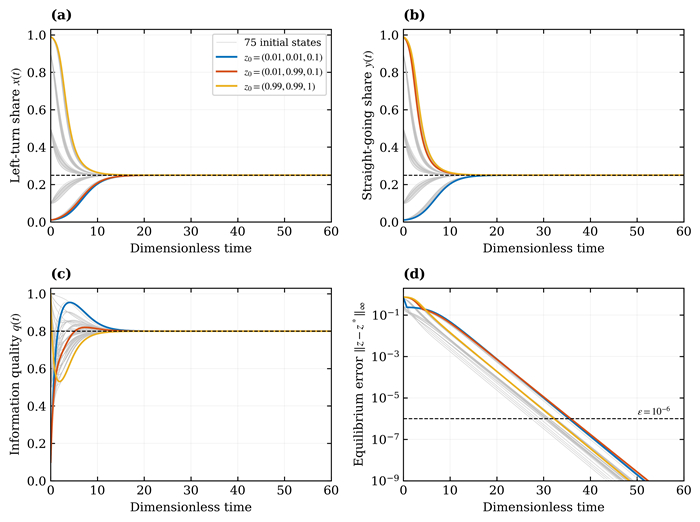
Baseline results for 75 initial conditions. (a) Left-turn policy share; (b) straight-going policy share; (c) effective information quality; (d) maximum-norm error relative to the analytical equilibrium. Gray curves represent all initial conditions, and the colored curves identify the same three representative initial conditions across panels. Horizontal dashed lines in (a–c) indicate the corresponding equilibrium values; the dashed line in (d) marks the $ {10}^{-6} $ error tolerance. Integration continues to $ T = 100 $, whereas the displayed interval ends at 60. Points below $ {10}^{-9} $ are omitted in (d)
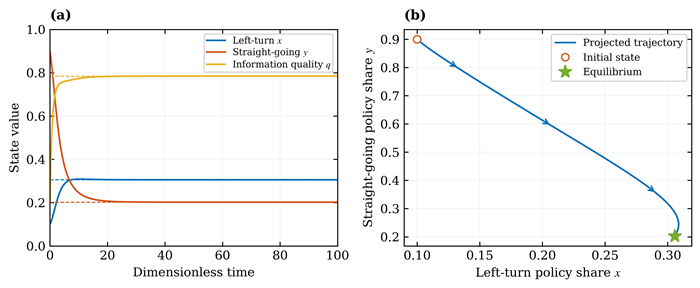
Asymmetric-role scenario. (a) Time histories of the left-turn share, straight-going share, and information quality, with dashed lines indicating their analytical equilibria. (b) Projection of the same three-dimensional trajectory onto the policy plane; the open circle marks the initial state, the star marks the equilibrium, and the arrows indicate increasing time. Panel (a) displays the interval up to 100, although integration continues to 150. Panel (b) is neither a complete phase-plane vector field nor a basin of attraction
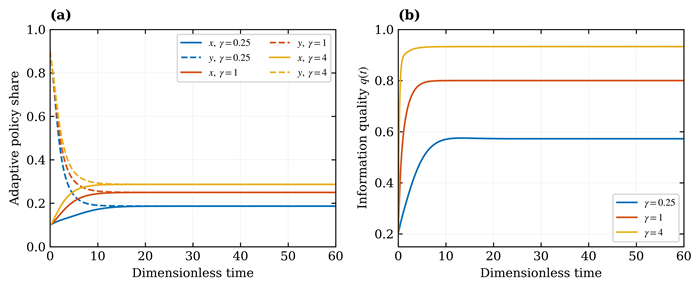
Results for different information-recovery rates. (a) Left-turn shares $ x $ are shown by solid curves and straight-going shares $ y $ by dashed curves; matching colors indicate the same $ \gamma $. (b) Quality trajectories for the three recovery rates. All cases use the same initial state and are integrated to 150, with the displayed interval ending at 60. Changing $ \gamma $ alone changes both the equilibrium and the transient
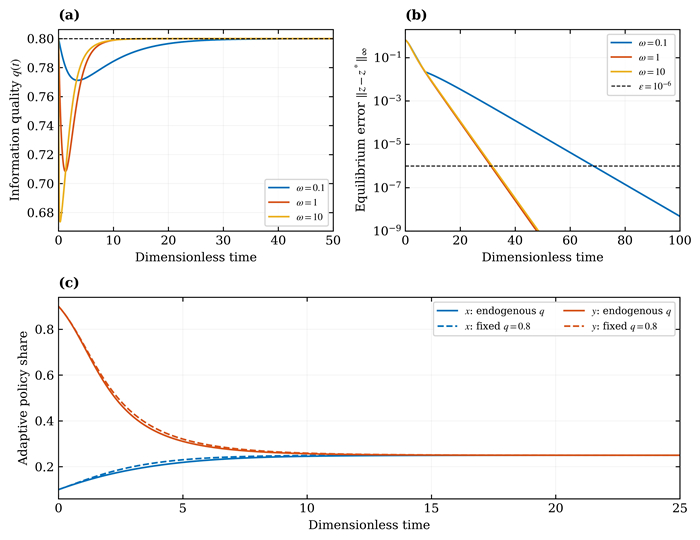
Information-response speeds and the fixed-quality control. (a) Quality transients for $ \omega = \mathrm{0.1, 1}, 10 $; the dashed line indicates their common equilibrium $ {q}^{\mathrm{*}} = 0.80 $. (b) Corresponding full-state equilibrium errors; the dashed line marks the $ {10}^{-6} $ tolerance, and plotting points below $ {10}^{-9} $ are omitted. (c) Policy trajectories under fixed and endogenous quality; solid curves indicate endogenous quality, dashed curves indicate fixed $ q = 0.80 $, and the two roles are distinguished by color. Panels (a) and (b) display intervals ending at 50 and 100, respectively, with both integrated to 200. Panel (c) displays the interval ending at 25, with integration continuing to 100
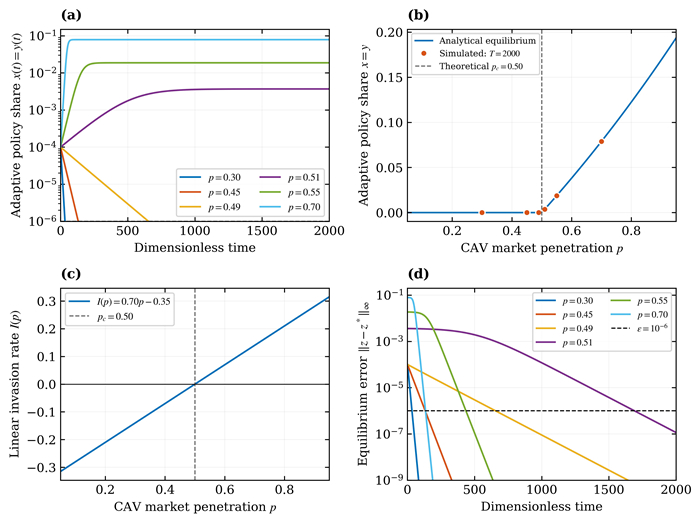
The original six off-critical scenarios for the synthetic penetration family. (a) Policy shares with values below $ {10}^{-6} $ omitted from the logarithmic plot; (b) analytical equilibrium branch and six endpoints at $ T = 2000 $; (c) linear invasion rate; (d) full-state equilibrium errors, with values below $ {10}^{-9} $ omitted. The vertical reference is this family's policy invasion threshold, $ {p}_{c} = 0.50 $
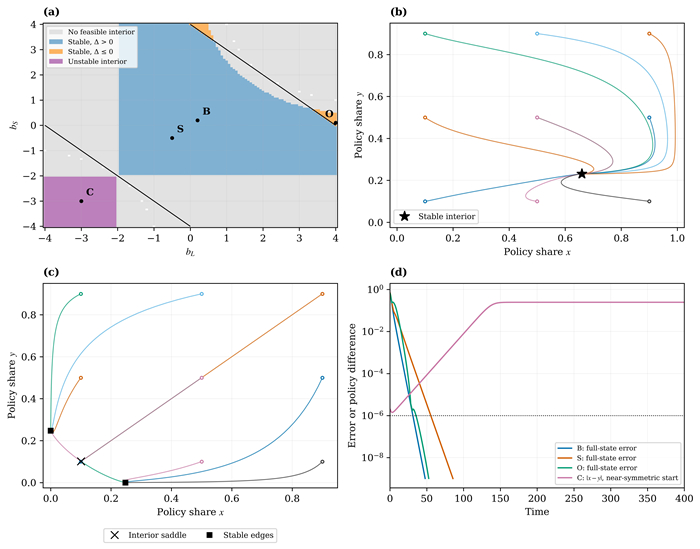
Signed interactions and stability. (a) Interior classification on the $ 121\times 121 $ grid; black lines mark $ \varDelta = 0 $, and 18 points with $ D = 0 $ are excluded. B, S, O, and C refer to Table 10. (b, c) Policy-plane projections of 11 trajectories for O and C; the star is a stable interior equilibrium, and the cross is an interior saddle. (d) Full-state errors for B, S, and O from $ \left(\mathrm{0.1, 0.9, 0.5}\right) $, and $ \left|x-y\right| $ from a nearly symmetric competitive start. The dotted line is $ {10}^{-6} $. Integrations continue to $ T = 400 $; the projections are not complete phase-plane vector fields
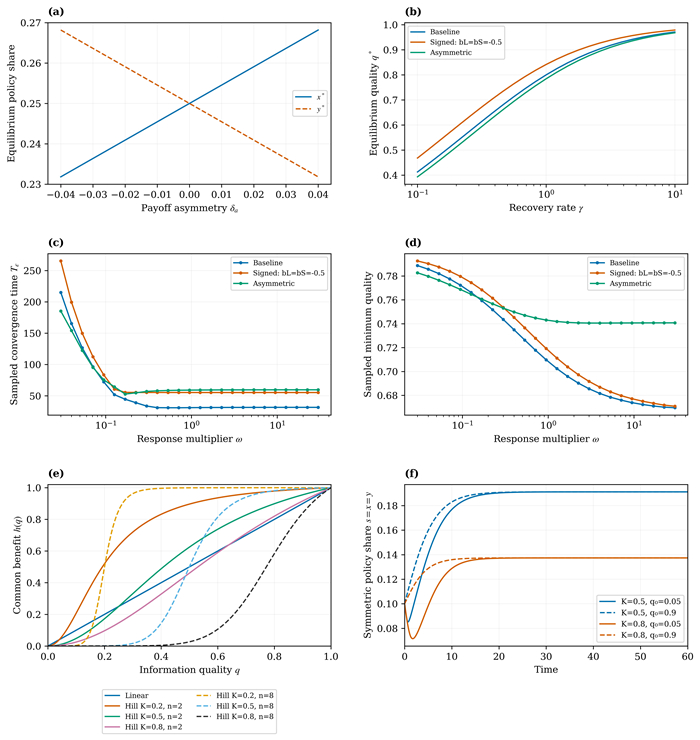
Controlled mechanism scans. (a) Isolated payoff asymmetry; (b) equilibrium quality for 25 recovery rates in each of three backgrounds; (c, d) sampled convergence time and minimum quality for 25 response multipliers per background; (e) linear and normalized Hill benefits; (f) low-quality controls with $ {a}_{L} = {a}_{S} = -0.15 $, $ n = 8 $, and $ {x}_{0} = {y}_{0} = 0.1 $. Solid and dashed curves in (f) use $ {q}_{0} = 0.05 $ and 0.9. Remaining coefficients are baseline values. Recovery capacity and response speed are varied separately; all quantities are dimensionless
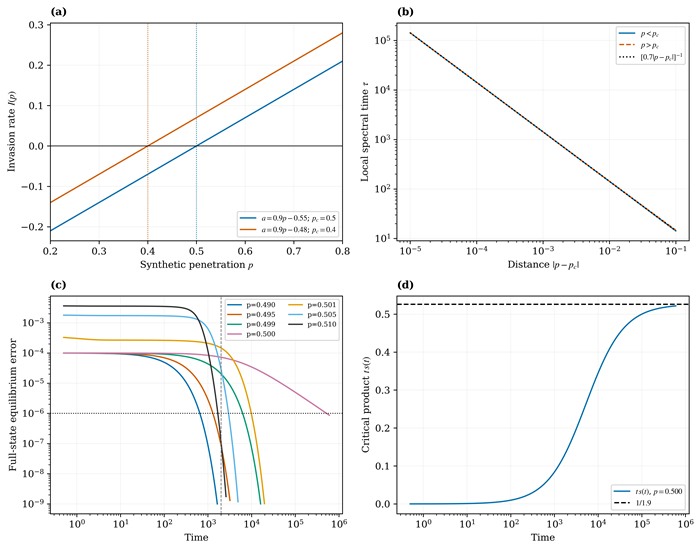
Policy invasion and critical convergence. (a) Two synthetic intercept choices give policy invasion thresholds of 0.5 and 0.4; (b) local spectral relaxation times on both sides compared with $ {\left[0.7\left|p-{p}_{c}\right|\right]}^{-1} $; (c) full-state errors from symmetric initial states, with references at $ {10}^{-6} $ and $ T = 2000 $; (d) the critical product $ ts\left(t\right) $ approaches $ 1/1.9 $. Trajectories have the parameter-dependent horizons and output intervals in the text. The critical asymptotics concern the invariant subspace $ x = y $




 DownLoad: