This work constructed a predator-prey model incorporating hunting cooperation and group defense, and explored its dynamical behavior. First, for the non-spatial model, the existence and local asymptotical stability of all feasible equilibria for the model were analyzed. Furthermore, the existence of Hopf bifurcation was investigated, and the occurrence direction of Hopf bifurcation as well as the stability and evolutionary characteristics of bifurcated periodic solutions were determined based on bifurcation theory. Second, a reaction-diffusion model was established by introducing spatial self-diffusion effects. The Turing instability of the positive equilibrium was emphatically studied, and the results verified that diffusion serves as a core inducement for Turing instability and spatial pattern formation. Meanwhile, the existence, direction, and stability of Hopf bifurcation in the diffusion system were analyzed, revealing the regulatory mechanism of spatial diffusion on system dynamical behavior. Finally, numerical simulations were carried out to validate the theoretical analyses and intuitively demonstrate the evolution processes of equilibria stability, bifurcation phenomena, and Turing instability.
Citation: Huisen Zhang. Stability and Hopf bifurcation of a predator-prey model with hunting cooperation and group defense[J]. AIMS Mathematics, 2026, 11(11): 36723-36746. doi: 10.3934/math.20261420
This work constructed a predator-prey model incorporating hunting cooperation and group defense, and explored its dynamical behavior. First, for the non-spatial model, the existence and local asymptotical stability of all feasible equilibria for the model were analyzed. Furthermore, the existence of Hopf bifurcation was investigated, and the occurrence direction of Hopf bifurcation as well as the stability and evolutionary characteristics of bifurcated periodic solutions were determined based on bifurcation theory. Second, a reaction-diffusion model was established by introducing spatial self-diffusion effects. The Turing instability of the positive equilibrium was emphatically studied, and the results verified that diffusion serves as a core inducement for Turing instability and spatial pattern formation. Meanwhile, the existence, direction, and stability of Hopf bifurcation in the diffusion system were analyzed, revealing the regulatory mechanism of spatial diffusion on system dynamical behavior. Finally, numerical simulations were carried out to validate the theoretical analyses and intuitively demonstrate the evolution processes of equilibria stability, bifurcation phenomena, and Turing instability.

| [1] |
A. J. Lotka, Undamped oscillations derived from the law of mass action, J. Am. Chem. Soc., 42 (1920), 1595–1599. https://doi.org/10.1021/ja01453a010 doi: 10.1021/ja01453a010
|
| [2] |
V. Volterra, Fluctuation in the abundance of a species considered mathematically, Nature, 118 (1926), 558–560. https://doi.org/10.1038/118558a0 doi: 10.1038/118558a0
|
| [3] |
R. Levins, Some demographic and genetic consequences of environmental heterogeneity for biological control, Bull. Entomol. Soc. Am., 15 (1969), 237–240. https://doi.org/10.1093/besa/15.3.237 doi: 10.1093/besa/15.3.237
|
| [4] |
S. Wright, Breeding structure of populations in relation to speciation, Am. Nat., 74 (1940), 232–248. https://doi.org/10.1086/280891 doi: 10.1086/280891
|
| [5] |
H. Freedman, G. Wolkowicz, Predator-prey systems with group defence: the paradox of enrichment revisited, Bull. Math. Biol., 48 (1986), 493–508. https://doi.org/10.1007/BF02462320 doi: 10.1007/BF02462320
|
| [6] |
H. Freedman, S. G. Ruan, Hopf bifurcation in three-species food chain models with group defense, Math. Biosci., 111 (1992), 73–87. https://doi.org/10.1016/0025-5564(92)90079-C doi: 10.1016/0025-5564(92)90079-C
|
| [7] |
M. Das, G. P. Samanta, A prey-predator fractional order model with fear effect and group defense, Int. J. Dyn. Control, 9 (2021), 334–349. https://doi.org/10.1007/s40435-020-00626-x doi: 10.1007/s40435-020-00626-x
|
| [8] |
P. Brehmer, F. Gerlotto, C. Laurent, P. Cotel, A. Alina, B. Samb, Schooling behaviour of small pelagic fish: phenotypic expression of independent stimuli, Mar. Ecol. Prog. Ser., 334 (2007), 263–272. https://doi.org/10.3354/meps334263 doi: 10.3354/meps334263
|
| [9] |
J. Zwolinski, D. Demer, A cold oceanographic regime with high exploitation rates in the Northeast Pacific forecasts a collapse of the sardine stock, Proc. Natl. Acad. Sci. U. S. A., 109 (2012), 4175–4180. https://doi.org/10.1073/pnas.1113806109 doi: 10.1073/pnas.1113806109
|
| [10] |
V. Ajraldi, M. Pittavino, E. Venturino, Modelling herd behavior in population systems, Nonlinear Anal. Real World Appl., 12 (2011), 2319–2338. https://doi.org/10.1016/j.nonrwa.2011.02.002 doi: 10.1016/j.nonrwa.2011.02.002
|
| [11] |
P. A. Braza, Predator-prey dynamics with square root functional responses, Nonlinear Anal. Real World Appl., 13 (2012), 1837–1843. https://doi.org/10.1016/j.nonrwa.2011.12.014 doi: 10.1016/j.nonrwa.2011.12.014
|
| [12] |
Z. A. Manaf, H. M. Mohd, Bifurcation analysis of the prey-predator models incorporating herd behaviours, IOP Conf. Ser. Earth Environ. Sci., 380 (2019), 012009. https://doi.org/10.1088/1755-1315/380/1/012009 doi: 10.1088/1755-1315/380/1/012009
|
| [13] |
D. P. Hector, Cooperative hunting and its relationship to foraging success and prey size in an avian predator, Ethology, 73 (1986), 247–257. https://doi.org/10.1111/j.1439-0310.1986.tb00915.x doi: 10.1111/j.1439-0310.1986.tb00915.x
|
| [14] |
D. Scheel, C. Packer, Group hunting behaviour of lions: a search for cooperation, Anim. Behav., 41 (1991), 697–709. https://doi.org/10.1016/S0003-3472(05)80907-8 doi: 10.1016/S0003-3472(05)80907-8
|
| [15] |
C. Boesch, Cooperative hunting in wild chimpanzees, Anim. Behav., 48 (1994), 653–667. https://doi.org/10.1006/anbe.1994.1285 doi: 10.1006/anbe.1994.1285
|
| [16] |
S. Creel, N. M. Creel, Communal hunting and pack size in African wild dogs, Lycaon pictus, Anim. Behav., 50 (1995), 1325–1339. https://doi.org/10.1016/0003-3472(95)80048-4 doi: 10.1016/0003-3472(95)80048-4
|
| [17] |
P. A. Schmidt, L. D. Mech, Wolf pack size and food acquisition, Am. Nat., 150 (1997), 513–517. https://doi.org/10.1086/286079 doi: 10.1086/286079
|
| [18] |
R. Bshary, A. Hohner, K. A. T. Djoudi, H. Fricke, Interspecific communicative and coordinated hunting between groupers and giant moray eels in the Red Sea, PLoS Biol., 4 (2006), e431. https://doi.org/10.1371/journal.pbio.0040431 doi: 10.1371/journal.pbio.0040431
|
| [19] |
M. T. Alves, F. M. Hilker, Hunting cooperation and Allee effects in predators, J. Theor. Biol., 419 (2017), 13–22. https://doi.org/10.1016/j.jtbi.2017.02.002 doi: 10.1016/j.jtbi.2017.02.002
|
| [20] |
J. Duarte, C. Januario, N. Martins, J. Sardanyes, Chaos and crises in a model for cooperative hunting: a symbolic dynamics approach, Chaos, 19 (2009), 043102. https://doi.org/10.1063/1.3243924 doi: 10.1063/1.3243924
|
| [21] |
L. Berec, Impacts of foraging facilitation among predators on predator-prey dynamics, Bull. Math. Biol., 72 (2010), 94–121. https://doi.org/10.1007/s11538-009-9439-1 doi: 10.1007/s11538-009-9439-1
|
| [22] |
J. Zhang, W. N. Zhang, Dynamics of a predator-prey model with hunting cooperation and Allee effects in predators, Int. J. Bifurcation Chaos, 30 (2020), 2050199. https://doi.org/10.1142/S0218127420501990 doi: 10.1142/S0218127420501990
|
| [23] |
D. Y. Wu, M. Zhao, Qualitative analysis for a diffusive predator-prey model with hunting cooperative, Physica A, 515 (2019), 299–309. https://doi.org/10.1016/j.physa.2018.09.176 doi: 10.1016/j.physa.2018.09.176
|
| [24] |
D. X. Song, C. Li, Y. L. Song, Stability and cross-diffusion-driven instability in a diffusive predator-prey system with hunting cooperation functional response, Nonlinear Anal. Real World Appl., 54 (2020), 103106. https://doi.org/10.1016/j.nonrwa.2020.103106 doi: 10.1016/j.nonrwa.2020.103106
|
| [25] |
J. Q. Li, Y. M. Chen, N. N. Xue, P. J. Zhang, Z. W. Long, Y. Q. He, Impacts of hunting cooperation among predators on predator-prey dynamics, J. Theor. Biol., 627 (2026), 112460. https://doi.org/10.1016/j.jtbi.2026.112460 doi: 10.1016/j.jtbi.2026.112460
|
| [26] |
S. Pal, N. Pal, S. Samanta, J. Chattopadhyay, Effect of hunting cooperation and fear in a predator-prey model, Ecol. Complex., 39 (2019), 100770. https://doi.org/10.1016/j.ecocom.2019.100770 doi: 10.1016/j.ecocom.2019.100770
|
| [27] |
T. Singh, R. Dubey, V. N. Mishra, Spatial dynamics of predator-prey system with hunting cooperation in predators and Type Ⅰ functional response, AIMS Math., 5 (2019), 673–684. https://doi.org/10.3934/math.2020045 doi: 10.3934/math.2020045
|
| [28] |
F. Capone, M. F. Carfora, R. De Luca, I. Torcicollo, Turing patterns in a reaction-diffusion system modeling hunting cooperation, Math. Comput. Simul., 165 (2019), 172–180. https://doi.org/10.1016/j.matcom.2019.03.010 doi: 10.1016/j.matcom.2019.03.010
|
| [29] |
X. C. Hu, S. R. J. Jang, Stochasticity and cooperative hunting in predator-prey interactions, J. Biol. Syst., 29 (2021), 525–541. https://doi.org/10.1142/S0218339021400040 doi: 10.1142/S0218339021400040
|
| [30] |
N. Mukherjee, M. Banerjee, Hunting cooperation among slowly diffusing specialist predators can induce stationary Turing patterns, Physica A, 599 (2022), 127417. https://doi.org/10.1016/j.physa.2022.127417 doi: 10.1016/j.physa.2022.127417
|
| [31] |
J. Roy, S. Dey, B. W. Kooi, M. Banerjee, Prey group defense and hunting cooperation among generalist-predators induce complex dynamics: a mathematical study, J. Math. Biol., 89 (2024), 22. https://doi.org/10.1007/s00285-024-02121-9 doi: 10.1007/s00285-024-02121-9
|
| [32] |
A. K. Umrao, P. K. Srivastava, Bifurcation analysis of a predator-prey model with Allee effect and fear effect in prey and hunting cooperation in predator, Differ. Equ. Dyn. Syst., 33 (2025), 1123–1149. https://doi.org/10.1007/s12591-023-00663-w doi: 10.1007/s12591-023-00663-w
|
| [33] |
R. A. Fisher, The waves of advance of advantageous genes, Ann. Hum. Genet., 7 (1937), 355–369. https://doi.org/10.1111/j.1469-1809.1937.tb02153.x doi: 10.1111/j.1469-1809.1937.tb02153.x
|
| [34] |
B. Dubey, B. Das, J. Hussain, A predator-prey interaction model with self and cross-diffusion, Ecol. Model., 141 (2011), 67–76. https://doi.org/10.1016/S0304-3800(01)00255-1 doi: 10.1016/S0304-3800(01)00255-1
|
| [35] |
B. D. Hassard, N. D. Kazarinoff, Y. H. Wan, Theory and applications of Hopf bifurcation, In: London mathematical society lecture note series, Cambridge: Cambridge University Press, 1981. https://doi.org/10.1090/conm/445 |
| [36] |
W. Alsadi, Z. C. Wei, I. Moroz, A. Alkhazzan, Existence and stability of solution in Banach space for an impulsive system involving Atangana-Baleanu and Caputo-Fabrizio derivatives, Fractals, 31 (2023), 2340085. https://doi.org/10.1142/S0218348X23400856 doi: 10.1142/S0218348X23400856
|
| [37] |
W. Alsadi, Z. C. Wei, T. Q. S. Abdullah, A. Abdullah, J. F. Gomez-Aguilar, Dynamical and numerical analysis of the hepatitis B virus treatment model through fractal-fractional derivative, Math. Methods Appl. Sci., 48 (2024), 639–657. https://doi.org/10.1002/mma.10348 doi: 10.1002/mma.10348
|
| [38] |
Y. H. Lv, H. Wang, J. Ding, Q. X. Zhu, Dynamic analysis of a stochastic three species predator-prey model with intraguild predation and predator-switching, Commun. Nonlinear Sci. Numer. Simul., 157 (2026), 109748. https://doi.org/10.1016/j.cnsns.2026.109748 doi: 10.1016/j.cnsns.2026.109748
|
Figures(8) / Tables(1)

Huisen Zhang. Stability and Hopf bifurcation of a predator-prey model with hunting cooperation and group defense[J]. AIMS Mathematics, 2026, 11(11): 36723-36746. doi: 10.3934/math.20261420

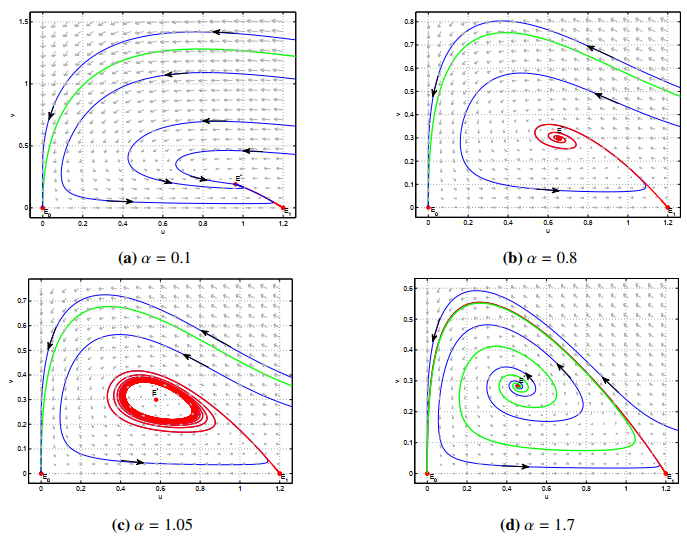
Phase portraits of model (4) with fixed $ \sigma = 1 $, $ \kappa = 1.2 $, where the model admits a unique positive equilibrium
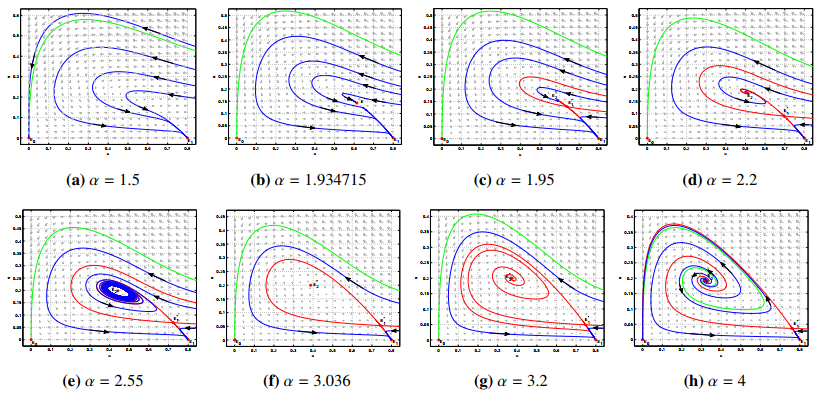
Phase portraits of model (4) with fixed $\sigma = 1$, $\kappa = 0.8$, depicting the emergence and stability transitions of positive equilibria in the predator-prey model
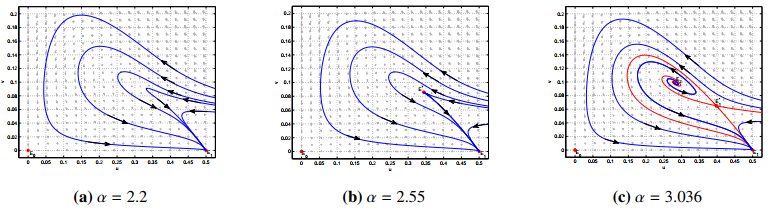
Phase portraits of model (4) with fixed $ \sigma = 0.8 $, $ \kappa = 0.5 $, illustrating cusp bifurcation induced by the variation of predator hunting cooperation intensity $ \alpha $
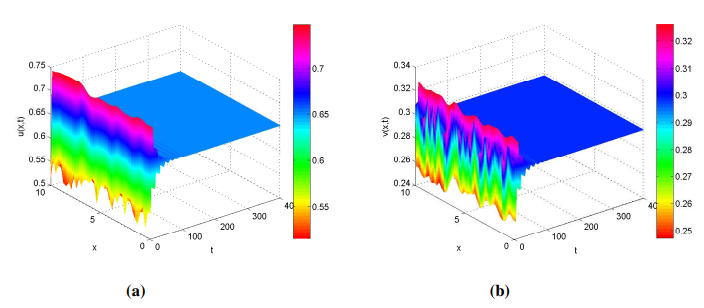
Numerical simulations of the stable equilibrium of model (5) with parameters in (20) and $ d_1 = 0.1 $
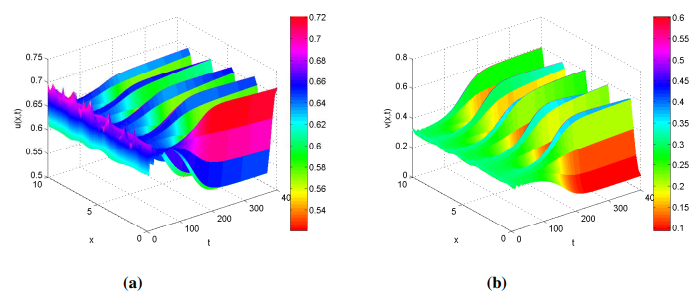
Numerical simulations of the Turing instability of the equilibrium of model (5) with parameters in (20) and $ d_1 = 0.4 $
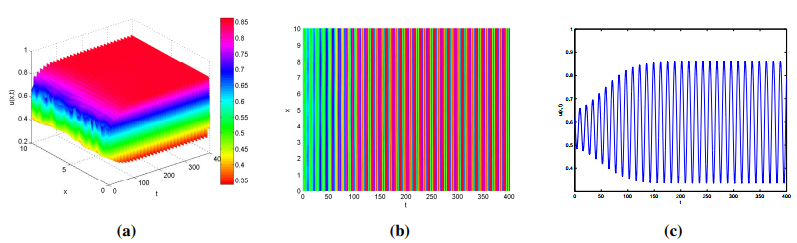
When $ \alpha = 1.1 $, the spatially homogeneous periodic solution of the prey is shown
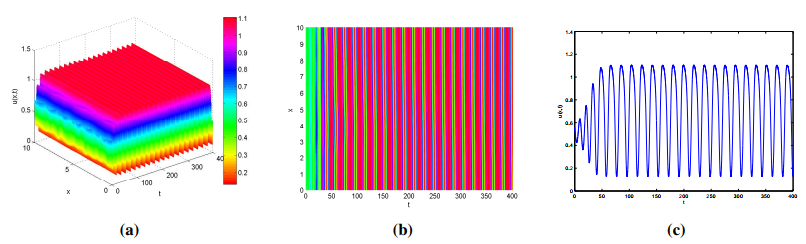
When $ \alpha = 1.35 $, the spatially homogeneous periodic solution of the prey is shown
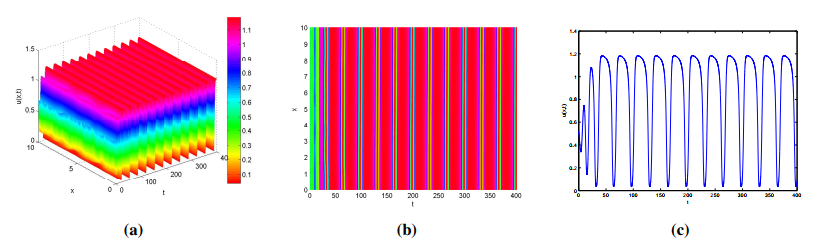
When $ \alpha = 1.55 $, the spatially homogeneous periodic solution of the prey is shown




 DownLoad: