This paper presents a new two-parameter discrete probability distribution called the discrete modified weighted exponential (DM-WE) distribution. A thorough examination of its mathematical and structural aspects is performed, resulting in closed-form formulas for essential statistical attributes. This encompasses the form, unimodality, and characteristics of both the hazard rate and reversed hazard rate functions. Additionally, essential foundational aspects, including parameter identifiability, asymptotic tail behavior, mode, quantile function, random data generation, and moments, are derived. The DM-WE distribution demonstrates a discontinuous growing failure rate and features a highly adaptable probability mass function that can represent various distributional forms. The examination of dispersion, zero-modification indices, and entropy metrics indicates the model is specifically tailored for over-dispersed, leptokurtic, and zero-inflated count data environments. Numerical investigations show that the coefficients of skewness and kurtosis exhibit a pronounced bathtub-shaped pattern within the explored parameter grid, indicating significant variability in tail thickness and asymmetry. Order statistics and their descriptive characteristics are also determined. The maximum likelihood estimation framework is established for parameter estimation, along with its asymptotic features. A thorough Monte Carlo simulation analysis is conducted to assess and compare the finite-sample performance and efficacy of the estimators. The practical applicability and superiority of the DM-WE distribution are proved using a comprehensive model comparison methodology and goodness-of-fit criteria applied to real-world datasets, establishing its effectiveness over existing rival discrete models.
Citation: Mohamed S. Eliwa, Mahmoud El-Morshedy, Afrah Al-Bossly, Mohamed El-Dawoody, M. E. Sobh. The discrete modified weighted exponential distribution: mathematical theory with applications[J]. AIMS Mathematics, 2026, 11(11): 36469-36516. doi: 10.3934/math.20261411
This paper presents a new two-parameter discrete probability distribution called the discrete modified weighted exponential (DM-WE) distribution. A thorough examination of its mathematical and structural aspects is performed, resulting in closed-form formulas for essential statistical attributes. This encompasses the form, unimodality, and characteristics of both the hazard rate and reversed hazard rate functions. Additionally, essential foundational aspects, including parameter identifiability, asymptotic tail behavior, mode, quantile function, random data generation, and moments, are derived. The DM-WE distribution demonstrates a discontinuous growing failure rate and features a highly adaptable probability mass function that can represent various distributional forms. The examination of dispersion, zero-modification indices, and entropy metrics indicates the model is specifically tailored for over-dispersed, leptokurtic, and zero-inflated count data environments. Numerical investigations show that the coefficients of skewness and kurtosis exhibit a pronounced bathtub-shaped pattern within the explored parameter grid, indicating significant variability in tail thickness and asymmetry. Order statistics and their descriptive characteristics are also determined. The maximum likelihood estimation framework is established for parameter estimation, along with its asymptotic features. A thorough Monte Carlo simulation analysis is conducted to assess and compare the finite-sample performance and efficacy of the estimators. The practical applicability and superiority of the DM-WE distribution are proved using a comprehensive model comparison methodology and goodness-of-fit criteria applied to real-world datasets, establishing its effectiveness over existing rival discrete models.

| [1] |
A. C. Cameron, P. K. Trivedi, Regression analysis of count data, 2 Eds., Cambridge University Press, 2013. |
| [2] |
J. M. Hilbe, Negative binomial regression, 2 Eds., Cambridge University Press, 2011. https://doi.org/10.1017/cbo9780511973420 |
| [3] |
D. Lambert, Zero-inflated Poisson regression, with an application to defects in manufacturing, Technometrics, 34 (1992), 1–14. https://doi.org/10.2307/1269547 doi: 10.2307/1269547
|
| [4] |
J. Mullahy, Specification and testing of some modified count data models, J. Econometrics, 33 (1986), 341–365. https://doi.org/10.1016/0304-4076(86)90002-3 doi: 10.1016/0304-4076(86)90002-3
|
| [5] |
S. Chakraborty, Generating discrete analogues of continuous probability distributions: a survey of methods and constructions, J. Stat. Distrib. Appl., 2 (2015), 1–30. https://doi.org/10.1186/s40488-015-0028-6 doi: 10.1186/s40488-015-0028-6
|
| [6] |
N. L. Johnson, A. W. Kemp, S. Kotz, Univariate discrete distributions, 3 Eds., Wiley, 2005. https://doi.org/10.1002/0471715816 |
| [7] |
T. Nakagawa, S. Osaki, The discrete Weibull distribution, IEEE Trans. Reliab., 24 (1975), 300–301. https://doi.org/10.1109/tr.1975.5214915 doi: 10.1109/tr.1975.5214915
|
| [8] |
D. Roy, The discrete normal distribution, Comm. Statist. Theory Methods, 32 (2003), 1871–1883. https://doi.org/10.1081/sta-120023256 doi: 10.1081/sta-120023256
|
| [9] |
D. Roy, Discrete Rayleigh distribution, IEEE Trans. Reliab., 53 (2004), 255–260. https://doi.org/10.1109/tr.2004.829161 doi: 10.1109/tr.2004.829161
|
| [10] |
H. Krishna, P. S. Pundir, Discrete Maxwell distribution, InterStat, 3 (2007), 1–15. |
| [11] |
H. Krishna, P. S. Pundir, Discrete Burr and discrete Pareto distributions, Stat. Methodol., 6 (2009), 177–188. https://doi.org/10.1016/j.stamet.2008.07.001 doi: 10.1016/j.stamet.2008.07.001
|
| [12] |
M. A. Jazi, C. D. Lai, M. H. Alamatsaz, A discrete inverse Weibull distribution and estimation of its parameters, Stat. Methodol., 7 (2010), 121–132. https://doi.org/10.1016/j.stamet.2009.11.001 doi: 10.1016/j.stamet.2009.11.001
|
| [13] |
E. Gómez-Déniz, E. Calderín-Ojeda, The discrete Lindley distribution: properties and applications, J. Stat. Comput. Simul., 81 (2011), 1405–1416. https://doi.org/10.1080/00949655.2010.487825 doi: 10.1080/00949655.2010.487825
|
| [14] |
A. A. Al-Huniti, G. R. AL-Dayian, Discrete Burr type Ⅲ distribution, Am. J. Math. Stat., 2 (2012), 145–152. https://doi.org/10.5923/j.ajms.20120205.07 doi: 10.5923/j.ajms.20120205.07
|
| [15] |
M. H. Alamatsaz, S. Dey, T. Dey, S. S. Harandi, Discrete generalized Rayleigh distribution, Pak. J. Stat., 32 (2016), 1–20. |
| [16] |
M. El-Morshedy, M. S. Eliwa, E. Altun, Discrete Burr–Hatke distribution with properties, estimation methods and regression model, IEEE Access, 8 (2020), 74359–74370. https://doi.org/10.1109/access.2020.2988431 doi: 10.1109/access.2020.2988431
|
| [17] |
S. Chakraborty, D. Chakravarty, J. Mazucheli, W. Bertoli, A discrete analog of Gumbel distribution: properties, parameter estimation and applications, J. Appl. Stat., 48 (2021), 712–737. https://doi.org/10.1080/02664763.2020.1744538 doi: 10.1080/02664763.2020.1744538
|
| [18] |
M. El-Morshedy, M. S. Eliwa, H. Nagy, A new two-parameter exponentiated discrete Lindley distribution: properties, estimation and applications, J. Appl. Stat., 47 (2020), 354–375. https://doi.org/10.1080/02664763.2019.1638893 doi: 10.1080/02664763.2019.1638893
|
| [19] |
K. M. Alqahtani, M. El-Morshedy, H. S. Shahen, M. S. Eliwa, A discrete extension of the Burr–Hatke distribution: Generalized hypergeometric functions, different inference techniques, simulation ranking with modeling and analysis of sustainable count data, AIMS Math., 9 (2024), 9394–9418. https://doi.org/10.3934/math.2024458 doi: 10.3934/math.2024458
|
| [20] |
M. Ahsan-ul-Haq, M. N. Hussain, A. Babar, L. A. Al-Essa, M. S. Eliwa, Analysis, estimation, and practical implementations of the discrete power quasi-Xgamma distribution, J. Math., 2024 (2024), 1913285. https://doi.org/10.1155/2024/1913285 doi: 10.1155/2024/1913285
|
| [21] |
H. Haj Ahmad, A. Elshahhat, A new Hjorth distribution in its discrete version, Mathematics, 13 (2025), 875. https://doi.org/10.3390/math13050875 doi: 10.3390/math13050875
|
| [22] |
D. Alsulami, A discrete analogue of the exponentiated generalized Weibull-G family: a new discrete distribution with different methods of estimation and application, Axioms, 15 (2026), 140. https://doi.org/10.3390/axioms15020140 doi: 10.3390/axioms15020140
|
| [23] |
V. Nekoukhou, M. H. Alamatsaz, H. Bidram, A discrete analog of the generalized exponential distribution, Commun. Statist. Theory Methods, 41 (2012), 2000–2013. https://doi.org/10.1080/03610926.2011.555044 doi: 10.1080/03610926.2011.555044
|
| [24] |
A. Tyagi, S. Tyagi, K. Waliya, A. Chaudhary, V. Tripathi, A flexible discrete logarithmic-transformed exponential model for count data analysis, Life Cycle Reliab. Saf. Eng., 15 (2026), 859–875. https://doi.org/10.1007/s41872-026-00403-3 doi: 10.1007/s41872-026-00403-3
|
| [25] |
R. L. Prentice, L. A. Gloeckler, Regression analysis of grouped survival data with application to breast cancer data, Biometrics, 34 (1978), 57–67. https://doi.org/10.2307/2529588 doi: 10.2307/2529588
|
| [26] |
S. Yang, D. Meng, H. Wang, C. Yang, A novel learning function for adaptive surrogate-model-based reliability evaluation, Philos. Trans. Roy. Soc. A, 382 (2024), 20220395. https://doi.org/10.1098/rsta.2022.0395 doi: 10.1098/rsta.2022.0395
|
| [27] |
J. Keilson, H. Gerber, Some results for discrete unimodality, J. Amer. Stat. Assoc., 66 (1971), 386–389. https://doi.org/10.1080/01621459.1971.10482273 doi: 10.1080/01621459.1971.10482273
|
| [28] |
R. E. Glaser, Bathtub and related failure rate characterizations, J. Amer. Stat. Assoc., 75 (1980), 667–672. https://doi.org/10.1080/01621459.1980.10477530 doi: 10.1080/01621459.1980.10477530
|
| [29] |
B. C. Arnold, N. Balakrishnan, H. N. Nagaraja, A first course in order statistics, SIAM, 2008. https://doi.org/10.1137/1.9780898719062 |
| [30] |
A. Wehrl, General properties of entropy, Rev. Modern Phys., 50 (1978), 221–260. https://doi.org/10.1103/revmodphys.50.221 doi: 10.1103/revmodphys.50.221
|
| [31] |
A. Rényi, Proceedings of the fourth Berkeley symposium on mathematical statistics and probability, Vol. 1: Contributions to the theory of statistics, University of California Press, 1961,547–562. |
| [32] |
World Health Organization, WHO Coronavirus (COVID-19) dashboard, Available from: https://covid19.who.int/. |
| [33] |
W. Bodhisuwan, S. Sangpoom, The discrete weighted Lindley distribution, 2016 12th International Conference on Mathematics, Statistics, and Their Applications (ICMSA), 2016, 99–103. https://doi.org/10.1109/icmsa.2016.7954317 doi: 10.1109/icmsa.2016.7954317
|
Figures(14) / Tables(19)

Mohamed S. Eliwa, Mahmoud El-Morshedy, Afrah Al-Bossly, Mohamed El-Dawoody, M. E. Sobh. The discrete modified weighted exponential distribution: mathematical theory with applications[J]. AIMS Mathematics, 2026, 11(11): 36469-36516. doi: 10.3934/math.20261411

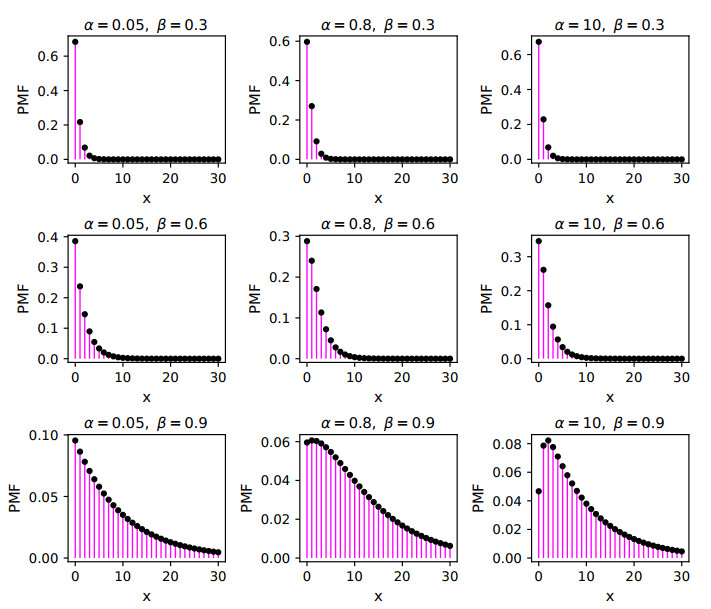
The PMF plots of the DM-WE distribution for various values of $ \alpha $ and $ \beta $
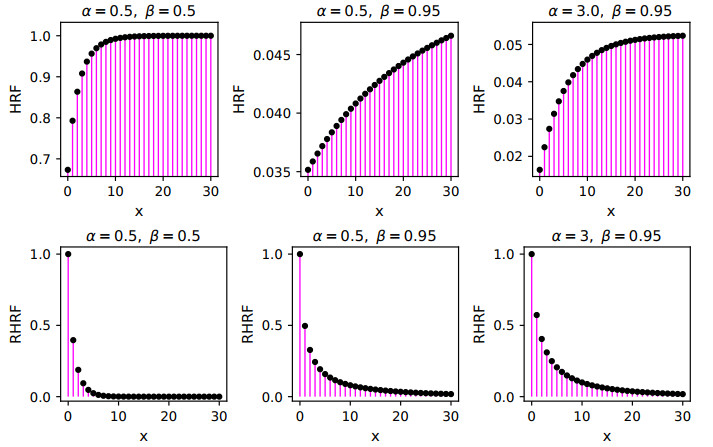
The HRF and RHRF plots of the DM-WE distribution for various values of $ \alpha $ and $ \beta $
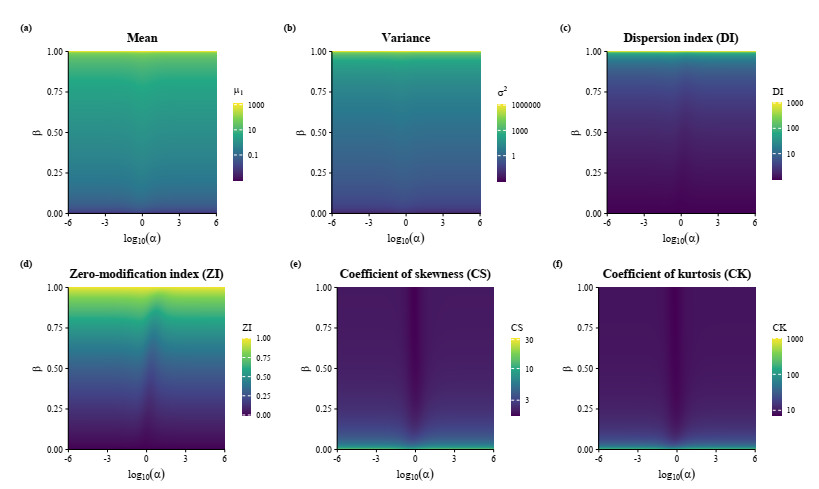
Mean, variance, DI, ZI, CS, and CK of the DM-WE distribution over the full parameter space $ (\alpha, \beta) $
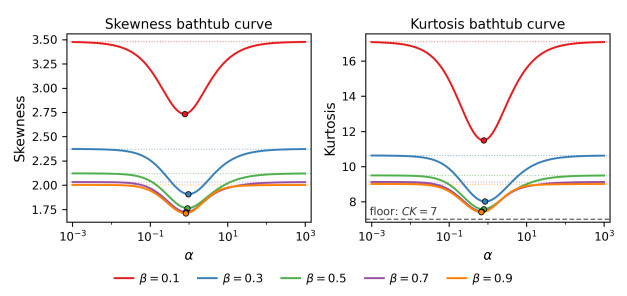
CS and CK versus $ \alpha $ for five values of $ \beta $; markers show the minima
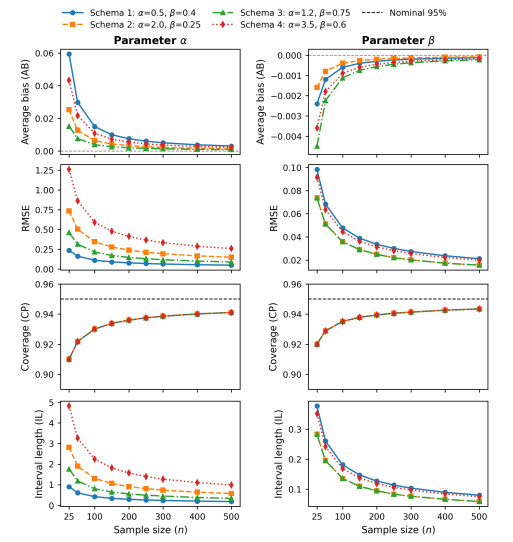
Simulation performance metrics across sample size
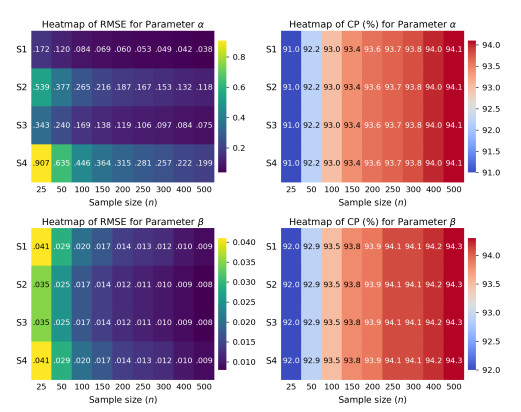
Monte Carlo simulation meta-analysis: error decomposition and interval coverage matrix
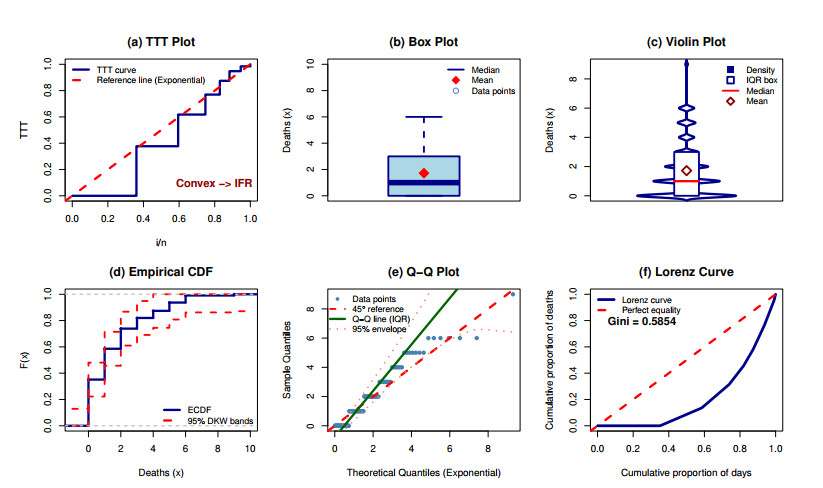
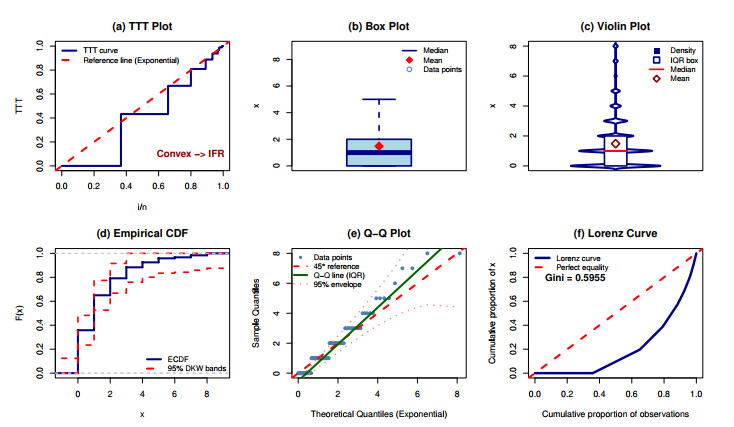
Exploratory data analysis of the COVID-19 daily deaths dataset, reflecting a right-skewed distribution, discrete nature, and an increasing hazard behavior
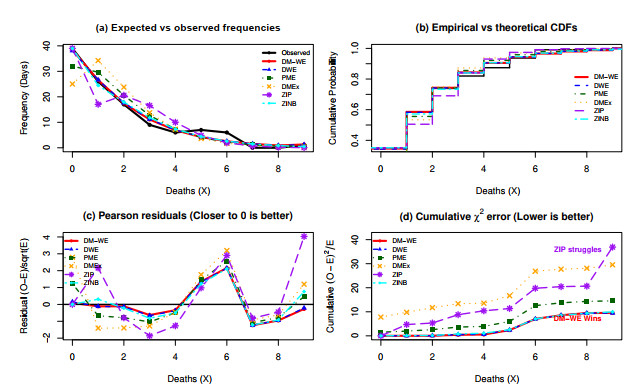
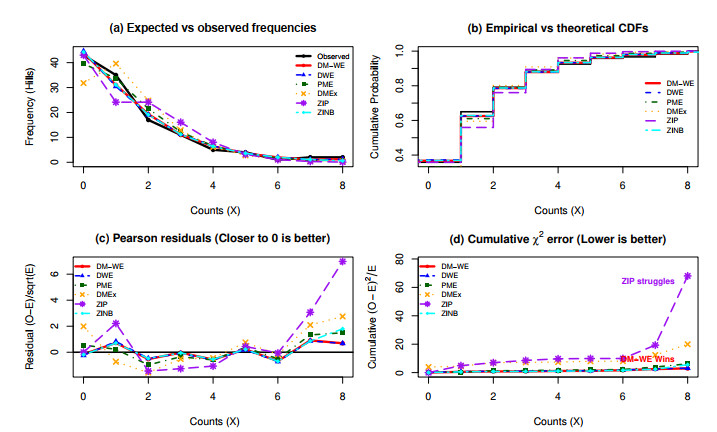
Comparative visual analysis verifying the goodness-of-fit for the proposed DM-WE against competing distributions (COVID-19 dataset)
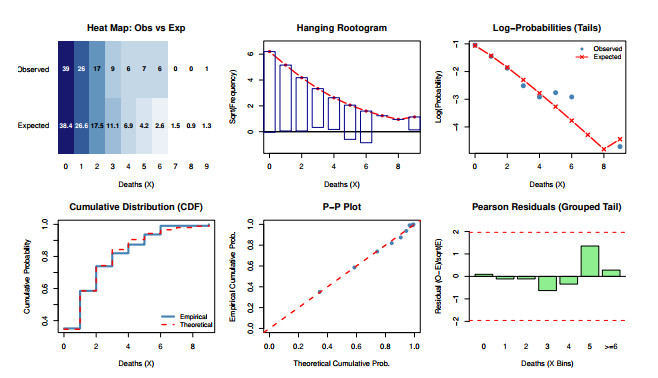
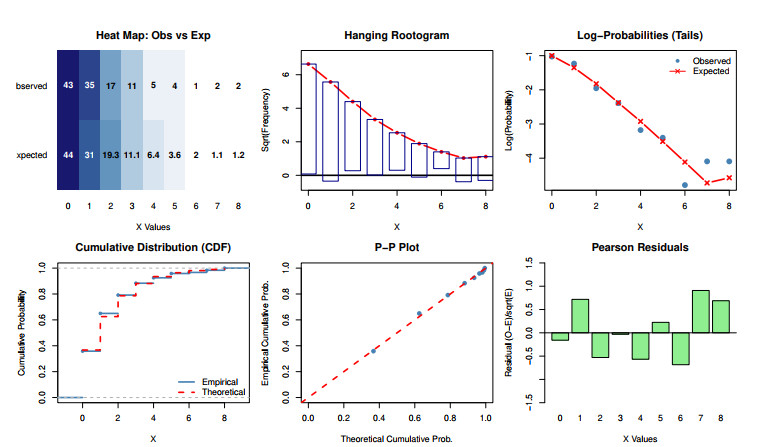
Comprehensive diagnostic plots confirming the precision of the DM-WE distribution fit to the COVID-19 dataset
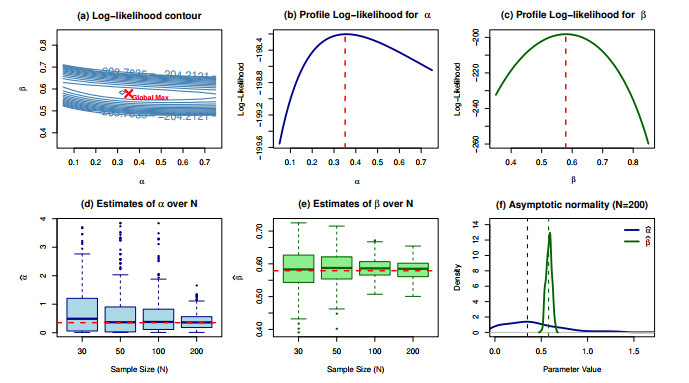
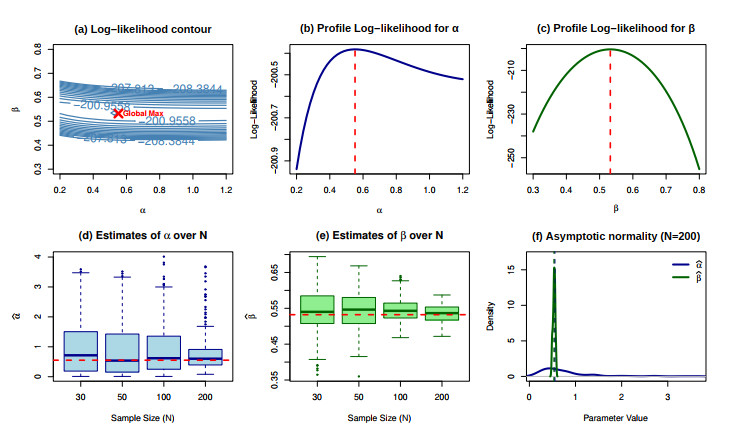
Graphical validation of MLEs properties for the COVID-19 dataset
Exploratory data analysis identifying the nonparametric characteristics of the European corn borer dataset
Graphical comparison emphasizing the lowest cumulative error achieved by the DM-WE distribution (corn borer dataset)
Diagnostic goodness-of-fit plots verifying the robustness of the DM-WE distribution on the corn borer dataset
Graphical validation of the MLE properties associated with the corn borer dataset estimations




 DownLoad: