Testing distributional symmetry about an unknown center is a composite-null problem in which signed information contrasts can cancel under asymmetric alternatives. We developed a two-layer framework built on reflected probability kernels from paired consecutive reliability systems: Global fractional-entropy identities characterize symmetry, while a positive-weight complementary log-quantile-density discrepancy measures local departures without cancellation. The discrepancy identified symmetry for any strictly positive weight; the consecutive-system kernels supplied a structured, reliability-interpretable choice rather than a necessary or optimal one. We proved consistency of the moving-spacing estimator under explicit conditions and gave a compact-support sufficient class with uniform control of all complete windows, including boundary windows. For finite-sample inference, we introduced ACES-R, a distinct blockwise reflection-randomization core with finite-sample level control over the composite symmetry null, without estimating the center. Sign-paired ties generally made its complete-orbit levels conservative, and fixed-block consistency held on the stated compact-support class. A separate Monte Carlo member used a prespecified quadratic statistic. Blocking carried an information cost: ACES-R exhibited lower raw rejection rates than full-sample ACES in the reported asymmetric settings, and its finite-group guarantee did not validate the full-sample bootstrap calibration. Full-sample ACES combined the score orders 1, 3/2, and 2 in a symmetrized-bootstrap standardized maximum whose primitive bootstrap validity and joint null limit remained unproved. Paired-sample simulations quantified the blocking-power trade-off and examined Student-t, Cauchy, and skew-t settings without claiming equal-size or uniform power superiority; classical and characteristic-function benchmarks, ablations, rounding diagnostics, and two engineering datasets mapped empirical strengths and limitations, with any heavy-tail power advantage remaining exploratory. Archived code, seeds, and replicate-level outputs support reproducibility of the paired-sample experiments.
Citation: Ibrahim A. Nafisah, Tahani Alshathri, Mashael A. Alshehri. Cancellation-free distributional symmetry testing via reliability-inspired consecutive-system entropy scores[J]. AIMS Mathematics, 2026, 11(11): 36293-36355. doi: 10.3934/math.20261406
Testing distributional symmetry about an unknown center is a composite-null problem in which signed information contrasts can cancel under asymmetric alternatives. We developed a two-layer framework built on reflected probability kernels from paired consecutive reliability systems: Global fractional-entropy identities characterize symmetry, while a positive-weight complementary log-quantile-density discrepancy measures local departures without cancellation. The discrepancy identified symmetry for any strictly positive weight; the consecutive-system kernels supplied a structured, reliability-interpretable choice rather than a necessary or optimal one. We proved consistency of the moving-spacing estimator under explicit conditions and gave a compact-support sufficient class with uniform control of all complete windows, including boundary windows. For finite-sample inference, we introduced ACES-R, a distinct blockwise reflection-randomization core with finite-sample level control over the composite symmetry null, without estimating the center. Sign-paired ties generally made its complete-orbit levels conservative, and fixed-block consistency held on the stated compact-support class. A separate Monte Carlo member used a prespecified quadratic statistic. Blocking carried an information cost: ACES-R exhibited lower raw rejection rates than full-sample ACES in the reported asymmetric settings, and its finite-group guarantee did not validate the full-sample bootstrap calibration. Full-sample ACES combined the score orders 1, 3/2, and 2 in a symmetrized-bootstrap standardized maximum whose primitive bootstrap validity and joint null limit remained unproved. Paired-sample simulations quantified the blocking-power trade-off and examined Student-t, Cauchy, and skew-t settings without claiming equal-size or uniform power superiority; classical and characteristic-function benchmarks, ablations, rounding diagnostics, and two engineering datasets mapped empirical strengths and limitations, with any heavy-tail power advantage remaining exploratory. Archived code, seeds, and replicate-level outputs support reproducibility of the paired-sample experiments.

| [1] |
M. S. Mohamed, M. A. Almuqrin, Properties of fractional generalized entropy in ordered variables and symmetry testing, AIMS Math., 10 (2025), 1116–1141. https://doi.org/10.3934/math.2025053 doi: 10.3934/math.2025053
|
| [2] |
M. Mahdizadeh, E. Zamanzade, Estimation of a symmetric distribution function in multistage ranked set sampling, Stat. Pap., 61 (2020), 851–867. https://doi.org/10.1007/s00362-017-0965-x doi: 10.1007/s00362-017-0965-x
|
| [3] |
M. Fashandi, J. Ahmadi, Characterizations of symmetric distributions based on Rényi entropy, Stat. Probab. Lett., 82 (2012), 798–804. https://doi.org/10.1016/j.spl.2012.01.004 doi: 10.1016/j.spl.2012.01.004
|
| [4] |
N. Balakrishnan, A. Selvitella, Symmetry of a distribution via symmetry of order statistics, Stat. Probab. Lett., 129 (2017), 367–372. https://doi.org/10.1016/j.spl.2017.06.023 doi: 10.1016/j.spl.2017.06.023
|
| [5] |
J. Ahmadi, M. Fashandi, Characterization of symmetric distributions based on some information measures properties of order statistics, Phys. A, 517 (2019), 141–152. https://doi.org/10.1016/j.physa.2018.11.009 doi: 10.1016/j.physa.2018.11.009
|
| [6] |
J. Ahmadi, M. Fashandi, Characterization of symmetric distributions based on concomitants of ordered variables from FGMs family of bivariate distributions, Filomat, 33 (2019), 4239–4250. https://doi.org/10.2298/FIL1913239A doi: 10.2298/FIL1913239A
|
| [7] |
J. Ahmadi, Characterization of continuous symmetric distributions using information measures of records, Stat. Pap., 62 (2021), 2603–2626. https://doi.org/10.1007/s00362-020-01206-z doi: 10.1007/s00362-020-01206-z
|
| [8] |
J. Ahmadi, Characterization results for symmetric continuous distributions based on the properties of (k)-records and spacings, Stat. Probab. Lett., 162 (2020), 108764. https://doi.org/10.1016/j.spl.2020.108764 doi: 10.1016/j.spl.2020.108764
|
| [9] |
H. A. Noughabi, Tests of symmetry based on the sample entropy of order statistics and power comparison, Sankhya B, 77 (2015), 240–255. https://doi.org/10.1007/s13571-015-0103-5 doi: 10.1007/s13571-015-0103-5
|
| [10] |
N. Gupta, S. K. Chaudhary, Some characterizations of continuous symmetric distributions based on extropy of record values, Stat. Pap., 65 (2024), 291–308. https://doi.org/10.1007/s00362-022-01392-y doi: 10.1007/s00362-022-01392-y
|
| [11] |
M. Amiri, B. Khaledi, A new test for symmetry against right skewness, J. Stat. Comput. Simul., 86 (2016), 1479–1496. https://doi.org/10.1080/00949655.2015.1071374 doi: 10.1080/00949655.2015.1071374
|
| [12] |
T. P. McWilliams, A distribution-free test for symmetry based on a runs statistic, J. Amer. Stat. Assoc., 85 (1990), 1130–1133. https://doi.org/10.1080/01621459.1990.10474985 doi: 10.1080/01621459.1990.10474985
|
| [13] |
A. Baklizi, A conditional distribution free runs test for symmetry, J. Nonparametr. Stat., 15 (2003), 713–718. https://doi.org/10.1080/10485250310001634737 doi: 10.1080/10485250310001634737
|
| [14] |
J. D. Gibbons, S. Chakraborti, Nonparametric statistical inference, Marcel Dekker, 1992. |
| [15] |
I. Tajuddin, Distribution-free test for symmetry based on Wilcoxon two-sample test, J. Appl. Stat., 21 (1994), 409–415. https://doi.org/10.1080/757584017 doi: 10.1080/757584017
|
| [16] |
W. Cheng, N. Balakrishnan, A modified sign test for symmetry, Commun. Stat. Simul. Comput., 33 (2004), 703–709. https://doi.org/10.1081/SAC-200033302 doi: 10.1081/SAC-200033302
|
| [17] |
R. Modarres, J. Gastwirth, Hybrid test for the hypothesis of symmetry, J. Appl. Stat., 25 (1998), 777–783. https://doi.org/10.1080/02664769822765 doi: 10.1080/02664769822765
|
| [18] |
R. Modarres, J. Gastwirth, A modified runs test for symmetry, Stat. Probab. Lett., 31 (1996), 107–112. https://doi.org/10.1016/S0167-7152(96)00020-X doi: 10.1016/S0167-7152(96)00020-X
|
| [19] |
A. Baklizi, Testing symmetry using a trimmed longest run statistic, Aust. N. Z. J. Stat., 49 (2007), 339–347. https://doi.org/10.1111/j.1467-842X.2007.00485.x doi: 10.1111/j.1467-842X.2007.00485.x
|
| [20] |
A. Baklizi, Improving the power of the hybrid test, Int. J. Contemp. Math. Sci., 3 (2008), 497–499. |
| [21] |
J. Corzo, G. Babativa, A modified runs test for symmetry, J. Stat. Comput. Simul., 83 (2013), 984–991. https://doi.org/10.1080/00949655.2011.647026 doi: 10.1080/00949655.2011.647026
|
| [22] |
P. Cabilio, J. Masaro, A simple test of symmetry about an unknown median, Can. J. Stat., 24 (1996), 349–361. https://doi.org/10.2307/3315744 doi: 10.2307/3315744
|
| [23] |
A. Mira, Distribution-free test for symmetry based on Bonferroni's measure, J. Appl. Stat., 26 (1999), 959–972. https://doi.org/10.1080/02664769921963 doi: 10.1080/02664769921963
|
| [24] |
W. Miao, Y. R. Gel, J. L. Gastwirth, A new test of symmetry about an unknown median, In: Agnes C. Hsiung, Z. Ying, C. H. Zhang, Random walk, sequential analysis and related topics, World Scientific, 2006,199–214. https://doi.org/10.1142/9789812772558_0013 |
| [25] |
T. Zheng, J. L. Gastwirth, On bootstrap tests of symmetry about an unknown median, J. Data Sci., 8 (2010), 413–427. https://doi.org/10.6339/JDS.2010.08(3).614 doi: 10.6339/JDS.2010.08(3).614
|
| [26] |
V. Lyubchich, X. Wang, A. Heyes, Y. R. Gel, A distribution-free m-out-of-n bootstrap approach to testing symmetry about an unknown median, Comput. Stat. Data Anal., 104 (2016), 1–9. https://doi.org/10.1016/j.csda.2016.05.004 doi: 10.1016/j.csda.2016.05.004
|
| [27] |
N. Henze, B. Klar, S. G. Meintanis, Invariant tests for symmetry about an unspecified point based on the empirical characteristic function, J. Multivar. Anal., 87 (2003), 275–297. https://doi.org/10.1016/S0047-259X(03)00044-7 doi: 10.1016/S0047-259X(03)00044-7
|
| [28] |
M. Kayid, M. Shrahili, Information properties of consecutive systems using fractional generalized cumulative residual entropy, Fractal Fract., 8 (2024), 568. https://doi.org/10.3390/fractalfract8100568 doi: 10.3390/fractalfract8100568
|
| [29] |
M. Kayid, M. A. Alshehri, Shannon differential entropy properties of consecutive k-out-of-n: G systems, Oper. Res. Lett., 57 (2024), 107190. https://doi.org/10.1016/j.orl.2024.107190 doi: 10.1016/j.orl.2024.107190
|
| [30] |
T. Alshathri, M. Kayid, Extropy-based characterization and nonparametric testing of symmetry in continuous distributions via consecutive systems, AIMS Math., 11 (2026), 10638–10667. https://doi.org/10.3934/math.2026438 doi: 10.3934/math.2026438
|
| [31] |
P. Hall, Limit theorems for sums of general functions of m-spacings, Math. Proc. Cambridge Philos. Soc., 96 (1984), 517–532. https://doi.org/10.1017/S0305004100062459 doi: 10.1017/S0305004100062459
|
| [32] |
N. Cressie, On the logarithms of high-order spacings, Biometrika, 63 (1976), 343–355. https://doi.org/10.1093/biomet/63.2.343 doi: 10.1093/biomet/63.2.343
|
| [33] |
P. Hall, On powerful distributional tests based on sample spacings, J. Multivar. Anal., 19 (1986), 201–224. https://doi.org/10.1016/0047-259X(86)90027-8 doi: 10.1016/0047-259X(86)90027-8
|
| [34] |
S. M. Mirakhmedov, Asymptotic properties of goodness of fit tests based on higher order overlapping spacings, Stat. Probab. Lett., 225 (2025), 110461. https://doi.org/10.1016/j.spl.2025.110461 doi: 10.1016/j.spl.2025.110461
|
| [35] |
S. Eryılmaz, Reliability properties of consecutive k-out-of-n systems of arbitrarily dependent components, Reliab. Eng. Syst. Saf., 94 (2009), 350–356. https://doi.org/10.1016/j.ress.2008.03.027 doi: 10.1016/j.ress.2008.03.027
|
| [36] |
C. E. Shannon, A mathematical theory of communication, Bell Syst. Tech. J., 27 (1948), 379–423. https://doi.org/10.1002/j.1538-7305.1948.tb01338.x doi: 10.1002/j.1538-7305.1948.tb01338.x
|
| [37] |
M. Rao, Y. Chen, B. C. Vemuri, F. Wang, Cumulative residual entropy: a new measure of information, IEEE Trans. Inf. Theory, 50 (2004), 1220–1228. https://doi.org/10.1109/TIT.2004.828057 doi: 10.1109/TIT.2004.828057
|
| [38] |
A. Di Crescenzo, M. Longobardi, On cumulative entropies, J. Stat. Plan. Inference, 139 (2009), 4072–4087. https://doi.org/10.1016/j.jspi.2009.05.038 doi: 10.1016/j.jspi.2009.05.038
|
| [39] |
A. D. Crescenzo, S. Kayal, A. Meoli, Fractional generalized cumulative entropy and its dynamic version, Commun. Nonlinear Sci. Numer. Simul., 102 (2021), 105899. https://doi.org/10.1016/j.cnsns.2021.105899 doi: 10.1016/j.cnsns.2021.105899
|
| [40] |
H. Xiong, P. Shang, Y. Zhang, Fractional cumulative residual entropy, Commun. Nonlinear Sci. Numer. Simul., 78 (2019), 104879. https://doi.org/10.1016/j.cnsns.2019.104879 doi: 10.1016/j.cnsns.2019.104879
|
| [41] |
G. Alomani, M. Kayid, Fractional survival functional entropy of engineering systems, Entropy, 24 (2022), 1275. https://doi.org/10.3390/e24091275 doi: 10.3390/e24091275
|
| [42] |
M. Kayid, M. Shrahili, Some further results on the fractional cumulative entropy, Entropy, 24 (2022), 1037. https://doi.org/10.3390/e24081037 doi: 10.3390/e24081037
|
| [43] |
G. Psarrakos, P. Economou, On the generalized cumulative residual entropy weighted distributions, Commun. Stat. Theory Methods, 46 (2017), 10914–10925. https://doi.org/10.1080/03610926.2016.1252402 doi: 10.1080/03610926.2016.1252402
|
| [44] |
U. Kamps, Characterizations of distributions by recurrence relations and identities for moments of order statistics, Handbook Stat., 16 (1998), 291–311. https://doi.org/10.1016/S0169-7161(98)16012-1 doi: 10.1016/S0169-7161(98)16012-1
|
| [45] |
J. S. Hwang, G. D. Lin, On a generalized moment problem. Ⅱ, Proc. Amer. Math. Soc., 91 (1984), 577–580. https://doi.org/10.1090/S0002-9939-1984-0746093-4 doi: 10.1090/S0002-9939-1984-0746093-4
|
| [46] |
O. Vasicek, A test for normality based on sample entropy, J. R. Stat. Soc. Ser. B Stat. Methodol., 38 (1976), 54–59. https://doi.org/10.1111/j.2517-6161.1976.tb01566.x doi: 10.1111/j.2517-6161.1976.tb01566.x
|
| [47] |
M. C. Jones, Estimating densities, quantiles, quantile densities and density quantiles, Ann. Inst. Stat. Math., 44 (1992), 721–727. https://doi.org/10.1007/BF00053400 doi: 10.1007/BF00053400
|
| [48] |
S. Boucheron, G. Lugosi, P. Massart, Concentration inequalities: a nonasymptotic theory of independence, Oxford University Press, 2013. |
| [49] |
A. W. van der Vaart, Asymptotic statistics, Cambridge University Press, 1998. https://doi.org/10.1017/CBO9780511802256 |
| [50] |
M. Raab, A. Steger, Balls into bins—a simple and tight analysis, Springer, 1998,159–170. |
| [51] |
D. J. Henderson, C. F. Parmeter, A consistent bootstrap procedure for nonparametric symmetry tests, Econ. Lett., 131 (2015), 78–82. https://doi.org/10.1016/j.econlet.2015.03.038 doi: 10.1016/j.econlet.2015.03.038
|
| [52] |
M. D. Ernst, Permutation methods: a basis for exact inference, Stat. Sci., 19 (2004), 676–685. https://doi.org/10.1214/088342304000000396 doi: 10.1214/088342304000000396
|
| [53] |
J. Hemerik, J. J. Goeman, Exact testing with random permutations, TEST, 27 (2018), 811–825. https://doi.org/10.1007/s11749-017-0571-1 doi: 10.1007/s11749-017-0571-1
|
| [54] |
N. W. Koning, J. Hemerik, More efficient exact group invariance testing: using a representative subgroup, Biometrika, 111 (2024), 441–458. https://doi.org/10.1093/biomet/asad050 doi: 10.1093/biomet/asad050
|
| [55] |
W. Hui, Y. R. Gel, J. L. Gastwirth, lawstat: an R package for law, public policy and biostatistics, J. Stat. Softw., 28 (2008), 1–26. https://doi.org/10.18637/jss.v028.i03 doi: 10.18637/jss.v028.i03
|
| [56] |
A. Azzalini, A. Capitanio, Distributions generated by perturbation of symmetry with emphasis on a multivariate skew t distribution, J. R. Stat. Soc. Ser. B Stat. Methodol., 65 (2003), 367–389. https://doi.org/10.1111/1467-9868.00391 doi: 10.1111/1467-9868.00391
|
| [57] |
G. Qiu, K. Jia, Extropy estimators with applications in testing uniformity, J. Nonparametr. Stat., 30 (2018), 182–196. https://doi.org/10.1080/10485252.2017.1404063 doi: 10.1080/10485252.2017.1404063
|
| [58] |
D. M. Wilson, Statistical tensile strength of NextelTM 610 and NextelTM 720 fibres, J. Mater. Sci., 32 (1997), 2535–2542. https://doi.org/10.1023/A:1018538030985 doi: 10.1023/A:1018538030985
|
| [59] |
M. A. Arcones, E. Giné, Some bootstrap tests of symmetry for univariate continuous distributions, Ann. Stat., 19 (1991), 1496–1511. https://doi.org/10.1214/aos/1176348258 doi: 10.1214/aos/1176348258
|
| [60] |
S. K. Chaudhary, N. Gupta, Extropy and Varextropy estimators with applications, arXiv, 2024. https://doi.org/10.48550/arXiv.2401.13065 |
| [61] |
CRAN lawstat source, symmetry. test. R. Available from: https://github.com/cran/lawstat/blob/master/R/symmetry.test.R |
Figures(4) / Tables(30)

Ibrahim A. Nafisah, Tahani Alshathri, Mashael A. Alshehri. Cancellation-free distributional symmetry testing via reliability-inspired consecutive-system entropy scores[J]. AIMS Mathematics, 2026, 11(11): 36293-36355. doi: 10.3934/math.20261406

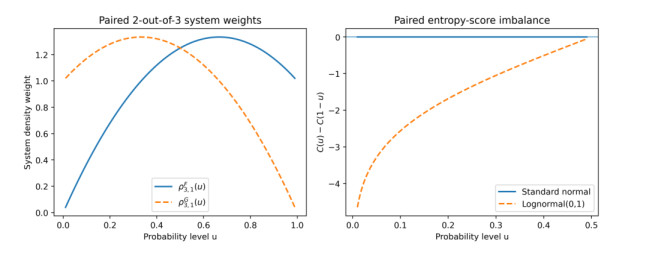
Paired consecutive 2-out-of-3 system densities and complementary entropy-score imbalance for normal and lognormal distributions. The local imbalance is zero under normal symmetry
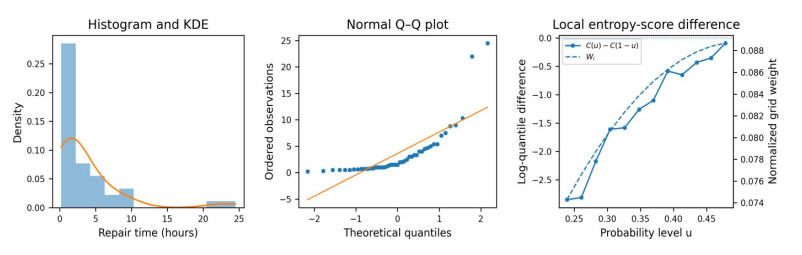
Repair-time histogram with kernel density estimate, normal Q–Q plot, and signed local score $ \mathit{\boldsymbol{C}}\left(\mathit{\boldsymbol{u}}\right)-\mathit{\boldsymbol{C}}({\bf{1}}-\mathit{\boldsymbol{u}}) = \mathit{\boldsymbol{l}}\mathit{\boldsymbol{o}}\mathit{\boldsymbol{g}}\mathit{\boldsymbol{q}}\left(\mathit{\boldsymbol{u}}\right)-\mathit{\boldsymbol{l}}\mathit{\boldsymbol{o}}\mathit{\boldsymbol{g}}\mathit{\boldsymbol{q}}({\bf{1}}-\mathit{\boldsymbol{u}}) $. The dashed curve shows the normalized discrete grid weights $ {\mathit{\boldsymbol{W}}}_{\mathit{\boldsymbol{i}}} $, not the continuously normalized weight function
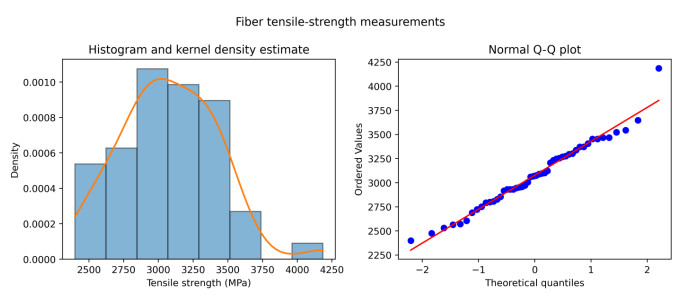
Histogram with kernel density estimate and normal Q–Q plot for the tensile-strength observations
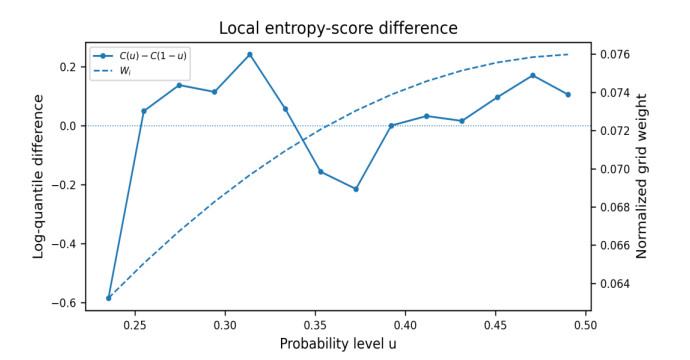
Signed complementary log-quantile-density difference for the tensile strengths and normalized discrete weights. This is a descriptive curve, not a simultaneous confidence band or an independent test at each probability level




 DownLoad: