The dependence of fractional dynamical systems on the differentiation order is commonly studied through sensitivity, monotonicity, or inverse order determination. In this paper, we investigated a complementary phenomenon: critical fractional orders at which the first-order sensitivity of a Mittag–Leffler response with respect to its order vanishes. We first considered the map
$ \alpha\longmapsto E_{\alpha}(\lambda), \qquad 0<\alpha<1, $
for sufficiently small nonzero $ \lambda $. A uniform $ C^1 $ perturbation argument shows that this map possesses a unique critical order $ \alpha_*(\lambda) $ in $ (0, 1) $, emerging from the distinguished value $ \alpha_0 $ determined by $ \psi(\alpha_0 \ + \ 1) = 0 $. The critical point is proved to be nondegenerate; it is a strict minimum for $ \lambda < 0 $ and a strict maximum for $ \lambda > 0 $. Consequently, the usual linear order sensitivity is lost at the critical point and is replaced by the quadratic local law
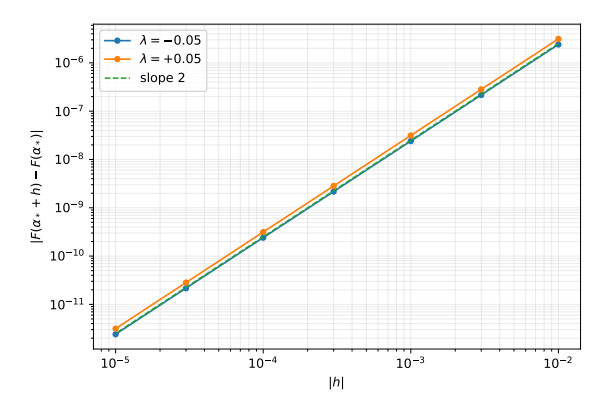
$ \left| E_{\alpha_*(\lambda)+h}(\lambda) - E_{\alpha_*(\lambda)}(\lambda) \right| \asymp |h|^2. $
We also derived an explicit first-order asymptotic expansion of the critical branch. The analysis was then extended to the dynamical map $ E_{\alpha}(\lambda t^\alpha) $ arising from a scalar Caputo evolution equation. An explicit unperturbed critical-order curve was obtained and shown to persist, on compact time intervals, as a unique nondegenerate critical surface for small $ |\lambda| $. High-precision numerical computations confirmed the critical-branch displacement, the minimum–maximum classification, and the predicted quadratic scaling. The results characterize a local loss of first-order order sensitivity that is distinct from the monotonicity regimes usually employed in fractional-order identification.
Citation: Areen Al-khateeb. Critical fractional orders and quadratic loss of sensitivity in Mittag–Leffler dynamics[J]. AIMS Mathematics, 2026, 11(11): 36244-36274. doi: 10.3934/math.20261404
The dependence of fractional dynamical systems on the differentiation order is commonly studied through sensitivity, monotonicity, or inverse order determination. In this paper, we investigated a complementary phenomenon: critical fractional orders at which the first-order sensitivity of a Mittag–Leffler response with respect to its order vanishes. We first considered the map
$ \alpha\longmapsto E_{\alpha}(\lambda), \qquad 0<\alpha<1, $
for sufficiently small nonzero $ \lambda $. A uniform $ C^1 $ perturbation argument shows that this map possesses a unique critical order $ \alpha_*(\lambda) $ in $ (0, 1) $, emerging from the distinguished value $ \alpha_0 $ determined by $ \psi(\alpha_0 \ + \ 1) = 0 $. The critical point is proved to be nondegenerate; it is a strict minimum for $ \lambda < 0 $ and a strict maximum for $ \lambda > 0 $. Consequently, the usual linear order sensitivity is lost at the critical point and is replaced by the quadratic local law
$ \left| E_{\alpha_*(\lambda)+h}(\lambda) - E_{\alpha_*(\lambda)}(\lambda) \right| \asymp |h|^2. $
We also derived an explicit first-order asymptotic expansion of the critical branch. The analysis was then extended to the dynamical map $ E_{\alpha}(\lambda t^\alpha) $ arising from a scalar Caputo evolution equation. An explicit unperturbed critical-order curve was obtained and shown to persist, on compact time intervals, as a unique nondegenerate critical surface for small $ |\lambda| $. High-precision numerical computations confirmed the critical-branch displacement, the minimum–maximum classification, and the predicted quadratic scaling. The results characterize a local loss of first-order order sensitivity that is distinct from the monotonicity regimes usually employed in fractional-order identification.

| [1] |
I. Podlubny, Fractional Differential Equations: An Introduction to Fractional Derivatives, Fractional Differential Equations, to Methods of Their Solution and Some of Their Applications, Mathematics in Science and Engineering, Vol. 198, Academic Press, San Diego, 1999. |
| [2] |
K. Diethelm, The Analysis of Fractional Differential Equations: An Application-Oriented Exposition Using Differential Operators of Caputo Type, Lecture Notes in Mathematics, Vol. 2004, Springer, Berlin, Heidelberg, 2010. |
| [3] |
A. A. Kilbas, H. M. Srivastava, J. J. Trujillo, Theory and Applications of Fractional Differential Equations, North-Holland Mathematics Studies, Vol. 204, Elsevier, Amsterdam, 2006. |
| [4] |
H. J. Haubold, A. M. Mathai, R. K. Saxena, Mittag–Leffler functions and their applications, J. Appl. Math., 2011 (2011), Article ID 298628, 51. |
| [5] |
R. Gorenflo, A. A. Kilbas, F. Mainardi, S. V. Rogosin, Mittag-Leffler Functions, Related Topics and Applications, 2nd ed., Springer Monographs in Mathematics, Springer, Berlin, Heidelberg, 2020. |
| [6] |
F. Mainardi, Fractional Calculus and Waves in Linear Viscoelasticity: An Introduction to Mathematical Models, World Scientific, Singapore, 2022. |
| [7] |
Y. Guo, B. Ma, R. Wu, On sensitivity analysis of parameters for fractional differential equations with Caputo derivatives, Electron. J. Qual. Theory Differ. Equ., 2016 (2016), 1–17. https://doi.org/10.14232/ejqtde.2016.1.118 doi: 10.14232/ejqtde.2016.1.118
|
| [8] |
E. Kharazmi, M. Zayernouri, Fractional sensitivity equation method: Application to fractional model construction, J. Sci. Comput., 80 (2019), 110–140. https://doi.org/10.1007/s10915-019-00935-0 doi: 10.1007/s10915-019-00935-0
|
| [9] |
A. Y. A. Salamooni, D. D. Pawar, Continuous dependence of a solution for fractional order Cauchy-type problem, Partial Differ. Equ. Appl. Math., 4 (2021), 100110. https://doi.org/10.1016/j.padiff.2021.100110 doi: 10.1016/j.padiff.2021.100110
|
| [10] |
A. Apelblat, Differentiation of the Mittag–Leffler functions with respect to parameters in the Laplace transform approach, Mathematics, 8 (2020), 657. https://doi.org/10.3390/math8050657 doi: 10.3390/math8050657
|
| [11] |
A. Apelblat, J. L. González-Santander, Differentiation of integral Mittag–Leffler and integral Wright functions with respect to parameters, Fract. Calc. Appl. Anal., 26 (2023), 567–598. https://doi.org/10.1007/s13540-023-00142-7 doi: 10.1007/s13540-023-00142-7
|
| [12] |
R. Ashurov, S. Umarov, Determination of the order of fractional derivative for subdiffusion equations, Fract. Calc. Appl. Anal., 23 (2020), 1647–1662. https://doi.org/10.1515/fca-2020-0081 doi: 10.1515/fca-2020-0081
|
| [13] |
S. Alimov, R. Ashurov, Inverse problem of determining an order of the Caputo time-fractional derivative for a subdiffusion equation, J. Inverse Ill-Posed Probl., 28 (2020), 651–658. https://doi.org/10.1515/jiip-2020-0072 doi: 10.1515/jiip-2020-0072
|
| [14] |
M. Yamamoto, Uniqueness in determining fractional orders of derivatives and initial values, Inverse Probl., 37 (2021), 095006. https://doi.org/10.1088/1361-6420/abf9e9 doi: 10.1088/1361-6420/abf9e9
|
| [15] |
B. Jin, Y. Kian, Recovering multiple fractional orders in time-fractional diffusion in an unknown medium, Proc. R. Soc. A Math. Phys. Eng. Sci., 477 (2021), 20210468. https://doi.org/10.1098/rspa.2021.0468 doi: 10.1098/rspa.2021.0468
|
| [16] |
B. Jin, Y. Kian, Recovery of the order of derivation for fractional diffusion equations in an unknown medium, SIAM J. Appl. Math., 82 (2022), 1045–1067. https://doi.org/10.1137/21M1398264 doi: 10.1137/21M1398264
|
| [17] |
X. Jing, M. Yamamoto, Simultaneous uniqueness for multiple parameters identification in a fractional diffusion-wave equation, Inverse Probl. Imaging, 16 (2022), 1199–1217. https://doi.org/10.48550/arXiv.2103.07720 doi: 10.48550/arXiv.2103.07720
|
| [18] |
X. Zheng, J. Cheng, H. Wang, Uniqueness of determining the variable fractional order in variable-order time-fractional diffusion equations, Inverse Probl., 35 (2019), 125002. https://doi.org/10.1088/1361-6420/ab3aa3 doi: 10.1088/1361-6420/ab3aa3
|
| [19] |
Z. Li, Z. Zhang, Unique determination of fractional order and source term in a fractional diffusion equation from sparse boundary data, Inverse Probl., 36 (2020), 115013. https://doi.org/10.1088/1361-6420/abbc5d doi: 10.1088/1361-6420/abbc5d
|
| [20] |
R. R. Ashurov, R. T. Zunnunov, Inverse problem for determining the order of fractional derivative in mixed-type equations, Lobachevskii J. Math., 42 (2021), 2714–2729. https://doi.org/10.1134/S1995080221120052 doi: 10.1134/S1995080221120052
|
| [21] |
G. Li, Z. Wang, X. Jia, Y. Zhang, An inverse problem of determining the fractional order in the TFDE using the measurement at one space-time point, Fract. Calc. Appl. Anal., 26 (2023), 1770–1785. https://doi.org/10.1007/s13540-023-00170-3 doi: 10.1007/s13540-023-00170-3
|
| [22] |
R. Ashurov, I. Sulaymonov, Determining the order of time and spatial fractional derivatives, Math. Methods Appl. Sci., 48 (2025), 1503–1518. https://doi.org/10.1002/mma.10393 doi: 10.1002/mma.10393
|
| [23] |
I. Sulaymonov, R. Ashurov, Monotonicity in the parameter of the Mittag–Leffler function and determining the fractional exponent of the subdiffusion equation, Lobachevskii J. Math., 46 (2025), 6411–6424. https://doi.org/10.1134/S199508022561402X doi: 10.1134/S199508022561402X
|
| [24] |
J. Xiao, K. Shi, Y. Teng, J. Qi, H. Fan, Relaxed research on synchronization problem of fractional-order fuzzy octonion-valued BAM neural networks by the non-decomposition method on the high-dimension oblique field, Fractal Fract., 10 (2026), 414. https://doi.org/10.3390/fractalfract10060414 doi: 10.3390/fractalfract10060414
|
| [25] |
J. Xiao, B. Huang, S. Wen, The new quadratic inequality and particle swarm optimization method for the relaxed synchronization criteria of fractional-order lower-dimension-valued bilayer neural networks, Nonlinear Dynam., (2026). https://doi.org/10.1007/s11071-026-12599-1. |
Figures(4) / Tables(2)

Areen Al-khateeb. Critical fractional orders and quadratic loss of sensitivity in Mittag–Leffler dynamics[J]. AIMS Mathematics, 2026, 11(11): 36244-36274. doi: 10.3934/math.20261404

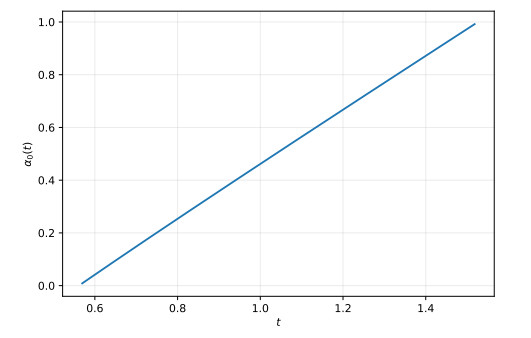
The unperturbed critical-order curve $ \alpha_0(t) = \psi^{-1}(\log t)-1 $
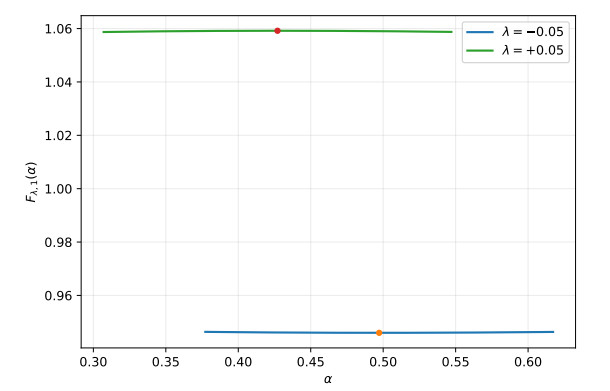
Local profiles of $ F_{\lambda, 1}(\alpha) $ near their critical orders for $ \lambda = -0.05 $ and $ \lambda = 0.05 $
Log–log verification of the quadratic critical-order scaling for $ \lambda = \pm0.05 $ at $ t = 1 $
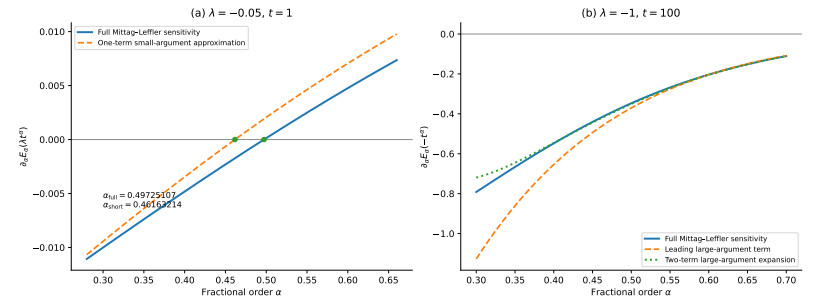
Order sensitivity of the full Mittag–Leffler response and its approximations. (a) Small-argument regime $ \lambda = -0.05 $, $ t = 1 $: the zero of the complete sensitivity is compared with the stationary order of the first nonconstant truncation. (b) Large-argument relaxation regime $ \lambda = -1 $, $ t = 100 $: the full order sensitivity is compared with derivatives of the one- and two-term asymptotic expressions for interior orders. The curves illustrate approximation differences and do not imply a global absence theorem for the full response




 DownLoad: