Graphical invariants play a fundamental role in characterizing the structural and distance-related properties of complex networks, with significant applications in graph theory, chemical graph theory, and communication systems. Among these, the distance eccentric connectivity index (DECI) and the $ d $-connectivity index (DCI) have emerged as effective descriptors that integrate vertex degree, eccentricity, and distance information. In this paper, we present an exact analytical study of these two distance-based graphical invariants for several families of circulant networks. Closed-form expressions are established for the DECI and DCI of 3-, 4-, and 5-regular circulant networks. Furthermore, unified general formulas for the DCI are derived for generalized circulant networks with arbitrary even and odd regularities. The obtained results reveal the influence of graph order, regularity, and parity on the behavior of these invariants, providing a comprehensive characterization of their structural properties. The proposed formulas not only extend the theoretical understanding of distance-based graphical invariants for highly symmetric networks but also offer efficient computational tools for the analysis of communication networks, chemical graph structures, and other complex, interconnected systems.
Citation: Haoyu Kong, Muhammad Salman, Tahira Noreen, Hanen Karamti, Ziye Kong. Distance eccentric connectivity and $ d $-connectivity indices of circulant networks: exact formulas and generalizations[J]. AIMS Mathematics, 2026, 11(11): 36100-36118. doi: 10.3934/math.20261398
Graphical invariants play a fundamental role in characterizing the structural and distance-related properties of complex networks, with significant applications in graph theory, chemical graph theory, and communication systems. Among these, the distance eccentric connectivity index (DECI) and the $ d $-connectivity index (DCI) have emerged as effective descriptors that integrate vertex degree, eccentricity, and distance information. In this paper, we present an exact analytical study of these two distance-based graphical invariants for several families of circulant networks. Closed-form expressions are established for the DECI and DCI of 3-, 4-, and 5-regular circulant networks. Furthermore, unified general formulas for the DCI are derived for generalized circulant networks with arbitrary even and odd regularities. The obtained results reveal the influence of graph order, regularity, and parity on the behavior of these invariants, providing a comprehensive characterization of their structural properties. The proposed formulas not only extend the theoretical understanding of distance-based graphical invariants for highly symmetric networks but also offer efficient computational tools for the analysis of communication networks, chemical graph structures, and other complex, interconnected systems.

| [1] |
A. Ali, B. Furtula, I. Redžepović, I. Gutman, Atom-bond sum-connectivity index, J. Math. Chem., 60 (2022), 2081–2093. https://doi.org/10.1007/s10910-022-01403-1 doi: 10.1007/s10910-022-01403-1
|
| [2] |
A. Alkqesmah, A. Saleh, R. Rangarajan, A. Yurttas, I. N. Cangul, Distance eccentric connectivity index of graphs, Kyungpook Math. J., 61 (2021), 61–74. https://doi.org/10.5666/KMJ.2021.61.1.61 doi: 10.5666/KMJ.2021.61.1.61
|
| [3] |
A. T. Balaban, Highly discriminating distance-based topological index, Chem. Phys. Lett., 89 (1982), 399–404. https://doi.org/10.1016/0009-2614(82)80009-2 doi: 10.1016/0009-2614(82)80009-2
|
| [4] |
A. T. Balaban, Topological indices based on topological distances in molecular graphs, Pure Appl. Chem., 55 (1983), 199–206. https://doi.org/10.1351/pac198855020199 doi: 10.1351/pac198855020199
|
| [5] |
J. C. Bermond, F. Comellas, D. F. Hsu, Distributed loop computer networks: a survey, J. Parallel Distr. Com., 24 (1995), 2–10. https://doi.org/10.1006/jpdc.1995.1002 doi: 10.1006/jpdc.1995.1002
|
| [6] |
F. Boesch, J. F. Wang, Reliable circulant networks with minimum transmission delay, IEEE Trans. Circuits Syst., 32 (1985), 1286–1291. https://doi.org/10.1109/TCS.1985.1085667 doi: 10.1109/TCS.1985.1085667
|
| [7] |
G. Chartrand, P. Zhang, Introduction to graph theory, New York: McGraw-Hill, 2006. |
| [8] |
A. A. Dobrynin, A. A. Kochetova, Degree distance of a graph: a degree analogue of the Wiener index, J. Chem. Inf. Comput. Sci., 34 (1994), 1082–1086. https://doi.org/10.1021/ci00021a008 doi: 10.1021/ci00021a008
|
| [9] |
E. Estrada, L. Torres, L. Rodríguez, I. Gutman, An atom-bond connectivity index: modelling the enthalpy of formation of alkanes, Indian J. Chem. A, 37 (1998), 849–855. |
| [10] |
M. U. Ghani, F. J. H. Campena, S. Ali, S. Dehraj, M. Cancan, F. M. Alharbi, et al., Characterizations of chemical networks entropies by K-banhatii topological indices, Symmetry, 15 (2023), 143. https://doi.org/10.3390/sym15010143 doi: 10.3390/sym15010143
|
| [11] |
M. U. Ghani, S. Ali, M. Imran, H. Karamti, F. Sultan, M. Y. Almusawa, Hex-derived molecular descriptors via generalized valency-based entropies, IEEE Access, 11 (2023), 42052–42068. https://doi.org/10.1109/ACCESS.2023.3248507 doi: 10.1109/ACCESS.2023.3248507
|
| [12] |
S. Gupta, M. Singh, A. K. Madan, Eccentric distance sum: a novel graph invariant for predicting biological and physical properties, J. Math. Anal. Appl., 275 (2002), 386–401. https://doi.org/10.1016/S0022-247X(02)00373-6 doi: 10.1016/S0022-247X(02)00373-6
|
| [13] |
S. Gupta, M. Singh, A. K. Madan, Connective eccentricity index: a novel topological descriptor for predicting biological activity, J. Mol. Graph. Model., 18 (2000), 18–25. https://doi.org/10.1016/S1093-3263(00)00027-9 doi: 10.1016/S1093-3263(00)00027-9
|
| [14] |
I. Gutman, M. Lepović, Choosing the exponent in the definition of the connectivity index, J. Serb. Chem. Soc., 66 (2001), 605–611. https://doi.org/10.2298/JSC0109605G doi: 10.2298/JSC0109605G
|
| [15] |
I. Gutman, Selected properties of the Schultz molecular topological index, J. Chem. Inf. Comput. Sci., 34 (1994), 1087–1089. https://doi.org/10.1021/ci00021a009 doi: 10.1021/ci00021a009
|
| [16] |
H. Hua, K. C. Das, The relationship between eccentric connectivity index and Zagreb indices, Discrete Appl. Math., 161 (2013), 2480–2491. https://doi.org/10.1016/j.dam.2013.05.034 doi: 10.1016/j.dam.2013.05.034
|
| [17] |
A. Ilic, D. Stevanovic, L. Feng, G. Yu, P. Dankelmann, Degree distance of unicyclic and bicyclic graphs, Discrete Appl. Math., 159 (2011), 779–788. https://doi.org/10.1016/j.dam.2011.01.013 doi: 10.1016/j.dam.2011.01.013
|
| [18] |
I. Khalid, F. Ali, M. Salman, On the metric index of circulant networks: an algorithmic approach, IEEE Access, 7 (2019), 58595–58601. https://doi.org/10.1109/ACCESS.2019.2914933 doi: 10.1109/ACCESS.2019.2914933
|
| [19] |
D. J. Klein, Z. Mihalić, D. Plavsić, N. Trinajstić, Molecular topological index: a relation with the Wiener index, J. Chem. Inf. Comput. Sci., 32 (1992), 304–305. https://doi.org/10.1021/ci00008a008 doi: 10.1021/ci00008a008
|
| [20] |
V. Kumar, S. Sardana, A. K. Madan, Predicting anti-HIV activity of 2, 3-diaryl-1, 3-thiazolidin-4-ones: computational approach using reformed eccentric connectivity index, J. Mol. Model., 10 (2004), 399–407. https://doi.org/10.1007/s00894-004-0215-8 doi: 10.1007/s00894-004-0215-8
|
| [21] |
J. B. Liu, C. Wang, S. Wang, B. Wei, Zagreb indices and multiplicative Zagreb indices of Eulerian graphs, Bull. Malays. Math. Sci. Soc., 42 (2019), 67–78. https://doi.org/10.1007/s40840-017-0463-2 doi: 10.1007/s40840-017-0463-2
|
| [22] |
J. B. Liu, J. Zhao, J. Min, J. Cao, The Hosoya index of graphs formed by a fractal graph, Fractals, 27 (2019), 1950135. https://doi.org/10.1142/S0218348X19501354 doi: 10.1142/S0218348X19501354
|
| [23] |
M. J. Morgan, S. Mukwembi, H. C. Swart, On the eccentric connectivity index of a graph, Discrete Math., 311 (2011), 1229–1234. https://doi.org/10.1016/j.disc.2009.12.013 doi: 10.1016/j.disc.2009.12.013
|
| [24] |
S. Mukhtar, M. Salman, A. D. Maden, M. U. Rehman, Metric properties of non-commuting graph associated with two groups, Int. J. Found. Comput. Sci., 33 (2022), 931–952. https://doi.org/10.1142/S0129054122420229 doi: 10.1142/S0129054122420229
|
| [25] |
T. Noreen, M. Salman, Indices analysis of hexa organic molecular structures together with fundamental insights of a novel connectivity index, Main Group Met. Chem., 49 (2026), 17–20. https://doi.org/10.1515/mgmc-2025-0016 doi: 10.1515/mgmc-2025-0016
|
| [26] |
T. Noreen, M. Salman, Distance-based connectivity indices for chain polygonal cactus networks and their applications in wireless communication systems, Boletim Da Sociedade Paranaense De Matemática, 44 (2026), 1–22. https://doi.org/10.5269/bspm.78071 doi: 10.5269/bspm.78071
|
| [27] |
H. S. Ramane, A. S. Yalnaik, Status connectivity indices of graphs and its applications to the boiling point of benzenoid hydrocarbons, J. Appl. Math. Comput., 55 (2017), 609–627. https://doi.org/10.1007/s12190-016-1052-5 doi: 10.1007/s12190-016-1052-5
|
| [28] |
M. Salman, N. Rasheed, M. U. Rehman, J. Cao, On the metric determination of linear dependence graph, Optim. Control Appl. Meth., 44 (2023), 1632–1647. https://doi.org/10.1002/oca.2883 doi: 10.1002/oca.2883
|
| [29] |
S. Sardana, A. K. Madan, Predicting anti-HIV activity of TIBO derivatives: a computational approach using a novel topological descriptor, J. Mol. Model., 8 (2002), 258–265. https://doi.org/10.1007/s00894-002-0093-x doi: 10.1007/s00894-002-0093-x
|
| [30] |
V. Sharma, R. Goswami, A. K. Madan, Eccentric connectivity index: a novel highly discriminating topological descriptor for structure-property and structure-activity studies, J. Chem. Inf. Comput. Sci., 37 (1997), 273–282. https://doi.org/10.1021/ci960049h doi: 10.1021/ci960049h
|
| [31] |
H. Wiener, Structural determination of paraffin boiling points, J. Am. Chem. Soc., 69 (1947), 17–20. https://doi.org/10.1021/ja01193a005 doi: 10.1021/ja01193a005
|
| [32] |
G. Yu, L. Feng, On the connective eccentricity index of graphs, MATCH Commun. Math. Comput. Chem., 69 (2013), 611–628. |
| [33] |
B. Zhou, N. Trinajstić, On a novel connectivity index, J. Math. Chem., 46 (2009), 1252–1270. https://doi.org/10.1007/s10910-008-9515-z doi: 10.1007/s10910-008-9515-z
|
Figures(5) / Tables(6)

Haoyu Kong, Muhammad Salman, Tahira Noreen, Hanen Karamti, Ziye Kong. Distance eccentric connectivity and $ d $-connectivity indices of circulant networks: exact formulas and generalizations[J]. AIMS Mathematics, 2026, 11(11): 36100-36118. doi: 10.3934/math.20261398

Preliminaries and basic results
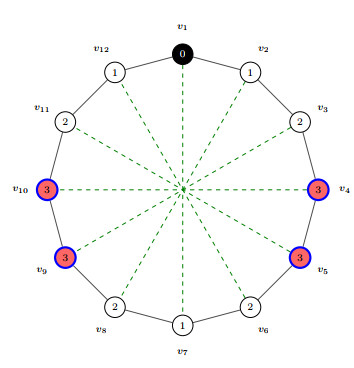
The circulant network $ C_{12}(1, \tfrac{12}{2}) $ with the distance $ d(v_1, v) $ written inside each vertex. The fixed vertex $ v_1 $ is black, the eccentric vertices (at distance $ \mathrm{ecc} = 3 $) are red, and the $ d $-neighbors (at distance $ d = 3 $) have a thick blue border. Here, $ \deg^{De}(v) = 4 $, so $ \xi^{De}(G) = 12\cdot 4\cdot 3 = 144 $ (Theorem 2), and $ n_d(v) = 4 $, so $ C_d(G) = 12\cdot 4\cdot 3 = 144 $ (Theorem 3)
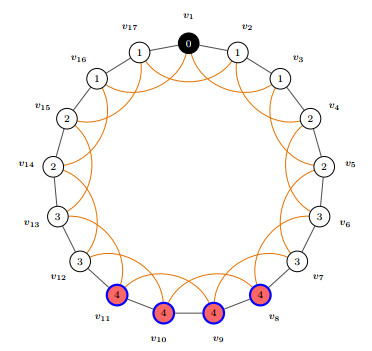
The circulant network $ C_{17}(1, 2) $ with the distance $ d(v_1, v) $ written inside each vertex. The fixed vertex $ v_1 $ is black, the eccentric vertices (at distance $ \mathrm{ecc} = 4 $) are red, and the $ d $-neighbors (at distance $ d = 4 $) have a thick blue border. Here, $ \deg^{De}(v) = 4 $, so $ \xi^{De}(G) = 17\cdot 4\cdot 4 = 272 $ (Theorem 5), and $ n_d(v) = 4 $, so $ C_d(G) = 17\cdot 4\cdot 4 = 272 $ (Theorem 6)
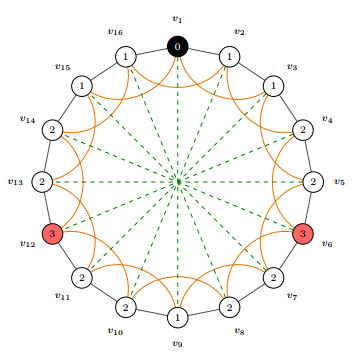
The circulant network $ C_{16}(1, 2, \tfrac{16}{2}) $ with the distance $ d(v_1, v) $ written inside each vertex. The fixed vertex $ v_1 $ is black, and the eccentric vertices (at distance $ \mathrm{ecc} = 3 $) are red. Here, $ \deg^{De}(v) = 2 $, so $ \xi^{De}(G) = 16\cdot 2\cdot 3 = 96 $ (Theorem 7). Because $ d(v) = 5 > \mathrm{ecc}(v) $, there is no $ d $-neighbor, $ n_d(v) = 0, $ and $ C_d(G) = 0 $ (Theorem 8)
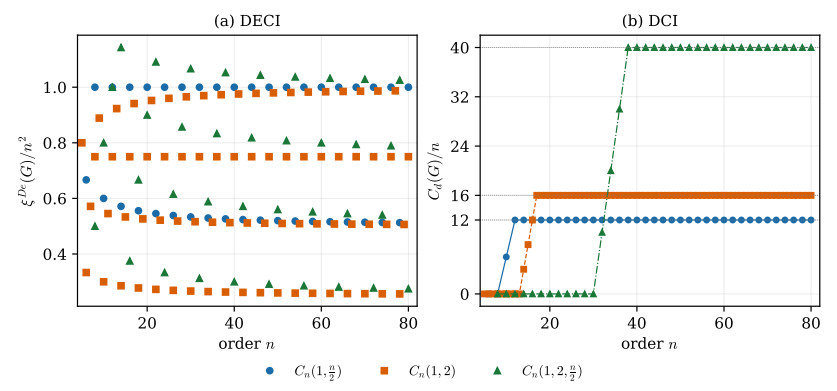
Behavior of the two indices on the three circulant networks, computed from Theorems 2–8. (a) $ \xi^{De}(G)/n^{2} $: values group into levels determined by the residue class of $ n $ (mod 4 or mod 8). (b) $ C_d(G)/n $: index vanishes below a family-dependent threshold and then stabilizes at $ 12 $, $ 16, $ and $ 40 $ for $ C_n(1, n/2) $, $ C_n(1, 2), $ and $ C_n(1, 2, n/2), $ respectively




 DownLoad: