A new three-parameter Ujlayan-Dixit fractional Weibull distribution (UDFWD) is proposed by replacing the ordinary derivative in the differential equation generating the classical Weibull density with the Ujlayan-Dixit fractional (UDF) derivative of order $q \in (0, 1]$. The resulting density is expressed as a convergent infinite series involving the gamma function. Series representations are obtained for the cumulative distribution, survival, and hazard rate functions in terms of the lower and upper incomplete gamma functions, together with sufficient conditions on $(\theta, \beta, q)$ for absolute convergence. Unlike most Weibull-type extensions, whose aging behavior is examined only numerically, the proposed density is proved to be strictly log-concave for $ \theta > 1 $, $ \beta > 0 $, and $ 0 < q\leq1 $. The UDFWD therefore has a strictly increasing hazard rate and a unique mode, and the fractional parameter is shown to govern the level and the growth of the hazard through the factor $1/{q}$ and the additive constant ${(1-q)}/{q}$. Several structural properties are also derived, including the mode; the quantile function; the ordinary moments; and the Shannon, Tsallis, and Rényi entropies. The unknown parameters are estimated using the maximum likelihood, least squares, and weighted least squares methods, and a Monte Carlo simulation study provides numerical evidence that the mean square errors (MSEs) and absolute relative biases generally decrease as the sample size increases, with the maximum likelihood method attaining the smallest MSEs in most settings with moderate and large sample sizes. Finally, two real datasets, on carbon fiber tensile strength and serum creatinine, show that the UDFWD attains the smallest values of all model-selection criteria against six competing lifetime models, while remaining highly competitive on the distance-based goodness-of-fit measures.
Citation: Nesreen M. Al-Olaimat, Hatim Solayman Migdadi, Afaf Alrashidi, Samirah Alzubaidi. The Ujlayan-Dixit fractional Weibull distribution: statistical properties, estimation, and applications to engineering and biomedical data[J]. AIMS Mathematics, 2026, 11(10): 35429-35468. doi: 10.3934/math.20261375
A new three-parameter Ujlayan-Dixit fractional Weibull distribution (UDFWD) is proposed by replacing the ordinary derivative in the differential equation generating the classical Weibull density with the Ujlayan-Dixit fractional (UDF) derivative of order $q \in (0, 1]$. The resulting density is expressed as a convergent infinite series involving the gamma function. Series representations are obtained for the cumulative distribution, survival, and hazard rate functions in terms of the lower and upper incomplete gamma functions, together with sufficient conditions on $(\theta, \beta, q)$ for absolute convergence. Unlike most Weibull-type extensions, whose aging behavior is examined only numerically, the proposed density is proved to be strictly log-concave for $ \theta > 1 $, $ \beta > 0 $, and $ 0 < q\leq1 $. The UDFWD therefore has a strictly increasing hazard rate and a unique mode, and the fractional parameter is shown to govern the level and the growth of the hazard through the factor $1/{q}$ and the additive constant ${(1-q)}/{q}$. Several structural properties are also derived, including the mode; the quantile function; the ordinary moments; and the Shannon, Tsallis, and Rényi entropies. The unknown parameters are estimated using the maximum likelihood, least squares, and weighted least squares methods, and a Monte Carlo simulation study provides numerical evidence that the mean square errors (MSEs) and absolute relative biases generally decrease as the sample size increases, with the maximum likelihood method attaining the smallest MSEs in most settings with moderate and large sample sizes. Finally, two real datasets, on carbon fiber tensile strength and serum creatinine, show that the UDFWD attains the smallest values of all model-selection criteria against six competing lifetime models, while remaining highly competitive on the distance-based goodness-of-fit measures.

| [1] |
H. Wu, X. Guo, W. Sun, L. K. Song, Q. Deng, S. Yang, et al., Fatigue life prediction of steels in hydrogen environments using physics-informed learning, Appl. Sci., 16 (2026), 1905. https://doi.org/10.3390/app16041905 doi: 10.3390/app16041905
|
| [2] |
F. Laganà, Design and simulation-based validation of an embedded acquisition architecture for in situ PCB integrity monitoring in biomedical devices, Electronics, 15 (2026), 833. https://doi.org/10.3390/electronics15040833 doi: 10.3390/electronics15040833
|
| [3] |
W. Weibull, A statistical distribution function of wide applicability, J. Appl. Mech., 18 (1951), 293–297. https://doi.org/10.1115/1.4010337 doi: 10.1115/1.4010337
|
| [4] |
G. S. Mudholkar, D. K. Srivastava, Exponentiated Weibull family for analyzing bathtub failure-rate data, IEEE Trans. Reliab., 42 (1993), 299–302. https://doi.org/10.1109/24.229504 doi: 10.1109/24.229504
|
| [5] |
C. D. Lai, M. Xie, D. N. P. Murthy, A modified Weibull distribution, IEEE Trans. Reliab., 52 (2003), 33–37. https://doi.org/10.1109/TR.2002.805788 doi: 10.1109/TR.2002.805788
|
| [6] |
Y. Y. Abdelall, A. S. Hassan, E. M. Almetwally, A new extention of the odd inverse Weibull-G family of distributions: Bayesian and non-Bayesian estimation with engineering applications, Comput. J. Math. Stat. Sci., 3 (2024), 359–388. https://doi.org/10.21608/CJMSS.2024.285399.1050 doi: 10.21608/CJMSS.2024.285399.1050
|
| [7] |
M. Bebbington, C. D. Lai, R. Zitikis, A flexible Weibull extension, Reliab. Eng. Syst. Saf., 92 (2007), 719–726. https://doi.org/10.1016/j.ress.2006.03.004 doi: 10.1016/j.ress.2006.03.004
|
| [8] |
M. E. Ghitany, E. K. Al-Hussaini, R. A. Al-Jarallah, Marshall-Olkin extended Weibull distribution and its application to censored data, J. Appl. Stat., 32 (2005), 1025–1034. https://doi.org/10.1080/02664760500165008 doi: 10.1080/02664760500165008
|
| [9] |
G. M. Cordeiro, E. M. M. Ortega, S. Nadarajah, The Kumaraswamy Weibull distribution with application to failure data, J. Franklin Inst., 347 (2010), 1399–1429. https://doi.org/10.1016/j.jfranklin.2010.06.010 doi: 10.1016/j.jfranklin.2010.06.010
|
| [10] |
G. R. Aryal, C. P. Tsokos, Transmuted Weibull distribution: a generalization of the Weibull probability distribution, Eur. J. Pure Appl. Math., 4 (2011), 89–102. |
| [11] |
M. Nassar, A. Alzaatreh, M. Mead, O. Abo-Kasem, Alpha power Weibull distribution: properties and applications, Commun. Stat. Theory Methods, 46 (2017), 10236–10252. https://doi.org/10.1080/03610926.2016.1231816 doi: 10.1080/03610926.2016.1231816
|
| [12] |
M. S. Shama, A. S. Alharthi, F. A. Almulhim, A. M. Gemeay, M. A. Meraou, M. S. Mustafa, et al., Modified generalized Weibull distribution: theory and applications, Sci. Rep., 13 (2023), 12828. https://doi.org/10.1038/s41598-023-38942-9 doi: 10.1038/s41598-023-38942-9
|
| [13] |
H. M. Alshanbari, O. H. Odhah, H. Al-Mofleh, Z. Ahmad, S. K. Khosa, A. A. H. El-Bagoury, A new flexible Weibull extension model: different estimation methods and modeling an extreme value data, Heliyon, 9 (2023), e21704. https://doi.org/10.1016/j.heliyon.2023.e21704 doi: 10.1016/j.heliyon.2023.e21704
|
| [14] |
W. Emam, On statistical modeling using a new version of the flexible Weibull model: Bayesian, maximum likelihood estimates, and distributional properties with applications in the actuarial and engineering fields, Symmetry, 15 (2023), 560. https://doi.org/10.3390/sym15020560 doi: 10.3390/sym15020560
|
| [15] |
R. Alotaibi, H. Okasha, M. Nassar, A. Elshahhat, A novel modified alpha power transformed Weibull distribution and its engineering applications, Comput. Model. Eng. Sci., 135 (2023), 2065–2089. https://doi.org/10.32604/cmes.2023.023408 doi: 10.32604/cmes.2023.023408
|
| [16] |
F. Hernández-Barajas, O. Usuga-Manco, C. Patino-Rodríguez, F. Marmolejo-Ramos, Distributional modelling of positively skewed data via the flexible Weibull extension distribution, Aust. N. Z. J. Stat., 66 (2024), 306–324. https://doi.org/10.1111/anzs.12423 doi: 10.1111/anzs.12423
|
| [17] |
A. Z. Afify, R. Alsultan, A. S. Alghamdi, H. A. Mahran, A new flexible Weibull distribution for modeling real-life data: improved estimators, properties, and applications, AIMS Math., 10 (2025), 5880–5927. https://doi.org/10.3934/math.2025270 doi: 10.3934/math.2025270
|
| [18] |
A. M. Mathai, Statistical distribution theory and fractional calculus, Stats, 7 (2024), 1259–1295. https://doi.org/10.3390/stats7040074 doi: 10.3390/stats7040074
|
| [19] |
A. Abuualshaikh, M. Z. Aldrabseh, T. S. Alshammari, K. A. Rashedi, K. M. K. Alshammari, A new generalized differential transform method for fractional ODEs with statistical applications, AIMS Math., 11 (2026), 9541–9562. https://doi.org/10.3934/math.2026395 doi: 10.3934/math.2026395
|
| [20] |
A. Di Crescenzo, A. Meoli, On a fractional alternating Poisson process, AIMS Math., 1 (2016), 212–224. https://doi.org/10.3934/Math.2016.3.212 doi: 10.3934/Math.2016.3.212
|
| [21] |
M. Abu Hammad, A. Awad, R. Khalil, Properties of conformable fractional chi-square probability distribution, J. Math. Comput. Sci., 10 (2020), 1239–1250. https://doi.org/10.28919/jmcs/4583 doi: 10.28919/jmcs/4583
|
| [22] |
A. Dixit, A. Ujlayan, P. Ahuja, On the properties of the UD differential and integral operator, Math. Eng. Sci. Aerosp., 11 (2020), 291–300. |
| [23] |
A. Dixit, A. Ujlayan, The theory of UD derivative and its applications, TWMS J. Appl. Eng. Math., 11 (2021), 350–358. |
| [24] |
I. Alhribat, M. H. Samuh, Generating statistical distributions using fractional differential equations, Jordan J. Math. Stat., 16 (2023), 379–396. https://doi.org/10.47013/16.2.11 doi: 10.47013/16.2.11
|
| [25] |
A. Jamal, I. Alhribat, M. H. Samuh, Generating novel probability distributions: a UD fractional derivative approach, J. Stat. Res., 58 (2024), 279–298. https://doi.org/10.3329/jsr.v58i2.80609 doi: 10.3329/jsr.v58i2.80609
|
| [26] |
N. M. Al-Olaimat, M. A. Amleh, B. Abughazaleh, R. Saadeh, M. Hafez, Statistical applications of the Ujlayan-Dixit fractional Lomax probability distribution, Fractal Fract., 10 (2026), 155. https://doi.org/10.3390/fractalfract10030155 doi: 10.3390/fractalfract10030155
|
| [27] |
G. Derflinger, W. Hörmann, J. Leydold, Random variate generation by numerical inversion when only the density is known, ACM Trans. Model. Comput. Simul., 20 (2010), 1–25. https://doi.org/10.1145/1842722.1842723 doi: 10.1145/1842722.1842723
|
| [28] |
W. J. Padgett, S. D. Durham, A. M. Mason, Weibull analysis of the strength of carbon fibers using linear and power law models for the length effect, J. Compos. Mater., 29 (1995), 1873–1884. https://doi.org/10.1177/002199839502901405 doi: 10.1177/002199839502901405
|
| [29] |
M. E. Qura, A. Fayomi, M. Kilai, E. M. Almetwally, Bivariate power Lomax distribution with medical applications, PLoS ONE, 18 (2023), e0282581. https://doi.org/10.1371/journal.pone.0282581 doi: 10.1371/journal.pone.0282581
|
Figures(13) / Tables(10)

Nesreen M. Al-Olaimat, Hatim Solayman Migdadi, Afaf Alrashidi, Samirah Alzubaidi. The Ujlayan-Dixit fractional Weibull distribution: statistical properties, estimation, and applications to engineering and biomedical data[J]. AIMS Mathematics, 2026, 11(10): 35429-35468. doi: 10.3934/math.20261375

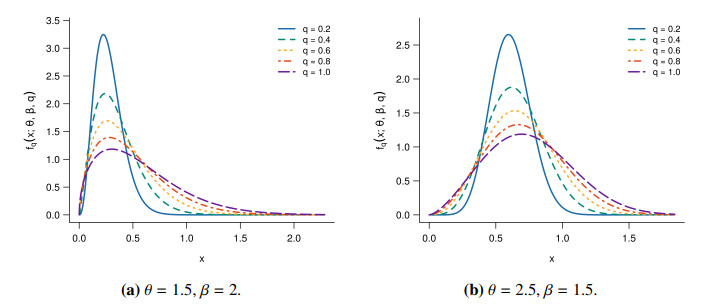
PDF curves of the UDFWD for selected values of $ q $: (a) $ \theta = 1.5 $, $ \beta = 2 $; (b) $ \theta = 2.5 $, $ \beta = 1.5 $
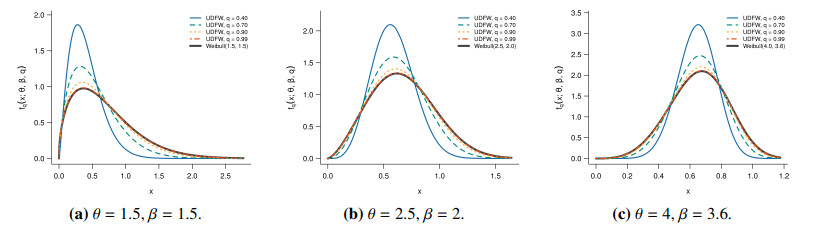
Convergence of the UDFWD PDF to the WD PDF as $ q\to1^{-} $
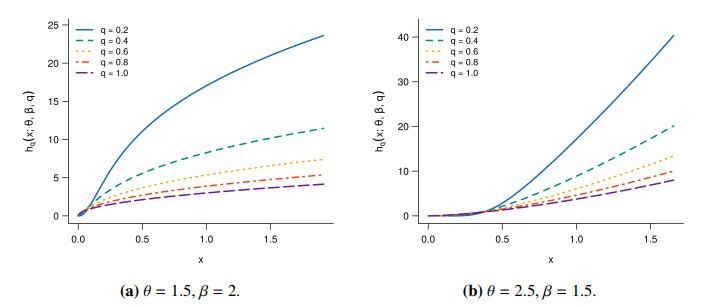
Hazard-function curves of the UDFWD for selected values of $ q $
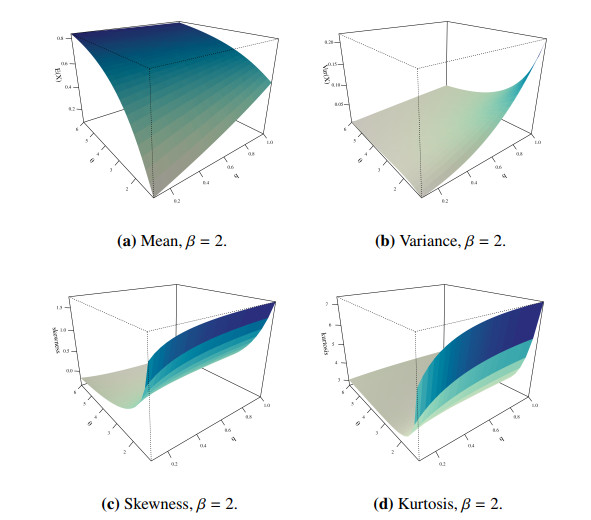
Effects of $ \theta $ and $ q $ on the moment-based measures of the UDFWD for $ \beta = 2 $
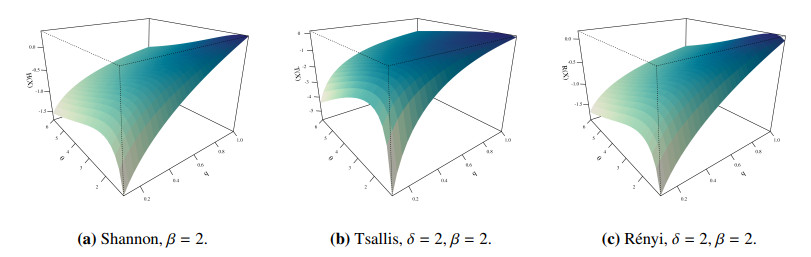
Effects of $ \theta $ and $ q $ on the entropy measures of the UDFWD for $ \beta = 2 $
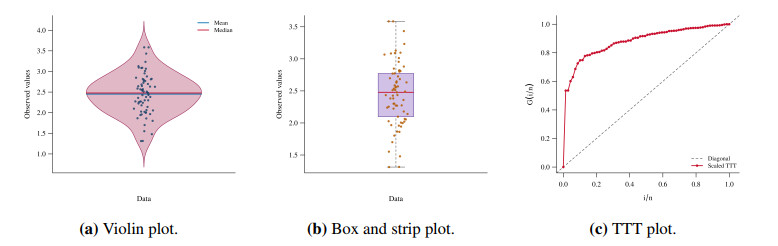
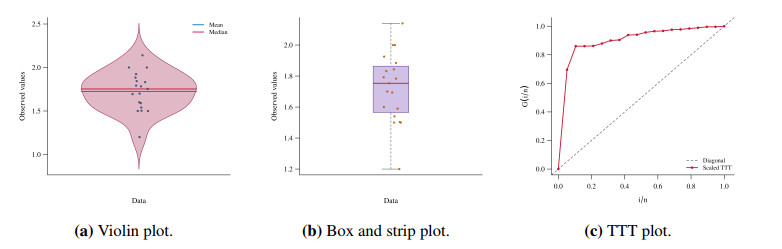
Exploratory plots for Dataset Ⅰ
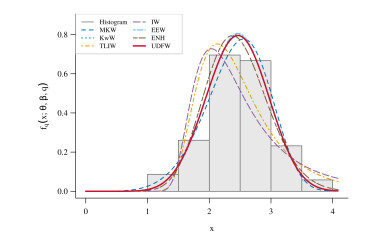
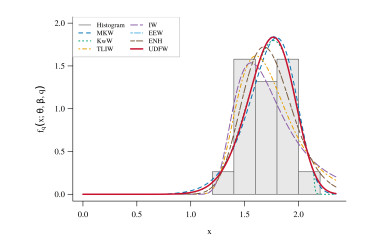
Fitted PDFs of the competing models
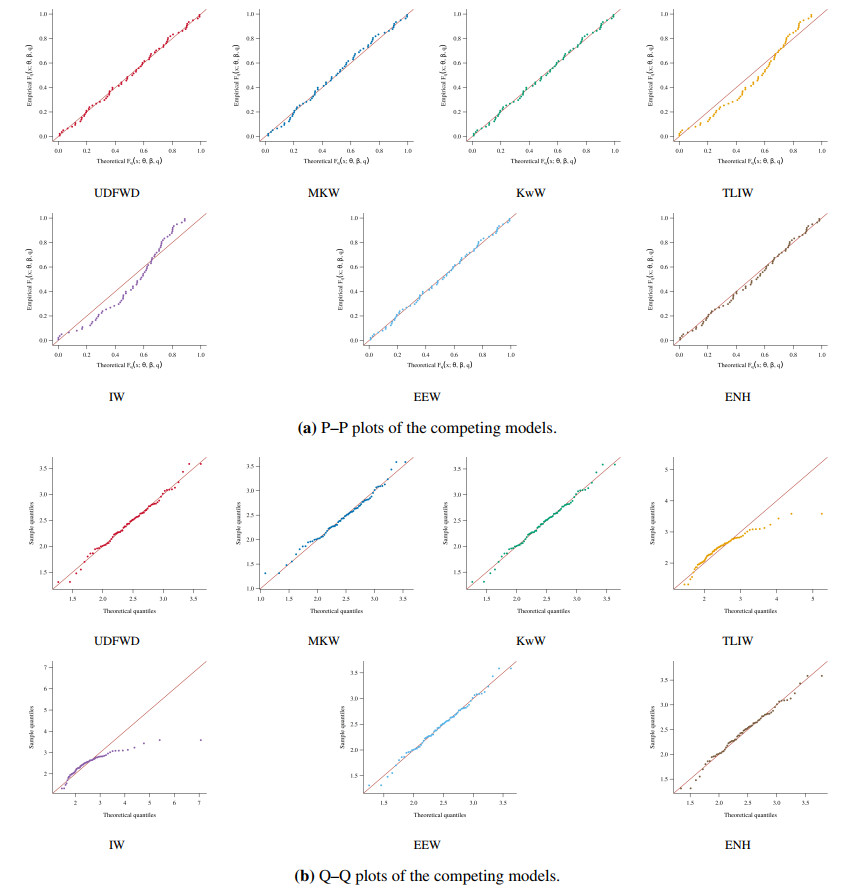
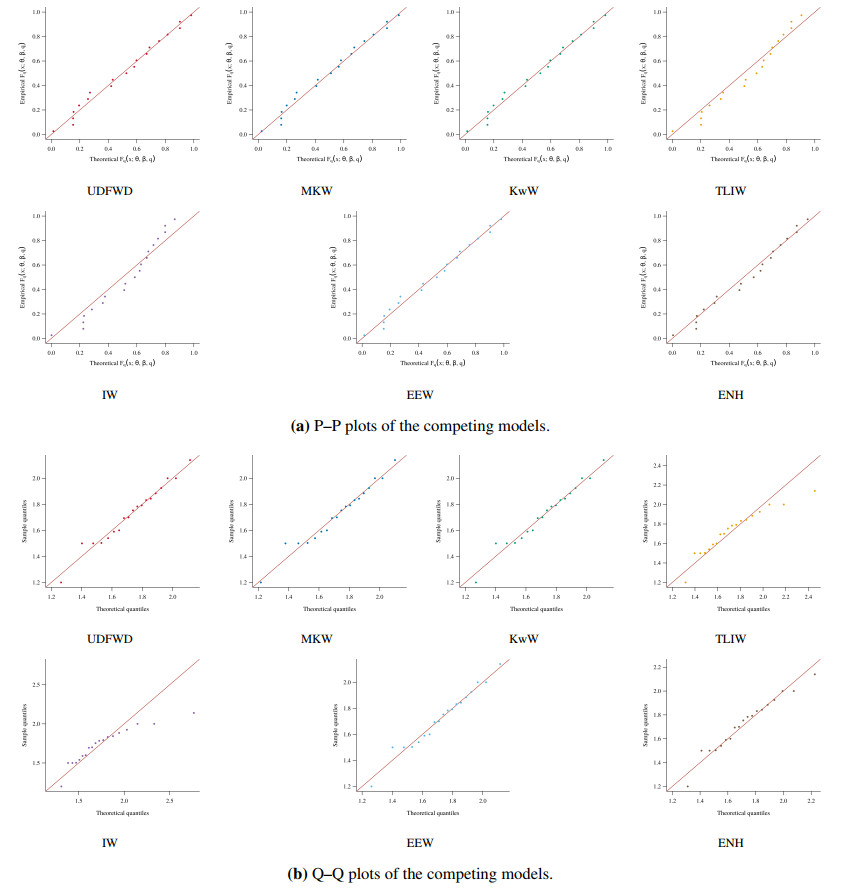
Model-comparison diagnostics for Dataset Ⅰ
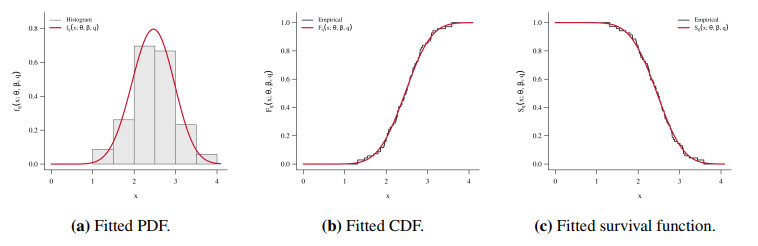
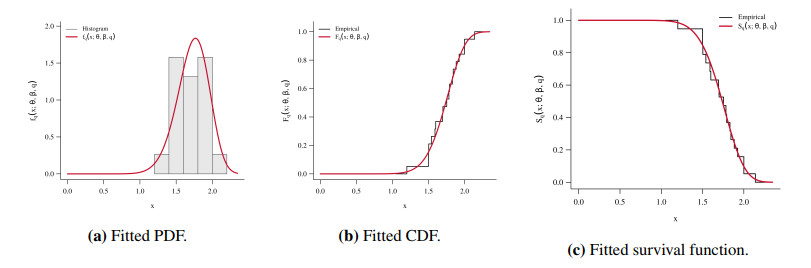
Empirical and fitted UDFWD functions for Dataset Ⅰ
Exploratory plots for Dataset Ⅱ
Fitted PDFs of the competing models
Model-comparison diagnostics for Dataset Ⅱ
Empirical and fitted UDFWD functions for Dataset Ⅱ




 DownLoad: